




Written by: Aaron Rovner, Founder, Saas Hero
Key Takeaways
- ABM budgets work best when you calculate them from your ACV, target account count, and sales cycle instead of copying generic benchmarks.
- Cost per account changes by tier: $8,000–$15,000 for 1:1 strategic, $5,000–$10,000 for 1:few cluster, and $2,000–$5,000 for 1:many programmatic programs.
- ABM makes economic sense once ACV passes roughly $20,000–$30,000, with tier selection aligned to deal size.
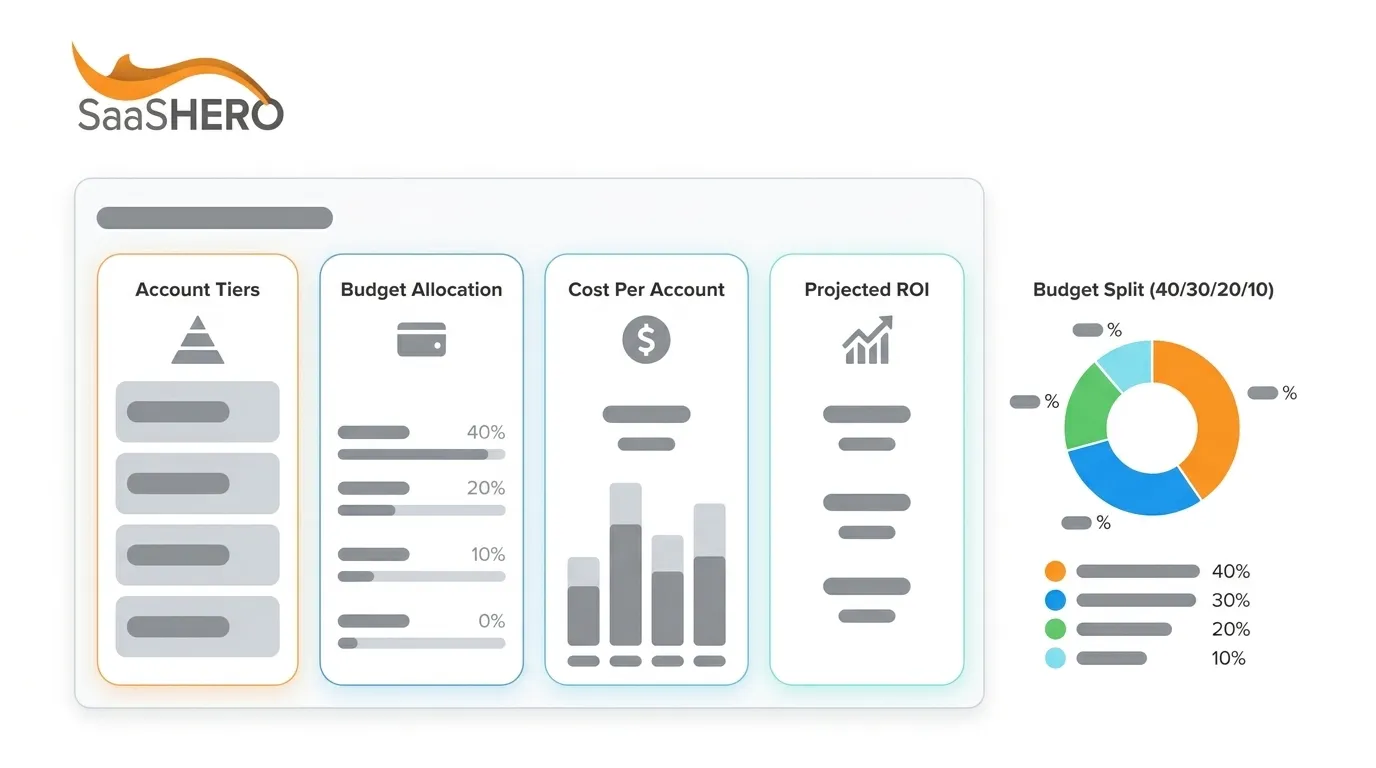
- A 40/30/20/10 split across paid media, content, tech, and events gives you a practical allocation once you know the total budget.
- SaaSHero provides the execution layer that runs paid media, creative, landing pages, and CRM-connected attribution as one team for B2B companies ready to operationalize their ABM budget.
Plan Your ABM Budget With SaaSHero
Step 1: Use Benchmark Ranges As Guardrails, Not The Final Number
The Forrester ABM Budget Study produced the figures most teams still cite: roughly $200,000 for a pilot. Forrester’s 2019 ABM budget study found an average annual ABM budget of around $350,000, excluding headcount. Mature programs that had proven value ran about $600,000, and very large organizations could reach into the millions. Those numbers come from older research and a cost structure that has shifted.
More current data from the Inflexion Group 2026 ABM Benchmarking Study puts average ABM spend at 17% of total marketing budget, with 86% of respondents reporting flat or higher spend year over year. The Worxwide 2026 ABM Pricing Guide places pilot and 1:many programs at $3,000–$8,000 per month. It shows growth and 1:few programs at $8,000–$20,000 per month. It prices enterprise 1:1 engagements at $25,000–$60,000+ per month.
These figures reflect other companies’ account counts, ACV, tier mix, and headcount model. Treat them as reference points. Build your own number from the bottom up, then use benchmarks as a final check.
Step 2: Build Your ABM Cost Per Account By Tier
The cost-per-account model is the calculation most benchmark tables omit. The table below shows how per-account cost falls as you move from bespoke 1:1 plays to programmatic 1:many, which becomes the key input into your bottom-up budget. The figures come from Abmatic AI’s 2026 ABM Budget Planning Guide and the Worxwide 2026 ABM Pricing Guide. Depending on methodology, they include tech, content, media, and sales resources in varying proportions.
| ABM Tier | Typical Account Count | Cost Per Account (Annual) | What It Buys |
|---|---|---|---|
| 1:1 Strategic | 5–25 | $8,000–$15,000 | Fully bespoke plays, custom content, executive engagement |
| 1:Few Cluster | 25–100 | $5,000–$10,000 | Segment-level personalization, coordinated multi-channel |
| 1:Many Programmatic | 100–500+ | $2,000–$5,000 | Intent-triggered, scaled personalization, automated delivery |
Cost per account falls as account count rises because fixed program costs spread across more accounts. Personalization depth falls with it. A 1:many program at $2,000 per account is a structurally different motion. It uses a different channel mix, different content requirements, and different win-rate expectations.
Step 3: Turn Your Target Account List Into A Budget
The core formula is simple: target account count × cost per account for the chosen tier = annual ABM budget.
Gather these inputs first:
- Average contract value (ACV)
- Target account count, split by tier
- Sales cycle length
- Whether the program is net-new spend or a reallocation from existing demand gen
Then work through the decision points in order:
- Determine ACV. This sets which tiers are economically viable, covered in the section after the worked example below.
- Build the account list. Segment it by tier based on deal size potential and strategic priority.
- Apply the per-account benchmark for each tier. Multiply account count by cost per account for each tier and sum the result.
- Decide whether paid media sits inside or on top of the retainer. Most ABM agency retainers exclude media spend; a $15,000/month retainer typically sits on top of $20,000–$80,000/month in ad spend the client funds directly.
- Run the top-down sanity check. Compare the bottom-up number against 15–25% of total marketing spend. If it exceeds 25%, either the account list is too large, the tier mix is too rich, or the program is genuinely additive and needs to be defended as such.
Step 4: See The Budget In A Worked Example
A hypothetical B2B SaaS company with 50 target enterprise accounts running a 1:few program at $5,000 per account produces an annual ABM budget of $250,000. That figure breaks into concrete line items across four cost categories, which makes the budget easier to defend with finance.

| Category | Allocation | Annual Amount |
|---|---|---|
| Paid media | 40% | $100,000 |
| Content and personalization | 30% | $75,000 |
| Data and technology | 20% | $50,000 |
| Events and outreach | 10% | $25,000 |
This example is hypothetical and does not include headcount. Abmatic AI’s 2026 guide estimates $50,000–$75,000 per 10–15 accounts when loaded fully. A program that includes internal team time will run materially higher than the media-and-services figure alone.
The number now has a clear structure. The next question is who executes it and whether that team owns the paid media, creative, landing pages, and attribution the budget funds, or whether those pieces sit with different vendors and internal teams.
Get Your ABM Budget Executed End To End
What ACV You Need For ABM To Make Economic Sense
DemandScience’s Fit-Criteria Analysis states that ABM is inefficient below roughly $20,000–$30,000 in annual deal size because the cost floor of personalization, coordination, and data infrastructure stays relatively fixed. The coordination overhead rarely fits inside the deal economics at lower price points.
The threshold shifts by tier. A $25,000-ACV company can justify 1:few or 1:many ABM because the per-account cost is low enough that even a modest win-rate lift pays back. A $100,000-ACV company can justify 1:1 investment. Tomba’s 2026 ABM Benchmark Report warns that if ACV is under $25,000, 1:1 ABM is mathematically nonsensical because CAC payback will exceed the contract length. At $100,000+ ACV, the economics of bespoke plays, custom content, and executive engagement become compelling because a modest lift in win rate on a handful of accounts pays for the program.
The practical rule is simple: match tier to ACV. A $25,000-ACV company running 1:1 ABM will produce a CAC payback period that no CFO will approve twice.
How Much Each ABM Tier Costs And When It Works
Once ACV tells you which tiers are viable, the next step is to understand what each tier actually costs. Concentrating budget on a small Tier 1 list outperforms spreading it when ACV justifies the per-account cost. The budget implication of each tier ties directly to deal size:
- 1:1 Strategic: Highest cost per account ($8,000–$15,000 annually), justified only at six-figure ACV. Median win rate is 38%, against a 9% non-ABM B2B baseline. Creative production for 1:1 plays adds $2,000–$10,000 per account, which undermines ROI below six-figure deal sizes.
- 1:Few Cluster: The workhorse tier for mid-market ACV ($25,000–$100,000). Per-account cost runs $5,000–$10,000 annually. Median win rate is 24%, with ACV lifts of 45% versus non-ABM baseline.
- 1:Many Programmatic: Lowest cost per account ($2,000–$5,000 annually), best suited to $25,000–$50,000 ACV at volume. Median win rate is 14%, above the 9% non-ABM baseline, and the economics work because fixed costs spread across 100–500+ accounts.
A program running all three tiers simultaneously typically produces fragmented execution. Monaqo’s 2026 ABM Cost Guide documents the pattern: early programs that attempt to launch all three tiers at once fail across all of them. Sequencing tiers as the program matures, proving the model at Tier 1 or Tier 2 before expanding, produces cleaner reads and better allocation decisions.
How To Split An ABM Budget: The 40/30/20/10 Framework
Once the total budget is set, the allocation across cost categories determines what the program can actually do. A standard planning split for a mid-market ABM program looks like this:
| Allocation | Category | What It Covers |
|---|---|---|
| 40% | Paid media | LinkedIn ads, display retargeting, intent data platforms |
| 30% | Content and creative | Custom landing pages, case studies, account-specific assets |
| 20% | Tech and data | Account intelligence, CRM integrations, enrichment |
| 10% | Events and outreach | Executive dinners, conference sponsorships, direct mail |
The split shifts by tier. 1:1 programs weight content and events more heavily because bespoke content per account and executive engagement are the primary levers. 1:many programs weight paid media and tech more heavily because intent-triggered delivery and automated personalization make the economics work at scale. Abmatic AI’s 2026 ABM Budget Allocation Framework warns that most companies get the ratio backwards, spending roughly 70% on tools and 10% on people, which inverts the mix that drives results.
What A $10,000–$15,000/Month ABM Test Really Funds
A $10,000–$15,000 per month budget funds a real ABM motion. It does not cover a full enterprise program, but it can generate meaningful engagement signals when you allocate it correctly.
What it covers:
- One to two primary channels, usually LinkedIn ads plus email or display retargeting. Momentum Nexus’s 2026 ABM Agency Pricing Analysis confirms that pilot-tier engagements typically fund only one to two primary channels rather than broad omnichannel coverage.
- Roughly 10–15 ads against a single persona. ZenABM’s 2026 LinkedIn Ads Budget Guide recommends a minimum of $8,000–$10,000 per month per persona to support 10–15 ads with enough daily clicks to improve performance. Running 30 ads on a $10,000 budget means LinkedIn concentrates delivery on early performers and the rest receive almost no impressions.
- A lean tech stack: CRM, list-building tool, and a scoring layer. ZenABM’s Minimum Viable ABM Stack outlines $8,000–$10,000/month on LinkedIn, a CRM, Clay for list building, and a scoring tool, with no enterprise ABM platform required to start.
What it cannot do:
- Support multiple personas at meaningful frequency. Below roughly $8,000–$10,000 per month per persona, budget dilution prevents reaching target accounts with sufficient frequency for engagement signals to emerge.
- Fund broad omnichannel coverage across LinkedIn, display, direct mail, and events simultaneously.
- Produce statistically significant optimization data across many audiences. At $10,000/month the program should run approximately 10 ads, not 20 or 30.
The practical implication is clear: a $10,000–$15,000/month test is a one-persona, one-to-two-channel program. It is enough to validate the model, but not enough to run the full motion.
ABM Budget As A Percentage Of Total Marketing Spend
After building the number from the bottom up, compare it to total marketing spend. ABM is commonly recommended to run 15–25% of total marketing budget, and the Inflexion Group study cited earlier puts the average at 17%.
ABM usually represents a reallocation rather than purely additive spend, with budget moving from broad demand gen into account-specific programs. If the bottom-up number exceeds 25% of total marketing spend, one of three things is true: the account list is too large for the budget, the tier mix is too rich for the ACV, or the program is genuinely additive and needs to be defended as incremental investment rather than a reallocation. Each scenario requires a different conversation with finance, and mixing them together is how ABM budgets get cut before they produce results.
How To Tell If Your ABM Budget Is Working
Revenue-adjacent metrics are the only ones that survive a board conversation. The relevant measures for B2B SaaS ABM programs include:
- Pipeline created by channel
- Cost per sales-qualified lead
- Customer acquisition cost (CAC)
- CAC payback period, with under 12 months considered strong
- LTV:CAC, with 3:1 generally considered healthy for SaaS
Common measurement problems at this stage include attribution gaps from long sales cycles, low data volume in the first 90 days, and tracking inconsistencies between ad platforms and the CRM. Tomba’s 2026 ABM Benchmark Report identifies holdout testing, excluding a set of ICP-matched accounts from the program and measuring the pipeline difference, as the only true causal measurement and the number finance teams respect most. Account-level progression tracking and multi-touch attribution weighted by account are the two other approaches that produce defensible data across a long sales cycle.
Review Your ABM Performance With SaaSHero
Where SaaSHero Fits In Your ABM Budget
An ABM budget funds four things: paid media, creative, landing pages, and attribution. SaaSHero owns all four as one team, acting as the outsourced inbound growth team for B2B companies and optimizing against CRM revenue data rather than form-fill counts.

The scope covers:
- Paid media across Google Ads, Microsoft Ads, LinkedIn, Meta, Reddit, and TikTok
- Creative end to end through concept, copy, and design, handled in-house
- Landing pages and conversion rate optimization, designed, built, hosted, and tested by the same team running the campaigns
- Attribution and reporting inside the client’s CRM, connecting ad spend to pipeline and revenue rather than form volume
SaaSHero’s flat retainer is indexed to total monthly ad spend rather than channel count. Shifting budget between channels, opening a new channel test, or consolidating spend does not change the fee. This structure supports an ABM program whose channel mix will evolve as the program matures, without contract amendments every time you move budget from LinkedIn to Google or add a display retargeting layer.
SaaSHero is a Google Premier Partner (top 3% of agencies) and a G2 High Performer in digital marketing for over two consecutive years, currently ranked #20 of approximately 6,000 agencies. The firm has served 100+ B2B companies and manages roughly $16 million in annual ad spend, with more than $60 million lifetime, giving it pattern exposure that informs channel-mix recommendations instead of default allocations.
For a marketing leader who has the budget number and needs a team that owns execution without adding a management layer to their week, SaaSHero provides that engagement model.
Talk To SaaSHero About ABM Execution
Frequently Asked Questions
How Long Does It Take To Set Up An ABM Program?
ABM setup typically runs about 4–8 weeks for the account list build, buying committee mapping, CRM integration, and campaign architecture on account-targeted advertising platforms such as RollWorks, whose onboarding documentation cites 45–60 days. Enterprise implementations can run 8–16 weeks or longer. Meaningful engagement signals such as account-level activity, content consumption, and buying committee penetration usually appear within 30–90 days. Pipeline impact takes longer, with 90–180 days as the realistic window depending on deal size and sales cycle length. A program judged at day 45 is being judged on its setup rather than its performance.
What Roles Do We Need Internally To Run ABM?
At minimum, you need one marketing owner who holds the number and approves what goes live, one person with CRM and marketing automation access to manage data hygiene and routing, and sales participation in account selection and follow-up. A mature program requires capabilities across strategy, account research, content, campaign operations, paid media, marketing automation, analytics, and sales enablement. Most companies at the $10M–$50M revenue band buy execution rather than hire all of it; the fully loaded cost of an in-house ABM team runs $610,000–$840,000 annually in labor alone before technology.
What Are The Most Common Risks In ABM Budgeting?
Underfunding is the most common mistake. Allocating $50,000 for a 20-account program produces $2,500 per account, which is too little to build quality messaging or ads. The fix is either increasing budget or reducing account count. The second major risk is overallocating to technology; the tech stack should support execution rather than dominate the cost structure. A third risk is launching all three tiers simultaneously, the fragmentation problem described earlier in this article. Programs that sequence tiers, proving the model at one tier before expanding, produce cleaner data and better allocation decisions.
How Often Should The ABM Budget Be Revisited?
Quarterly reviews strike the right balance. Monthly reallocations create chaos, so teams should stick to a plan for 90 days before adjusting. A quarterly review should double down on what is working and cut what is not. An annual review should cut budget if ROI falls below 1.5x and increase it if above 2.5x. Finance teams usually kill ABM programs because of attribution gaps rather than cost. If the multi-touch path from first ad impression to closed-won cannot be shown, the budget is at risk on the next planning cycle regardless of engagement metrics.
What Should We Expect In Terms Of Measurement At The Start?
Early engagement signals such as account-level activity, buying committee penetration, and content consumption appear within the first 30–90 days. Pipeline impact takes longer. Holdout testing, which excludes a set of ICP-matched accounts from the program and measures the pipeline difference, is the only true causal measurement and the number finance teams respect most. Account-level progression tracking, which measures how accounts move through stages rather than counting form fills, is the primary attribution model that produces defensible data across a long B2B sales cycle.
Conclusion
Benchmark tables give ranges. The number that survives a CFO conversation comes from your ACV, your target account count, and your sales cycle, built from the bottom up and checked against total marketing spend from the top down. The formula stays simple while the execution carries the complexity.
SaaSHero is the team that executes the budget once the number is set, owning paid media, creative, landing pages, and CRM-connected attribution as one team and optimizing against revenue rather than form fills. The fee structure lets the channel mix change without a contract conversation. When the budget is defensible and the execution partner is aligned, the number starts to matter.
Put Your ABM Budget To Work With SaaSHero