




Written by: Aaron Rovner, Founder, Saas Hero | Last updated: September 6, 2026
Key Takeaways For Accounting Tech Funnels
- Generic B2B funnels miss the mark for accounting tech because CFOs, controllers, and IT gatekeepers expect trust, compliance, and ROI proof at every stage.
- Map messaging to each persona: strategic ROI for CFOs, workflow and close-time improvements for Controllers, and SOC 2 documentation for IT and security reviewers.
- Structure your funnel in four stages: TOFU, MOFU, BOFU, and Post-Funnel. Use compliance-focused lead magnets, ROI calculators, stakeholder-specific case studies, and ongoing business reviews.
- Use PLG for quick-value SMB tools under $25K ACV and sales-led for complex enterprise deals above $50K ACV. Hybrid models work well for mid-market accounting tech.
- Ready to align your funnel with how finance teams actually buy? Book A Discovery Call With SaaSHero.
Understanding The Accounting Tech Buyer And Trust Barrier
Start by mapping the personas you actually sell to before you design any accounting software marketing funnel. Each has distinct pain points and veto power.
- CFO (Economic Buyer): Cares about strategic ROI, risk reduction, reporting quality, audit readiness, and support for growth plans. Rarely evaluates features and focuses on the business case. ERP selection directly influences efficiency, scalability, and control across the organization.
- Controller (Operational Owner/Champion): Owns the close, general ledger, and controls. Focuses on accurate reporting, strong internal controls, audit readiness, automation, and faster month-end close. Often shapes requirements and builds the shortlist.
- VP Finance / Finance Systems Owner: Runs the evaluation project, scores vendors, and advises the CFO. This contact often decides which vendors reach the CFO.
- IT/Security (Gatekeeper): Controls integration, data, security, and application standards. Can block any tool that fails security review or does not integrate cleanly.
Because each persona evaluates differently, tailor your messaging. Sell the outcome to the CFO, the workflow to the Controller, and the compliance story to IT. Sales cycles for accounting tech often run 3–9 months and involve 5–10 stakeholders, each with veto power and unique evaluation criteria. Trust sits at the center of every decision, so every funnel stage must reinforce it.
Want A Team That Builds Trust At Every Stage? Talk With SaaSHero.
The 4-Stage Funnel Framework For Accounting Tech
Trust becomes manageable when you structure your B2B SaaS funnel around four stages: TOFU, MOFU, BOFU, and Post-Funnel. Each stage uses accounting-specific tactics that speak to compliance, controls, and measurable ROI.
TOFU (Awareness): Lead With Compliance And Pain
Focus top-of-funnel content on regulatory and operational pain. Lead magnets like “The CFO's Guide To Automating Month-End Close” or a SOC 2 compliance checklist outperform generic eBooks because they address recognized problems. As of August 2024, approximately 85% of B2B content marketers surveyed worldwide said LinkedIn delivers the best value of any social platform, according to Statista. Use LinkedIn to reach CFO, Controller, and VP Finance titles. Educational assets build early trust before you introduce product messaging.
MOFU (Consideration): Prove ROI And Security
Middle-funnel assets should demonstrate capability and reduce perceived risk. Interactive ROI calculators let prospects input team size and manual hours to see dollar savings in their own context. Security hubs with SOC 2 Type II reports, data encryption details, and compliance whitepapers are non-negotiable. Mature trust programs close enterprise deals 34% faster. Competitor comparison pages help buyers evaluate you against alternatives without leaving your site.
Map specific assets to each stage. Use SOC 2 report templates and security audit checklists at TOFU and MOFU, compliance whitepapers at MOFU and BOFU, and implementation guides after purchase.
BOFU (Decision): De-Risk The Choice And Equip Champions
Offer free trials or demos with a clear security review process. Case studies with quantified ROI, such as “How A Mid-Sized CPA Firm Saved 15 Hours Per Week,” give champions material for internal consensus-building. Retarget buyers with testimonials from similar companies so they see peers succeeding with your product. According to Forrester's Buyers' Journey Survey 2024, 92% of B2B buyers have at least one vendor in mind before formal evaluation, and 41% have a single preferred vendor selected; separately, 6sense data indicates that 81% of buyers already had a preferred vendor before speaking to a sales representative. Strong BOFU content supports this self-serve evaluation pattern.
Stakeholder-specific assets are essential at this stage. Create one-page ROI summaries with payback periods for CFOs, workflow proof and close-time improvements for Controllers, and SOC 2 documentation for IT and security gatekeepers.
Post-Funnel: Drive Retention, Expansion, And Advocacy
Revenue growth in accounting tech depends on what happens after the initial deal. Dedicated implementation managers, certification programs, and periodic business reviews that highlight ongoing ROI reduce churn and drive expansion. Accounting tech often scales on seat count or transaction volume, so net revenue retention above 100% signals growth from the existing base alone.
Get A Funnel Review Focused On Retention And Expansion With SaaSHero.
PLG Vs. Sales-Led Funnels For Accounting Tech
Accounting tech funnels follow different motions depending on product complexity and deal size. Product-led growth (PLG) often fits bookkeeping tools for SMBs where users reach value in minutes, while sales-led growth fits enterprise ERP where implementation takes months and ACV is high.
| Decision Criteria | PLG Funnel | Sales-Led Funnel |
|---|---|---|
| Target Audience | Freelance bookkeepers, SMB accounting firms | Enterprise CFOs, controllers, mid-market finance teams |
| Primary Driver | Self-serve product experience | Human relationship building and demos |
| Free Offer | Freemium plans or 7–14 day free trials | Demo plus proof of concept (POC) for high-ACV enterprise deals |
| Average Sales Cycle | For SMB PLG motions, typical cycles range from under 1 day to 14 days. | For enterprise B2B SaaS over $100K ACV, average cycles often range from 3 to 9 months. |
| Critical Funnel Asset | Activation and the defined “aha moment.” | SOC 2 documentation and a complete security review packet |
Choose PLG when three conditions hold. Your product delivers core value quickly, with modern benchmarks around 60 seconds. Your entry price stays low enough for self-serve purchase, typically under $5K–$25K in annual contract value. The user who experiences value also has purchasing authority without a buying committee. Choose sales-led when implementation requires configuration, ACV exceeds $25K (especially $50K+), or multiple stakeholders gate purchases. Hybrid models now appear frequently, with PLG to land efficiently and sales-led motions to expand strategically.
Key Metrics And Benchmarks For Accounting Tech Funnels
Accounting tech funnels rely on a specific metric set that reflects long cycles and multi-stakeholder deals. Track these against realistic benchmarks:
- Visitor-to-lead rate: 1–3% is typical for B2B SaaS, with top performers reaching 8–15%.
- Lead-to-close rate: 20–30% for accounting tech with rigorous qualification.
- Sales cycle length: For SaaS deals over $100K ACV, cycles often range from 3 to 9 months, depending on deal size and stakeholder count.
- MQL-to-SQL conversion: 25–40% is healthy for B2B tech, according to SyncGTM's 2026 benchmarks, though medians for B2B SaaS often sit around 13–15% and vary by segment.
- SQL-to-close (win rate): For B2B technology and SaaS, average win rate is 20–25%, with top performers exceeding 30%.
Track these metrics in your CRM and ad platforms, and align decisions to CRM revenue data such as pipeline, lifecycle stage, and closed revenue. An ad platform optimized toward form fills tends to find people most likely to submit forms, including students, competitors, and job seekers, while reporting a falling cost per conversion. Feed the machine high-quality data, and you receive high-quality performance. This approach reflects the core SaaSHero principle.
Case Studies: Accounting-Style Funnels In Action
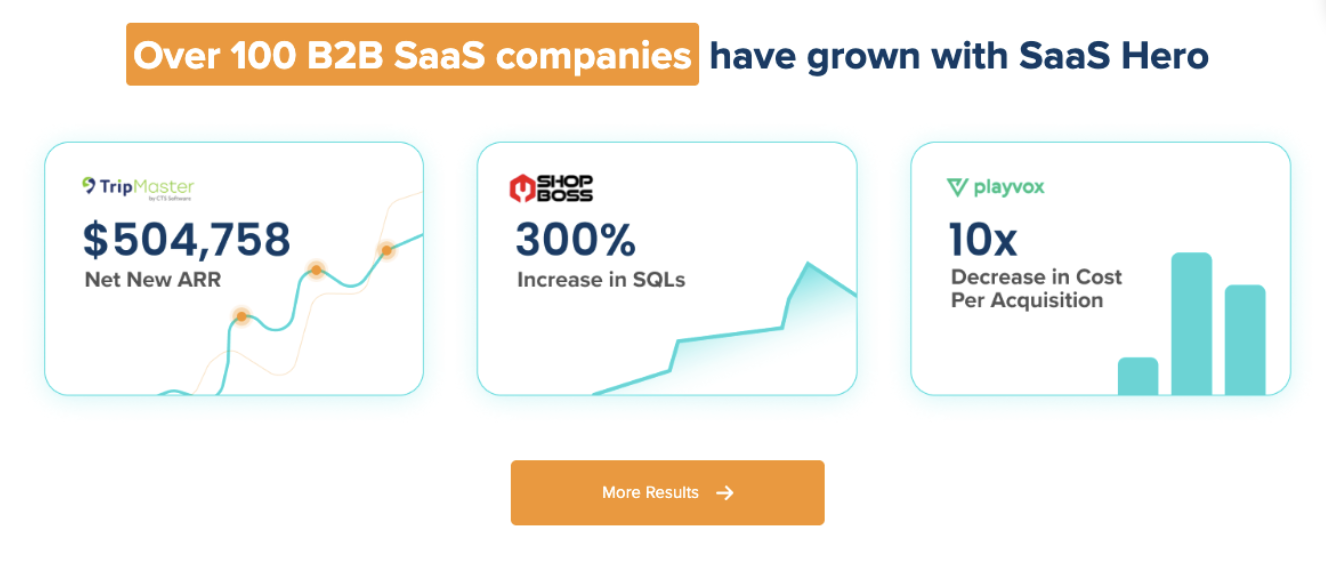
TripMaster (Transit Software): Faced long, procurement-heavy sales cycles with paid search producing traffic but no measurable revenue. SaaSHero rebuilt the funnel around CRM-attributed optimization. Result: $504,758 in net new ARR added over one year, 650% ROAS, and a 20% conversion rate from paid search.

TestGorilla (HR Tech): Needed to scale paid acquisition without stretching payback beyond sustainable limits. SaaSHero's funnel work achieved an 80-day payback period with more than 5,000 new customers added.
Playvox (CX Software): Faced uneconomical cost per lead that blocked scaling. SaaSHero delivered a 10x reduction in cost per lead alongside a 163% increase in lead volume.
Each funnel centered on CRM outcomes instead of form fills. Each owned the post-click experience, including landing pages, creative, and conversion tracking, from end to end.
Common Accounting Tech Funnel Mistakes
Avoid these frequent accounting tech funnel pitfalls:
- Ignoring compliance in messaging. Financial buyers expect security proof at every stage. Fix this by building a Trust-Building Toolkit with SOC 2 reports, security checklists, and compliance whitepapers mapped to each funnel stage.
- Using generic lead magnets. “10 Tips For Better Accounting” rarely converts CFOs. Fix this by creating pain-specific assets like “The CFO's Guide To Automating Month-End Close.”
- Overlooking multi-stakeholder concerns. The most common cause of late-stage deal loss is buyer-side risk aversion and internal consensus failure, often resulting in “no decision.” Fix this by creating stakeholder-specific assets such as ROI summaries for CFOs, workflow proof for Controllers, and security documentation for IT.
- Optimizing for form fills instead of pipeline. This pattern trains ad platforms to find the wrong people. Fix this by pushing lifecycle stage events back into ad platforms and optimizing against qualified pipeline.
- Naming funnel stages after seller activities. Stages like “Proposal Sent” hide where deals actually stall. Fix this by defining stages through verified buyer milestones such as “Budget Confirmed” and “Security Review Approved.”
Conclusion: Build A Trust-First Funnel For Finance Buyers
Effective B2B accounting tech funnels rely on vertical-specific tactics such as trust-building assets at every stage, multi-stakeholder messaging, clear PLG or sales-led model selection, and CRM-attributed optimization. Accounting buyers expect compliance proof, quantified ROI, and visible risk reduction before they move forward.
Most marketing teams lack the bandwidth and specialization to run this motion alone. SaaSHero operates as an outsourced growth team that owns your entire funnel, including paid media, creative, landing pages, and reporting, all aligned to CRM revenue data instead of form-fill counts. With over $60M in lifetime ad spend managed, more than 100 B2B clients served, and Google Premier Partner status, SaaSHero brings the pattern exposure needed to build accounting tech funnels that convert.
FAQ
What Is A B2B Accounting Tech Funnel?
A B2B accounting tech funnel is a marketing and sales framework that converts financial decision-makers such as CFOs, CPAs, and controllers by addressing trust, compliance, and ROI at every stage from awareness through post-purchase expansion. Unlike generic SaaS funnels, accounting tech funnels account for multi-stakeholder buying committees, security review gates, and strict compliance requirements. Each stage uses assets calibrated to persona concerns, including strategic ROI proof for CFOs, workflow and controls evidence for Controllers, and SOC 2 documentation for IT gatekeepers.
How Long Is A Typical B2B Sales Cycle For Accounting Tech?
Enterprise accounting tech deals often follow multi-month cycles. Mid-market deals ($25K–$100K ACV) commonly take 60–120 days with 3–5 stakeholders, while enterprise deals ($100K–$500K ACV) take 6–9 months with 6–10 stakeholders. The primary bottlenecks include multithreading complexity, security review, and procurement and legal gates. Each of these can add roughly 30–60 days to accounting tech sales cycles if not proactively managed, with legal review often adding 2–6 weeks and procurement adding up to 8 weeks or more. Shortening the cycle depends on removing friction from the multi-stakeholder process through stakeholder-specific assets, early multithreading, and a complete security review packet delivered well before final approval.
What Are The Stages Of A B2B Accounting Tech Funnel?
The four stages are TOFU (Awareness), MOFU (Consideration), BOFU (Decision), and Post-Funnel (Retention and Expansion). At TOFU, compliance-focused lead magnets and LinkedIn campaigns targeting CFO and Controller titles build trust before product messaging appears. At MOFU, ROI calculators, SOC 2 Type II security hubs, and competitor comparison pages reduce evaluation risk. At BOFU, demos with built-in security review processes, quantified case studies, and retargeting with peer testimonials help champions build internal consensus. Post-funnel, dedicated implementation support, certification programs, and periodic business reviews support retention and expansion revenue.
How Do I Market Accounting Software To CFOs?
Lead with strategic ROI, risk reduction, and audit readiness. CFOs act as economic buyers who want a clear business case instead of feature lists. Create a one-page ROI summary with payback period and total cost of ownership for CFO-stage conversations. Pair that with a security hub containing SOC 2 Type II documentation so IT gatekeepers can complete their review without stalling the deal. Avoid single-threading to the Controller champion by engaging the CFO, Finance Systems owner, and IT early so no single stakeholder's absence blocks the purchase. Content that speaks to reporting trust, audit readiness, and growth-plan compatibility consistently outperforms feature-led messaging with this persona.
PLG Or Sales-Led: Which Funnel Model Fits My Accounting Tech Product?
The right model depends on product complexity, ACV, and buyer profile. PLG works when your product delivers core value in under 10 minutes, entry price stays under roughly $100 per user per month, and users hold purchasing authority, which often fits bookkeeping tools and SMB-focused accounting platforms. Sales-led works when implementation requires configuration, ACV exceeds $10K (especially $50K+), or multiple stakeholders gate the purchase, which often fits mid-market and enterprise ERP, close-management platforms, and AP or AR automation tools. Hybrid models now appear frequently, with PLG landing self-serve entry and sales-led motions expanding into larger accounts. For products in the $5K–$50K ACV range, a hybrid motion where the product qualifies leads and sales closes usually performs strongest.