




Written by: Aaron Rovner, Founder, Saas Hero
Key Takeaways For Choosing A Revenue-Focused Agency
- The core problem is a structural disconnect: boards demand pipeline and closed-won metrics while most agencies only report impressions, CPL, and MQL volume.
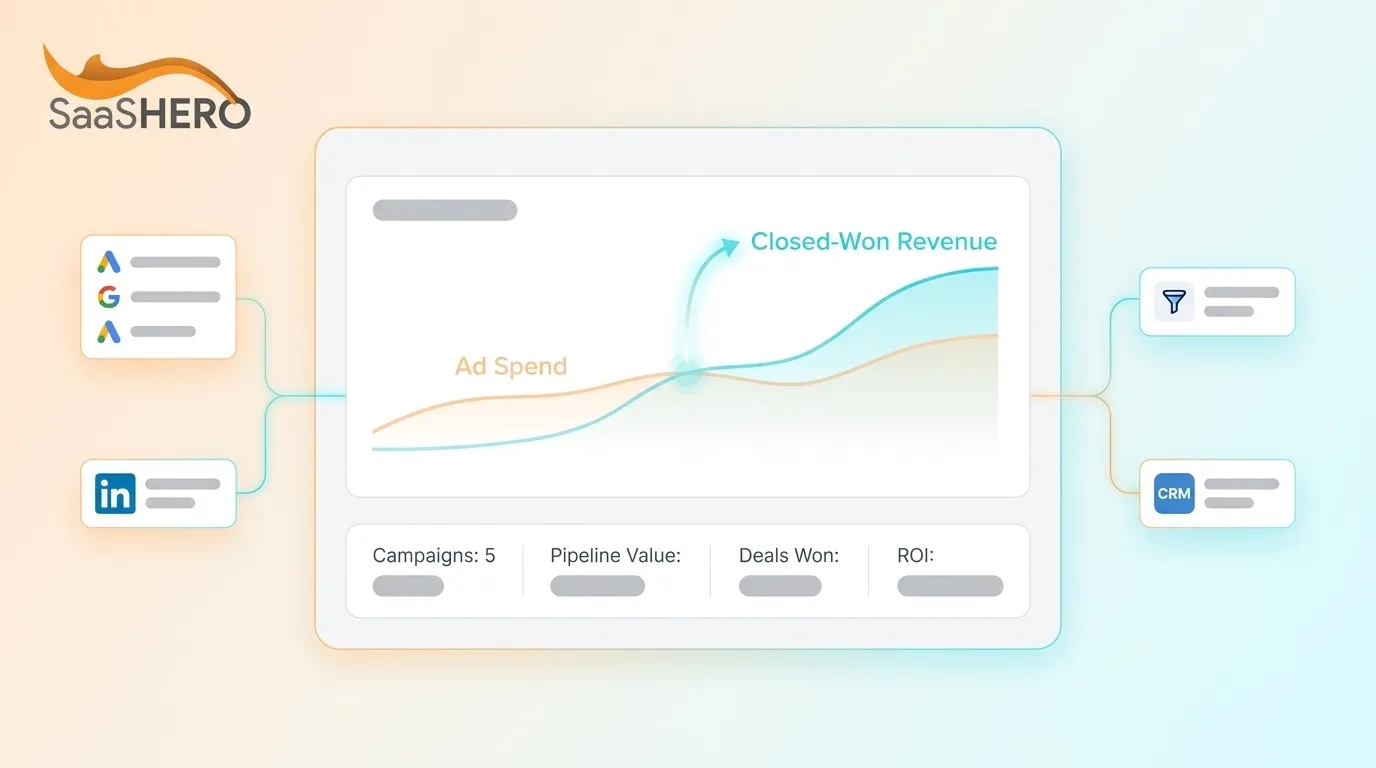
- Connecting ad spend to closed-won revenue requires owning the full chain across paid media, creative, landing pages, and CRM integration, then pushing revenue signals back to ad platforms for active bidding.
- Agencies that integrate directly with the client’s CRM, map lifecycle stages, and feed offline conversions (SQLs, opportunities, closed-won) into bidding algorithms can steer campaigns toward buyers instead of form-fillers.
- Verification should include live CRM dashboards, confirmation of primary versus secondary conversion events, and opportunity-level data access before you sign any engagement.
- SaaSHero delivers the complete closed-won chain as a single accountable team for $10M+ B2B SaaS companies spending $15k+ monthly on ads.
Evaluate SaaSHero Against These Criteria
What Connecting Ad Spend To Closed-Won Revenue Actually Involves
The full chain runs in one direction and then back: ad platform click → CRM record → lifecycle stage progression → closed-won deal → that closed-won outcome pushed back to the ad platform as an optimization signal. Every link must hold, or the chain breaks.
Consider a concrete example. A LinkedIn click becomes a HubSpot contact on March 1. That contact becomes a sales-qualified lead on March 10, an open opportunity on March 20, and a closed-won deal worth $48,000 on November 15. This happens 272 days after first touch, the current average B2B journey length according to Dreamdata’s 2026 benchmarks. For that outcome to improve future bidding, the closed-won event must be pushed back to LinkedIn and Google so the algorithm learns to find more people like that buyer, instead of more people who simply fill out forms.
The distinction between an agency that reports on revenue after the fact and one that optimizes toward it lives in this feedback loop. Reporting describes what happened, while optimization changes what happens next by feeding outcomes back into the bidding algorithm. Without CRM-connected conversion signals feeding the bidding algorithm, the platform optimizes toward whatever event it was last rewarded for, typically a form fill, and finds more of the wrong people at a falling cost per lead.
Only an agency that owns the tracking configuration, the CRM integration, and the lifecycle stage mapping can close this loop. An agency that stops at the ad account cannot influence how the algorithm learns from real revenue.
SaaSHero As A Closed-Won Revenue Agency For B2B SaaS
SaaSHero acts as the outsourced inbound growth team for B2B companies. Founded in 2018, it has served more than 100 B2B companies, manages roughly $16 million in annual advertising spend, and has managed more than $60 million in lifetime ad spend across Google Ads, Microsoft Ads, LinkedIn, Meta, Reddit, and TikTok. The team includes about 20 full-time specialists, including in-house designers and copywriters, so work stays in house.

SaaSHero owns the entire chain. Paid media, creative, landing pages and CRO, and attribution and reporting inside the client’s own CRM are delivered as one team on one accountability line. Every step from impression to closed-won is handled by the same in-house team. That structure matters because performance is set by the weakest link in the chain, and the scope boundary of a conventional agency runs through the middle of it.

On the measurement side, SaaSHero separates primary from secondary conversions so only revenue-relevant events drive account-wide optimization. Content downloads and low-commitment form completions are tracked but excluded from bidding. Lifecycle stage events such as SQL creation, opportunity creation, and closed-won are pushed back into the ad platforms so bidding learns from qualified outcomes. This integration makes optimization toward revenue mechanically possible instead of aspirational.

Reporting runs in the client’s own CRM, including HubSpot, Salesforce, or any other system, with Looker Studio dashboards showing pipeline, CAC, and payback period instead of impressions and clicks. The retainer is flat and indexed to total monthly ad spend rather than channel count, so channel-mix recommendations carry no fee consequence.
SaaSHero holds Google Premier Partner status, a designation held by the top 3% of Google Partners. It has been a G2 High Performer in Digital Marketing for more than two consecutive years and is currently ranked number 20 of approximately 6,000 agencies.
The fit profile includes $10M+ annual revenue, $15k+ monthly ad spend already in market, a sales-led motion, and an internal marketing team of two to four people with no paid media specialist.
See How SaaSHero Connects Spend To Closed-Won
Other Agencies Evaluated Against The Closed-Won Chain
SaaSHero is not the only agency claiming revenue attribution. To test that claim, the table below evaluates other agencies surfaced in current SERPs and AI Overviews against the same four criteria. The pattern it reveals: several agencies name a CRM and mention offline conversions, but few describe a full feedback loop that pushes closed-won events back to ad platforms as the primary optimization signal. Cells marked “Not stated” reflect only what each agency publicly describes, and no scores or performance numbers are invented.
| Agency | CRM Integration Named | Offline Conversion Syncing | Stated Optimization Target | Best For |
|---|---|---|---|---|
| SaaSHero | HubSpot, Salesforce, any CRM | Lifecycle stage events pushed to ad platforms | Closed-won revenue, qualified pipeline | B2B SaaS, $10M+ revenue, $15k+ monthly spend |
| GrowthSpree | HubSpot, Salesforce | LinkedIn CAPI, offline conversion syncing | SQLs, opportunities, closed-won ARR | B2B SaaS, $2M–$50M ARR |
| AdConversion | CRM syncing (HubSpot, Salesforce) | Conversions API, offline conversion tracking | SQLs, opportunities, customers | B2B companies, any size |
| Optimize Goal | Not stated | Not stated | ROAS, purchases, revenue | D2C/e-commerce brands |
| Tack Media | HubSpot, Salesforce, Pipedrive, Go High Level, Zoho | AI wired into existing systems via APIs | Not stated | Not stated |
GrowthSpree publicly describes a five-phase HubSpot-to-LinkedIn integration that maps lifecycle stage transitions, including MQL, SQL, Opportunity, and Closed-Won, to LinkedIn conversion events via CAPI. It also recommends assigning monetary values to each stage in Campaign Manager, and its stated optimization target is SQLs, opportunities, and closed-won ARR. AdConversion builds a Paid Revenue Dashboard pulling from the client’s CRM and ad accounts and uses CRM syncing so prospects enter campaigns when they become opportunities. It states its top priority is generating SQLs, opportunities, and customers instead of clicks and form fills. Optimize Goal’s homepage is dominated by D2C and e-commerce case studies, and it does not publicly describe CRM integration or closed-won optimization. Tack Media publicly states its CRM integration approach, naming HubSpot, Salesforce, Pipedrive, Go High Level, and Zoho as CRMs it integrates with and describing how it wires AI into existing systems via APIs.
How To Evaluate An Agency For Closed-Won Attribution: Seven Questions
Use these questions in your next agency pitch. A strong answer to each is described below.
- Can you attribute an individual opportunity, not an aggregate, back to the campaign and keyword that sourced it? A strong answer names the specific CRM field, the UTM capture method, and how the data travels from click to contact to opportunity record.
- Do you integrate natively with our CRM (HubSpot or Salesforce), or do we export data to you? Native integration means the agency reads lifecycle stage changes in real time. Export-based workflows introduce lag and manual error.
- Do you push offline conversion signals back to Google Ads and LinkedIn, and how? LinkedIn’s Conversions API streams server-side conversion events, including SALES_QUALIFIED_LEAD and QUALIFIED_LEAD types, back to LinkedIn for optimization. Google’s Data Manager API is now the primary path for importing offline conversions into Google Ads, replacing the older Ads API method for new adopters as of June 15, 2026. A strong answer names the specific API and describes the CRM field mapping.
- Do you report sourced pipeline, influenced pipeline, or both, and can you define the difference in our account? Sourced means marketing was the first touch. Influenced means marketing touched the account at any point. Conflating the two inflates attribution numbers and loses credibility in board reviews.
- How do you handle a 6–18 month B2B sales cycle in reporting and optimization? A strong answer describes multi-touch attribution and cohort-based reporting windows calibrated to the actual sales cycle length. It should also distinguish leading indicators, reviewed weekly, from closed-won attribution, reviewed quarterly.
- Are you optimizing campaigns to closed-won revenue or to form fills, and can you show me the conversion events currently feeding the bidding algorithm? Ask to see the primary conversion actions in a live account. If they are all form fills weighted equally, the algorithm is finding form-fillers instead of buyers.
- Will you give us raw, opportunity-level access to the data, or only a summarized dashboard? Opportunity-level access means you can audit individual deals back to their source campaign. A summarized dashboard alone cannot be verified.
Review These Questions With SaaSHero
Agencies Vs. Software: When To Hire And When To Buy
Before applying those seven questions, clarify whether an agency is the right category at all. Tools like Cometly, Dreamdata, Hyros, and Ruler Analytics solve the measurement and reporting layer. They connect ad platforms to CRM data, model multi-touch attribution, and surface which campaigns influenced closed-won revenue. They do not run the campaigns, write the ad copy, build the landing pages, or decide what to test next.
An agency is the right call when the problem is execution and ownership across the full chain. That is the case when no internal team member can configure offline conversion imports, build and test landing pages, or manage bidding across multiple platforms. A tool is the right call when the team has the execution capacity and only lacks the measurement layer to see what is working.
For most $10M–$50M B2B SaaS companies, the gap is execution instead of measurement. The CRM exists. The data exists. The missing piece is the party accountable for connecting them to the ad platforms and steering spend toward the outcomes they contain.

How To Verify The Integration Before You Sign
Five verification steps to run before signing any agency engagement:
- Start by asking to see a live Looker Studio or CRM dashboard from a comparable client, with redaction if needed. If the agency cannot produce one, the reporting capability is aspirational.
- Then ask which conversion events are marked primary versus secondary in a current account. If all events are weighted equally, the bidding algorithm is not learning from qualified outcomes.
- Next ask how lifecycle stage events are pushed back to the ad platforms and on what cadence. A strong answer names the specific API, and LinkedIn’s Conversions API can take up to 72 hours for conversion data to appear in reports, comprising up to 24 hours for ingestion plus an additional 48 hours for reporting, so cadence matters for optimization freshness.
- After that, ask who owns the tag manager and the CRM field mapping. If the answer is “the client’s RevOps team,” ask how the agency coordinates changes with them and what happens when a field mapping breaks.
- Finally, ask what happens to the data and accounts if the engagement ends. A revenue-accountable agency owns the work while the engagement is active, and all assets, files, and historical data should transfer to the client on exit.
Treat this as a work sample instead of a favor. An agency confident in its integration will show you the evidence before you sign.
Red Flags When An Agency Claims Revenue Reporting But Optimizes To Form Fills
If the verification steps above reveal any of the following signals, the agency is likely reporting on revenue after the fact instead of optimizing toward it:
- Monthly reports lead with CPL and impression share instead of pipeline and CAC payback.
- The agency does not own the landing page and cannot change it without a client-side request.
- All conversion events are weighted equally in the ad platform, with no primary versus secondary distinction.
- The proposal or discovery call contains no mention of CRM integration or offline conversion syncing.
- The agency cannot explain how a closed-won deal gets attributed back to a specific campaign and keyword.
- The agency asks the client to supply the test agenda instead of arriving with one.
Validate Your Current Agency Against These Red Flags
Frequently Asked Questions About Revenue-Connected Agencies
The questions below address the practical objections that come up after you apply the evaluation criteria above, including measurement method, evaluation timeline, tooling, cost, and data readiness.
What Is The Most Reliable Way To Measure Advertising Effectiveness For B2B?
The most reliable method is the full closed-won chain. The ad platform click is captured with a click ID or first-party identifier. A CRM record is created with UTM parameters stored at the contact level. Lifecycle stage progression is tracked through the CRM, and closed-won deal value is recorded. That closed-won event is then pushed back to the ad platform as an optimization signal. This approach requires CRM integration, server-side conversion tracking, and a primary-versus-secondary conversion architecture in the ad account. Reporting should show pipeline by channel, cost per sales-qualified lead, and CAC payback period instead of impressions, clicks, or cost per form fill. Only 0.75% of B2B marketing-qualified leads convert to closed-won revenue across the full funnel, which means MQL volume is a weak proxy for revenue and the measurement layer must reach all the way to closed-won to be meaningful.
How Long Before We Can Judge Whether An Agency Is Connecting Spend To Closed-Won Revenue?
One full sales cycle is the minimum evaluation window. If your average deal closes in six months, a 90-day agency review cannot show whether closed-won attribution is working. It can only show whether the tracking architecture is in place and whether in-flight pipeline is progressing. Leading indicators reviewed weekly, such as micro-conversion rates, pipeline stage advancement, and SQL creation by channel, serve as proxies during the cycle. Closed-won attribution should be reviewed quarterly against cohorts of leads generated at least one full cycle ago. Agencies that promise revenue results in 30 days on a six-month sales cycle are reporting on form fills instead of revenue.
Do We Need Attribution Software As Well As An Agency?
Many teams do not. If the agency builds and maintains CRM-connected reporting inside your existing HubSpot or Salesforce instance, with Looker Studio dashboards showing pipeline, CAC, and payback period, a separate attribution platform may be redundant. Attribution software like Dreamdata, Cometly, or Ruler Analytics adds value when the internal team needs a neutral measurement layer above the ad platforms, when account-based attribution across a large buying committee is required, or when the team has the execution capacity to run campaigns independently and only lacks the measurement infrastructure. For most mid-market B2B SaaS companies, the agency’s CRM-connected reporting layer is sufficient if it is built correctly.
What Does A Revenue-Attribution Agency Cost?
Pricing varies by agency and engagement structure. SaaSHero charges a flat monthly retainer indexed to total monthly ad spend, not a percentage of spend and not a per-channel fee, starting at $4,000 per month for the growth team. The flat structure means channel-mix recommendations carry no fee consequence, so adding LinkedIn to a Google program or consolidating channels does not change the retainer. Other agencies in this category charge per channel, as a percentage of spend, or on a project basis. The relevant comparison is the retainer plus media spend against pipeline produced and CAC payback period, which matches the unit economics the board uses to evaluate the channel.
Can An Agency Optimize To Closed-Won Revenue If Our CRM Data Is Messy?
Messy CRM data is the most common barrier to revenue-connected optimization, and a competent agency will diagnose it before launch instead of after. The minimum requirements are lifecycle stage definitions that distinguish a form fill from a qualified opportunity, lead source fields populated consistently, and a CRM record created for every inbound contact. If those three conditions are not met, the agency is optimizing toward form fills regardless of what the proposal says. A revenue-accountable agency will audit the CRM during onboarding, identify the gaps, and work with RevOps to close them before configuring the conversion architecture. If the agency does not ask about CRM data quality during discovery, that behavior is a red flag.