




Written by: Aaron Rovner, Founder, Saas Hero | Last updated: August 6, 2026
Key Takeaways for Houston B2B SaaS Teams
- Traditional percentage-of-spend agency models reward higher ad budgets instead of revenue outcomes, which conflicts with capital-efficient B2B SaaS growth.
- Flat-fee retainers and month-to-month contracts align agency incentives with client success by removing the financial push to increase spend.
- Revenue-first reporting that tracks net new ARR, pipeline value, and SQLs gives leaders the visibility they need for board-level CAC payback accountability.
- Houston-based execution supports faster iteration cycles and real-time collaboration compared to national agencies working across multiple time zones.
- Schedule a discovery call with SaaSHero to evaluate whether your current agency model supports the capital-efficient growth your board expects.
The Problem: How Traditional Agency Models Undercut Houston SaaS Growth
Capital efficiency now serves as the primary lens investors use to evaluate SaaS businesses. Metrics like Customer Acquisition Cost (CAC), CAC payback period, and net new Annual Recurring Revenue (ARR) now matter more than raw growth rate. Most Houston SaaS teams still work with agencies whose financial incentives run in the opposite direction.
The B2B SaaS buyer journey intensifies this problem. Buyers research independently on platforms like G2 and Capterra, seek peer validation on LinkedIn, and move through a non-linear, multi-stakeholder process before they ever talk to sales. Much of this activity happens in what practitioners call the “dark funnel”, outside the visibility of standard attribution models. A generalist agency that optimizes for last-click conversions often claims credit for brand-search traffic it did not generate, which hides its failure to create incremental demand. Reported ROAS looks inflated, true CAC stays hidden, and the board conversation becomes unwinnable.
For a VP of Marketing managing $10k–$50k in monthly ad spend, weak visibility into pipeline quality and closed-won revenue creates more than a reporting headache. It creates a direct career risk.
Why the Incentive Problem Is Structural
The misalignment does not stem primarily from agency competence. It sits inside the billing model. A percentage-of-spend agency charging 10–20% of media budget earns more money when the client spends more money. This structure creates a clear financial incentive to recommend higher ad spend even when the data does not support scaling. The client carries the cost, and the agency collects the fee.
Long-term lock-in contracts deepen the issue. A 12-month contract shifts all performance risk onto the client. The agency’s revenue stays guaranteed, and urgency to deliver results fades. Junior account managers, often handling 30 or more clients at once, run campaigns that senior strategists sold. Reporting centers on impressions, clicks, and CTR, which look credible on a dashboard but do not connect directly to closed revenue.
The following comparison shows how different billing models create different incentive structures for SaaS marketing:
| Billing Model | Fee Structure | Agency Incentive | Best SaaS Use Case |
|---|---|---|---|
| Percentage of Spend | 10–20% of monthly ad budget | Maximize spend volume, with fees rising alongside budget regardless of revenue outcome | E-commerce or brand campaigns where spend scales linearly with revenue and attribution stays simple |
| Flat-Fee Retainer | Fixed monthly fee within spend bands (for example, $1,250–$4,500 per month depending on tier and channel count) | Focus on revenue outcomes, since fees do not increase when spend increases inside the band | B2B SaaS with long sales cycles, multi-stakeholder attribution, and CAC payback requirements |
| Hybrid (Retainer + Performance Bonus) | Base retainer plus a bonus tied to pipeline or revenue milestones | Partially aligned, since a base fee exists independent of outcome while the bonus creates upside for both parties | Mid-market SaaS with defined SQL-to-close ratios and CRM data mature enough to calculate bonuses accurately |
How a Performance-Focused B2B SaaS Agency Solves the Misalignment
A performance-focused B2B SaaS marketing agency inverts these structural failures through four specific principles. SaaSHero’s operating model follows each of these principles in daily execution. Together they shift incentives from spend volume to revenue efficiency and board-ready accountability.

Principle 1: Flat-fee, spend-band retainers. Fees stay fixed within defined spend bands, so a budget move from $12k to $15k does not change the agency fee. Budget recommendations then read as data-driven decisions instead of self-serving suggestions. Detailed tier breakdowns live on the pricing page for teams that need exact numbers.
Principle 2: Month-to-month contracts. Month-to-month agreements create a forcing function where the agency must re-earn the client’s business every 30 days. This structure ties agency survival directly to client success in a way that a 12-month contract cannot match.
Principle 3: Revenue-first reporting. North star metrics include net new ARR, pipeline value, and Sales Qualified Leads (SQLs), not impressions or CTR. This approach requires passing click data (GCLID) through the landing page into the CRM so campaigns can be tuned based on who bought, not just who clicked.
Principle 4: Senior-led, specialized execution. SaaSHero caps client-to-manager ratios at a maximum of 8–10 clients per manager and works only with B2B SaaS and technology companies. Every team member understands churn, MRR, demo-request funnels, and onboarding dynamics, which generalist agencies rarely speak fluently.
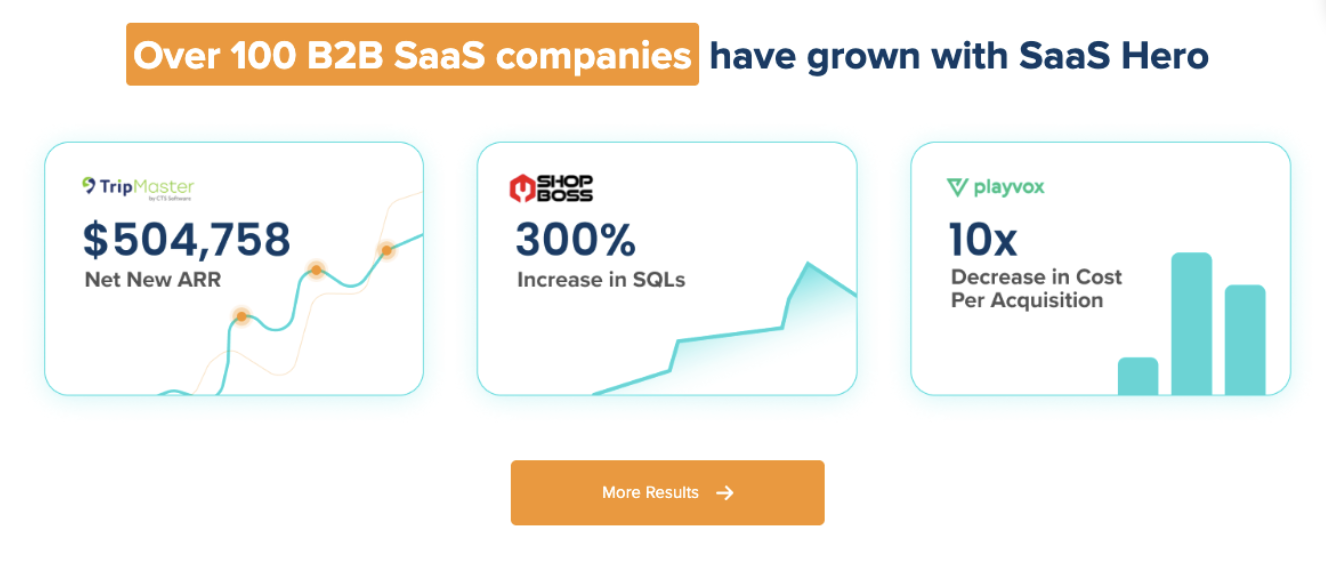
Client outcomes quantify this model. TripMaster added $504,758 in net new ARR, TestGorilla achieved an 80-day CAC payback period during its $70M Series A raise, and Playvox cut cost per lead by 10x.

Why Houston-Based Execution Improves Performance
National agencies typically serve Houston clients remotely, which creates asynchronous communication, delayed creative approvals, and strategy calls that juggle multiple time zones. A Houston-based performance partner works inside the same business day, attends in-person CRO workshops, and joins the client’s Slack or Google Chat for real-time collaboration.
SaaSHero’s embedded communication model uses dedicated Slack channels, weekly performance updates, and bi-weekly strategy calls as a single system. These touchpoints combine to function like an internal growth pod instead of a distant vendor. For Series A and B companies with two or three marketers, this proximity removes coordination overhead that slows campaigns and weakens results.
In-person CRO workshops also speed up testing. Landing page hypotheses that might sit in a remote agency ticket queue for weeks can be reviewed, revised, and launched within a single working day when the team operates locally.
Implementation Roadmap for Revenue-First Campaigns
A structured onboarding sequence shortens the time between contract signature and the first revenue-attributable insights. The standard sequence follows four phases:
- Readiness assessment (Week 1): Audit existing ad accounts, CRM configuration, and tracking infrastructure. Identify attribution gaps between ad click and closed-won opportunity.
- Tracking setup (Weeks 2–3): Implement GCLID passthrough, HubSpot or Salesforce integration, and Looker Studio revenue dashboards. Establish baseline CAC and pipeline velocity metrics.
- 90-day pilot: Launch campaigns with competitor conquesting pages, heuristic CRO review of existing landing pages, and SQL-focused bidding strategies. Report on pipeline value and CAC payback at Day 30, 60, and 90.
- Monthly optimization: Use closed-won CRM data to reallocate budget toward the highest-converting segments. Iterate landing page copy and offer structure based on conversion data instead of assumption.
Setup fees range from $1,000 to $2,000 as a one-time investment, which covers the audit, tracking build, and strategy architecture. Beyond funding these deliverables, this upfront fee filters out non-serious engagements and confirms that both sides commit to building attribution infrastructure before media spend scales.
When a Performance Agency Is Not the Right Fit
A performance-focused agency partnership does not suit every situation. Three scenarios favor a different path:
- In-house team: Companies with $15M or more in ARR and a mature marketing operations function may achieve better unit economics by hiring a dedicated paid media director and CRO specialist. The fixed cost of two senior hires can fall below agency fees at high spend volumes, as long as the internal team has enough domain depth to operate without external oversight.
- National agency: SaaS companies targeting enterprise accounts across several verticals at once may benefit from a national agency’s broader creative production capacity and account-based marketing infrastructure, as long as they negotiate outcome-based reporting into the contract.
- Pre-product-market-fit stage: Companies still refining ICP and pricing should not scale paid media. Agency spend before PMF reliably accelerates cash burn without building durable pipeline. The correct sequence runs PMF first, then performance marketing.
Frequently Asked Questions
What does a flat-fee B2B SaaS marketing agency in Houston typically cost?
SaaSHero’s retainer fees start at $1,250 per month for a dedicated campaign manager handling up to $10,000 in monthly ad spend on one channel, on a month-to-month basis. The Full Marketing Team tier starts at $2,500 per month for the same spend band. Fees scale with spend band and channel count, reaching $4,500–$7,000 per month for accounts spending $50,000 or more across multiple channels. A one-time setup fee of $1,000–$2,000 covers tracking infrastructure, account audits, and initial strategy. These figures appear transparently on the SaaSHero pricing page.
How long does onboarding take before campaigns generate revenue-attributable data?
The tracking and CRM integration phase usually takes a few weeks, depending on the existing infrastructure. Pipeline data tied to specific campaigns and ad groups typically becomes available within the first one to two months of active campaign management. CAC payback calculations require closed-won data from the CRM, so the first reliable payback period measurement depends on the client’s average sales cycle length.
What metrics does SaaSHero report on, and how are they defined?
Primary reporting metrics include net new ARR, defined as closed-won revenue from marketing-sourced opportunities, and pipeline value, defined as open opportunities with a probability-weighted dollar value. Sales Qualified Leads (SQLs) follow the client’s CRM qualification criteria, and CAC payback period measures the months of gross margin required to recover the fully loaded cost of acquiring one customer. Vanity metrics such as impressions, CTR, and raw click volume are tracked but not used as optimization targets or presented as primary performance indicators.
Does SaaSHero work with companies that already have an internal marketing team?
Yes. SaaSHero positions itself as an extension of existing internal teams rather than a replacement. The agency integrates with internal marketing directors, content managers, and demand generation leads who need specialized paid media and CRO execution without adding headcount. Communication runs through the client’s existing tools, such as Slack or Google Chat, and strategy calls include relevant internal stakeholders.
What makes a Houston-based SaaS marketing agency different from a national remote agency?
The primary operational difference is execution velocity. A Houston-based team works in the same time zone, attends in-person strategy and CRO workshops, and processes creative approvals within the same business day. For Series A and B companies where speed of iteration directly affects CAC payback, this reduction in coordination latency creates a measurable advantage. A secondary difference involves local market context. Familiarity with Houston’s concentration of energy tech, healthcare SaaS, and logistics software companies shapes ICP targeting and competitive positioning in ways a national agency serving 15 verticals rarely matches.
Conclusion: Align Your Agency Model With SaaS Unit Economics
The structural misalignment between percentage-of-spend billing and SaaS unit economics does not represent a fixable relationship issue. It represents a billing model issue. As long as an agency earns more when the client spends more, the incentive to pursue revenue efficiency remains weak. Flat-fee retainers, month-to-month contracts, and CRM-integrated revenue reporting remove that conflict at the structural level.
For Houston SaaS revenue leaders managing $10k–$50k in monthly ad spend and accountable to a board for CAC payback and net new ARR, the agency model described here offers a structure where financial incentives match the client’s growth targets.