




Written by: Aaron Rovner, Founder, Saas Hero
Key Takeaways
- Enterprise CRM integration is 80% architecture: data flows, lifecycle mappings, and revenue-based decisions. Connector setup is the remaining 20%.
- Silent failure modes include lifecycle stage mismatches, lead routing conflicts, offline conversion gaps, consent-mode degradation, and optimization toward form fills instead of qualified opportunities.
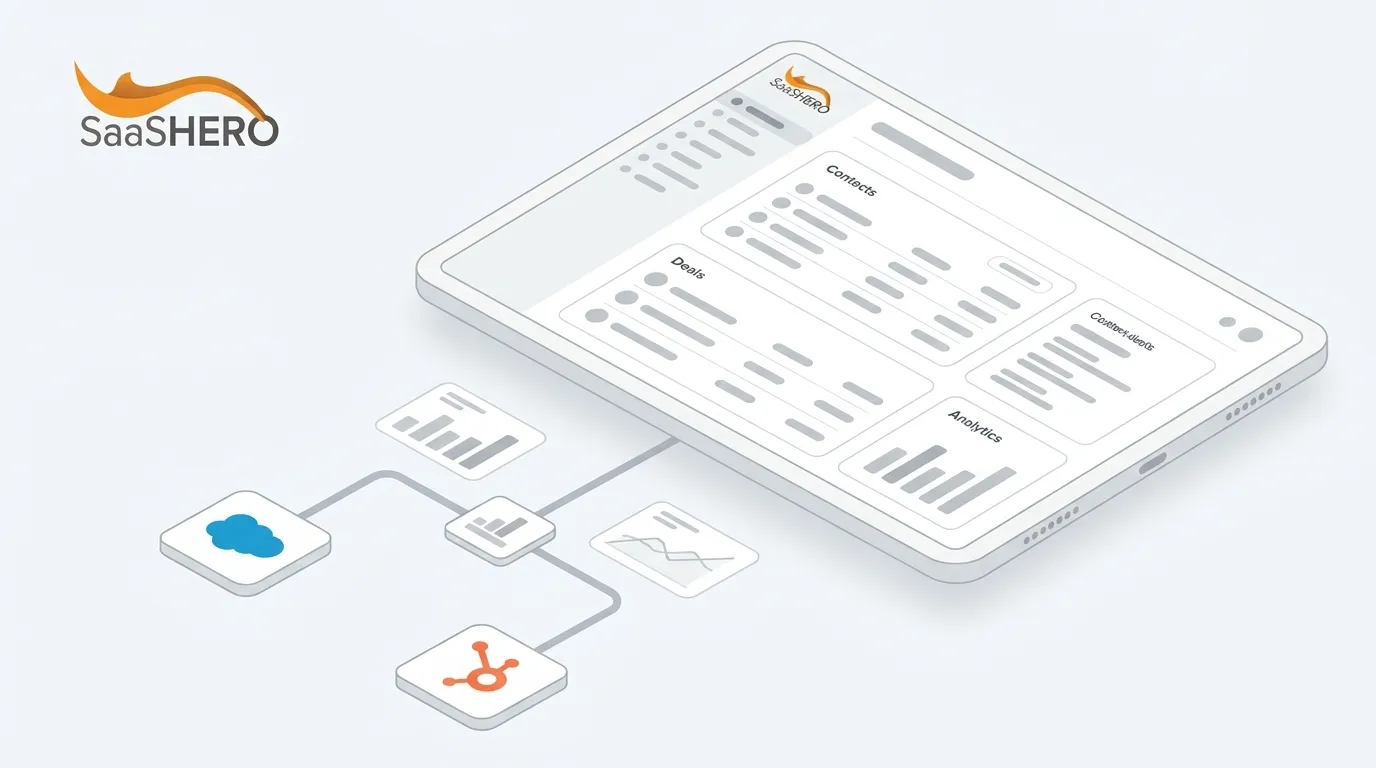
- The four-layer architecture connects CRM as the revenue source of truth, marketing automation for lifecycle stages, ad platforms for execution, and BI tools for board-level reporting.
- Attribution works when CRM-confirmed pipeline and revenue events flow back to ad platforms and replace last-click or form-fill optimization.
- SaaSHero owns the full chain from ad click to CRM record and trains campaigns on CRM revenue data instead of raw form-fill counts.
Talk With SaaSHero About Your CRM Integration
Why Enterprise CRM Integration Breaks In B2B
Enterprise B2B creates structural conditions that break CRM integration in ways smaller organizations never encounter. Multi-month sales cycles, buying committees, multi-touch journeys, fragmented attribution, and multi-business-unit org structures each introduce a gap between what the ad platform reports and what the CRM confirms. The click is recorded in Google Ads or LinkedIn, while the opportunity appears in Salesforce or HubSpot months later. Because nothing joins them unless somebody builds and maintains the join, the default report falls back to last-touch attribution. That default understates every upper-funnel channel and steadily defunds the campaigns that created demand in the first place.
The measurement layer widens the gap. Third-party cookie restrictions, browser tracking prevention, consent requirements, cross-device journeys, and research that happens where no pixel reaches each remove part of the path between a first impression and a signed contract. Advanced Consent Mode v2 can recover an estimated 65–70% of attribution data that would otherwise be lost to opt-out traffic, but modeling accuracy degrades as consent rates fall below roughly 60% because training data becomes too thin. In EU markets, opt-out rates can exceed 40% in some sectors, so consent mode configuration becomes a material factor in attribution accuracy.
The following failure modes are documented, platform-specific, and each fails silently. The system behaves incorrectly in the background without triggering an error.
- Lifecycle Stage Mismatch Between Marketing Automation And CRM. If the CRM uses “Qualified” but the automation tool listens for “MQL,” the trigger never fires. Field-name mismatches are platform-specific: Salesforce calls the field
Lead Status, HubSpot splits it acrossLifecycle StageandLead Status, and Pipedrive maps it to pipelineStage. A mismatch means sequences never fire. Teams often notice only when a rep flags a cold lead that should have been hot. - Lead Routing Conflicts In Multi-Business-Unit Orgs. When HubSpot workflows and Salesforce lead assignment rules run simultaneously, they fight each other: HubSpot assigns an owner, then Salesforce’s web-to-lead rule fires on sync and overrides it, landing the lead on the default owner, often an integration user, where it sits indefinitely.
- Offline Conversion Import Gaps. The GCLID capture step often breaks when the form is embedded in an iframe or a tool that does not pass the hidden field on, and the CRM storage step breaks when the GCLID field gets overwritten or is not copied from the contact to the deal record.
- Consent-Mode Impact On Attribution. Consent-mode degradation appears as opt-out rates rise. As modeling relies on thinner training data, the recovered attribution signal weakens and accuracy falls. The consent figures above show how quickly this becomes a structural issue.
- The Form-Fill-Versus-Qualified-Opportunity Optimization Trap. An optimization algorithm finds more of whatever it is rewarded for. Pointed at a form fill, it finds the people most likely to fill in forms, such as students, competitors, job seekers, and existing customers, while reporting a falling cost per conversion. Google Ads behaves like a self-fulfilling prophecy: feed the machine high-quality data and performance improves. Feed it form fills and it finds form fillers.
For a deeper look at how these failure modes interact with measurement architecture, see Enterprise Marketing Agency Measurement And Attribution. The rest of this guide walks through the architecture that prevents these failures.
Review Your Current Failure Modes With SaaSHero
The Integration Architecture: What Enterprise Marketing Agency CRM Integration Actually Connects
The four-layer architecture stacks in sequence, with each layer feeding the one above it. Start with the system of record, then move up through the layers that turn CRM states into optimization signals. Most agencies operate in only one of these layers, so understanding the full stack is the starting point for evaluation.
CRM (Salesforce Or HubSpot) is the system of record for pipeline and revenue, the destination every paid media decision should ultimately be measured against. Organizations with aligned CRM systems report up to 36% higher customer retention and 38% higher sales win rates. The CRM acts as the source of truth that makes revenue-based optimization mechanically possible.
Marketing Automation (HubSpot, Marketo, Pardot, ActiveCampaign) owns forms, lifecycle stages, scoring, nurture, and the handoff to sales. Its lifecycle stage definitions provide the raw material for revenue-based optimization because they distinguish a form fill from a qualified opportunity. Marketo ships with a native, purpose-built bi-directional Salesforce connector, but account and opportunity data are typically Salesforce-owned and flow one way into Marketo. That directional constraint matters when designing the integration architecture.
Ad Platforms (Google Ads, Microsoft Ads, LinkedIn Ads, Meta, Reddit, TikTok, Performance Max) form the execution layer and represent the only layer many agencies touch. The CRM and marketing automation integration makes it possible to push lifecycle stage events back into these platforms so the signal reaching the auction reflects a CRM state, not a page event. When a lead becomes a sales-qualified lead, when an opportunity opens, and when a deal closes, those events can return to the platform as the outcome worth finding more of.
BI Layer (Looker Studio) is where paid media, CRM, and analytics data combine into something a marketing leader can present to a board. Without this layer, the VP of Marketing reconciles three systems by hand the week before every board meeting.
Supporting layers complete the architecture. Tag management (Google Tag Manager) is where conversion tracking actually lives and often becomes a source of broken measurement, especially when configured by someone who has since left the company. Analytics (GA4 and Google Search Console) forms the behavioral layer where the discrepancy between platform-reported and site-reported conversions surfaces. Without server-side tracking, B2B advertisers are measuring only about 40% of what matters, because iOS privacy changes, ad blockers, and Safari ITP have gutted client-side pixels. ABM and intent platforms (6sense, Demandbase) act as targeting and measurement inputs. A company running 6sense alongside Marketo and Salesforce has committed six figures a year to go-to-market software before a single ad is served, which itself signals qualification. Customer data platforms (Segment, Rudderstack) govern how event data moves between the website, the product, the CRM, and the ad platforms.
See also: Paid Media Agencies With CRM Integration: 2026 Guide.
See How SaaSHero Designs This Four-Layer Stack
How Attribution Actually Works When CRM Is The Source Of Truth
The ad platform’s reported conversion rarely matches the CRM’s conversion. Ad platforms report observed plus modeled conversions combined, while a CRM records actual closed deals, and this gap stays invisible in standard reports while creating a real and growing discrepancy, especially for audiences in GDPR-regulated regions. In a six-to-nine-month B2B cycle with a buying committee, last-click credits the branded search that happens after the decision, so the channels that created the demand appear worthless and lose budget.
Google Ads defaults to a 30-day click and 1-day view-through attribution window, Meta uses a 7-day click and 1-day view window, and LinkedIn defaults to a 30-day click window. When the same conversion falls inside multiple windows, every platform counts it. A single customer journey can produce five different conversion counts across tools: Google Ads reports one number, Meta another, GA4 a third, the CRM a fourth, and the payment platform a fifth. Each count is technically valid because every platform observes a different part of the journey and applies its own measurement rules.
The primary-versus-secondary conversion architecture resolves this confusion. Secondary conversions such as content downloads, webinar registrations, and low-commitment form completions stay tracked and visible in reporting but do not drive account-wide optimization. They show interest rather than purchase intent. Optimizing Google Ads for page views produces great CPMs and zero pipeline. The primary conversion set stays deliberate and small: demo requests, sales calls booked, and CRM-confirmed qualified opportunities.
The reconciliation layer is a single CRM-connected reporting view in HubSpot, Salesforce, or whichever CRM the client runs, with Looker Studio alongside it, that resolves discrepancies rather than reproducing them. Aligning ad networks, GA4, and CRM data is difficult because these systems were built for different purposes and measure different moments. A properly built CRM-connected reporting layer makes alignment achievable. The correct response is triangulation across systems, not forcing three tools to output the same number.
Every buyer should ask agencies a direct discovery question: “Are you optimizing campaigns around CRM data or just form submissions?” That answer reveals whether the agency treats CRM as the source of truth.
How To Evaluate An Agency’s CRM Integration Capability
The questions below help separate agencies that truly handle enterprise CRM integration from those that only install connectors. An agency with real experience can answer each question clearly and show the supporting work.
- Can You Show Me A Lifecycle Stage Mapping Document? If the agency cannot produce one, they have not done the work. Every stage name must be mapped explicitly between CRM and marketing automation, and the reference table must be updated whenever a sales rep renames a pipeline stage.
- How Do You Handle Offline Conversion Imports? A complete answer includes GCLID capture at form submission, storage on the contact and deal record, and a scheduled or webhook-driven upload.
- What Happens When MAP And CRM Disagree On Lead Status? There must be a documented conflict resolution rule. Fields both systems can write to without a clear owner produce flapping records that overwrite each other on every sync cycle.
- Who Owns The Post-Click Experience? When ownership sits with “the client” or “the web team,” the agency cannot be accountable for conversion rate or pipeline.
- What Is Your Ad Platform Trained On? The answer should highlight qualified opportunities and lifecycle-stage events as the primary signals, with form fills weighted appropriately.
- What Does The Monthly Report Lead With? Strong reports open with pipeline, CAC, and payback period instead of leads, CPL, and impression share.
- What Happens When Volume Rises? Lead count and qualified opportunities should rise together. When only lead count rises, the account is optimizing toward the wrong signal.
Ask for four concrete artifacts before signing: a data-flow diagram, a conversion hierarchy document, an attribution model spec, and a lifecycle stage mapping document. If the agency cannot produce these, they have not completed the integration design. The problem goes beyond simply connecting two platforms, because field mappings, sync rules, record matching, user permissions, and API limitations affect whether data flows accurately and can create data quality and operational issues.
Get A CRM Integration Readiness Review
CRM Integration Agency Vs In-House RevOps: Build Vs Buy
Marketing leaders usually decide between hiring an agency, building in-house RevOps capacity, or engaging a specialized integration consultancy. Each path carries clear strengths and tradeoffs that affect accountability for pipeline.
An in-house RevOps hire accumulates product and customer knowledge no agency will match and is available immediately. That advantage is real. The constraint is scope: the paid media job spans paid search, paid social, creative production, landing page design and testing, and conversion tracking and attribution architecture. Very few individuals excel across all five disciplines. The post-click experience and attribution plumbing often receive the least attention because they fail silently. A widely cited consultancy estimate holds that 55% of CRM implementations fail to meet their planned objectives, and that failure rate applies to in-house builds as readily as to agency-led ones.
A specialized integration consultancy offers deep, fast expertise in one platform. For a defined project such as an account audit, a campaign rebuild, or a tracking implementation, a strong specialist often represents the right choice. The constraint is coverage. No single party owns outcomes across disciplines, so the marketing leader becomes the integration layer between the specialist and every other team.
The agency model fits when paid media is a material channel that needs to be owned end to end, and when the marketing leader has drifted into strategist, project manager, and quality-control roles for a vendor already paid to hold those seats. The strongest configuration pairs an internal owner who sets goals and holds the number with a specialist team that owns strategy and execution across the underlying disciplines.
For more on how this decision plays out at enterprise scale, see Enterprise B2B Lead Gen Agency: Integrating With Your Stack.
Discuss Build Vs Buy For Your Team
Platform-Specific Notes: Salesforce-Centric Vs HubSpot-Centric Enterprises
The integration work looks different in Salesforce-centric and HubSpot-centric enterprises, so agency selection should match your primary platform.
For HubSpot-centric enterprises, HubSpot’s Salesforce integration maps HubSpot’s single Contact object to Salesforce’s split Leads (unqualified) and Contacts (account-associated) objects, and maps Companies to Accounts, Deals to Opportunities, Tickets to Cases, and Tasks/Activities to Tasks or Activities. Lifecycle stage mapping requires custom configuration because the native connector does not handle it by default. HubSpot-Salesforce integration timelines vary by approach: native connector 1–2 weeks, middleware (MuleSoft/Workato) 4–8 weeks, and custom API 8–16 weeks, with data cleanup typically the biggest variable. The most critical architectural decision concerns Salesforce’s separation of Leads from Contacts versus HubSpot’s single Contact object. Conditional routing based on HubSpot lifecycle stage is the recommended approach.
For Salesforce-centric enterprises, object models tend to be more complex, with multi-business-unit lead routing and heavier dependence on marketing automation (Marketo, Pardot) as the bridge between ad platforms and the CRM. A standard MSI-based Marketo Salesforce setup for a single Salesforce org typically runs from a few days to two weeks of admin time; custom object sync, multi-currency handling, or merging two Salesforce orgs pushes that into the four-to-six-week range. Marketo ships with a native, purpose-built bi-directional Salesforce connector, but account and opportunity data are typically Salesforce-owned and flow one way into Marketo.
The architecture remains deliberately platform-agnostic in its principles. Google Ads and Microsoft Ads share similar structures, and the same architecture ports between them, with conversion tracking as the main configuration difference on Microsoft. The core principles, including lifecycle stage mapping, primary-versus-secondary conversion hierarchy, offline conversion import, and CRM-connected reporting, apply regardless of which CRM or marketing automation platform the client runs.
Plan Your Salesforce Or HubSpot Integration With SaaSHero
Why SaaSHero Is The Best Solution For Enterprise Marketing Agency CRM Integration
SaaSHero leads enterprise marketing agency CRM integration by owning the full chain from ad click to CRM record as part of how engagements are scoped and priced. That ownership structure makes accountability for pipeline explicit.
SaaSHero operates as the outsourced inbound growth team for B2B companies, with one team owning strategy and execution across paid media, creative, landing pages, and reporting. Every decision is optimized against CRM revenue data rather than form-fill counts. SaaSHero integrates with the client’s CRM and marketing automation platform for lead flow and lifecycle measurement, which enables optimization toward qualified pipeline instead of raw form volume. The team also connects into tag management, analytics, ABM and intent platforms, and the BI layer.
SaaSHero owns paid search and paid social campaign strategy, structure, and management. The team writes ad copy and designs ad creative. It handles landing page design, copy, build, hosting, and A/B testing. It configures conversion tracking and the primary-versus-secondary conversion architecture. It builds paid media reporting and CRM-level attribution for paid channels, and it runs keyword research, competitor analysis, and budget allocation across paid channels. None of these responsibilities shift back to the client for implementation. The landing page, the highest-leverage variable in the funnel, is designed, built, hosted, and tested by SaaSHero instead of being handed to a backlogged web team.

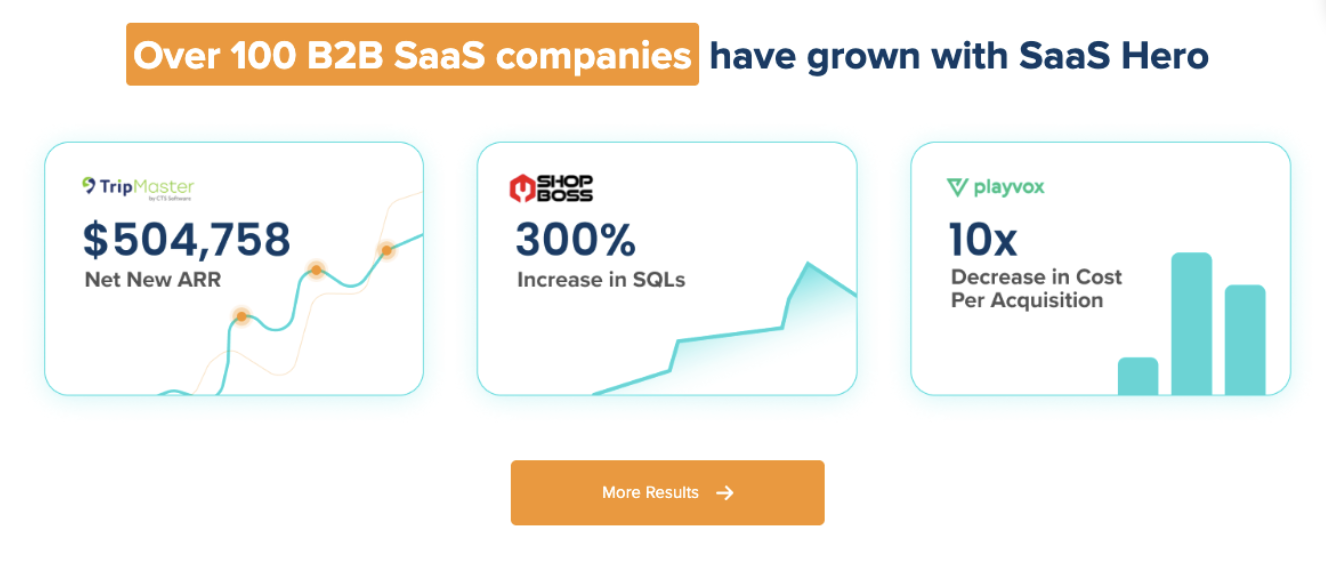
SaaSHero’s credentials are externally verified and work together as a proof set. Founded in 2018, SaaSHero has spent more than eight years in the B2B category, served more than 100 B2B companies, and manages roughly $16M in annual advertising spend, with more than $60M over its lifetime. The team includes about 20 full-time specialists, including in-house designers and copywriters, and does not outsource execution. SaaSHero is a Google Premier Partner, a designation held by the top 3% of agencies, and has been a G2 High Performer in Digital Marketing for over two consecutive years, currently ranked #20 of approximately 6,000 agencies.
The commercial structure reinforces alignment. Clients work with one team on one flat retainer across all channels, with no percentage-of-spend fees. The retainer scales with total ad spend under management rather than channel count, so recommending a channel shift or a new test does not raise the client’s cost. When SaaSHero recommends increasing a budget, the recommendation rests on performance data instead of fee incentives.

The operating cadence makes performance transparent. Clients receive bi-weekly strategy calls, weekly performance updates, monthly competitor analysis, quarterly budget analysis, a shared Slack channel, Looker Studio dashboards alongside HubSpot reporting, and continuous A/B testing. Nothing goes live without the client’s sign-off, including ads, landing pages, audiences, creatives, and messages. The client owns all accounts, assets, and files, and offboarding is treated as a normal event. SaaSHero operates inside the client’s accounts, so historical data, account structure, and learnings stay with the business that funded them.
See If SaaSHero Is A Fit For Your Team
Frequently Asked Questions
What Is Enterprise Marketing Agency CRM Integration?
Enterprise marketing agency CRM integration means deciding what data flows between CRM, marketing automation, ad platforms, and BI, in which direction, mapped to which lifecycle definitions, and optimized toward which revenue outcomes. Connector installation provides the transport layer. The integration defines the strategy on top of that transport: which fields sync in which direction, which system owns each field, how lifecycle stages map between platforms, and how CRM outcomes feed back to ad platforms as optimization signals.
How Long Does CRM Integration Take For An Enterprise Marketing Agency?
HubSpot-Salesforce native connector implementation typically runs 1–2 weeks, middleware approaches 4–8 weeks, and custom API integration 8–16 weeks, with data cleanup usually the biggest variable and often the longest step. Marketo-Salesforce native connector setup for a single Salesforce org typically runs from a few days to two weeks of admin time, with custom object sync or multi-currency handling pushing that into the four-to-six-week range. These timelines cover the technical connection only. Lifecycle stage mapping, conversion hierarchy design, and offline conversion import architecture run alongside connector work and often take longer.
What Breaks In Enterprise CRM Integrations?
Common failure modes include lifecycle stage mismatches between marketing automation and CRM, lead routing conflicts in multi-business-unit orgs, offline conversion import gaps, consent-mode impact on attribution, and the form-fill-versus-qualified-opportunity optimization trap. Each failure happens silently, so the system behaves incorrectly without throwing errors. Lead volume can look healthy while pipeline does not move. Ad platforms can report conversions that the CRM cannot confirm. The marketing leader often discovers the problem before the agency.
How Do I Verify An Agency Actually Did The CRM Integration Work?
Ask for the four core artifacts: a data-flow diagram, a conversion hierarchy document, an attribution model spec, and a lifecycle stage mapping document. Ask the discovery question: “Are you optimizing campaigns around CRM data or just form submissions?” Request an explanation of your lifecycle stage mapping in plain language. Clarify who owns the post-click experience and whether that ownership includes landing page testing and tracking.
What Is The Difference Between A Native Connector And A CRM Integration?
A native connector moves records reliably between systems. A CRM integration defines the architecture on top of that connection, including which fields sync in which direction, which system owns each field, how lifecycle stages map between platforms, and how CRM outcomes feed back to ad platforms as optimization signals. Agencies that stop at installing the HubSpot-Salesforce native connector typically complete only a small portion of the overall integration work.
How Does Attribution Work When CRM Is The Source Of Truth?
The CRM acts as the system of record for pipeline and revenue, while ad platforms report claimed conversions. Build a single CRM-connected reporting layer that resolves discrepancies instead of reproducing them, and push lifecycle stage events back to ad platforms so the signal reaching the auction reflects a CRM state rather than a page event. Treat the CRM as the financial source of truth and treat platforms as directional optimization tools. The expected variance between platform-reported and CRM-confirmed conversions is often 10–25%, and that variance is structural rather than a tracking failure.
Should We Use An Agency Or Hire In-House RevOps?
An in-house RevOps hire builds deep product and customer knowledge and stays close to internal teams, but the role spans five specializations: paid search, paid social, creative production, landing page design and testing, and conversion tracking and attribution architecture. Few people excel across all five, so the post-click experience and tracking often receive less attention. The agency model fits when paid media is a material channel that needs to be owned end to end. The strongest configuration combines an internal owner who sets goals and holds the number with a specialist team that owns strategy and execution across the supporting disciplines.
How Does The Integration Differ Between Salesforce And HubSpot?
HubSpot’s Salesforce integration syncs contacts, companies, deals, and activities natively, while lifecycle stage mapping requires custom configuration. The most critical architectural decision involves handling Salesforce’s separation of Leads from Contacts versus HubSpot’s single Contact object, and conditional routing based on HubSpot lifecycle stage is the recommended approach. Salesforce-centric enterprises usually have more complex object models, multi-business-unit lead routing, and heavier dependence on marketing automation (Marketo, Pardot) as the bridge between ad platforms and the CRM. Marketo’s native Salesforce connector is bi-directional for Leads and Contacts, while account and opportunity data typically flow one way from Salesforce into Marketo.
What Does CRM Integration Cost?
The platform-side pieces usually fall under existing licenses. For example, the HubSpot-Salesforce native connector is included at no additional cost with HubSpot Professional and Enterprise subscriptions. Implementation time varies by complexity: native connector 1–2 weeks, middleware 4–8 weeks, and custom API 8–16 weeks. The larger cost appears in ongoing maintenance, including sync error reviews, field audits, and a documented ownership model between marketing and sales ops. A Marketo-Salesforce integration requires the same ongoing attention as any system moving data on a five-minute clock.
Get A CRM Integration Cost And Timeline Estimate
Conclusion: The Integration Is The Accountability Line
The native connector solves transport, but the integration defines accountability. Most agencies sell the 20% technical connection between systems and stop there. The remaining 80% determines whether ad spend produces qualified pipeline or just form fills. That work includes lifecycle stage mapping, offline conversion import architecture, primary-versus-secondary conversion hierarchy, CRM-connected reporting, and lifecycle event pushback to ad platforms.
The failure modes described here are documented and silent. Lifecycle stage mismatches prevent triggers from firing. Lead routing conflicts strand leads on an integration user. GCLID capture breaks at the iframe. Consent mode degrades as opt-out rates rise. The optimization algorithm learns to find form fillers instead of buyers. None of these issues raise obvious errors. They produce a healthy-looking dashboard and a pipeline that does not move.
The due-diligence framework stays simple. Ask for the four artifacts before signing. Use the seven evaluation questions. Require that the agency can explain your lifecycle stage mapping clearly. Agencies that cannot do these things have not completed the integration work. Agencies that train platforms on form submissions instead of CRM revenue data teach bidding models to find the wrong audience, and each month of mis-training compounds the problem.
Internal audits, benchmark reviews, and a conversion tracking audit against your current setup make strong next steps regardless of which direction you choose. The questions in this guide provide a practical starting point for those exercises.
SaaSHero stands out in enterprise marketing agency CRM integration because the team owns the full chain from ad click to CRM record, optimizes against CRM revenue data instead of form-fill counts, and treats the post-click experience as in-scope by default. That ownership line defines accountability for pipeline.
Schedule A Working Session On Your CRM Integration