




Written by: Aaron Rovner, Founder, Saas Hero | Last updated: July 28, 2026
Key Takeaways
- Rising LinkedIn CPCs ($5–$25) and 281-day sales cycles turn agency billing models into direct drivers of CAC and payback.
- Percentage-of-spend fees create misaligned incentives, while flat-fee retainers tie recommendations to performance instead of revenue expansion.
- Month-to-month contracts shift performance risk back to the agency and replace 12-month lock-ins that protect agency revenue at the client’s expense.
- CRM-level attribution that connects LinkedIn spend to closed-won revenue captures 3–5× more pipeline value than last-click reporting and improves cost per SQL by 30–50%.
- SaaSHero structures every engagement around flat monthly retainers, month-to-month terms, and full CRM attribution to deliver measurable Net New ARR; book a discovery call to audit your current agency.
The 2026 LinkedIn Reality for B2B SaaS Teams
LinkedIn now commands 41% of total B2B paid media budgets, making it the single largest advertising investment for many B2B companies. That dominance is backed by performance data. LinkedIn is the only major platform to deliver positive ROAS at 121%, compared with 67% for Google Search and 51% for Meta when measured on closed-won deals using data-driven attribution across 3.5 million B2B customer journeys.
The cost environment is unforgiving. Sponsored Content CPCs for B2B SaaS on LinkedIn range from $5–$22, with software and tech audiences reaching up to $22 per click. The median cost per lead for B2B SaaS on LinkedIn Ads in 2026 is $220 (range $120–$380). These rising costs turn the agency billing model into a unit-economics decision, not a simple procurement preference.
The buyer journey adds another layer of complexity. Eighty-one percent of the B2B customer journey now occurs before the sales pipeline begins, with multiple touchpoints across channels and stakeholders. Only a small percentage of B2B SaaS companies maintain full pipeline attribution connecting LinkedIn ad spend to CRM revenue. The remaining majority optimize on cost-per-lead metrics that are structurally blind to the lengthy sales cycles described above. The move from CPL to pipeline value and Net New ARR is therefore a requirement for accurate measurement, not a reporting preference.
Strategic Decision 1: Choosing Between Percentage-of-Spend and Flat-Fee Retainers
The billing model an agency uses determines whose interests it serves when budget decisions arise. Under a 15% percentage-of-spend model, an agency managing a $20,000 monthly budget earns $3,000, and increasing that budget to $30,000 adds $1,500 in agency revenue regardless of performance. The financial incentive to recommend higher spend exists independently of campaign results.
Percentage-based models also create unpredictable agency revenue, since a $5,000-per-month account often requires similar strategic effort to a $15,000-per-month account. This structure means the agency overcharges high-spend clients and underinvests in low-spend ones. For a Series A SaaS company with a $10,000–$25,000 monthly LinkedIn budget, this dynamic directly inflates CAC without improving pipeline quality.
Flat-fee retainers separate agency revenue from spend volume. SaaSHero’s tiered retainer starts at $1,250 per month for up to $10,000 in managed spend on a single channel, month-to-month. Within each spend band, the fee stays fixed, so a recommendation to increase budget from $12,000 to $15,000 carries no financial benefit for the agency. The recommendation is driven by performance data and unit economics, not fee expansion. A practical diagnostic question for any agency under consideration is, “In the last 12 months, have you recommended a spend reduction to any client?” An agency on a percentage-based model has a structural reason to answer no.

Strategic Decision 2: Protecting Yourself from Long-Term Contracts
Agencies using 12-month contracts with steep early termination fees transfer all performance risk to the client. The agency secures guaranteed revenue for a year, while the client bears the cost of underperformance with no practical exit. For a B2B SaaS company operating under board-level pipeline targets, this arrangement misaligns incentives from day one.
Long contracts also remove the performance forcing function. When an agency cannot be replaced for 12 months, urgency to generate pipeline in the first 90 days fades. The client’s growth timeline and the agency’s contractual security diverge immediately after signing.
Month-to-month agreements reverse this dynamic. SaaSHero operates exclusively on month-to-month retainers, so the agency must re-earn the engagement every 30 days. That structure creates accountability that no service-level agreement can match. Minimum terms of four to six months are reasonable for LinkedIn programs, given that the average B2B sales cycle spans 192 days with 60+ touchpoints. Those terms should reflect the time needed to measure pipeline impact, not the time needed to protect agency revenue.
Strategic Decision 3: Moving from Last-Click to CRM-Level Attribution
Last-click LinkedIn attribution captures only about 19–30% of true influenced pipeline in B2B SaaS accounts because LinkedIn primarily functions as a top-of-funnel and mid-funnel touchpoint in sales cycles that span multiple quarters. An agency reporting on last-click conversions underreports LinkedIn’s contribution and optimizes campaigns toward the wrong signal.
CRM-level attribution connects the full journey. The path runs from LinkedIn ad impression to lead creation with campaign, ad group, and creative stamped in the CRM, then through MQL, SQL, opportunity, and finally closed-won revenue. Sending HubSpot lifecycle stage transitions back to LinkedIn via the Conversions API improves cost per SQL by 30–50% by training the algorithm on pipeline progression signals rather than form fills. Integrating Meta’s Conversions API to feed offline CRM pipeline data back into Meta Ads optimization may improve lead quality, though the provided sources report no specific metrics such as a 20% CPA reduction or 31% revenue increase.
SaaSHero implements this full-stack attribution architecture as a standard component of every engagement. The team connects LinkedIn Campaign Manager to HubSpot or Salesforce and reports on Net New ARR, pipeline value, and CAC payback instead of impressions or click-through rates. This attribution infrastructure is not just a technical requirement. It reveals whether an agency is structured to serve your growth stage and report in the language your board expects.

How Specialist Agencies Support Different Growth Stages
Generalist agencies focus on volume: more leads, more clicks, more spend. Vertical specialists focus on pipeline velocity and CAC payback. The distinction matters most at growth stages where unit economics sit under board scrutiny, especially Series A through C.
A useful internal readiness maturity model covers three dimensions that together determine whether an agency can execute on this revenue-focused framework. First, CRM integration asks whether LinkedIn campaign IDs are stamped on every lead record and whether closed-won deals flow back to Campaign Manager as offline conversions. Without this foundation, the attribution architecture described earlier cannot function.
- CRM integration: Are LinkedIn campaign IDs stamped on every lead record, and are closed-won deals flowing back to Campaign Manager as offline conversions?
- Senior-led management: Is the strategist who presents on discovery calls the same person optimizing campaigns daily, or does the account transfer to a junior team after signature?
- Real-time collaboration: Does the agency operate inside the client’s Slack or communication infrastructure, or does reporting arrive as a monthly PDF?
Second, senior-led management determines whether strategic decisions come from someone with context on your business model instead of a rotating junior team. Third, real-time collaboration reveals whether the agency treats your account as a partnership or a deliverable.
SaaSHero maintains a maximum of eight to ten clients per senior manager, integrates into client Slack channels for real-time communication, and delivers weekly performance updates alongside bi-weekly strategy calls. This structure reverses the “churn and burn” agency model, where account managers handle 30+ clients and optimization remains reactive instead of proactive.
Top performers in the ZenABM 2026 benchmarks spent more consistently on LinkedIn, used Thought Leader Ads more aggressively, and optimized for pipeline rather than clicks. That behavioral profile requires a specialist partner with B2B SaaS domain knowledge, not a generalist team managing e-commerce and local service accounts alongside SaaS. Book a discovery call to see how the best LinkedIn advertising agencies for B2B SaaS growth structure attribution and team operations differently.
Common Agency Pitfalls and the Questions That Expose Them
Three structural failure modes appear consistently across underperforming agency relationships in B2B SaaS LinkedIn programs.
The first failure mode is hidden percentage fees. Some agencies advertise a flat retainer but embed a spend-based clause above a certain budget threshold, which recreates the misaligned incentive at scale.
- Does your fee structure change at any spend level, and if so, at what threshold and by what mechanism?
- Can you show me the last three clients for whom you recommended a budget reduction?
The second failure mode is junior-heavy execution teams. The bait-and-switch pattern, with senior strategists on the sales call and junior account managers on the account, is common in agencies that prioritize revenue per headcount over client outcomes.
- Who specifically will manage this account day-to-day, and what is their current client load?
- How many total clients does the person optimizing our campaigns manage simultaneously?
The third failure mode is vanity-metric reporting. Only a small percentage of B2B SaaS companies have full pipeline attribution connecting ad spend to CRM revenue, which means most agencies report on impressions, CTR, and CPL instead of metrics tied to closed-won revenue.
- What CRM fields do you stamp at lead creation, and how do you connect closed-won deals back to specific campaigns?
- Can you show a sample report that includes pipeline value and Net New ARR by campaign, not just CPL?
Three B2B SaaS Team Archetypes and How They Should Choose
LinkedIn advertising agency selection criteria change with growth stage and internal team structure. Three archetypes capture the most common decision contexts.
The Bootstrap Founder runs a SaaS product at $500K–$2M ARR with a small team and limited marketing bandwidth. The primary constraint is risk, since a $5,000 monthly retainer on a 12-month contract represents a significant share of revenue. Relevant evaluation criteria include entry-level pricing, month-to-month flexibility, and a clear path from ad spend to pipeline without a dedicated marketing operations hire. Seed-stage companies should run only a limited LinkedIn test of $3,000–$5,000 per month for eight to twelve weeks if they have a clear ICP and validated messaging, which makes a flat-fee, month-to-month agency the only structurally appropriate partner.
The Frustrated VP of Marketing works at a Series B company with a $50,000+ monthly budget and an existing agency that sends monthly PDF reports showing impressions and CTR while the CEO asks about pipeline and CAC. The primary constraint is accountability, since the current agency is financially incentivized to maintain spend instead of improving payback. Relevant evaluation criteria include CRM attribution depth, flat-fee billing, and an agency that reports in the language of board-level metrics.
The Post-Funding Scaler has just closed a Series A or B round and faces aggressive growth targets with a 60–90 day runway to demonstrate pipeline traction to investors. The primary constraint is speed, because hiring and onboarding an internal paid media team takes three to four months. Relevant evaluation criteria include rapid deployment capability, competitor conquesting infrastructure, and a proven track record of CAC payback periods that satisfy investor expectations. SaaSHero’s TestGorilla engagement produced an 80-day CAC payback period and contributed to a $70M Series A raise, which sets a benchmark outcome for this archetype.
2026 LinkedIn Ads Benchmarks B2B SaaS Leaders Should Track
The table below compares key LinkedIn advertising performance benchmarks relevant to B2B SaaS evaluation. All figures come from 2026 benchmark reports and represent median or average values unless otherwise noted. Pipeline and ROAS figures use different methodologies across sources and are presented separately rather than combined.
| Metric | Median / Average | Top Quartile | Source |
|---|---|---|---|
| Sponsored Content CPC (B2B SaaS) | $5–$22 | up to $22 (software/tech) | Dupple 2026 |
| Lead Gen Form CVR (B2B SaaS) | Varies | 10–13% | Digital Applied / MiniLoop 2026 |
| Median Closed-Won ROAS (LinkedIn) | 1.21x | 2.79x | Dreamdata / ZenABM 2026 |
| Median Pipeline per Dollar Spent | Varies | $15.20 | ZenABM 2026 (211 B2B companies) |
| Median Cost Per Lead (B2B SaaS) | $220 (range $120–$380) | — | Growthspree 2026 |
| Avg. First Impression to Closed Revenue | 281 days | — | Dreamdata 2026 |
Frequently Asked Questions
What is the minimum viable LinkedIn Ads budget for a B2B SaaS company in 2026?
The practical floor for a single LinkedIn campaign with a defined ICP audience of at least 50,000 people is $3,000–$5,000 per month, sustained for a minimum of eight to twelve weeks before drawing conclusions. Below $3,000 per month, campaigns rarely exit LinkedIn’s learning phase, which requires about 50 conversions per campaign per month to optimize effectively. Series A companies with $5M–$20M raised are commonly advised to start at $8,000–$12,000 per month across two campaigns. Series B and later-stage companies typically allocate $25,000–$80,000+ per month across multiple ICPs and funnel stages. Budget below the minimum viable threshold produces unreliable data and creates the risk of incorrectly concluding that LinkedIn does not work for a given ICP.
How long does it take for LinkedIn Ads to show pipeline and revenue impact for B2B SaaS?
Expect 30–60 days to generate initial leads, 60–90 days to produce measurable pipeline, and 90–180 days to see closed revenue, depending on sales cycle length. The average first-impression-to-closed-revenue cycle for LinkedIn-sourced B2B SaaS deals is 281 days, so 30-day attribution windows are structurally inadequate for evaluating LinkedIn performance. A cohort-based ROAS model, which groups leads by the month they were generated and measures pipeline value at 90, 180, and 365 days, provides the most accurate view of LinkedIn’s contribution. Healthy programs target a 5x–10x pipeline-to-spend ratio at 180 days, with full ROAS of 6–12x expected at 365 days.
What red flags indicate an agency is not aligned with B2B SaaS revenue outcomes?
The most reliable red flags fall into three categories. First, billing structure, where any agency charging a percentage of ad spend has a financial incentive to increase budgets regardless of performance. Second, reporting content, where monthly reports that lead with impressions, CTR, or raw lead volume without connecting those metrics to pipeline value, SQL rate, or closed-won revenue signal misalignment with board-level reporting. Third, contract terms, where a 12-month lock-in with steep early termination fees transfers all performance risk to the client and removes the agency’s incentive to deliver results in the first 90 days. A month-to-month agreement is the only structure that consistently creates a genuine performance forcing function.
How does SaaSHero’s flat-fee model differ from typical LinkedIn advertising agency pricing?
SaaSHero uses tiered flat monthly retainers based on ad spend bands and channel count, with fees fixed within each band regardless of exact spend volume. The Dedicated Campaign Manager tier starts at $1,250 per month for up to $10,000 in managed spend on a single channel, month-to-month. The Full Marketing Team tier starts at $2,500 per month for the same spend band. All engagements are month-to-month with no long-term lock-in. A one-time setup fee of $1,000–$2,000 covers the initial audit, tracking architecture, and strategy build. This structure means that when SaaSHero recommends increasing a budget, the recommendation carries no financial benefit for the agency and is driven entirely by campaign data and client unit economics.
What attribution setup is required to connect LinkedIn Ads to Net New ARR?
A complete attribution stack for LinkedIn in B2B SaaS includes four components. The LinkedIn Insight Tag provides baseline click and view-through tracking. The LinkedIn Conversions API recovers 15–30% of conversions missed by the pixel due to ad blockers and cookie attrition, and feeding CRM lifecycle stage transitions back through CAPI improves cost per SQL by 30–50%. CRM closed-loop integration stamps every lead record with campaign, ad group, and creative at creation, then tracks the record through MQL, SQL, opportunity, and closed-won stages with timestamps. Finally, offline conversion uploads push closed-won deal data back to LinkedIn Campaign Manager to train the algorithm on revenue signals rather than form fills. Without all four components, reported pipeline will suffer from the same 19–30% capture rate that plagues last-click models.
Conclusion: Use This Framework to Audit Your Agency
The three-pillar framework in this guide, covering incentive alignment, contractual flexibility, and attribution depth, gives you a structured way to audit any current or prospective LinkedIn advertising agency against the revenue outcomes that matter to Series A–C B2B SaaS leaders. Rising CPCs, 281-day sales cycles, and board-level pipeline scrutiny turn the choice of agency model into a direct input to CAC payback and LTV, not a secondary procurement decision.
The diagnostic questions in each pillar are designed to surface misalignment before it compounds into months of wasted spend. An agency that cannot answer questions about CRM attribution architecture, budget reduction history, or account manager client loads is operating outside the revenue-focused framework that B2B SaaS unit economics require in 2026.

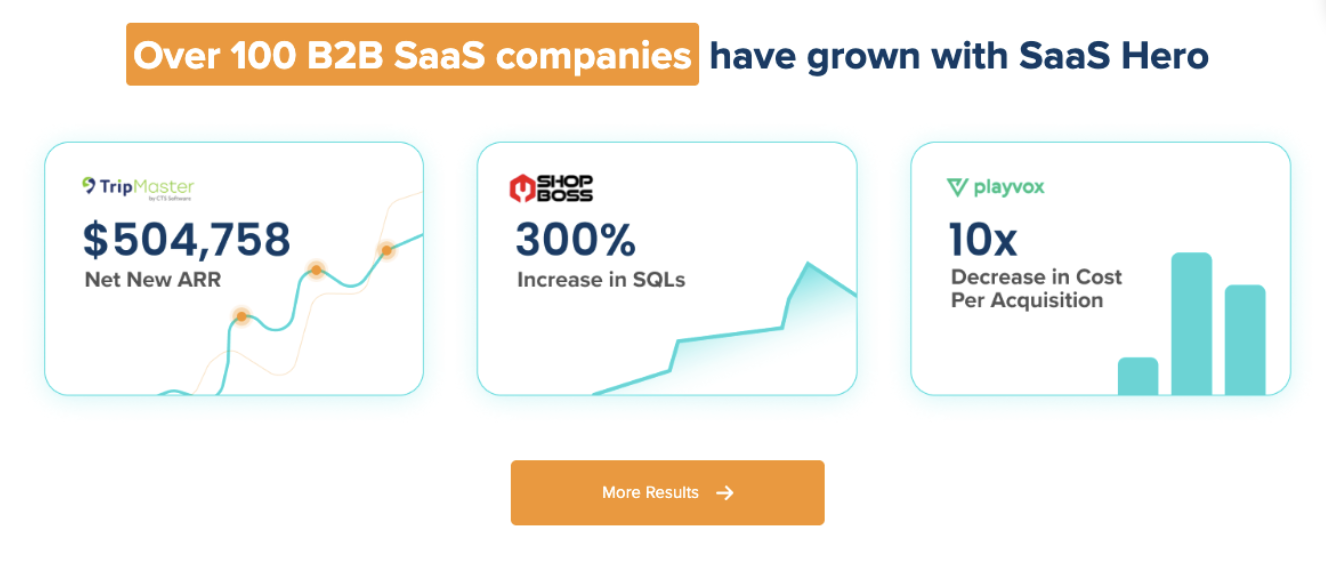
SaaSHero has managed over $30 million in B2B SaaS ad spend exclusively within the vertical, delivering outcomes including $504,758 in Net New ARR for TripMaster, an 80-day CAC payback period for TestGorilla, and a 10x decrease in cost per lead for Playvox. Every engagement runs on a flat monthly retainer, month-to-month, with CRM-level attribution connecting LinkedIn spend to closed-won revenue.