




Written by: Aaron Rovner, Founder, Saas Hero | Last updated: July 22, 2026
Key Takeaways for 2026 B2B LinkedIn Programs
- 2026 B2B SaaS revenue teams face 15–18 month median CAC payback periods and rising LinkedIn CPM costs, so precise revenue attribution must come before any scale-up in spend.
- Platform selection should prioritize CRM sync depth that maps LinkedIn touchpoints directly to closed-won Opportunity records in HubSpot or Salesforce to prove Net New ARR impact.
- Account safety depends on cloud-based architecture, 14-day warm-up protocols, and strict daily connection limits that reduce exposure to LinkedIn’s 4.2 million account restrictions recorded in 2025.
- Multichannel LinkedIn-plus-email sequences with position-based attribution increase reply rates and compress CAC payback compared to single-channel outreach.
- Audit your LinkedIn program for sub-12-month CAC payback with SaaSHero.
The 2026 Pressure on LinkedIn CAC and Payback
B2B SaaS customer acquisition costs now sit at levels that make undifferentiated LinkedIn spend indefensible to a CFO. LinkedIn Ads for SMB SaaS targeting carry average CAC of around $982 with 8–12 month payback periods, while mid-market B2B SaaS companies report CAC of $1,200–$2,000 with 14–18 month payback. LinkedIn Sponsored Content CTR benchmarks for 2026 sit in the 0.44–0.65% range, which compresses the efficiency of every dollar spent.
Four terms now define the selection criteria for any LinkedIn platform investment.
- CAC Payback: The number of months required to recover customer acquisition cost from gross margin. The 2026 healthy benchmark is under 12 months for SMB and under 18–24 months for mid-market and enterprise.
- Net New ARR: Closed-won annual recurring revenue from new logos, excluding expansion. This metric answers the CFO and investor question about growth efficiency.
- SQL-to-Opportunity Conversion: The rate at which sales-qualified leads progress to active pipeline opportunities. This rate forms the bridge between marketing activity and revenue impact.
- LinkedIn ToS Risk: The probability of account restriction or permanent ban that results from automation behavior violating LinkedIn’s User Agreement Section 8.2.
Generic automation tools fail against these terms. They create lead volume without attribution, and they expose accounts to enforcement risk that can eliminate an entire outbound motion overnight. To address these gaps in a structured way, platform selection should follow a three-stage evaluation framework that matches tool capabilities to operational reality, revenue reporting needs, and compliance posture.
Map your LinkedIn spend to Net New ARR and identify the fastest path to sub-12-month payback.
Three-Stage Decision Model for Platform Selection
Selecting an automated LinkedIn campaign management platform works best when you evaluate three sequential stages: Team Size & Governance, Revenue Attribution Requirements, and Account Safety & Compliance. The matrix below maps each stage to team archetype and platform requirements.
| Stage | Team Archetype | Platform Requirement |
|---|---|---|
| Team Size & Governance | Founder-led (1–2 users) | Built-in daily limits, simple warm-up, single-seat compliance controls |
| Team Size & Governance | Scaling SDR team (3–15 users) | Shared-inbox permissions, deduplication, role-based access, audit logs |
| Team Size & Governance | Enterprise RevOps (15+ users) | Multi-account distribution, centralized lead management, SOC-compliant audit trails |
| Revenue Attribution | All archetypes | Native HubSpot/Salesforce sync mapping LinkedIn touchpoints to Opportunity records |
| Account Safety & Compliance | All archetypes | Cloud-based architecture, 14-day warm-up protocol, 20–35 daily connection request ceiling |
Matching Governance Controls to Team Size
Governance requirements scale non-linearly with team size. A founder running solo outreach needs built-in daily limits and a straightforward warm-up schedule. A scaling SDR team introduces the risk of multiple reps contacting the same prospect simultaneously, so deduplication, shared lead management, and CRM sync become essential to standardize behavior across reps and prevent pipeline volatility at this stage.
Enterprise teams require multi-account distribution, centralized lead management, and audit logs that satisfy internal compliance and LinkedIn’s enforcement posture. The consequences of skipping governance show up quickly. Studies indicate elevated restriction rates within 90 days for accounts using browser extension tools, and teams that skip warm-up protocols face similar risk regardless of tool type. Platform selection should therefore begin with team size and governance fit before any feature comparison.
CRM Sync Depth That Proves Pipeline and ARR
CRM sync depth separates a simple LinkedIn automation tool from a true revenue-attribution platform. Without proper mapping, a large share of LinkedIn-influenced pipeline disappears from reporting. Lead volume metrics survive, while closed-won revenue attribution does not.

HubSpot’s native LinkedIn Ads integration, available on Marketing Hub Pro or Enterprise tiers, enables campaign-level revenue reporting that includes spend, leads, MQLs, SQLs, deals influenced, and revenue attributed per LinkedIn campaign. Lifecycle stage changes can sync back to LinkedIn as offline conversions, which lets Campaign Manager bid toward Cost per SQL and Cost per Customer instead of Cost per Click.
Salesforce requires LinkedIn campaign data to map into Lead Source fields, Campaign Member objects, and Opportunity records through campaign influence configuration. Without automated data pipelines from LinkedIn, marketing teams spend hours manually updating Salesforce campaigns instead of analyzing pipeline impact.
The average B2B buyer journey spans 272 days and 76 touchpoints, which far exceeds LinkedIn’s native 30-day default attribution window. Server-side tracking and a CRM-connected attribution layer form the required infrastructure to capture influence across the full sales cycle. SaaSHero’s integration methodology connects LinkedIn touchpoints through HubSpot and Salesforce to closed-won Opportunity records, which produces the Net New ARR reporting that CFOs and investors expect.
Account Safety and LinkedIn ToS Compliance in 2026
LinkedIn’s enforcement posture hardened significantly between 2023 and 2026. LinkedIn restricted 4.2 million accounts in 2025 for automation violations, a 340% increase from 2024. This shift came from three detection layers: behavioral fingerprinting such as mouse movement and scroll behavior, IP signals such as origin and history, and activity pattern analysis such as connection request velocity and message frequency. LinkedIn’s cumulative risk-score model builds over repeated suspicious sessions rather than triggering on a single event.
Tool architecture now matters as much as volume settings. Desktop-based LinkedIn automation carries 60% higher detection risk than cloud-based alternatives because these tools inject JavaScript directly into the LinkedIn page within the authenticated session. In March 2026, LinkedIn removed HeyReach’s company page and its founder’s profile while the company was at $10M ARR, which shows that enforcement can reach organizational leadership, not only individual accounts.
A compliant 2026 safety protocol builds on three layers of defense. The infrastructure layer requires cloud-based architecture instead of browser extensions to avoid JavaScript injection detection. The volume layer requires a 14-day warm-up starting at 5 manual requests on Days 1–3 and ramping to 20–25 by Day 14, then maintaining 20–25 daily connection requests for Premium accounts and 25–35 for Sales Navigator, while keeping pending invitations below 150–250 and withdrawing unaccepted invitations after 4–6 weeks.
The behavioral layer focuses on quality and signals. Teams should target a 20% or higher connection acceptance rate, monitor LinkedIn’s Social Selling Index and maintain a minimum score of 50, and stop all automation immediately after any restriction signal while resting the account for 48–72 hours before resuming. Permanent bans remain rare but usually result from four behaviors: browser extension tools, fixed timing patterns, high volume combined with low response rates, and running automation on free accounts. Platforms that enforce these controls by default, instead of leaving configuration to the user, materially reduce organizational risk.
Multichannel Sequences That Improve Reply Rates and Payback
Multichannel outreach now outperforms single-channel LinkedIn campaigns on both reply rate and CAC payback. Single-channel LinkedIn outreach produces 5–8% reply rates, while B2B cold email-only campaigns average 2–3.5% reply rates. Coordinated LinkedIn-plus-email sequences reach higher reply rates and book more meetings without a proportional increase in spend.
Sequence design follows a clear structure. High-performing LinkedIn-plus-email sequences use 2–3 day timing gaps between touchpoints, conditional branching based on prospect behavior, and clear stopping rules after 6–8 touchpoints with no response. When a prospect accepts a LinkedIn connection request, the sequence branches to a LinkedIn follow-up message and skips the cold email introduction. This behavior-based orchestration outperforms fixed cadences because it adapts to real prospect signals rather than broadcasting on a fixed schedule.
Attribution across these sequences requires position-based models and server-side tracking. Position-Based (U-Shaped) attribution suits B2B SaaS because it gives larger credit shares to the first and last touchpoints while still distributing credit to middle nurture touches. Browser-based pixels now fail frequently due to privacy changes and cookie deprecation. Server-side tracking connected to CRM pipeline stages and closed-won events provides the infrastructure for reliable cross-channel revenue attribution across a long buyer journey.
See how our attribution stack connects LinkedIn to closed-won ARR in HubSpot or Salesforce.
CAC Payback Benchmarks by Tool Type
The table below compares tool types by median CAC payback period and Net New ARR impact, using 2026 benchmarks. All figures reflect B2B SaaS companies in the $5M–$50M ARR range.

| Tool Type | Median CAC Payback | Net New ARR Impact |
|---|---|---|
| Generic LinkedIn automation (browser extension) | 8–12 months (SMB SaaS) | Unattributed; lead volume only, no closed-won mapping |
| Native LinkedIn Campaign Manager + CRM sync | 14–18 months (mid-market) | Influenced pipeline visible; closed-won attribution requires additional configuration |
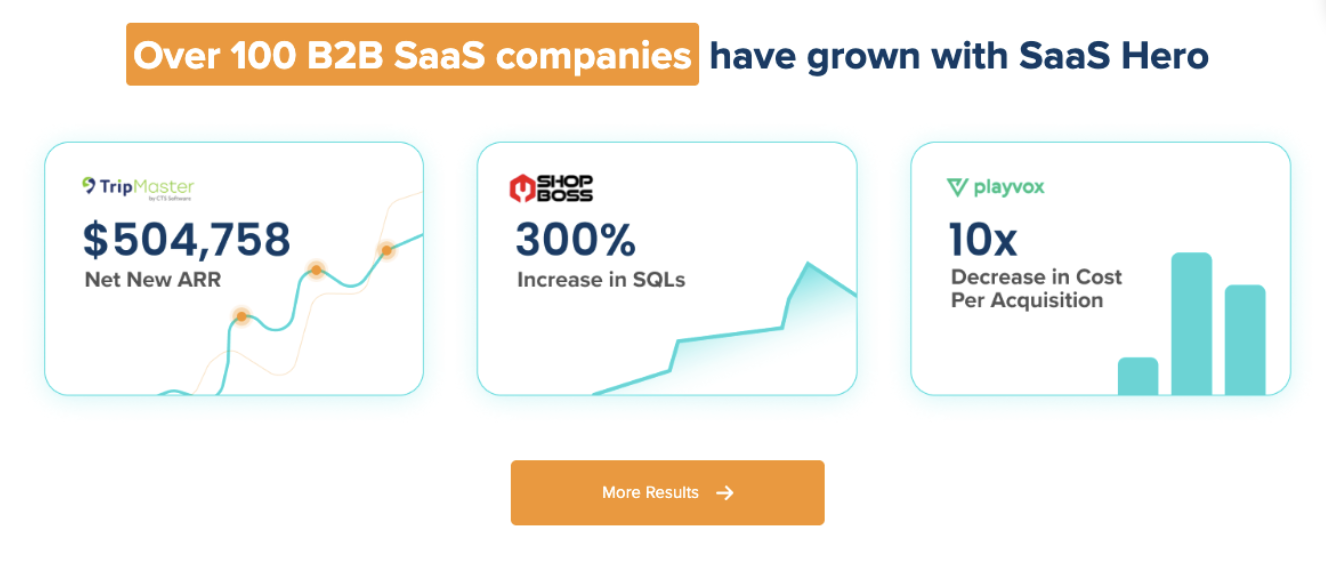
| Revenue-attribution platform (SaaSHero model) | 80 days (TestGorilla case study) | Net New ARR tracked to closed-won; $504,758 added in 12 months (TripMaster case study) |
Common Pitfalls and How to Diagnose Them
Four failure patterns recur across B2B SaaS LinkedIn programs, and each maps to a diagnostic question that revenue teams should answer before selecting or retaining a platform.
- Vanity metric reporting: Impressions, clicks, and CTR show activity but not closed-won revenue. Diagnostic: confirm whether your current platform reports Cost per SQL and Cost per Closed-Won Customer by LinkedIn campaign.
- Ignored ToS exposure: Desktop-based automation carries a 60% higher detection risk and notable restriction rates within 90 days. Diagnostic: confirm whether your platform uses cloud-based architecture and enforces daily volume limits by default.
- Weak attribution mapping: When LinkedIn touchpoints do not map to Opportunity records in HubSpot or Salesforce, a large portion of LinkedIn-influenced pipeline disappears from reporting. Diagnostic: confirm whether your CRM shows LinkedIn campaign influence on closed-won deals, not just contacts created.
- Mismatched team controls: Scaling SDR teams using founder-grade tools lack deduplication and shared-inbox governance, which creates pipeline volatility and compliance exposure. Diagnostic: confirm whether your platform enforces deduplication and role-based permissions across all active users.
Team Archetypes and Matching Decision Criteria
The Overwhelmed Founder needs a platform with built-in limits, a simple warm-up protocol, and month-to-month pricing that avoids a long commitment before trust exists. The priority is offloading execution while keeping strategic control.
The Frustrated VP of Sales or RevOps Lead needs a platform that reports in boardroom language: CAC, pipeline influenced, and Net New ARR. The current agency or tool sends impressions and CTR data, while the CFO asks about payback. That gap becomes the core selection criterion.
The Post-Funding Scaler needs rapid deployment of multichannel sequences, immediate CRM attribution, and governance controls that prevent a single rep’s behavior from triggering account-wide restrictions. Speed-to-pipeline matters, but not at the cost of the LinkedIn accounts that power the outbound motion.
The Enterprise RevOps team needs audit logs, multi-account distribution, centralized lead management, and a server-side attribution layer that connects LinkedIn impressions to Opportunity records across a buying committee of four to eight stakeholders. Single-threading to one contact no longer works for deals with $25,000–$100,000 ACV.
SaaSHero’s model addresses all four archetypes through tiered retainer structures, embedded strategy, and a revenue-attribution methodology validated by sub-90-day payback and six-figure ARR results documented in our case studies.
Frequently Asked Questions
What team size can safely run automated LinkedIn outreach in 2026?
Any team size can run automated LinkedIn outreach safely in 2026 when platform architecture and governance controls match the team’s scale. Founder-led teams with one or two users need cloud-based tools with built-in daily limits of 20–25 connection requests for Premium accounts or 25–35 for Sales Navigator, combined with a 14-day warm-up protocol.
Scaling SDR teams of 3–15 users require deduplication to prevent multiple reps from contacting the same prospect, shared-inbox permissions, and role-based access controls. Enterprise teams of 15 or more users need multi-account distribution, centralized lead management, and audit logs. Elevated restriction rates within 90 days have been documented for teams that skip warm-up protocols or use browser extension tools regardless of team size. Teams that follow a full warm-up protocol and stay within safe daily limits reduce restriction rates below 5%.
How deep must CRM sync be to prove Net New ARR impact?
CRM sync must reach the Opportunity record level, not just the Contact or Lead level, to prove Net New ARR impact. Syncing LinkedIn lead-gen form submissions to HubSpot contacts captures lead volume but not revenue. The closed-loop path requires LinkedIn campaign data to flow from the Contact record to the Opportunity record, which enables reporting on pipeline influenced and closed-won revenue attributed to specific LinkedIn campaigns.
In HubSpot, this path requires Marketing Hub Pro or Enterprise and proper UTM capture for non-form conversions. In Salesforce, it requires LinkedIn campaign data mapped into Lead Source fields, Campaign Member objects, and Opportunity records through campaign influence configuration. Without this depth, a large portion of LinkedIn-influenced pipeline disappears from reporting. Given that B2B buyer journeys extend well beyond nine months with dozens of touchpoints, attribution windows must extend beyond LinkedIn’s native 30-day default through server-side tracking connected to CRM pipeline stages.
What are the current LinkedIn account safety controls that prevent bans?
The controls that prevent LinkedIn account bans in 2026 operate at the architecture, volume, and behavioral levels. At the architecture level, desktop-based LinkedIn automation carries 60% higher detection risk than cloud-based tools because these tools inject JavaScript directly into the LinkedIn page within the authenticated session.
At the volume level, safe daily limits are 20–25 connection requests for Premium accounts and 25–35 for Sales Navigator, with weekly ceilings of 80–100 and 100–150 respectively. Pending invitations should remain below 150–250 depending on account tier, and unaccepted invitations should be withdrawn after 4–6 weeks.
At the behavioral level, a 14-day warm-up protocol starting at 5 manual requests per day and ramping to 20–25 by Day 14 is required for new or reactivated accounts. Maintaining a connection acceptance rate above 20% and a LinkedIn Social Selling Index score above 50 reduces cumulative risk scores. Permanent bans usually result from four behaviors: browser extension tools, fixed timing patterns, high volume combined with low response rates, and automation on free accounts.
Do multichannel LinkedIn plus email sequences improve CAC payback?
Multichannel LinkedIn plus email sequences improve CAC payback by increasing reply rates and meeting volume without a matching increase in spend. B2B cold email-only campaigns average 2–3.5% reply rates, and LinkedIn-only campaigns achieve 5–8% reply rates, while coordinated multichannel sequences reach higher reply rates and book more meetings than single-channel campaigns.
The improvement in reply rate reduces the number of prospects required to generate a given number of SQLs, which directly compresses CAC. Payback improvement depends on attribution infrastructure. Every touchpoint should sync automatically and bidirectionally to the CRM in real time so that meetings booked, pipeline generated, and deals closed can be traced to specific sequence steps and channels. Position-based attribution models that credit both the first LinkedIn touchpoint and the last closing touchpoint provide a more accurate picture of which sequence elements drive closed-won revenue. Teams that implement dedicated sending infrastructure, signal-based targeting, and multichannel sequencing consistently reach 6–10% reply rates, while those skipping any element often remain below 3–4%.
Conclusion: Selecting a Revenue-Attribution Leader
The three-stage decision model of Team Size & Governance, Revenue Attribution Requirements, and Account Safety & Compliance provides a structured path through a market where generic automation tools create either compliance risk or unattributed spend. Neither outcome satisfies a CFO evaluating LinkedIn ROI against industry median payback benchmarks.
SaaSHero’s methodology closes the loop that generic tools leave open. Economic proofs like the results achieved for TestGorilla and TripMaster show a revenue-attribution model that connects LinkedIn touchpoints through HubSpot and Salesforce to closed-won Opportunity records. The flat monthly retainer, month-to-month contract structure, and senior-led execution model remove the incentive misalignments that cause traditional agencies to chase spend volume instead of Net New ARR.
Revenue teams at $5M–$50M ARR that need to justify LinkedIn spend to a CFO, compress CAC payback below 12 months, and maintain full LinkedIn ToS compliance face a clear decision. They can select a platform that attributes every impression to closed-won revenue, or they can continue reporting impressions and CTR to a board that asks about pipeline.
Run a revenue-attribution audit on your LinkedIn program and build a path to sub-12-month CAC payback.