




Written by: Aaron Rovner, Founder, Saas Hero | Last updated: September 3, 2026
Key Takeaways
- Cold email agencies vary widely in quality. Success depends on deliverability infrastructure, data sourcing, and transparent processes rather than volume promises.
- Realistic 2026 pricing ranges from $2,500–$15,000+ per month, with full-service retainers typically between $5,000–$10,000 for post-Series A B2B SaaS companies.
- Deliverability is the non-negotiable foundation. Agencies must manage domain warm-up, authentication, sending limits, and list hygiene to avoid spam filters and protect sender reputation.
- Red flags include guaranteed meeting volumes without methodology, lack of transparency on data sources, and absence of verifiable case studies tied to pipeline outcomes.
- Choosing between a cold email agency, an in-house team, or a full-funnel partner depends on your growth stage, sales motion, and whether you need a single channel or an integrated acquisition engine.
1. What a Cold Email Agency Actually Does (Beyond “Sending Emails”)
Cold email agencies run a complex operational stack that goes far beyond hitting send. A competent partner manages several interconnected functions that work together as one system.
- List building and data hygiene — sourcing and verifying contacts that match your ideal customer profile, using tools like Apollo or ZoomInfo. The quality of this list directly shapes the effectiveness of the next layer.
- Copywriting — crafting personalized, multi-touch email sequences calibrated to your ICP’s specific pain points. Strong copy turns a clean list into real conversations.
- Deliverability setup and management — domain warm-up, SPF/DKIM/DMARC authentication, and ongoing inbox rate monitoring. This layer determines whether prospects ever see your emails.
- Sending infrastructure — managing platforms like Smartlead, Instantly, or Lemlist to control volume, rotation, and bounce handling. These tools keep sending consistent and safe.
- Reply management and meeting booking — filtering positive responses, handling objections, and scheduling qualified meetings. This step converts replies into pipeline.
- Reporting and analytics — tracking KPIs beyond open rates and connecting campaign activity to pipeline outcomes. Clear reporting shows what is working and what needs adjustment.
The typical tech stack runs Apollo or ZoomInfo for data sourcing, Smartlead or Instantly for sending, and HubSpot or Salesforce for tracking outcomes. Execution quality across each layer varies enormously between agencies, and a good agency stays transparent about its infrastructure and process at every step.
2. How Much Does a Cold Email Agency Cost? (Realistic 2026 Pricing)
Cold email pricing spans a wide range, and the tier you choose should match the scope of services you actually need. Realistic 2026 benchmarks break down as follows.
- Basic email-only services: typically cover sequence writing and sending infrastructure, with limited list building and no dedicated reply management. Pricing varies by agency and scope.
- Full-service (list building, copywriting, deliverability, and reply management): Full-service cold email agencies typically charge $5,000–$10,000 per month for services including list building, copywriting, deliverability, and reply handling. This tier is most common for post-Series A B2B SaaS companies with an active sales team and a proven ICP.
- Premium or performance-based: Premium or performance-based cold email services typically cost $7,000–$15,000+ per month for full-service retainers, or $200–$500 per qualified meeting for performance-based models. These offers usually include dedicated strategy, A/B testing, multi-channel sequencing, and a clearly documented methodology behind any meeting guarantees.
Most tiers exclude ad spend on other channels, CRM integration work, inbound content, and any paid media. Pricing alone does not signal quality. An agency charging $3,000 per month with a rigorous deliverability process can outperform one charging $8,000 that uses shared domains and purchased lists. When comparing quotes, ask each agency to itemize what is included and what is excluded so you can compare like for like.
3. The Technical Non-Negotiables: Deliverability and Infrastructure
Deliverability is the single most important factor in cold email success. If emails land in spam, reply rates, copy quality, and list targeting do not matter. Sinch Mailgun reports that the average email delivery rate across all senders is around 85%, but senders should target 95% or higher, and Mailgun’s own users average 97.4%.
Every serious agency must manage several technical components.
- Domain warm-up: IP and domain warming, which gradually increases sending volume over time, is necessary to establish a good reputation with mailbox providers and can take a month or more.
- Sending limits: Responsible cold email programs typically send 20–50 emails per day per properly warmed mailbox to avoid triggering spam filters, while new mailboxes start at 10–20 per day.
- Authentication: SPF specifies authorized sending IP addresses, DKIM uses an encrypted digital signature, and DMARC checks for both and instructs receiving servers how to handle failed authentication. Sinch Mailgun recommends setting DMARC to p=quarantine at a minimum.
- List hygiene: Sending to unverified or low-quality lists, including invalid addresses, spam traps, and disengaged recipients, damages sender reputation and inbox placement. Sinch Mailgun recommends cleaning lists at least once per quarter.
- Subdomain separation: High-volume senders should use separate subdomains for outbound campaigns, because subdomains carry a separate reputation from the root domain and protect core business email deliverability.
Technical red flags include agencies that do not discuss deliverability proactively, use shared sending domains across multiple clients, or promise unrealistic inbox rates without a documented warm-up process. Ask directly whether the agency owns its infrastructure or relies on a third-party shared pool, and how it handles bounce rates and spam complaints.
4. Red Flags to Watch For (And Why They Matter)
The cold email agency market includes many vendors who sell outcomes they cannot reliably produce. Certain patterns signal either misaligned incentives or a lack of technical competence.
- Guaranteed meeting volumes, such as “we’ll book 50 meetings a month,” without a clear, documented methodology for how those numbers are reached. This usually indicates a focus on promises instead of process.
- No transparency on data sources, especially when agencies cannot explain where their lists come from or how contacts are verified. That opacity often pairs with aggressive guarantees and suggests weak underlying systems.
- Absence of verifiable case studies with specific metrics tied to named clients or industries. This gap makes it hard to judge whether past results resemble your situation.
- High-pressure sales tactics or long-term contracts without a trial or validation phase. That structure shifts risk to you while the agency avoids proving its approach.
- No defined process for personalization, which shows up as clearly templated sequences with minimal ICP-specific customization. Shallow personalization usually correlates with lower reply quality.
- Purchasing email lists, which Sinch Mailgun identifies as a reliable path to spam traps and deliverability damage. Bought lists also undermine targeting and trust.
- Agencies that do not discuss domain warm-up, authentication protocols, or sending limits during the sales process. Silence on these topics often accompanies poor deliverability practices.
5. The 6 Questions You Must Ask Before Signing
Strong agencies welcome detailed vetting and answer with specifics. These six questions quickly separate capable partners from everyone else.
- “What is your current average inbox rate, and how do you measure it?”
- “How do you source and verify your contact lists, and how often are they cleaned?”
- “Can you share examples of email sequences and the results they produced for a company in our category?”
- “Who writes the copy, and what is your personalization process beyond first-name tokens?”
- “What is your domain warm-up process, and what sending limits do you apply per mailbox?”
- “How do you handle replies, and who manages the handoff to our sales team?”
Vague or defensive answers to any of these questions are a signal in themselves. An agency with a real process describes it in detail without hesitation.
6. How to Measure Success: KPIs That Matter
Open rates rarely tell you whether cold email drives revenue. Focus on KPIs that connect campaign activity to business outcomes.
- Reply rate: total replies divided by emails delivered. This metric shows baseline sequence relevance.
- Positive reply rate: A positive reply rate of 1.5–3% is generally considered good for cold email, with 3–6% being top decile.
- Meetings booked: the number of qualified conversations generated per month. Most programs treat this as the primary output metric.
- Opportunities created: meetings that convert into active pipeline in your CRM. This metric connects cold email to forecasted revenue.
- Revenue influenced: closed deals that originated from cold email outreach, tracked through your CRM.
A good agency reports on the full funnel, not just the top. Insist on a dashboard that connects campaign activity to CRM data so you can see what cold email produces in pipeline terms, not just how many people replied.
7. Cold Email Agency vs. In-House SDRs vs. Full-Funnel Growth Partner
Your choice between a cold email agency, in-house SDRs, or a broader partner depends on stage, sales motion, and how outbound fits into your demand strategy. Most B2B SaaS companies compare three main options.
The table highlights a key trade-off. Cold email agencies offer speed and specialization, in-house teams offer control, and full-funnel partners offer integration across channels.
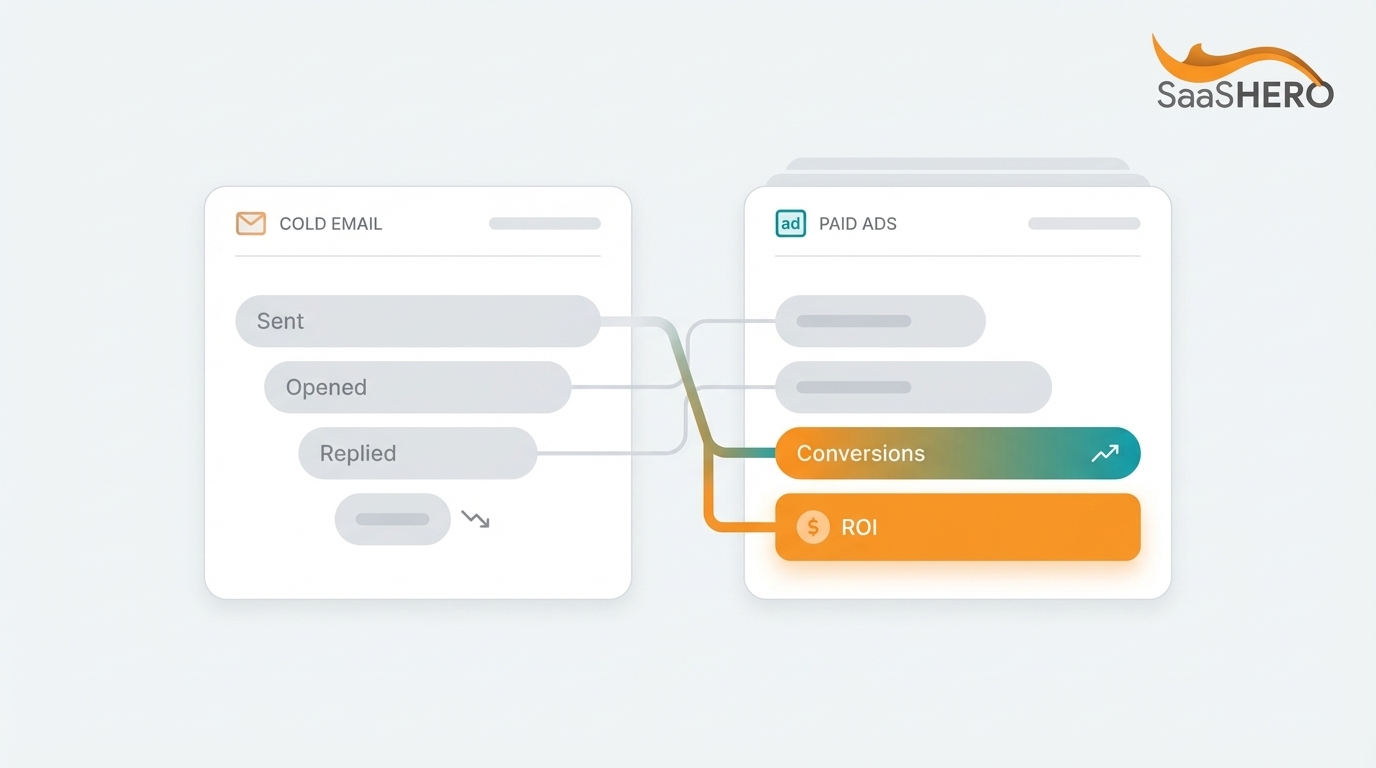
Cold email agencies are purpose-built for one channel. For companies with a sales-led motion that also need paid search, paid social, and landing page performance working together, a single-channel cold email agency creates a coordination problem. Nobody owns the connection between outbound activity and inbound demand, and the CRM sees two separate programs rather than one integrated pipeline engine.
Frequently Asked Questions
Does cold email actually work?
Cold email works when you combine the right infrastructure with precise targeting. Well-built programs that target a defined ICP with personalized sequences and clean deliverability can achieve positive reply rates of 1.5–3% and contribute meaningfully to pipeline. Most failures stem from list quality problems, deliverability shortcuts, or sequences that are not personalized beyond surface-level tokens. The channel itself is effective; execution quality determines whether your program performs.
How long does it take to see results from a cold email agency?
As the comparison table shows, most programs require 60–90 days before producing meaningful pipeline signal. The first month is typically consumed by domain warm-up, list building, sequence development, and campaign setup. Sending volume increases gradually during warm-up to protect domain reputation, so the first weeks produce limited data. A good agency sets realistic expectations about this ramp-up period and avoids promising meetings in week one.
What is a good reply rate for cold email?
As noted in the KPIs section, a positive reply rate of 1.5–3% is a solid benchmark, and top programs reach higher levels. The definition of “positive” matters, because it excludes unsubscribe requests and objections. For well-targeted cold email campaigns, total reply rates, including negative replies, are typically higher, often in the 5–10% range, which is considered “good” performance, while the overall industry average is lower at around 3.4%. Treat any promise of double-digit positive reply rates with caution unless the agency explains exactly how it defines and measures that metric.
Can we run cold email in-house instead of hiring an agency?
Running cold email in-house is possible but requires dedicated expertise across copywriting, deliverability management, data sourcing, and CRM integration. Most B2B marketing teams at the $10M–$50M revenue stage do not have a specialist who covers all four. The deliverability layer in particular, including domain warm-up, authentication, bounce management, and inbox monitoring, fails silently when managed by a generalist. The damage to your domain reputation can take months to repair. If your team has the specialization, in-house can work. If it does not, an agency provides infrastructure and expertise that would take quarters to build internally.
How do I know if a cold email agency is using best practices?
Ask about deliverability infrastructure before you discuss pricing. A best-practice agency describes its domain warm-up process, per-mailbox sending limits, authentication setup, and list verification workflow without prompting. It monitors inbox rates continuously, not just at campaign launch. It uses dedicated subdomains for client campaigns rather than shared sending infrastructure. It cleans lists regularly and does not purchase contacts. If an agency’s sales process focuses on meeting volume guarantees and case study screenshots while ignoring the technical layer, that pattern signals weak underlying practices.
Conclusion: Match the Agency to Your Funnel
Hiring a cold email lead generation agency requires more than comparing price tiers or reading testimonials. Agencies that produce results own their deliverability infrastructure, stay transparent about data sourcing, and measure success against pipeline and revenue rather than reply rates alone. Common red flags include guaranteed volumes without methodology, no discussion of authentication or warm-up, and reporting that stops at the campaign level.
For B2B SaaS companies at the $10M–$50M+ revenue stage with a sales-led motion, the bigger decision is whether cold email alone covers your needs. A single-channel outbound agency generates meetings. It usually does not own the paid search program capturing demand those meetings create, the landing pages converting inbound traffic, or the CRM reporting that connects everything to closed revenue. That integration gap is where pipeline often gets lost.
Choose the model that fits your stage, budget, and internal capabilities, and use the questions and red flags in this guide to pressure-test any cold email agency before you sign.