




Written by: Aaron Rovner, Founder, Saas Hero
Key Takeaways For $1M–$2M SaaS Marketing Budgets
- At the $1M–$2M budget band, a hybrid model with a lean in-house owner plus a specialist agency usually beats both a full-service agency retainer and a large internal team.
- Budget math forces a structural choice. A media spend of $40K per month leaves limited room for people, retainers, and tooling, so you must allocate capabilities deliberately.
- Strategy, revenue ownership, lifecycle, and marketing ops work best in-house. Paid media, creative, landing pages/CRO, and CRM-connected attribution fit better with a specialist agency.
- Hidden costs such as a 9‑month senior-hire ramp and 15–25% agency-management overhead often exceed the headline price of either model.
- SaaSHero delivers the hybrid configuration on a flat retainer indexed to total ad spend, so SaaS teams can focus on pipeline and revenue instead of form fills.
Talk Through Your Hybrid Options With SaaSHero
What A $1M–$2M SaaS Marketing Budget Really Buys
A company with $1M–$2M in annual revenue typically spends 8–12% on marketing. That range creates an annual marketing budget of $80,000–$240,000, or roughly $6,500–$20,000 per month. That monthly number must cover media spend, people, agency fees, and tooling at the same time. At this band, the budget usually supports one senior in-house marketing leader plus a small team, or a full-service agency retainer plus media.
The allocation math makes the constraint concrete. If media spend runs $40,000 per month, very little remains for people, agency fees, and tooling. A full-time senior marketing leader (CMO) costs roughly $21,000 to $33,000 per month in base salary before benefits. The fully loaded monthly cost reaches $22,500 to $42,000 once benefits, bonus, and equity are included, based on 2026 CMO compensation and pricing data. A demand gen agency retainer commonly runs from roughly $5,000 to $30,000+ per month, with enterprise and full-service engagements above that range, according to Clutch benchmarks cited in 2026 agency guides. The math forces a structural decision before a single campaign goes live.
The three models available at this budget band differ most on all-in cost and time to productivity. The table below shows why the hybrid model often wins on both. It carries the lowest steady-state cost and a short ramp, in exchange for a disciplined ownership split between the internal lead and the agency.
| Model | All-In Annual Cost | Ramp Time To Productivity | Primary Failure Mode |
|---|---|---|---|
| In-House Senior Leader + Support | Roughly $224,000–$306,000 in steady-state employment cost, rising to $401,000–$456,000 in first-year total cost for established and enterprise companies | For executive or senior-IC roles, full productivity typically takes 9 to 12 months. Senior hires and executives more broadly can take 12 to 24 months. | One hire covers too many disciplines, so post-click and tracking often fail silently. |
| Full-Service Agency Retainer | $8,000–$40,000 per month, or roughly $96,000–$480,000 annually, excluding media spend | For a full-service agency retainer, agencies usually quote a 4 to 6 week paid on-ramp during which they produce the operating model. The retainer itself begins in month two. | Product-context gap, scope that stops at the ad platform, and per-channel pricing that locks in the initial mix. |
| Hybrid (In-House Owner + Specialist Agency) | Roughly $145,000–$170,000 per year (about $120K for the in-house generalist fully loaded plus $2K–$4K per month for the contractor or fractional agency), excluding media spend | In a hybrid model of one or two internal strategic hires plus two or three specialist agency retainers, agencies reach full productivity in 60–90 days. The internal hire typically takes 6–12 months. | Requires a clear ownership split and active briefing and review from the internal owner. |
See How The Hybrid Model Prices Out
The Real All-In Cost Of Each Model In 2026
In-House: According to Pave’s 2026 marketing salary guide, senior marketing leaders command base salaries in the $250,000–$400,000+ range. The median base is $325,000 for a CMO and $252,471 for a VP of Marketing. Total compensation runs higher once bonus and equity enter the picture.
The support roles a demand gen function needs add substantially more cost. A paid media specialist typically earns a base salary of roughly $50,000–$95,000, with an average base of about $79,000 for paid media marketing professionals in the United States, per PayScale data. A designer often costs $80,000–$120,000 for mid-to-senior or specialized roles. The broader graphic designer market has a median of $61,300 and a 10th-to-90th percentile range of $37,600–$103,030, according to BLS OEWS May 2024 data. Marketing ops roles typically sit in the $80,000–$110,000 band.
Employers then add 31.4% for benefits and payroll taxes, per BLS Employer Costs for Employee Compensation data. On top of that, a senior hire takes time to ramp. According to MarketerHire’s 2026 Series B hiring guide, a full-time VP Marketing search takes 3–6 months from JD to signed offer plus 60–90 days of onboarding. The leader then needs roughly six months to produce at full strength. The total runway consumed before the team is producing runs approximately nine months.
Agency: Retainer ranges commonly observed in published agency pricing run roughly $8,000 to $40,000+ per month, according to Clutch benchmarks cited in 2026 agency guides. Media spend always sits outside the retainer and remains owned by the client. The management overhead the client absorbs through directing, chasing status, and quality-checking rarely appears in proposals and routinely consumes 15–25% of the effective program budget, according to INFUSE’s 2026 framework.
Hidden costs appear on both sides and shape the real decision:
- Agency management overhead: the VP of Marketing becomes the strategist, project manager, and quality control for the agency.
- Senior-hire ramp time: roughly nine months of runway before the team is producing, per MarketerHire’s 2026 Series B hiring guide.
- Contractor coordination tax: when work is split across a freelancer bench, the marketing leader acts as the integration layer.
The Capability-Allocation Framework For $1M–$2M Budgets
Each core demand gen function has a natural home at the $1M–$2M budget band. This allocation framework anchors the agency-versus-in-house decision.
Strategy And Ownership Of The Revenue Number: In-House. This capability stays internal because it depends on product and customer context that no external partner can match at the same speed. The internal owner sets goals, holds the number, and approves what goes live.
Paid Media Execution: Agency. Specialist depth across search and social matters here. A generalist hire struggles to cover that range. One in-house marketer rarely maintains expert-level skills in Google Ads, Microsoft Ads, LinkedIn, Meta, Reddit, and TikTok at the same time.
Creative Production: Agency, When Staffed In-House. Concept, copy, and design work best when they come from the same team that runs the media, not from a rotating contractor bench. A messaging sequence needs a single creative brain trust, not freelancers who see one brief at a time.
Landing Page And CRO: Agency. This capability often sits unowned, yet it decides where the funnel wins or loses. An agency responsible only for the ad account cannot change the landing page headline, the most impactful lever for getting more conversions from a landing page.

Attribution And Reporting: Agency, Connected To The Client’s CRM. Optimization should run against qualified pipeline and closed revenue instead of raw form fills. That approach requires connecting the ad platforms to the CRM and feeding lifecycle stage events back so bidding learns from qualified outcomes.
Lifecycle And Marketing Ops: In-House. This function owns the CRM, the lifecycle stage definitions, and the routing rules. It serves as the technical veto on any agency engagement and the ally that makes CRM-connected optimization possible. That allocation only holds when each side does its job, so it helps to understand how each model fails when it does not.
What Each Model Fails At In Practice
In-House Failure Modes:
One hire rarely covers five disciplines: paid search, paid social, creative, landing pages, and attribution. The disciplines that fail quietly are the post-click experience and the tracking. They do not break loudly enough to force a decision until a quarter of the budget has gone to the wrong audience. A $90,000 demand gen lead is the wrong first hire; the right person costs $130,000+ and pays back 3x to 5x, according to Let’s Nara’s 2026 analysis. Hiring a senior leader too early burns runway before the function has enough volume to justify the seat.
Agency Failure Modes:
These failures compound. An agency that does not live inside the business struggles to own positioning because it lacks daily product and customer context. Most agencies also stop at the ad platform, which leaves the landing page headline and the CRM’s definition of qualified untouched, even though those are the two highest-leverage variables in the funnel. Per-channel pricing then makes it expensive to move budget away from an underperforming channel, so the mix often calcifies where it was first placed. Choosing on price instead of fit and seniority usually becomes the most expensive option once wasted months are counted, according to Clever Zebo’s 2026 framework.
When SaaS Teams Should Hire In-House Vs Use An Agency
Conditions Where In-House Alone Works Well:
- Spend is concentrated in one platform, such as 80% or more in Google Ads.
- The sales motion is stable with predictable conversion rates.
- An internal leader has enough paid media fluency to manage and develop a specialist.
- The primary channel has been proven and now needs refinement rather than exploration.
Conditions Where A Full Agency Fits:
- The company needs multi-region, multi-channel delivery.
- There is an agency-of-record mandate across many channels and geographies.
- Enterprise procurement and security requirements rule out smaller boutiques.
- Offline, CTV, and programmatic media must sit under one roof.
The Default At $1M–$2M: Hybrid. A lean in-house owner sets goals and holds the number. A specialist team then owns strategy and execution across the disciplines underneath that owner. The Forrester 2026 B2B Marketing Survey reports that growth-stage SaaS companies running a hybrid demand generation model grow revenue 18% faster on average than companies running either a pure in-house or pure outsourced model in isolation.

Map Your Situation To The Right Model
How To Structure A Hybrid In-House And Agency Demand Gen Team
A workable configuration at this budget band pairs a lean in-house owner with a specialist team. The internal owner sets goals, holds the number, supplies product and customer context, approves what goes live, and owns the CRM and lifecycle definitions. The specialist team owns paid media across all major channels, creative production, landing pages and CRO, and attribution and reporting connected to the client’s CRM.
Strong specialist teams share several traits:
- One team owns paid media across all major channels instead of separate vendors per channel.
- Creative is produced in-house, including concept, copy, and design, rather than outsourced to a contractor bench.
- The same team that runs the media also designs, builds, hosts, and A/B tests landing pages.
- Reporting connects directly to the client’s CRM so optimization runs against qualified pipeline and closed revenue instead of form fills.
The commercial structure that supports this hybrid model uses a flat retainer indexed to total monthly ad spend rather than to channel count. Adding, closing, or reweighting a channel does not change the fee, so the channel-mix recommendation stays independent of the invoice. The client owns accounts, assets, and files throughout and after the engagement.
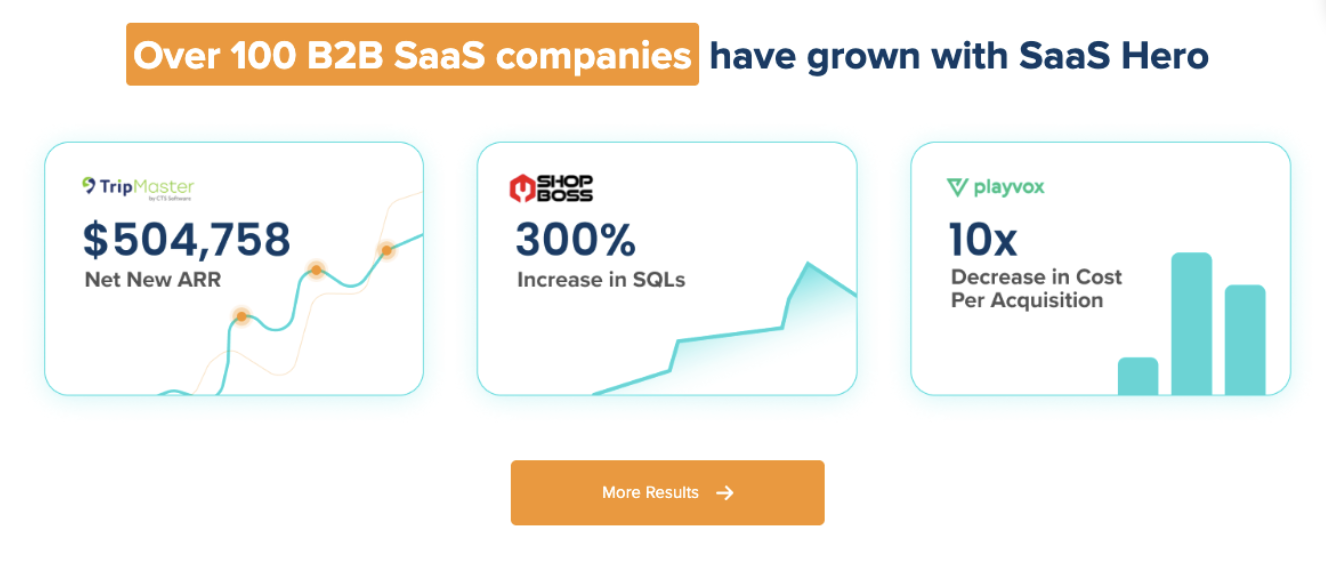
SaaSHero is built for this configuration. Founded in 2018, SaaSHero serves as the outsourced inbound growth team for B2B companies. One team owns strategy and execution across paid media, creative, landing pages, and reporting, and optimizes all of it against CRM revenue data rather than form-fill counts. The firm has served more than 100 B2B companies, manages roughly $16 million in annual advertising spend with more than $60 million over its lifetime, and operates with approximately 20 full-time specialists including in-house designers and copywriters. SaaSHero is a Google Premier Partner, a designation held by the top 3% of agencies, and has been a G2 High Performer in the digital marketing category for over two years, currently ranked #20 out of approximately 6,000 agencies.

The retainer is set against total monthly ad spend rather than channel count. Moving budget from LinkedIn to Google, opening a Meta test, or shutting a channel down entirely leaves the fee unchanged. That structure removes the conflict of interest that per-channel pricing creates and lets channel-mix decisions rest on evidence alone. You can see how SaaSHero compares to the alternatives in In-House Vs. Agency Vs. Hybrid Paid Media For SaaS.
The Migration Path Between Agency And In-House
Signals To Move From Agency To In-House:
- Spend is concentrated in one channel.
- The motion is stable with predictable conversion rates.
- An internal leader is ready to own the number and manage a specialist.
- The channel performs best when it receives daily customer context.
Signals To Move From In-House To Agency:
- The internal hire under-serves the post-click and attribution disciplines.
- The team spends most of its time coordinating contractors instead of running demand gen.
- The company is entering new markets or channels where internal expertise is missing.
- The internal team cannot ship weekly because it remains stuck in analysis.
The Migration Sequence: Start by documenting systems, decisions, assets, and performance history so the next owner inherits a clear record. Then hire for a validated role, let the new hire shadow the agency, and transfer access, execution, reporting, and decisions gradually. Retain specialist agency support where it still adds value, per Right Left Agency’s 2026 five-phase transition framework.
Frequently Asked Questions
What Does A $1M–$2M SaaS Marketing Budget Translate To Monthly?
The budget math above shows that this revenue band translates to roughly $6,500–$20,000 per month. That monthly number must cover media, people, agency fees, and tooling at once. The structural choice you make determines how much of that budget reaches actual media spend.
What Does A Demand Gen Agency Retainer Cost In 2026?
Published agency pricing commonly runs roughly $8,000 to $40,000+ per month for mid-market B2B demand generation engagements, according to Clutch benchmarks cited in 2026 agency guides. Media spend is always separate and always owned by the client. Management overhead the client absorbs through briefing, QA, status chasing, and context translation routinely consumes 15–25% of the effective program budget. Some agencies also bill separately for landing pages, creative production, CRM integration, and reporting dashboards, so confirm all-inclusive pricing or a detailed line-item breakdown before signing.
What Can A Demand Gen Agency Not Do For A SaaS Company?
An agency struggles to own positioning without living inside the business. Product and customer context accumulates over years of internal exposure, and an external team working at a distance from customer conversations cannot match that pace. Most agencies also stop at the ad platform, which leaves the landing page headline and the CRM’s definition of qualified unchanged, even though those are the two highest-leverage variables in the funnel. Replacing a CMO or Head of Marketing also sits outside the agency’s scope, because priorities, budget, product context, and final decisions still require internal ownership. Strategy that lives only at the agency becomes strategy the company cannot hold anyone accountable to.
How Do You Structure A Hybrid In-House And Agency Demand Gen Team?
A lean in-house owner sets goals and holds the revenue number. A specialist team owns strategy and execution across paid media, creative, landing pages and CRO, and attribution and reporting. The internal owner supplies product and customer context, approves what goes live, and owns the CRM and lifecycle definitions. The specialist team owns everything between the impression and the CRM record. A flat retainer indexed to total monthly ad spend rather than channel count keeps the channel-mix recommendation independent from the invoice. Clear ownership split prevents overlap, confusion, and wasted budget.
How Do You Report The Agency-Vs-In-House Decision To A Board?
Frame the decision in the terms the board already uses: pipeline, CAC, and payback period rather than impressions and clicks. Benchmarks to hold accounts to include LTV:CAC of 3:1 and CAC payback under 12 months. Present the staffing and spend plan as a capability-allocation exercise that shows which functions compound in-house, which you buy as variable expertise, and what the all-in monthly cost of each path is, including hidden costs. With CRM data connected properly, board reporting becomes a view of the same dashboard the team works from instead of a separate exercise assembled the week before the meeting.
Conclusion: Putting The Framework To Work
At a $1M–$2M marketing budget, a lean in-house operator who owns the revenue number plus specialized agency support for key disciplines usually forms the strongest structure. A full-service retainer that stops at the ad platform and a large internal team hired before the function has enough volume both strain this budget band. Run the capability-allocation exercise against the current team, price each model all-in including hidden costs, and bring that staffing and spend plan into the finance conversation.
That configuration is the one SaaSHero was built around, which is why the retainer is indexed to ad spend rather than channel count. For a VP of Marketing who must defend a pipeline number to a board in the next quarter, this structure deserves a close look.
Review Your Plan With SaaSHero