




Written by: Aaron Rovner, Founder, Saas Hero | Last updated: September 3, 2026
Key Takeaways for B2B SaaS Leaders
- Geographic proximity matters less than B2B SaaS expertise and a focus on revenue metrics like CAC, LTV, and pipeline coverage.
- Flat retainers aligned to total ad spend avoid the conflicts that percentage-of-spend or per-channel pricing introduce.
- Ten focused vetting questions reveal whether an agency optimizes to CRM revenue or chases form fills and vanity metrics.
- Seven clear red flags, including form-fill optimization and lack of landing-page ownership, signal agencies that need heavy management.
- Ready for a revenue-focused partner? Schedule a discovery call with SaaSHero and get an outsourced growth team that owns strategy, execution, and CRM-connected reporting.
1. Treat “Near Me” as a Myth and Prioritize Expertise
For B2B SaaS, an agency’s physical location matters far less than its industry expertise and ability to drive revenue. Remote collaboration through Slack, shared dashboards, and video calls often beats in-person meetings that consume travel time without improving performance.
The agency’s understanding of B2B SaaS sales cycles, CRM data architecture, and pipeline generation sets the ceiling on results. An agency two blocks away that optimizes to form fills will underperform a remote agency that connects ad spend to closed revenue. Investors and operators now demand tighter discipline on spending and profitability from SaaS firms, so your agency’s measurement framework matters more than its mailing address.
SaaSHero is a global performance marketing firm founded in 2018 that has served more than 100 B2B companies and managed over $60M in lifetime ad spend, working primarily with B2B SaaS and B2B professional services companies.
2. Read Agency Pricing Models as Incentive Structures
Pricing models act as incentive structures that shape every recommendation an agency makes. Three models dominate the market, and each one embeds a different conflict.
A percentage-of-spend model ties agency revenue directly to your budget size. Every recommendation to scale carries a financial interest, and every recommendation to cut spend reduces the agency’s income. The conflict is structural, not personal.
Per-channel pricing charges a separate fee for each platform managed. Testing a new channel raises your invoice before it proves itself, and consolidating budget reduces what the agency bills. Channel mix becomes a contract discussion instead of a strategic decision, and budget often stays where it started long after the opportunity has moved.
A well-structured flat retainer removes both conflicts. The agency can recommend budget shifts, channel tests, or consolidations without a financial penalty. For B2B SaaS, typical monthly retainers in 2026 range from about $3,000 to $20,000+ for companies under $5M ARR. The fee scales with ARR stage and scope, and ad spend is billed separately.
SaaSHero uses a flat retainer based on total monthly ad spend, not channel count. Adding LinkedIn to a search program, testing Meta, or shutting down an underperforming channel does not change the fee. The channel mix stays an empirical decision driven by performance data.
3. Use These 10 Vetting Questions to Spot True Experts
A precise set of questions quickly separates agencies that understand B2B SaaS from those that need you to act as strategist. Measuring qualified pipeline rather than raw lead volume signals real marketing effectiveness, and the agency you hire should explain exactly how they create and report on that signal.
- “What is your experience with B2B SaaS companies specifically?” Category expertise shows whether the agency understands your sales cycle, buyer committee, and CRM architecture before launch.
- “How do you measure success — do you optimize to CRM data or form submissions?” This question reveals whether the optimization loop ends at the form or at the revenue record.
- “Who will be working on my account day-to-day, and are they full-time employees?” Many agencies pitch senior strategists and deliver junior contractors. The answer shows who will be in your account in month seven.
- “How do you handle landing pages and conversion rate optimization?” An agency that cannot change the landing page headline cannot control the highest-leverage variable in the funnel.
- “Can you provide case studies with concrete revenue results, not just lead volume?” Pipeline and closed revenue are the outcomes that matter. Lead volume without revenue context is a vanity metric.
- “How do you report on pipeline and revenue, not just clicks and impressions?” Board-ready reporting determines whether the marketing budget survives scrutiny.
- “What is your approach to attribution in a long B2B sales cycle?” Last-click attribution credits the branded search that happens after the buyer is convinced. A credible agency has a documented alternative.
- “How do you handle creative production — is it in-house or outsourced?” A multi-stage messaging cadence requires a team that sees the full picture, not rotating contractors working in isolation.
- “What is your pricing model, and how does it align with my revenue goals?” The incentive structure inside the pricing model shapes every future recommendation.
- “What happens if we want to leave — do we own our accounts, data, and creative?” An agency that relies on switching costs has stopped relying on results.
See how SaaSHero answers these questions by scheduling a discovery call.
4. Watch for These 7 Red Flags in Agency Relationships
Specific warning signs indicate an agency relationship that forces you to act as strategist, project manager, and quality control for a vendor paid to own those roles.
- Optimizes to form fills instead of pipeline or revenue, which trains the ad platform on the wrong audience
- Provides monthly PDFs of platform metrics with no CRM connection, focusing on impressions and clicks instead of pipeline and CAC
- Requires you to chase status updates and supply most of the test ideas
- Lacks ownership or control of landing pages, which blocks changes to the most impactful conversion element in the funnel
- Uses percentage-of-spend or per-channel pricing that creates a conflict in every budget recommendation
- Cannot explain an attribution model for long B2B sales cycles and defaults to last-click for six-to-nine-month journeys
- Shows high team turnover or relies on contractors you never meet, so institutional knowledge disappears when they leave
5. Shift Optimization From Form Fills to CRM Revenue
Optimizing to CRM data such as qualified pipeline, lifecycle stage, and closed revenue consistently outperforms optimizing to form fills. When an ad platform targets form fills, it finds people most likely to complete forms, including students, competitors, job seekers, and existing customers. Cost per lead falls, lead volume rises, and dashboards improve on surface metrics while sales-ready pipeline stays flat.
For B2B SaaS with long sales cycles, last-click attribution deepens the issue. It credits the branded search that happens after the buyer is convinced, which makes demand-creation channels look weak and starves the top of the funnel.
The fix is to change what you send back to the platform. Primary conversions that represent real buying intent should drive account-wide optimization. Secondary conversions such as content downloads and webinar registrations deserve tracking but should not control bidding. Lifecycle stage events from the CRM, including sales-qualified leads, opportunity creation, and closed deals, can flow back to the platform as the signal worth finding more of.
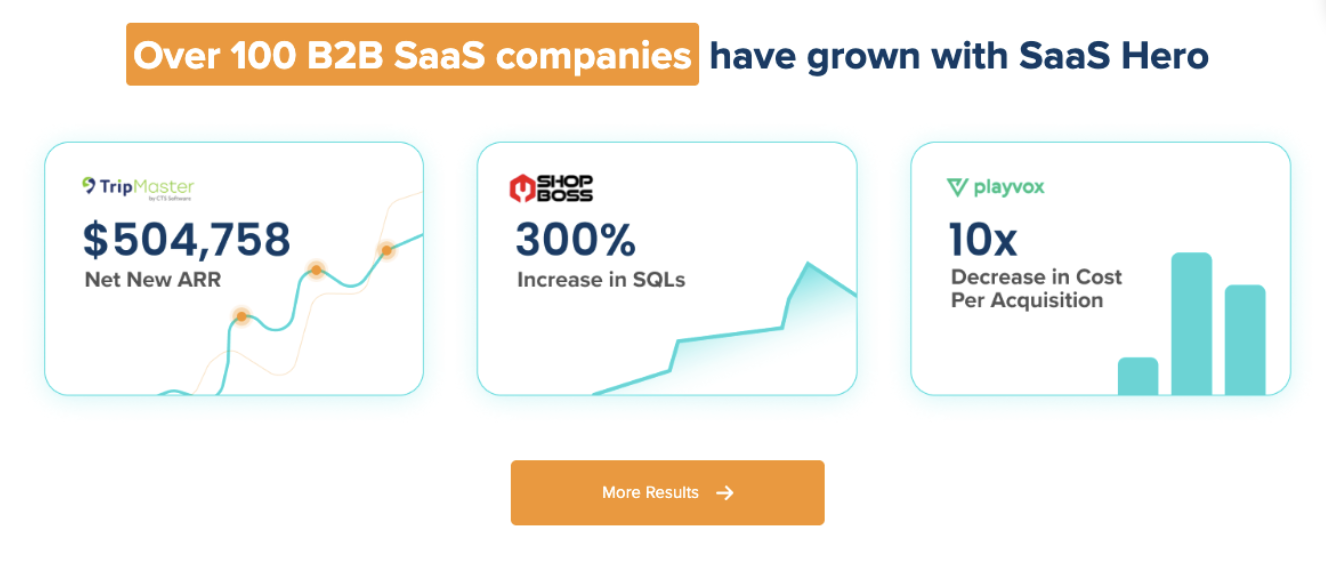
SaaSHero is a Google Premier Partner, a designation held by the top 3% of agencies, and has managed the $60M+ in ad spend mentioned earlier while optimizing to CRM revenue data through a documented primary and secondary conversion architecture. The results are concrete: TripMaster added $504,758 in net new ARR over one year with a 650% return on ad spend, and TestGorilla reached an 80-day CAC payback period while adding more than 5,000 new customers.

6. Insist on Full-Funnel Ownership and Accountability
Scope fragmentation quietly kills agency performance. When one vendor runs ads, another owns landing pages, and RevOps owns the CRM, nobody feels accountable for the chain from impression to closed revenue. The landing page headline is the highest-leverage conversion variable in the funnel, yet most agencies cannot change it because it belongs to someone else. That someone else might be a web team’s backlog, a design contractor, or a product site built for a different audience.
Performance follows the weakest link in the chain, and the standard agency scope boundary often cuts through the middle of that chain. An agency responsible only for the ad account can optimize the click but not the experience after it. A media buyer who does not own the landing page must optimize toward a page they cannot change.
The key question for every agency is whether they own the full funnel: paid media, creative, landing pages, and reporting against CRM data. SaaSHero’s model rests on this ownership principle. One team manages everything between the ad impression and the CRM record, with in-house designers and copywriters instead of a contractor bench, and landing pages designed, built, hosted, and tested on Unbounce without routing through a client’s web team.

7. Run a Structured Selection and 90-Day Pilot
A disciplined agency selection process mirrors the rigor you apply to any major revenue investment. Start by shortlisting three to four agencies that pass the vetting questions above. Then ask each one for a complimentary audit of your existing account and treat that audit as a work sample. Finally, check references with companies at similar revenue and spend levels, and ask specifically who was in the account day-to-day and whether the agency brought ideas or waited for direction.
Run a 90-day pilot before signing a long-term agreement. The first 30 days establish measurement architecture and campaign structure. Days 31 through 60 deliver the first optimization cycle. Day 90 becomes a validation gate with enough data to judge the channel on economics instead of activity.
The right agency arrives at the kickoff call with a documented campaign flow map, keyword research, a messaging thesis, and a testing plan. If you find yourself supplying the agenda at that first meeting, the relationship has already recreated the problem you wanted to solve.
Frequently Asked Questions
How much do digital marketing agencies cost?
Digital marketing agency costs vary by pricing model and scope. For B2B SaaS companies, flat retainers typically range from $4,000 to $20,000 or more per month depending on total ad spend under management. Percentage-of-spend models usually run 10 to 20 percent of the monthly ad budget, which creates a structural conflict because the agency’s revenue rises when your budget rises. Per-channel pricing adds a separate fee for each platform, which discourages experimentation and makes channel-mix decisions financially loaded instead of purely strategic. A flat retainer indexed to total monthly ad spend, not channel count, provides the clearest alignment between agency incentives and client outcomes because the agency can recommend budget shifts, new channel tests, or consolidations without a financial penalty.
How do I know if my digital marketing agency is legit?
A credible agency optimizes to pipeline and revenue rather than form fills and proves it through CRM-connected reporting instead of a monthly PDF of platform metrics. Specific warning signs include reporting that leads with impressions and clicks instead of pipeline and CAC, an inability to explain attribution for long B2B sales cycles, no ownership of or accountability for landing pages, pricing that creates conflicts in every budget recommendation, and high team turnover or work delivered by contractors you never meet. If you generate the test ideas and chase status updates, the relationship is misaligned. A legitimate agency provides case studies with concrete revenue results and names exactly who will work on your account in month seven, including whether those people are full-time employees.
What are the disadvantages of hiring a marketing agency?
The most common disadvantages stem from structure, not personalities. Agencies without B2B SaaS expertise will miss key nuances in your sales cycle, buyer committee, and qualification process. Misaligned pricing models such as percentage-of-spend or per-channel create conflicts in every budget and channel-mix recommendation. Scope fragmentation, where the agency owns the ad account but not the landing pages or CRM connection, leaves nobody accountable for the full path from impression to revenue. Reporting that focuses on activity instead of outcomes leaves marketing leaders unable to answer board-level questions about CAC, payback period, and pipeline coverage. Many agency relationships also force marketing leaders to act as strategist, project manager, and quality control, which consumes scarce time and attention.
How can a B2B SaaS company find a strong digital marketing agency?
B2B SaaS companies should prioritize expertise over geography. Evaluate agencies on five criteria: demonstrated experience with B2B SaaS, a revenue-based measurement approach that connects ad spend to CRM outcomes, full-funnel ownership including landing pages and creative, transparent pricing that avoids conflicts in channel-mix recommendations, and proactive communication where the agency brings ideas instead of waiting for direction. Ask for case studies with concrete revenue results and check references at companies with similar revenue and spend levels. Run a 90-day pilot before a longer commitment, and treat the complimentary audit as a work sample that previews the quality of thinking you can expect.
The Right Agency Acts as a Revenue Partner
For B2B SaaS, agency selection means finding a partner that understands your industry, optimizes to CRM revenue data, owns the full funnel from ad impression to CRM record, and arrives with ideas instead of waiting for instructions. Geographic proximity matters far less than measurement discipline and full-funnel accountability.
The seven criteria in this guide, from questioning the “near me” premise to running a structured decision process, separate agency relationships that demand constant management from those that function as an outsourced growth team.
SaaSHero is a Google Premier Partner ranked #20 of approximately 6,000 agencies on G2, with the client base and ad spend scale noted above and a team of approximately 20 full-time specialists. The team does not rely on contractors or outsourcing.