Written by: Aaron Rovner, Founder, Saas Hero | Last updated: September 4, 2026
Key Takeaways
Many B2B SaaS companies see flat pipeline while marketing spend climbs, so choosing a fractional CMO for demand generation becomes a high‑stakes decision.
The impact of a fractional CMO depends on whether your bottleneck is strategy, execution, or both, and this guide compares four realistic engagement models.
Fractional CMOs often charge $8,000–$15,000 per month, and added execution costs can raise the true total to $25,000–$45,000 monthly.
Companies without execution capacity usually find a solo fractional CMO insufficient, because strategy without implementation resources does not move pipeline.
Companies that need both strategy and execution should book a discovery call with SaaSHero to choose the right model before committing budget to the wrong one.
What Is a Fractional CMO for Demand Generation?
A fractional CMO for demand generation is a senior marketing executive hired on a part-time or contract basis to own and drive a company’s demand generation strategy. Unlike a full-time CMO, they work a set number of hours per week or month, typically 10–20, and provide executive-level leadership at roughly 40–60% of the cost of a full-time hire, though the exact percentage varies by engagement and source.
The demand generation specialization means the role is measured on pipeline and revenue. A fractional CMO for demand generation focuses on ICP definition, channel strategy, messaging, funnel architecture, attribution, and reporting across the path from first touch to sales-qualified lead. They do not execute the work themselves, because their job is to direct and lead the team that does.
Core Responsibilities of a Fractional CMO for Demand Generation
A fractional CMO for demand generation owns several responsibilities: demand gen strategy, channel management across paid search and paid social, landing page direction, conversion rate optimization oversight, attribution and reporting, team and vendor leadership, and budget allocation. They own the funnel from first touch to SQL and guide the work instead of pushing the buttons personally.
The table below shows how these responsibilities map across different engagement models.
SaaSHero’s retainer is indexed to total monthly ad spend, not channel count, so testing new channels never raises fees. Per-channel pricing creates a structural conflict, because the agency earns more when you add a channel and less when you consolidate, regardless of what the data shows. With cost structures in mind, the next step is choosing the model that actually fits your gap.
Fractional CMO vs. Demand Gen Agency vs. In-House Hire vs. Outsourced Growth Team: Which Model Fits Your Gap?
Choosing the right model depends on whether your main constraint is strategy, execution, or both. The table below compares each option across strengths, weaknesses, and ideal fit so you can match the model to your current stage.
Companies above $50M ARR with a large marketing function
Outsourced growth team (SaaSHero)
Strategy and execution under one roof, CRM-based optimization, no vendor management
Not a fit for companies below $10M ARR or $15K monthly ad spend
Companies that need both strategy and execution, end to end
The core distinction is clear. A fractional CMO provides strategy and leadership. An agency provides execution. An in-house hire provides dedicated focus but often lacks breadth across paid media, creative, landing pages, and attribution. SaaSHero functions as the hybrid, an outsourced growth team that owns both strategy and execution, which gives companies with execution bottlenecks a more complete solution than a single fractional CMO.
SaaS Hero: The client-friendly SaaS marketing agency that proves pipeline
Book a discovery call with SaaSHero to clarify whether your bottleneck is strategy, execution, or both before you spend another quarter on the wrong model.
The 90-Day Engagement Blueprint for Demand Generation
This 90-day roadmap applies regardless of which model you choose. The phases stay consistent, while the party responsible for each deliverable changes based on your engagement model.
How to Measure Success: KPIs for Demand Generation
A fractional CMO, or any demand gen partner, should be accountable to the following KPIs.
Pipeline generated (marketing-sourced)
Sales-qualified leads (SQLs)
MQL-to-SQL conversion rate
Customer acquisition cost (CAC) and CAC payback period
LTV:CAC ratio
Cost per SQL and cost per opportunity
Opportunity creation rate
Optimization should run against CRM data rather than raw form fills. MQL-to-SQL conversion sits around 13% on average across B2B funnels, which provides a reliable bottleneck signal that often points to a definition mismatch between marketing and sales. SaaSHero holds accounts to an LTV:CAC of 3:1 as a healthy benchmark and views CAC payback under 12 months as a strong result.
The mandatory question to ask any partner is, “Are you optimizing campaigns around CRM data or just form submissions?” If the answer is form submissions, the ad platform is being trained to find form-fillers rather than buyers. That mistake is one of several that routinely undermine demand generation programs.
Common Demand Generation Mistakes to Avoid
The following mistakes account for most underperforming demand generation programs at B2B SaaS companies.
Optimizing for form fills instead of pipeline, which trains the ad platform to find form-fillers rather than buyers
Letting the agency set the agenda instead of owning strategy, which turns the client into strategist, project manager, and quality control for a vendor paid to hold those roles
Splitting paid search, paid social, landing pages, and reporting across separate vendors with no single party accountable for the full chain
A well-structured fractional CMO engagement, or a growth team like SaaSHero, avoids these issues by design because one party owns the entire path from impression to CRM record.
How to Hire the Right Fractional CMO for Demand Generation
This checklist helps you evaluate any fractional CMO candidate or demand gen partner.
What is your experience with B2B SaaS at our stage ($5M–$50M ARR)?
How do you measure success, form fills or CRM-qualified pipeline?
What does your reporting look like, and who builds it?
The execution question matters most. The true total cost of a fractional CMO for B2B SaaS can reach $25,000–$45,000 per month when you add an execution team for campaign management, content, and platform operations, because most fractional CMOs provide strategy only. For many companies at $5M–$50M ARR, an outsourced growth team like SaaSHero fits better than a single fractional CMO, since it includes a full team of specialists in paid media, creative, landing pages, and reporting under one accountable roof.
Why SaaSHero Works for Demand Generation
SaaSHero serves as the outsourced inbound growth team for B2B SaaS companies, with one team owning strategy and execution across paid media, creative, landing pages, and reporting, and optimizing all of it against CRM revenue data instead of form-fill counts. For companies at $10M–$50M ARR with two to four in-house marketers and no paid media specialist, SaaSHero fills the execution gap that a solo fractional CMO cannot cover.
SaaS Hero: Trusted by Over 100 B2B SaaS Companies to Scale
Key differentiators:
One team owning strategy and execution, so no vendor management is required
Optimization against CRM revenue data rather than form-fill counts
Flat retainer based on total ad spend instead of channel count, so testing new channels never raises fees
In-house creative and landing page teams, with nothing outsourced
Google Premier Partner status, held by the top 3% of Google Partners
G2 High Performer in Digital Marketing for over two years, ranked #20 of approximately 6,000 agencies
$60M+ in lifetime managed ad spend across 100+ B2B companies
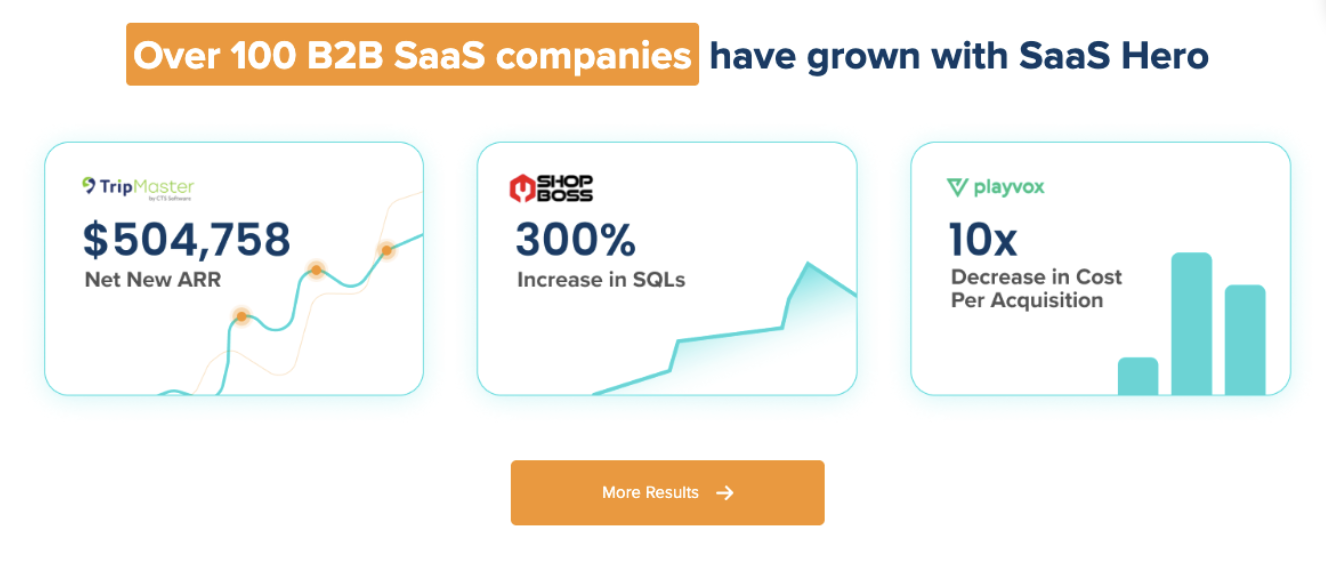
Results from SaaSHero engagements include $504,758 in net new ARR over one year with a 650% return on ad spend for TripMaster, a 10x reduction in cost per lead alongside a 163% increase in lead volume for Playvox, and a 305% increase in conversion rate for Shop Boss. These outcomes share a common mechanism: one team owning the entire chain from ad account to CRM record, with optimization pointed at qualified pipeline rather than form volume.
TripMaster adds $504,758 in Net New ARR in One Year
Book a discovery call with SaaSHero to see which model fits your pipeline gap and receive a free audit of your current demand generation program.
Over 100 B2B SaaS companies have grown with saas here
Frequently Asked Questions
Is demand generation the same as growth marketing?
Demand generation is the subset of growth marketing focused on creating and capturing demand through the top and middle of the funnel across paid media, content, landing pages, and campaigns. Growth marketing covers the entire funnel, including retention and expansion. A fractional CMO for demand generation is measured on pipeline and revenue outcomes rather than brand awareness or retention metrics.
What is the difference between a fractional CMO and a demand gen agency?
A fractional CMO owns strategy, positioning, and pipeline accountability but does not execute campaigns. A demand gen agency executes campaigns but does not own strategy or the pipeline number. The agency is accountable to deliverables, while the fractional CMO is accountable to revenue. An outsourced growth team like SaaSHero owns both strategy and execution under one accountability line, which makes it a stronger fit for companies whose bottleneck is execution capacity rather than strategic direction.
How much does a fractional CMO cost per month?
Monthly retainers typically range from $5,000–$25,000 depending on scope, hours, and company stage. As noted earlier, the typical monthly retainer for growth-stage B2B SaaS sits around $8,000–$15,000, but the true total can reach $25,000–$45,000 when you add execution for paid media, creative, landing pages, and attribution. An outsourced growth team that bundles strategy and execution under a single flat retainer often delivers better value at that total investment level.
How quickly can a fractional CMO impact pipeline?
Leading indicators such as improved MQL-to-SQL conversion, pipeline created, and cost per qualified opportunity usually show movement within 30–60 days. Meaningful pipeline impact is visible within 90 days. As mentioned in the 90-day blueprint, closed revenue typically lags one full sales cycle, which for most B2B SaaS companies means four to nine months from engagement start. Any partner promising closed revenue in 90 days either works in a very short-cycle business or overstates what is possible in that timeframe.
What are the most common red flags when hiring a fractional CMO for demand generation?
The most reliable red flags include vague promises about growth without a specific diagnosis of your constraint, jumping straight to channel recommendations without a structured audit, no clear answer on who executes the work, and an inability to name a specific pipeline number they have personally owned. Additional warning signs include optimizing campaigns against form fills rather than CRM-qualified pipeline and requiring a long-term lock-in before proving value in a 90-day window. The most expensive mistake is hiring a strategist when you actually need a team that owns both strategy and execution, then discovering that gap three months into a retainer.
Includes unlimited revisions as well as custom written copy (from a human, not ChatGPT). We’ll send a first draft in Figma and you can request as many edits as you’d like. We won’t ever activate any landing pages until you give us the final OK