





Written by: Aaron Rovner, Founder, Saas Hero | Last updated: September 4, 2026
Key Takeaways
- A fractional CMO delivers executive-level growth strategy and team mentorship on a part-time basis, typically 10–20 hours per week at a monthly cost of $5,000–$15,000.
- B2B SaaS companies between $10M–$50M ARR often hit a wall: founder-led marketing has plateaued, yet a full-time CMO’s first-year cost still feels out of reach.
- A fractional CMO excels at strategic road-mapping and accountability, yet limited hours constrain daily coaching and hands-on execution.
- Companies that need both strategy and execution benefit from an outsourced growth team that bundles leadership, campaign management, and skill development under one retainer.
- Schedule a free 30-minute call with SaaSHero to see whether an outsourced growth team fits your stage.
The Growth and Team-Building Gap at $10M–$50M ARR
B2B SaaS companies at the $10M–$50M revenue stage face a structural gap. Founder-led marketing has stopped scaling. The company needs executive-level growth strategy and a capable marketing team. It cannot justify a full-time CMO whose first-year total cost ranges from $290,000 to $515,000.
The marketing team is typically two to four generalists covering content, product marketing, events, and lifecycle. As a result, nobody specializes in paid media, and nobody owns the demand engine. The VP of Marketing is left as the strategist, project manager, and quality control for a fragmented vendor stack.
This guide compares three realistic options: fractional CMO, full-time CMO, and outsourced growth team. Each model is evaluated on its ability to drive growth and build team capability so you can choose a structure that closes your execution gap, not just your strategy gap.
What Does a Fractional CMO Actually Do?
A fractional CMO’s responsibilities split across five areas. Roughly 60% of their time goes to strategic activities such as planning, analysis, and decision-making, and 40% to leadership activities including meetings, team management, and reporting.
- Strategic roadmap: Analyzing business goals and designing data-driven go-to-market strategies, typically within the first two to four weeks of an engagement.
- Budget focus: Directing marketing spend toward proven or testable channels that can show clear ROI.
- Performance tracking: Setting KPIs, analytics frameworks, and attribution models so growth becomes measurable and defensible at the board level.
- Team building: Assessing skill gaps, structuring the internal team or agency mix, and coaching junior marketers toward independent execution.
- Accountability: Owning the revenue number and providing unified leadership so independent specialists work toward shared outcomes.
The dual mandate of driving growth and building a sustainable team separates a fractional CMO from a marketing consultant, who advises but does not own outcomes, and from a full-time CMO, who is embedded daily but costs several times more. A fractional CMO without direct access to the CEO and authority to make marketing decisions functions as a senior consultant.
Fractional CMO vs. Full-Time CMO vs. Outsourced Growth Team
This section compares the three models across cost, execution ownership, team-building focus, and best-fit scenario. The key takeaway: a fractional CMO offers strategic leadership at a fraction of full-time cost, yet limited hours leave execution and team-building gaps that an outsourced growth team is designed to fill.

| Dimension | Fractional CMO | Full-Time CMO | Outsourced Growth Team (SaaSHero) |
|---|---|---|---|
| Monthly cost | $5,000–$15,000 | $30,000–$45,000+ fully loaded | From $4,000/month |
| Time to impact | 2–4 weeks to full productivity | 6–9 months to hire and ramp | 14–30 days |
| Execution capacity | Limited, sets strategy and requires a separate team to execute | Full, but must build the team first | Full, 20+ specialists across paid media, creative, landing pages, and reporting |
| Team building | Mentors existing team, present only 10–20 hours per week | Builds and leads team daily | Provides execution capacity and mentors internal staff through a shared Slack channel, biweekly strategy calls, and weekly performance updates |
| Best fit | Roughly $5M–$25M ARR, existing team needs strategic direction (some sources cite broader ranges) | $75M+ ARR, marketing is the primary growth engine | $10M–$50M ARR, needs strategy and execution without managing vendors |
A fractional CMO provides strategic leadership without full-time cost, yet their impact on team building is constrained by hours. They cannot be in the Slack channel daily, attend every standup, or coach junior marketers through the weekly decisions that build capability. A full-time CMO offers deep integration but carries the full-time CMO cost mentioned earlier and a six-to-nine-month search window.
The most expensive mistake companies make is buying an agency to solve a leadership problem. An agency without a senior marketing leader above it will optimize its own scope to a “beautiful local maximum” while the company’s actual growth problem sits untouched. A fractional CMO without an execution team often hands over a well-prioritized plan that nobody has the hands to run.
Fractional CMO Cost in 2026: What You Really Pay For
Current market data from multiple fractional-executive marketplaces and pricing guides shows the following rate ranges for 2026:
- Hourly rates: $150–$500, with $200–$350 most common for senior operators
- Monthly retainers: $5,000–$20,000, with most growth-stage engagements landing at $8,000–$15,000
- Day rates: $1,200–$2,500 for intensive project work
- Project fees: $8,000–$50,000 for defined deliverables such as GTM strategy or brand repositioning
Three factors move the number:
- Stage: Seed-stage companies typically engage at 60–80% of benchmark rates, while PE-backed companies pay 110–130% due to higher governance requirements.
- Scope: Strategy-only engagements run $5,000–$8,000 per month, while full-stack engagements covering messaging, GTM, paid media, content, and events reach $15,000–$20,000.
- Experience: Practitioners with 20+ years and prior exits command $300–$500 per hour.
The full-time comparison: a full-time CMO’s first-year total cost ranges from $290,000 to $515,000, including base salary of $200,000–$350,000, benefits, equity, and recruiting fees. A fractional CMO at $10,000 per month costs $120,000 annually, which represents a 60–70% reduction.
ROI data shows a similar pattern. Companies working with fractional CMOs experience average revenue growth of 29%, compared to 19% for companies without senior marketing leadership. The break-even point where a full-time CMO makes more economic sense is typically around $25–30M in annual revenue. Measure ROI through pipeline growth, CAC payback, team retention, and marketing velocity, rather than form fills.

The hidden cost of the fractional model sits in execution. A fractional CMO retainer of $10,000–$15,000 per month does not include hands-on work. When execution resources are added, often costing $15,000–$30,000 per month additional, the true monthly cost can reach $25,000–$45,000. SaaSHero bundles strategy and execution into one retainer, starting at $4,000 per month, with typical engagements for companies spending $15,000 or more monthly on ads.
How to Build a Marketing Team with a Fractional CMO
Once you have weighed the cost models, the next step is deciding how to actually build the team, whether with a solo fractional CMO or an outsourced growth partner. The following process applies to both. Each step is sequential. Skipping ahead creates the coordination failures most $10M–$50M companies already know well.
Step 1: Assess current team and gaps. Audit existing skills across content, product marketing, events, lifecycle, and web. Identify the missing seat, typically paid media specialization. Most companies at this revenue stage have two to four generalists covering a surface area designed for a team three times larger.
Step 2: Define roles and a hiring plan. Each role needs a written purpose, expected outcomes, core responsibilities, and decision authority. Prioritize roles against the single biggest growth bottleneck instead of every marketing need at once.
- Demand generation lead
- Content marketer
- Paid media specialist
Step 3: Hire for potential and coach for skill. A fractional CMO should help interview candidates, assess practical judgment, and onboard new hires. The goal is to upskill existing generalists, not replace them. Look for operators, such as former VPs of Marketing or CMOs who have owned a revenue number, rather than strategists who deliver slides.
Step 4: Establish processes and KPIs. Install an operating cadence with weekly marketing standups and biweekly metrics reviews. Define KPIs tied to revenue: pipeline generated, cost per SQL, CAC payback, and marketing-sourced revenue. Document processes so the team can sustain the engine after the engagement ends.
Step 5: Foster a culture of experimentation and learning. A good fractional CMO makes themselves less necessary over time by building internal capability. Encourage testing, document what works, and create playbooks the team owns.
The structural trap appears when a fractional CMO lacks an execution team. They struggle to build one because they are not present daily. They cannot attend every standup, coach every decision, or model every skill. SaaSHero provides the execution capacity, with 20+ full-time specialists, and can mentor internal staff because the team is embedded in the account daily through a shared Slack channel, biweekly strategy calls, and weekly performance updates.
How to Measure Success: KPIs and Qualitative Outcomes
This framework applies to both fractional CMO engagements and outsourced growth team arrangements. Quantitative KPIs provide the board-ready numbers. Qualitative outcomes reveal whether the engagement is building durable capability.
Quantitative KPIs to track:
- Pipeline generated (marketing-sourced and marketing-influenced)
- Cost per SQL and cost per opportunity
- CAC payback period, where under 12 months is strong for SaaS
- Marketing-sourced revenue
- Team retention rate
- LTV:CAC ratio, where 3:1 is considered healthy
Qualitative outcomes to assess:
- Team confidence and ability to run campaigns independently
- Speed of decision-making across the marketing function
- Clarity of strategy across the organization
- Quality of reporting the team can produce without the fractional CMO present
The measurement principle is simple. Tie measurement to CRM data, not form fills. An ad platform optimized toward form fills will find the people most likely to fill in forms, such as students, competitors, and job seekers, while reporting a falling cost per conversion. Optimize against CRM outcomes: qualified pipeline, lifecycle stage, and closed revenue. The question SaaSHero poses in every discovery call is: “Are you optimizing campaigns around CRM data or just form submissions?”
Red Flags and How to Vet a Fractional CMO
Once you know what to measure, the next step is ensuring the person you hire can deliver on those metrics. These red flags help you filter candidates early.
Common red flags to watch for during evaluation:
- No experience in B2B SaaS or with your specific sales motion
- No team-building track record and cannot name a team they built or mentored
- Vague on process and unable to describe their 90-day plan or operating cadence
- Cannot provide references from companies where they owned a revenue number
- Tries to do everything alone as a solo operator with no support structure
- More than three active clients, which leaves them spread too thin to provide meaningful attention
- Leads with tactics and tools instead of strategy
- Promises specific revenue numbers before understanding your business
Vetting questions that separate operators from advisors:
- “What is the largest pipeline number you have personally owned, and what happened to it?”
- “How do you approach team building? Walk me through a team you built or mentored.”
- “What does your 90-day plan look like?”
- “How do you measure success, and what KPIs do you report to the CEO?”
- “Who actually executes the work? Do you have a team, or are you a solo operator?”
- “How do you handle a marketing team you did not hire?”
The structural question matters as much as the resume. Many fractional CMOs are solo operators who cannot deliver on team building because they lack a team to delegate to. If they cannot point to designers, copywriters, and campaign managers who execute their strategy, the strategy will stall.
90-Day Onboarding Plan for a Fractional CMO
Days 1–30: Audit and assessment. The first 30 days follow a structured assessment across commercial performance, strategy, team capability, technology and data, and vendor spend. Deliver a diagnostic that covers the current state of the funnel, the top three growth constraints, and a 90-day plan. Identify three to five quick wins. Grant access to analytics, CRM, ad accounts, and time with the people closest to revenue.
Days 31–60: Strategy and hiring plan. Set the marketing strategy and KPI framework. Prioritize ruthlessly and select the single highest-ROI initiative that can be proven in the next 30–45 days. Install an operating cadence with a weekly team rhythm and monthly performance review. Define roles and begin hiring or restructuring.
Days 61–90: Execution and optimization. Put the chosen initiative in market and measure it honestly. By day 90, the first initiative should be in market with a clear view of where the next quarter should focus. Launch campaigns, test channels, and begin deeper team development.
The proactivity test helps you gauge fit. A fractional CMO should arrive at strategy calls with recommendations made, tests designed, and the next three priorities scoped. If you find yourself chasing them for status, the engagement is failing.
The SaaSHero Alternative: One Team for Strategy and Execution
A fractional CMO is a viable option for strategic leadership at growth-stage B2B SaaS companies. They provide executive-level thinking at 25–60% of a full-time CMO’s cost. The model carries a structural limitation. A part-time executive cannot fully build a team they are not present to lead, and strategy without execution capacity produces decks instead of pipeline.
Companies that need a full growth engine, including strategy, execution, and team building, often benefit from an outsourced growth team. SaaSHero is the outsourced inbound growth team for B2B companies. One team owns strategy and execution across paid media, creative, landing pages, and reporting, and aligns everything to CRM revenue data rather than form-fill counts.

Founded in 2018, SaaSHero has served more than 100 B2B companies, manages roughly $16 million in annual advertising spend, and has managed more than $60 million over its lifetime. The team of about 20 full-time specialists includes in-house designers and copywriters, and nothing is outsourced. SaaSHero is a Google Premier Partner (top 3% of agencies) and a G2 High Performer in digital marketing for over two years.
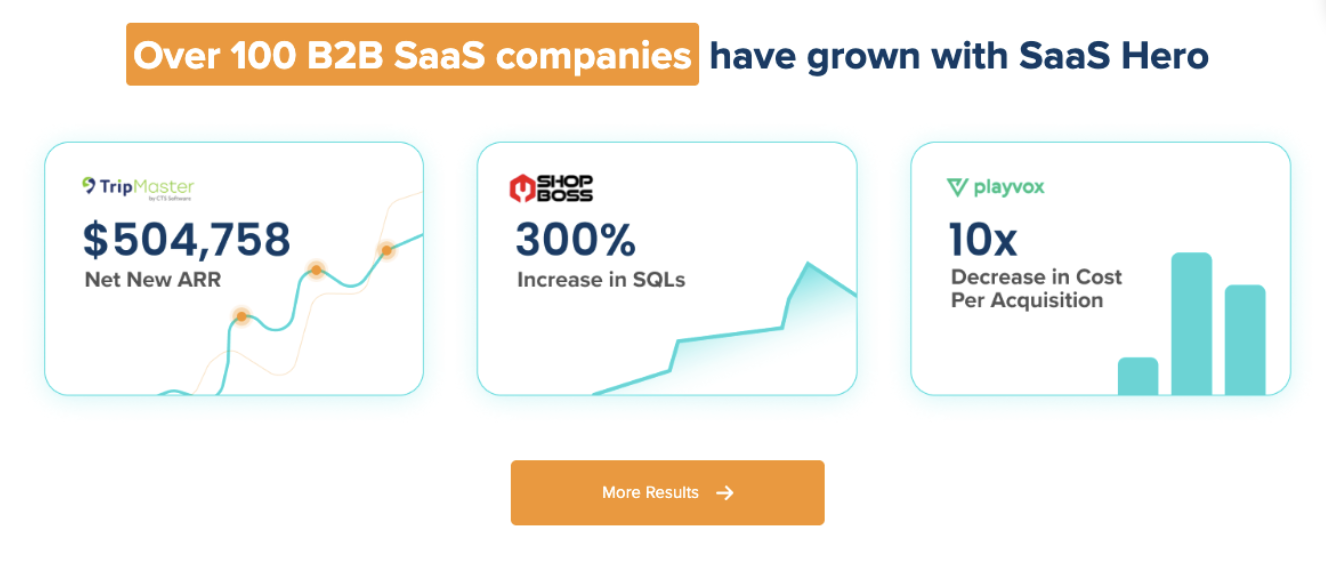
SaaSHero owns strategy, execution, and team development, so you avoid managing an agency and a part-time executive at the same time. The engagement is designed to run as a complete growth function.
Frequently Asked Questions
Can a fractional CMO actually build a marketing team if they are only present 10–20 hours per week?
A fractional CMO can assess skill gaps, define roles, help interview candidates, and establish an operating cadence, yet the structural constraint is real. Team building requires daily presence, including coaching junior marketers through weekly decisions, modeling judgment in real time, and maintaining the momentum that turns a group of generalists into a functional demand engine. A fractional CMO who lacks an execution team beneath them will hand over a well-structured hiring plan that nobody has the bandwidth to run. The most effective configurations pair a fractional CMO with either a capable internal team already in place or an outsourced execution team that is embedded in the account daily. Companies that expect both strategy and execution from a single part-time operator typically discover the execution gap around 90 days in, when the strategy is documented but the pipeline has not moved.
What is the difference between a fractional CMO and a marketing agency?
A fractional CMO owns the marketing strategy and is accountable for the revenue number it produces. They set the brief, manage vendors, lead the internal team, and report to the CEO on pipeline contribution and CAC. A marketing agency executes a defined brief across specific channels and is accountable for its deliverables, not the company’s revenue number. The practical consequence is clear. An agency without a senior marketing leader above it will optimize its own scope faithfully while the company’s actual growth problem goes unaddressed. Many growth-stage companies use both together, with the fractional CMO setting direction and the agency providing execution capacity. The failure mode appears when a company buys an agency to solve a leadership problem or hires a fractional CMO without providing them an execution team to direct.
What KPIs should a fractional CMO be held to in the first 90 days?
The first 30 days are primarily diagnostic. The deliverable is an honest assessment of the funnel, the top three growth constraints, and a 90-day plan, rather than pipeline numbers. By day 60, measurable improvements in lead quality, marketing-sourced pipeline, and conversion rates at key funnel stages should be visible. By day 90, the first initiative should be in market with clean data on whether the channel, structure, and messaging thesis are sound. Quantitative KPIs to track from the start include pipeline generated, cost per SQL, CAC payback period, and marketing-sourced revenue. Qualitative indicators such as team confidence, decision-making speed, and reporting quality matter equally in the first quarter because they predict whether the engagement will compound. A fractional CMO who cannot name the three metrics they are being held to at the start of an engagement is not operating as an executive and is functioning more like a consultant.
When does it make more sense to hire a full-time CMO than a fractional one?
The break-even point where a full-time CMO makes more economic sense is typically around $25–30M in annual revenue, when marketing has become the company’s primary growth engine and requires daily executive attention across a team of five or more people. A full-time CMO also makes sense when the equity story at exit depends on presenting a complete permanent leadership team, or when the company has raised a Series B or later round that demands a CMO on the cap table. Below that threshold, the fully loaded first-year cost mentioned earlier, plus a six-to-nine-month search window, is difficult to justify against a fractional engagement that can be operational within two to four weeks. The hidden cost of the full-time path is the time lost. A CMO hired on the median 45-day executive time-to-fill, followed by a normal six-to-nine-month ramp, produces meaningful output between month eight and month eleven.
What should a fractional CMO’s 90-day plan include?
A credible 90-day plan has three distinct phases with defined outputs at each gate. The first 30 days cover audit and assessment, including a structured review of commercial performance, team capability, technology and data, and vendor spend, delivered as a written diagnostic with the top three growth constraints and a prioritized opportunity list. Days 31–60 cover strategy and activation, including a marketing strategy and KPI framework, ruthless prioritization to a single highest-ROI initiative, an installed operating cadence, and the beginning of any hiring or restructuring. Days 61–90 cover execution and measurement, where the chosen initiative is in market, being measured honestly, with a clear view of where the next quarter should focus. A 90-day plan that fails to name a specific initiative, a specific metric, and a specific owner for each phase functions as a strategy presentation instead of an operating plan. Ask any fractional CMO candidate to walk through their 90-day plan in detail before signing an engagement.