




Written by: Aaron Rovner, Founder, Saas Hero | Last updated: September 4, 2026
Key Takeaways for SaaS Leadership Teams
- A fractional CMO owns outcomes and pipeline results. A marketing consultant is accountable only for deliverables like audits or strategy documents.
- Cost alone does not differentiate the models. The real distinction is what each engagement buys, ongoing leadership versus a bounded project or recommendation.
- Hire a consultant for a specific, time-bound question when you already have internal leadership. Hire a fractional CMO when the gap is ongoing strategic direction and team management.
- Many B2B SaaS companies at the $10M–$50M ARR stage face a third gap where execution capacity across paid media, creative, and landing pages is missing.
- If your marketing gap includes both strategic direction and execution capacity, schedule a free discovery call to evaluate whether an outsourced growth team is the right structural answer.
What Is the Difference Between a Fractional CMO and a Marketing Consultant?
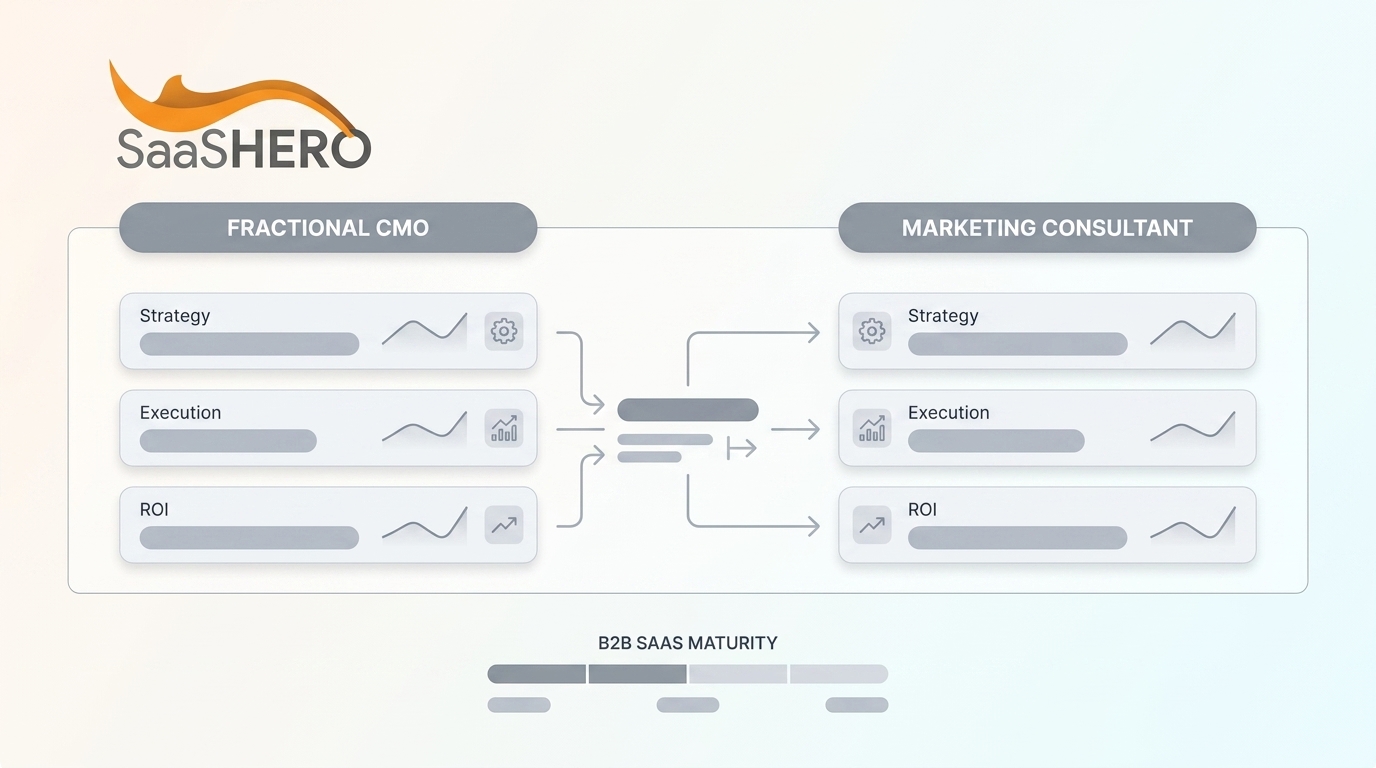
Both titles appear on proposals, both command five-figure monthly fees, and both claim to solve marketing problems. The structural differences are what matter. The table below contrasts the two roles across accountability, authority, engagement length, cost model, and typical deliverables so you can see where the real distinctions sit.
One important caveat: the “fractional CMO” title is unregulated, and many consultants sell advisory services under that label. Evaluate the structure of the engagement, including billing model, authority, and meeting participation, not the title on the proposal. The Reddit consensus on this distinction holds up: consultants give advice while executive leaders take operational responsibility.
Ready to assess which model fits your current gap? Schedule a free discovery call to map your situation to the right engagement structure.
Cost Comparison: Fractional CMO vs Marketing Consultant
Fractional CMO retainers in 2026 fall into three tiers. Tier 1 is strategy-focused at $5,000–$8,000 per month for 10–15 hours per week. Tier 2 combines strategic and operational work at $8,000–$15,000 per month for 15–25 hours per week. Tier 3 is near full-time at $15,000–$25,000 per month for 30–40 hours per week. For companies between $1M and $15M ARR that need to build or rebuild their marketing function, Tier 2 is the most common choice because it balances strategic oversight with hands-on execution.
Marketing consultants in 2026 typically charge $150–$500 per hour, with growth and paid media specialists at the higher end, and monthly retainers ranging from $5,000 to $20,000. Project-based fees include go-to-market strategy at $10,000–$30,000, marketing audits at $5,000–$15,000, and messaging and positioning frameworks at $7,500–$20,000.
Price alone does not distinguish the models. A senior consultant at $250 per hour for 30 hours per month costs $7,500, which falls squarely within the fractional CMO retainer range. The real difference is what each engagement structure buys, a deliverable versus an owned outcome. That distinction becomes clearer when you map your situation to the right engagement type.
When a Fractional CMO Makes More Sense Than a Consultant
The decision maps to three distinct situations.
Hire a consultant when:
- You have a strong internal marketing leader and a functioning team, and you need outside expertise on a specific, bounded question such as positioning, a channel audit, or market entry.
- You can write the deliverable you want on one page before the engagement starts.
- Someone internally will own implementation and results after the engagement ends.
Hire a fractional CMO when:
- You have no senior marketing leader, the founder is the de facto CMO, and the gap is ongoing leadership across the entire marketing function.
- You need someone to manage the team, hold agencies accountable, sit in leadership meetings, and own the budget.
- The gap spans months rather than weeks.
Fractional CMO vs Marketing Consultant: Matching the Model to Your Stage
The maturity model below maps company state to the recommended engagement. Apply the “who owns the outcome in month four” test: a consultant points to the recommendations, and a fractional CMO points to the number. As noted in the key takeaways, the gap for many B2B SaaS companies is execution ownership, not advice or leadership. If no one can point to a number because execution capacity does not exist, the structural gap is execution.
| Company State | Recommended Engagement | Rationale |
|---|---|---|
| No marketing leadership; founder owns marketing; team of 1–2 generalists | Fractional CMO | The gap is leadership and strategic direction, not a bounded question |
| VP Marketing in place; clear strategy; execution gaps in specific channels | Marketing consultant or specialized execution partner | Strategy exists; the gap is a defined tactical problem |
| VP Marketing in place; strategy exists; no execution capacity across paid media, creative, and landing pages | Outsourced growth team (strategy + execution) | The gap is end-to-end ownership of execution across channels and assets |
| $30M+ ARR; multiple products; complex multi-channel motion | Full-time CMO + team | Marketing complexity justifies a dedicated executive and internal capacity |
Common Pitfalls and How to Diagnose Them
Four structural mistakes recur across B2B SaaS companies at the $10M–$50M stage. Each has a diagnostic question that surfaces the real gap before money is spent.
Pitfall 1: Hiring a consultant for an ongoing execution problem. The consultant delivers an excellent strategy document, but nothing changes because no executive-level person exists to translate strategy into weekly decisions. To surface this, ask yourself: If the last piece of marketing advice you paid for was implemented and worked, you have execution capacity. If it is sitting in a folder, the problem was never the advice, it was the gap in ownership.
Pitfall 2: Hiring a fractional CMO who operates as a consultant. Many “fractional CMOs” deliver strategy documents and monthly advisory calls without touching execution. To test this, ask any candidate what they are accountable for and how you would know if they failed. A consultant answers in terms of analysis quality, while a true fractional CMO names numbers before the engagement starts.
Pitfall 3: Assuming a strong consultant will operate as a fractional CMO if the engagement is extended. The billing model, authority structure, and meeting participation are structurally different. Consultants cannot manage a marketing team, hire replacements, defend the budget with the CFO, or present marketing performance to the board. The diagnostic question is simple: does this person attend your leadership meetings, manage your team, and have authority over budget and vendors?
Pitfall 4: Underestimating the execution gap. A fractional CMO provides strategic leadership but typically does not write blog posts, design landing pages, manage paid media campaigns, or run SEO audits. Ask who will execute the strategy if you hired a fractional CMO today. If no clear answer exists, the execution gap remains.
Illustrative Scenarios: Three B2B SaaS Archetypes
Scenario 1: The $15M ARR company with a VP Marketing but no paid media specialist. The VP has deep marketing judgment but no execution capacity in paid media. The company runs Google and LinkedIn through an underperforming agency, landing pages sit behind a backlogged web team, and reporting does not answer whether spend produced pipeline. The gap centers on end-to-end execution ownership. A fractional CMO produces a strategy with no one to execute it. A consultant produces recommendations with no one to implement them. This company needs a team that owns the full chain from impression to CRM record.

Scenario 2: The $30M ARR company with a new CEO who needs strategic direction. The company has marketing activity but no marketing leader, and the founder is the accidental CMO. The gap is leadership: someone needs to own the function, set the strategy, and manage the team until a full-time hire can be made. A fractional CMO is the structurally correct answer here.
Scenario 3: The $10M ARR company with a founder doing marketing. The founder has product-market fit and a proven sales process but no internal marketing team. The gap includes both strategy and execution, but the company may not yet have the budget or complexity to justify either a fractional CMO or a full outsourced team. A phased approach that validates one channel first creates a lower-risk path.
The Structural Gap: When Neither a Fractional CMO nor a Consultant Is Enough
Throughout this article, the choice has been framed as fractional CMO versus consultant. For many B2B SaaS companies at the $10M–$50M stage, neither option fits because the gap is not advice or leadership alone, it is end-to-end execution. In that situation, a fractional CMO produces a strategy with no one to execute it, while a consultant produces recommendations with no one to implement them.
The biggest risk of hiring a fractional CMO is “strategy without execution” that results in a dusty strategy deck and no pipeline movement. The most common B2B SaaS configuration, a VP of Marketing with 2–4 generalists and no paid media specialist, maps directly to this gap.
This gap is why outsourced growth teams that combine strategy and execution are emerging as a distinct third category. SaaSHero operates as this model, one team owning strategy and execution across paid media, creative, landing pages, and reporting, and working against CRM revenue data rather than form-fill counts. The team includes in-house designers and copywriters, manages roughly $16 million in annual advertising spend, and holds Google Premier Partner status, a designation held by the top 3 percent of agencies. Nothing is outsourced. The client supplies the goals, and SaaSHero owns everything between those goals and the result.

If your marketing gap includes both strategic direction and execution capacity, schedule a free discovery call to see whether an outsourced growth team is the right structural answer.
FAQ
What is the difference between a fractional CMO and a marketing consultant?
A fractional CMO is a part-time executive who owns the marketing strategy, manages the team, and is accountable for outcomes including pipeline and revenue targets. A marketing consultant provides expert advice, audits, or specific deliverables without ongoing ownership of the marketing function. The key differentiator is accountability. A consultant advises and is judged on the quality of the deliverable, while a fractional CMO owns the outcome and is judged on whether the numbers moved. The fractional CMO sits in leadership meetings, makes budget decisions, and manages agencies. The consultant recommends, and the client decides whether and how to act.
How much does a fractional CMO cost vs a marketing consultant?
Fractional CMO retainers in 2026 typically range from $5,000 to $15,000 per month, with strategy-focused engagements at the lower end and strategic-plus-operational work at the higher end. Near full-time fractional CMO arrangements can reach $15,000–$25,000 per month. Marketing consultants typically charge $150–$500 per hour or project fees ranging from $5,000 for a focused audit to $30,000 or more for a full go-to-market strategy. At 30 hours per month, a senior consultant at $250 per hour costs $7,500, which sits within the fractional CMO retainer range. The real difference is what each engagement structure buys, a deliverable versus an owned outcome.
When should you hire a fractional CMO instead of a consultant?
Hire a fractional CMO when the gap is ongoing leadership across the entire marketing function, no one currently owns marketing decisions day to day, and you need someone to manage the team, hold agencies accountable, sit in leadership meetings, and own the budget. Hire a consultant when you have a specific, bounded question with a clear finish line, such as a positioning audit, a channel diagnostic, or a market entry plan, and someone internally will own implementation after the engagement ends. If the last piece of marketing advice you paid for is sitting unimplemented in a folder, the problem was never the advice. The gap sits in ownership, and a consultant will not close it.
Can a fractional CMO also execute?
Most fractional CMOs provide strategic leadership and team management but do not execute tactically. They typically do not write blog posts, design landing pages, manage paid media campaigns, or run SEO audits. If your gap includes execution capacity across paid media, creative, and conversion rate optimization, you need either an internal team, a specialist agency, or an outsourced growth team that combines strategy with execution under one accountability line. Hiring a fractional CMO without solving the execution gap produces a well-directed but unexecuted strategy, an expensive outcome that moves no pipeline.
What is the “who owns the outcome” test?
Ask any candidate before signing what they are accountable for and how you would know if they failed. A consultant should answer in terms of the quality and usefulness of their analysis, including the strategy document, the audit, or the framework. A fractional CMO should answer in terms of numbers such as pipeline, cost per sales-qualified lead, and revenue contribution, and should name those numbers before the engagement starts. If a candidate who calls themselves a fractional CMO answers in deliverable terms, they operate as a consultant regardless of the title. The test works because it forces the accountability structure into the open before money changes hands.
Conclusion and Practical Next Steps
The choice between a fractional CMO and a marketing consultant comes down to who owns the outcome. A consultant is accountable for the quality of the recommendation, while a fractional CMO is accountable for the result. As noted earlier, the gap for many B2B SaaS companies is execution ownership rather than advice or leadership alone.

Use this framework to structure an internal review before your next engagement decision:
- Assess your team capabilities. Confirm whether you have a senior marketing leader and execution capacity across paid media, creative, and landing pages.
- Define the gap precisely. Decide whether you face a bounded question, an ongoing leadership need, or an end-to-end execution challenge.
- Apply the “who owns the outcome in month four” test to any candidate. A consultant points to the recommendations, and a fractional CMO points to the number. If no one can point to a number because execution capacity does not exist, the gap is execution.
For companies that need the accountability of a fractional CMO with the execution capacity of a full team, SaaSHero offers an outsourced growth team that owns strategy and execution across paid media, creative, landing pages, and reporting, and works against CRM revenue data rather than form-fill counts. With over $60 million in lifetime ad spend managed exclusively for B2B SaaS companies, Google Premier Partner status, and a team of approximately 20 full-time specialists including in-house designers and copywriters, SaaSHero is built for the configuration most B2B SaaS companies actually have, a VP of Marketing with 2–4 generalists and no paid media specialist.
Schedule a free discovery call to assess your current marketing structure, identify the gap, and determine whether an outsourced growth team is the right structural answer for your stage.