




Written by: Aaron Rovner, Founder, Saas Hero | Last updated: September 4, 2026
Key Takeaways for B2B SaaS Leaders
- Most B2B SaaS agencies optimize to form fills instead of revenue, which inflates CAC while pipeline stays flat.
- Real CAC reduction requires connecting ad platforms to CRM data and optimizing to qualified pipeline and closed revenue.
- Agencies must own the full post-click experience, including landing pages, CRO, and CRM integration to stay accountable for outcomes.
- Evaluate agencies on revenue-first measurement, channel audits, high-intent targeting, creative testing, and flat-fee structures that remove conflicts of interest.
- Ready to benchmark your agency against revenue-first performance? Book a discovery call with SaaSHero.
What CAC Reduction Really Means in B2B SaaS
CAC (Customer Acquisition Cost) is total sales and marketing spend divided by the number of new customers acquired in the same period. A fully loaded CAC includes ad spend, salaries, tools, agency fees, and allocated overhead. Paid-only CAC answers whether a channel is working for in-quarter decisions, and fully loaded CAC is the number boards expect.
A single blended CAC number hides more than it reveals. The metrics that matter for B2B SaaS are the CAC payback period and the LTV:CAC ratio. The 2026 Aleph and Benchmarkit report, covering full-year 2025 actuals across 342 companies, found the median CAC payback period improved from 18 months in 2024 to 16 months in 2025, with top-quartile performance at 6 months or less and bottom-quartile at 24 months or more. The 2026 Optifai study of 939 B2B SaaS companies found a median LTV:CAC ratio of 3.2:1, with 3:1 as the healthy floor, 3–5:1 as the healthy band, and above 5:1 potentially indicating underinvestment in growth.
CAC differs from CPA (cost per acquisition). CPA typically measures the cost of a lead or form fill. CAC measures the cost of a paying customer. Most CAC problems get treated as a paid media strategy problem when they are actually a tracking or conversion problem wearing a paid media costume. An agency that reports falling CPA while CAC climbs is optimizing the wrong metric. The core framework of this guide is simple: the agency that reduces CAC optimizes to revenue, not leads.
Five Core Strategies Agencies Need to Reduce CAC
A growth marketing agency that can genuinely reduce CAC must demonstrate capability across five interconnected strategies. Use this as your evaluation framework when interviewing prospective partners.
- Revenue-First Measurement. The agency must connect ad platforms to CRM data such as Salesforce or HubSpot to track qualified pipeline and closed revenue, not just form fills. This requires clear primary conversions like SQLs and opportunity creation, and secondary conversions like newsletter signups and content downloads. Lifecycle stage events then need to flow back into the ad platforms. Google Ads behaves like a self-fulfilling prophecy: feed the machine high-quality data and receive high-quality performance. An agency that cannot explain its primary versus secondary conversion architecture is not equipped to reduce CAC.
- Channel Audits and Reallocation. A growth marketing agency should audit existing paid media channels to identify wasted spend and shift budget to high-performing channels. This work includes a willingness to recommend cutting channels that do not perform, even when that decision reduces the agency’s own billings. Ask any agency you are evaluating, “What happens to your fee if we cut a channel?” If the answer involves a contract amendment, the agency has a structural conflict of interest. Percentage-of-ad-spend billing creates misaligned incentives because agencies earn more when clients spend more, even if efficiency drops, while flat monthly retainers create a more honest structure.
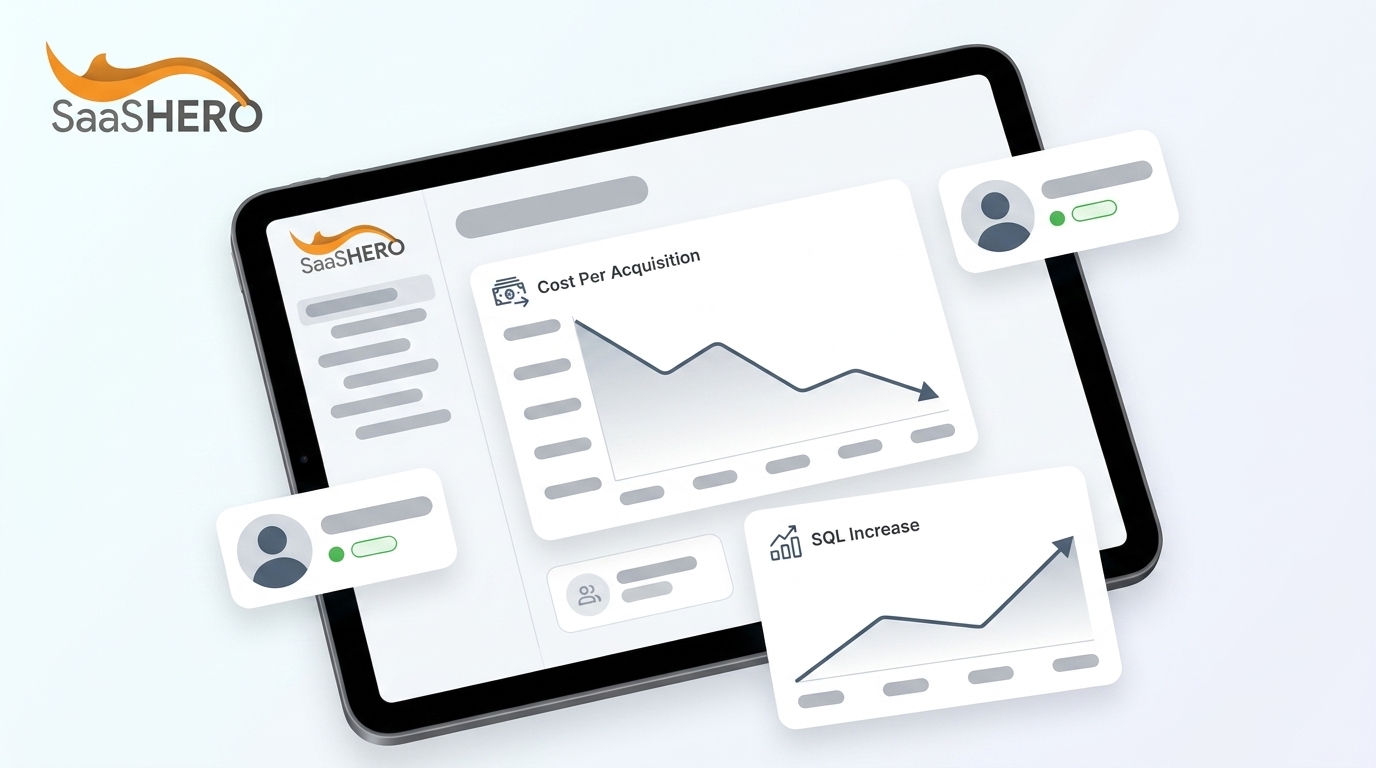
- Conversion Rate Optimization (CRO). Landing page work is where CAC reduction compounds. Headline copy is usually the most impactful lever for improving conversion rates. A strong headline explains how the product solves the prospect’s problem and avoids generic category claims like “#1 Category Software.” The agency should own landing page design, copy, build, and A/B testing, instead of only recommending changes for your web team. In a documented paid search engagement, restructuring campaigns around the full funnel and running dedicated landing page CRO reduced cost per acquisition by 47% and increased qualified demo bookings by 82% over six months.
- High-Intent Targeting. The agency should use intent data, ICP refinement, and aggressive negative keyword management to focus spend on high-intent segments. In the same Flowtrack case study, 43% of clicks came from irrelevant broad-match queries with no negative keyword coverage before the restructure, which directly inflated CAC. An agency that does not review search terms as a standing discipline allows the platform to drift toward irrelevant queries.
- Creative and Messaging Testing. Continuous creative testing is essential, especially for paid social. Messaging cadence drives performance, and many LinkedIn campaigns fail because companies say the wrong thing to the right person. Targeting is usually the easy part. The agency needs in-house creative capacity to produce and test new concepts continuously, not as an occasional change request.
How to Measure CAC Correctly: A Step-by-Step Guide
Last-click attribution breaks CAC measurement for B2B SaaS with long sales cycles. It credits the branded search that happened after the buyer was already convinced and defunds the channels that created demand. B2B SaaS companies see an average CAC reduction potential of 40% or more when they reinvest in upstream demand channels identified through multi-touch attribution, and properly attributed content and brand touchpoints show a 3–6× pipeline influence multiplier compared to last-click.
The correct approach involves four steps:
- Connect ad platforms to your CRM. Use native API connections to sync Google Ads, LinkedIn, and Meta with Salesforce or HubSpot. Native API connections are recommended over manual exports, with data hygiene rules including de-duplication, standardized naming, and a single source of truth for each performance indicator.
- Define primary and secondary conversions. Primary conversions such as SQLs and opportunity creation feed the bidding algorithms. Secondary conversions such as form fills and content downloads are tracked but excluded from optimization.
- Push lifecycle stage events back into the ad platforms. When a lead becomes an SQL or an opportunity is created, return that event to the platform as the outcome worth finding more of.
- Report on pipeline and revenue, not leads. Build dashboards in Looker Studio or your CRM that show ad spend connected to pipeline, CAC, and payback period. The 16‑month median payback mentioned earlier provides a useful benchmark for these reports.
Why CRM Data and Offline Conversion Tracking Matter
CRM integration separates a CAC-reducing agency from a lead-generating agency. Many agencies stop at the click. The landing page belongs to the client, the CRM to RevOps, and the conversion definitions to whoever configured the tag manager years ago. A growth marketing agency that reduces CAC must own the entire chain from impression to CRM record.

That ownership includes:
- Setting up conversion tracking that connects ad clicks to CRM outcomes
- Defining lifecycle stages such as MQL, SQL, and Opportunity in partnership with your RevOps team
- Feeding qualified opportunity data back into the ad platforms for bidding optimization
- Using multi-touch attribution to understand which channels create demand versus capture it
The mandatory discovery question for any agency is, “Are you optimizing campaigns around CRM data or just form submissions?” If the answer is form submissions, the agency is training the algorithm to find the wrong people. The best predictor of agency quality is whether they understand deal math, align fees with outcomes, and report in systems the client owns.
How to Evaluate a Growth Marketing Agency: Practical Checklist
When interviewing agencies, ask these specific questions:
- “Are you optimizing to CRM data or form fills?” This answer shows whether the agency can actually reduce CAC or only report lower cost-per-lead.
- “Who owns the landing page and post-click experience?” If the agency does not own the page, it cannot be accountable for conversion rate. Agencies that do not own the full funnel are a documented red flag for B2B SaaS marketing leaders.
- “How do you report on pipeline and revenue, not just leads?” Reporting should connect ad spend to CRM outcomes in a dashboard you can open yourself.
- “What is your approach to channel mix and budget reallocation?” The agency should have a documented process for shifting budget based on performance, without a fee structure that penalizes channel changes.
- “What is your fee structure?” Percentage-of-spend pricing creates a conflict of interest. Flat retainers indexed to total ad spend remove this conflict.
Watch for these red flags during evaluation:
- Agencies that do not own the full funnel
- Lack of CRM integration capabilities
- Per-channel pricing that discourages testing new channels
- Reporting on impressions and clicks rather than pipeline and revenue
- Agencies that resist month-to-month terms or a 90-day validation period, which signals low confidence in their own results.
Plan for a clear 90-day ramp. Month one focuses on setup and build, including onboarding, tracking, and campaign architecture. Days 31–60 involve narrowing the account by cutting underperformers, adjusting audiences, and moving budget toward what works. Day 90 becomes a validation gate with enough data to judge whether the channel, structure, and messaging thesis are sound.
Real-World Benchmarks: Examples of CAC Reduction
The following examples, drawn from public case studies, illustrate what a growth marketing agency can achieve when it optimizes to revenue instead of leads:

- Playvox reported a 10x reduction in cost per lead alongside a 163% increase in lead volume after rebuilding the conversion architecture to focus on qualified pipeline.
- TestGorilla reported an 80-day CAC payback period on paid acquisition, which enabled aggressive scaling after a $70M Series A and added more than 5,000 new customers.
- TripMaster added $504,758 in net new ARR over one year with a 650% return on ad spend and a 20% conversion rate from paid search.
- Shop Boss achieved a 305% increase in conversion rate after landing page performance was identified as the binding constraint on channel economics.
These results rely on the full-funnel ownership and revenue-first measurement described in this guide. They show what becomes possible when an agency stays accountable for pipeline outcomes and revenue.
Common Pitfalls and How to Avoid Them
The most common mistakes B2B SaaS companies make when trying to reduce CAC are listed below, each paired with a diagnostic question to ask your agency:
- Optimizing to form fills. Optimizing to form fills is a pitfall because the ad platform will find more people who fill out forms, not more people who buy. Diagnostic question: What conversion event is feeding your smart bidding campaigns?
- Using last-click attribution. In a 6–9 month B2B sales cycle, last-click credits the branded search that happened after the decision was made. An average enterprise B2B deal involves 8–12 meaningful buyer interactions and 6 or more stakeholders, each with their own touchpoint journey, which last-click attribution collapses into a single event. Diagnostic question: Which channels created demand versus captured it?
- Ignoring the post-click experience. Sending traffic to a generic page produces weak conversion rates and teaches the algorithm nothing useful. Diagnostic question: When was the last time anyone tested your landing pages?
- Not integrating CRM data. Without connecting ad platforms to the CRM, optimization happens at the wrong end of the funnel. Diagnostic question: Can you see which campaigns produced SQLs and opportunities, not just leads?
- Treating CAC as a single number. The channel that looks expensive in aggregate is often the one bringing in your highest-LTV customers, while the channel that looks cheap often creates churn two quarters later. Diagnostic question: What is your CAC by channel, by campaign, and by ICP segment?
- Confusing CAC with CPA. Confusing CAC with cost-per-lead is a common measurement mistake that compromises accuracy and leads to poor decision-making. Diagnostic question: Is your agency reporting on paying customers or form submissions?
Frequently Asked Questions
What is a good LTV:CAC ratio for B2B SaaS?
A 3:1 ratio is the industry standard floor, meaning the customer lifetime value is three times the cost to acquire that customer. The 2026 Optifai study found a 3.2:1 median across 939 B2B SaaS companies, with 3–5:1 considered healthy and above 5:1 potentially indicating underinvestment in growth. Below 3:1, the acquisition economics are not sustainable at scale. The ratio should be tracked by channel and by ICP segment rather than as a single blended figure, because a healthy blended ratio can mask a channel that is acquiring low-retention customers at an unsustainable cost.
How is CAC calculated?
CAC equals total sales and marketing spend divided by the number of new customers acquired in the same period. A fully loaded CAC includes ad spend, salaries, tools, agency fees, and allocated overhead. Paid-only CAC, defined as media spend divided by new customers, answers whether a specific channel is working for in-quarter decisions, and fully loaded CAC is the number boards expect and the only figure comparable to published benchmarks. Both halves of the formula must cover the same period and the same customer segment, because mixing a quarter of spend with a year of customers produces a misleading number. Teams should also track marginal CAC, the cost of the next customer rather than the quarter’s average, because a sharp rise in marginal CAC as budgets scale indicates channel saturation.
What is the difference between CAC and CPA?
CPA (cost per acquisition) typically measures the cost of a lead or form fill. CAC measures the cost of a paying customer. An agency that reports falling CPA while CAC climbs is optimizing the wrong metric, and the platform is finding more people who fill out forms, not more people who buy. This distinction is structural. An ad platform optimized toward a form fill will systematically find the cheapest people to convert, which is not the same population as the people who buy. The only way to close the gap is to connect the ad platform to CRM data so the optimization signal is a qualified opportunity or a closed deal, not a page event.
How long does it take to see CAC reduction?
Early insights typically appear within 30–60 days once tracking is in place. Meaningful CAC reduction usually arrives in three to six months, depending on sales cycle length and analytics maturity. The first 30 days focus on setup, including onboarding, conversion tracking, and campaign architecture. Days 31–60 involve narrowing the account by cutting underperformers, adjusting audiences, and moving budget toward what works. Day 90 becomes a validation gate with enough data to judge whether the channel, structure, and messaging thesis are sound.
What is the 3-3-3 rule in marketing?
The 3-3-3 rule is a framework suggesting that marketing leaders should be able to articulate three key metrics, three strategic priorities, and three execution initiatives at any given time. In the context of CAC reduction for B2B SaaS, the relevant version is: know your LTV:CAC ratio with a target of 3:1 or better, your CAC payback period with a target under 12–18 months depending on segment, and your cost per qualified pipeline dollar. These three numbers answer the questions a board or PE operating partner will ask about acquisition efficiency, and they are only answerable if the agency has connected ad spend to CRM outcomes in a reporting layer the marketing leader can open without rebuilding it from three sources that do not agree.
Conclusion: Choose an Agency That Owns Revenue
The core problem is structural. Many agencies are scoped to the ad account, priced per channel, and measured on form fills. They cannot reduce CAC because they do not own the landing page, the CRM connection, or the definition of a qualified lead. A growth marketing agency that reduces CAC must own the entire chain from impression to CRM record, optimize to revenue data, and stay accountable for pipeline outcomes.
Use this guide as your evaluation framework. Ask the questions, look for the red flags, and review how the agency measures success. The agency that can explain its primary versus secondary conversion architecture, demonstrate CRM integration capability, and show you dashboards that connect ad spend to pipeline is the agency that can actually reduce your CAC.

SaaSHero is the outsourced inbound growth team for B2B SaaS, with one team owning paid media, creative, landing pages, and reporting, and optimizing all of it against CRM revenue data instead of form-fill counts. As a Google Premier Partner ranked in the top 3% of agencies and a G2 High Performer ranked #20 of approximately 6,000 agencies, SaaSHero has managed more than $60 million in lifetime ad spend for B2B SaaS companies and holds every account to the benchmarks in this guide, including an LTV:CAC of 3:1 or better and CAC payback under 12 months for top-tier performance.