




Written by: Aaron Rovner, Founder, Saas Hero | Last updated: September 1, 2026
Key Takeaways
- Immediate revenue generation (outbound and paid) delivers pipeline in 1–6 weeks, while traditional inbound marketing requires 6–12 months to compound.
- Conversion rates favor inbound (14–14.6%) over outbound (1.7–2%), and outbound-sourced deals close 18% larger on average.
- Budget allocation should shift by stage: 70/30 immediate-to-inbound at $1M–$5M ARR, 50/50 at $5M–$20M ARR, and 40/60 at $20M+ ARR.
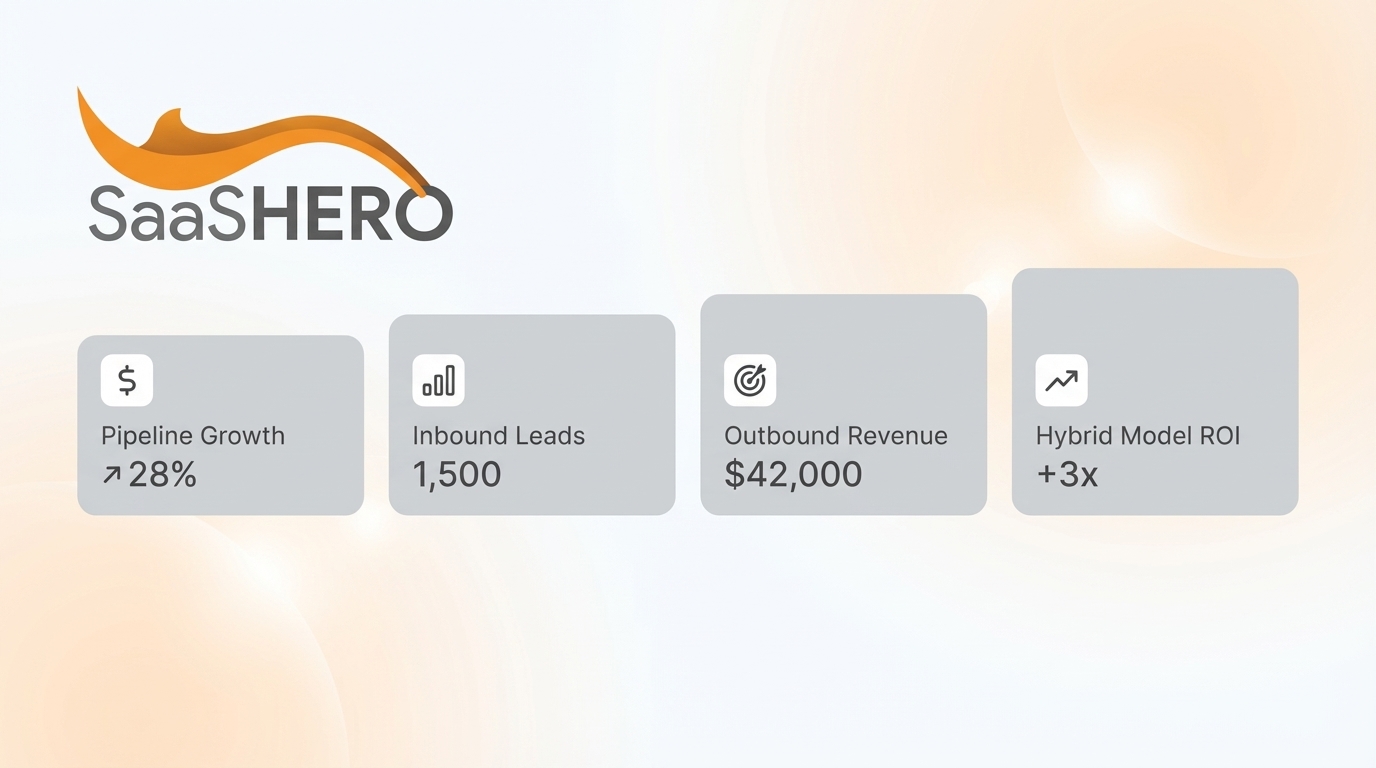
- Companies running coordinated outbound-plus-inbound strategies achieve 38% higher revenue growth and 3× higher ROI than single-channel approaches.
- Book a discovery call to map this stage-based framework to your pipeline targets with SaaSHero.
The Contenders: Speed vs. Compounding Value
Immediate revenue generation covers outbound sales (cold email sequences, cold calling, LinkedIn outreach) and paid acquisition (paid search on Google and Microsoft Ads, paid social on LinkedIn and Meta). These tactics share one defining characteristic: they produce pipeline within 30 to 60 days of launch. Outbound lead generation achieves a time-to-first-meeting of 3 to 7 days, compared to 5 to 14 days for inbound. That speed comes at a price. Inbound leads cost around $36 on average, while outbound leads cost $333 or more when you factor in rep time, data, tools, and follow-up infrastructure.
Traditional inbound marketing covers content marketing, SEO, webinars, and organic social. These assets compound over time and keep working after the initial investment. Time to first pipeline from organic inbound is 6 to 12 months, while paid inbound takes 2 to 6 weeks and outbound takes 1 to 4 weeks. The long-term advantage is significant. Organic CAC for B2B SaaS averages around $942 while paid CAC averages $1,907, and organic channels convert at roughly twice the rate of paid channels.
The hybrid approach treats these motions as a sequenced system. Immediate tactics fund the business and validate the ICP while inbound assets are built in parallel to reduce CAC over time. SaaSHero executes this hybrid model as an outsourced growth team, owning paid media, creative, landing pages, and CRM-connected reporting under one retainer so the marketing leader avoids coordinating multiple vendors.

Head-to-Head: A Data-Backed Comparison
| Dimension | Immediate Revenue (Outbound/Paid) | Traditional Inbound (Content/SEO) |
|---|---|---|
| Time to first pipeline | 1–6 weeks | 6–12 months (organic) |
| Lead-to-customer conversion rate | 1.7–2% (outbound cold) | 14–14.6% (inbound) |
| Average CAC (fully loaded) | $1,907 (paid); $1,980 (outbound sales) | $942 (organic) |
| CAC payback period | 6–12 months | 12–24 months (early); decreases as content compounds |
The conversion rate gap is the most important figure in this table. Inbound website leads convert to SQLs at 31.3%, more than three times higher than outbound sources. Outbound still plays a crucial role because it allows precise targeting of specific accounts and company sizes. That precision explains why outbound-sourced deals close 18% larger on average than inbound deals. Stage and ACV together determine which approach should lead.
Given that stage and ACV are the deciding factors, the next step is to align your budget with where your company sits today.
The Stage-Based Framework: How to Allocate Your Budget
Most B2B SaaS teams misallocate budget by using a fixed channel mix regardless of company stage. The correct split changes as the business matures, the ICP sharpens, and inbound assets begin to compound.
| Phase | ARR Stage | Budget Split (Immediate / Inbound) | Primary KPIs |
|---|---|---|---|
| Phase 1: Revenue First | $1M–$5M ARR | 70% immediate / 30% inbound | Pipeline generated, CAC payback period |
| Phase 2: Repeatability | $5M–$20M ARR | 50% immediate / 50% inbound | SQLs, opportunity velocity |
| Phase 3: Compound | $20M+ ARR | 40% immediate / 60% inbound | LTV:CAC ratio, organic pipeline share |
In Phase 1, the priority is validating the ICP through real sales conversations and generating enough revenue to fund the inbound engine being built in parallel. Outbound can produce pipeline in 60 to 90 days, making it the recommended primary strategy for early-stage companies. Meanwhile, inbound content built from sales conversation data begins accumulating domain authority for later stages.
In Phase 2, both engines run simultaneously with clear attribution. By $2M ARR, companies that have been building content since Phase 1 should see organic generating 20–35% of their pipeline. The KPI focus shifts from pure pipeline volume to opportunity velocity, which signals that the sales process is becoming repeatable.
In Phase 3, inbound becomes the dominant pipeline source while paid and outbound focus on demand capture and enterprise account penetration. By $5M ARR, the best-performing B2B SaaS companies have shifted to a 60% inbound, 40% outbound split. The primary financial KPIs at this stage, LTV:CAC and organic pipeline share, reflect the compounding value of the inbound assets built in earlier phases.
Stage is a key factor, and your company’s immediate constraint can override the default stage-based split.
How to Decide Based on Your Constraint
The company’s current binding constraint shapes which motion should lead. The following framework maps common constraints to the recommended approach.
| Current Constraint | Recommended Primary Motion | Rationale |
|---|---|---|
| Need $50K ARR in 90 days | Immediate (paid + outbound) | If a company needs revenue in the next 90 days, outbound is the answer |
| CAC too high to scale | Inbound investment + CRM optimization | Organic channels convert at roughly 2x the rate of paid and cost about 40% less per acquired customer |
| Sales cycle too long (>90 days) | Outbound (initiates contact before decision window) | Outbound is structurally better for sales cycles of 90+ days because you need to initiate contact long before the decision window opens |
| ACV below $10K | Inbound or PLG | Below $10K ACV, the cost of a personalized 8-touch outbound sequence often exceeds the deal value |
| ACV above $25K | Outbound-led with inbound support | Above $25K ACV, the outbound math inverts entirely |
The Hybrid Model: Best Practices for Combining Both
The most durable finding across the research is that companies running coordinated outbound and inbound strategies significantly outperform single-channel approaches. For example, companies running coordinated outbound plus inbound achieved 38% higher revenue growth than single-channel companies and 3x higher ROI compared to using either channel alone.
The integration mechanics matter as much as the budget split. Three practices separate effective hybrid models from ones that simply run two channels in parallel:
- Use inbound signals to prioritize outbound. Inbound intent signals such as blog visits and pricing-page visits should be routed back to outbound for personalized follow-up. This routing turns content into a demand-creation engine that feeds the outbound sequence.
- Use paid to capture demand created by inbound. A prospect who reads a blog post and then receives a signal-personalized email is 3–4x more likely to reply than a cold prospect who has never heard of the company.
- Measure against CRM revenue data, not form fills. An account optimizing to form submissions trains the ad platform to find the cheapest people to convert, such as students, job seekers, and competitors, while pipeline stays flat. SaaSHero’s method focuses on this distinction by optimizing paid campaigns against lifecycle stage events and qualified pipeline rather than raw form volume.
SaaSHero executes this hybrid model as one team owning paid media, creative, landing pages, and CRM-connected reporting. The flat retainer is indexed to total monthly ad spend rather than channel count, so shifting budget between channels or testing a new one carries no fee consequence. That structure removes the incentive for agencies to keep budget locked in its original allocation.

See how SaaSHero builds and manages this hybrid engine for your stage.
To understand why these splits work, it helps to look at the growth benchmarks investors use to judge SaaS performance.
SaaS Benchmarks and Rules: Growth Signals Behind the Model
3-3-2-2-2 Growth Rule for Early-Stage SaaS
The 3-3-2-2-2 rule is a growth rate benchmark for early-stage SaaS companies. It states that a company should triple ARR in years one and two (3x, 3x), then double ARR in years three, four, and five (2x, 2x, 2x). A company reaching $1M ARR and following this trajectory would reach approximately $72M ARR by year five. Investors use this rule to assess whether a company’s growth rate aligns with a credible path to scale. The rule implies that early-stage companies must prioritize immediate revenue generation through outbound and paid because inbound assets cannot compound fast enough to support 3x annual growth from a standing start.
Rule of 40 and Its Impact on GTM Spend
The Rule of 40 states that a healthy SaaS company’s revenue growth rate plus its profit margin should equal or exceed 40%. A company growing at 30% with a 10% profit margin scores 40, and a company growing at 50% with a -10% margin also scores 40. Only about 11% to 30% of private SaaS companies hit the Rule of 40 in any given year. The rule matters for the inbound versus outbound decision because cutting acquisition spend to improve margin can reduce the growth rate faster than it improves profitability, which worsens the Rule of 40 score. Improving marketing efficiency, by reducing CAC payback and increasing the pipeline-to-spend ratio, moves the Rule of 40 in the right direction.
Key Benchmarks Table
| Benchmark | Immediate Revenue (Outbound/Paid) | Traditional Inbound (Content/SEO) |
|---|---|---|
| Time to first pipeline | 1–6 weeks | 6–12 months (organic) |
| Lead-to-customer conversion rate | 1–3% | 5–10% |
| Median CAC payback period | 6–12 months | 12–24 months (early stage) |
| Healthy LTV:CAC ratio (both motions) | 3:1 minimum; 3:1–5:1 healthy band | 3:1 minimum; 3:1–5:1 healthy band |
The 80-day CAC payback period achieved by SaaSHero client TestGorilla, a company that added 5,000+ customers while scaling paid acquisition, shows what becomes possible when paid campaigns are tied to CRM data instead of form fills.
90-Day Action Plan for Early-Stage SaaS
This plan applies to a B2B SaaS company at Phase 1 ($1M–$5M ARR) with a 70/30 immediate-to-inbound budget split and a quarterly pipeline target.

- Weeks 1–2: Infrastructure and paid launch. Rebuild conversion tracking so primary conversion events are lifecycle stage events (SQL, opportunity created) rather than form fills. Launch paid search campaigns on Google Ads with intent-segmented ad groups, each pointing to a purpose-built landing page. Set up the CRM-to-ad-platform connection so bidding algorithms learn from qualified outcomes.
- Weeks 3–4: Outbound sequences. Build a tiered account list: 200–400 accounts matching the tightest ICP criteria and 500–1,000 accounts meeting core criteria. Launch a multichannel 8–12 touch sequence across email and LinkedIn over 2–3 weeks. Open every message with a specific trigger and multi-thread 2–3 contacts per account.
- Month 2: Content infrastructure. Publish content derived directly from sales conversation objections and questions. One substantial piece per week builds topical authority without requiring a full content team. Target bottom-of-funnel queries first, such as comparison pages, alternative pages, and ROI calculators, because bottom-of-funnel content converts at 5–10x the rate of top-of-funnel informational content.
- Month 3: CRM-based optimization. Review the first 60 days of paid data against CRM outcomes, not platform-reported conversions. Cut underperforming ad groups. Test landing page headlines, which usually represent the single highest-leverage conversion variable. Route inbound intent signals such as pricing page visits and content downloads to outbound sequences for personalized follow-up. Produce a board-ready report showing pipeline by channel, cost per SQL, and CAC payback trend.
Executing this plan without an internal paid media specialist requires a partner who owns the full chain from ad click to CRM record. SaaSHero’s team covers paid media, creative, landing pages, and attribution as one unit. The marketing leader supplies the goals and approves what goes live instead of coordinating four separate vendors.
Start building your 90-day hybrid growth plan.
Frequently Asked Questions
What is the 3-3-2-2-2 rule of SaaS?
The 3-3-2-2-2 rule is a growth rate framework for early-stage SaaS companies. It follows the same pattern described in the benchmarks section and supports the case for fast-moving revenue tactics such as outbound and paid acquisition when you are still at low ARR.
What is the Rule of 40 in SaaS?
The Rule of 40 states that a healthy SaaS company’s revenue growth rate plus its profit margin should equal or exceed 40. As covered earlier, the most reliable way to improve this score is to increase marketing efficiency by tightening CAC payback and improving the pipeline-to-spend ratio instead of cutting acquisition spend outright.
What is a good CAC payback period for B2B SaaS?
The healthy benchmark is under 12 months for most B2B SaaS companies. SMB companies with ACV under $15K should target 8–12 months; mid-market companies at $15K–$100K ACV should target under 18 months; enterprise companies above $100K ACV typically see 18–24 months. The median across B2B SaaS is currently around 15–18 months, which means most companies sit above the healthy threshold. Improving CAC payback requires either reducing acquisition cost through better targeting and landing page conversion or increasing the speed at which customers generate revenue. Both improvements depend on optimizing campaigns against CRM data rather than form fills.
How long does it take to see results from inbound marketing?
Organic inbound typically takes 6 to 12 months to produce a steady stream of qualified leads, with the first 3 months focused on infrastructure and months 3–6 showing early organic traffic with minimal lead conversion. Paid inbound (paid search, paid social) produces pipeline in 2 to 6 weeks. The most common inbound failure is stopping investment at month 4 to 6 when traffic is growing but demo requests have not materialized. Organic content compounds and produces leads in months 9, 12, and 24. Bottom-of-funnel content such as comparison pages, alternative pages, and case studies converts at 5–10x the rate of top-of-funnel informational content and deserves priority.
How should a B2B SaaS company balance inbound and outbound?
The correct balance depends on ARR stage and ACV. At $1M–$5M ARR, a 70/30 split favoring immediate tactics (outbound and paid) is appropriate because inbound has not yet had time to compound. At $5M–$20M ARR, a 50/50 split allows both engines to run with clear attribution. At $20M+ ARR, a 40/60 split favoring inbound reflects the compounding value of assets built in earlier stages. Regardless of stage, the two motions should be integrated so inbound intent signals feed outbound prioritization and paid captures demand created by content. This integration unlocks the 38% revenue growth advantage mentioned earlier.