





Written by: Aaron Rovner, Founder, Saas Hero | Last updated: September 4, 2026
Key Takeaways for Proptech SaaS Leaders
- Most proptech marketing agencies chase form fills instead of pipeline, which misleads boards and wastes ad spend on unqualified leads.
- Proptech SaaS sales cycles last 6–14 months and require CRM-level attribution, multi-stakeholder messaging, and long-cycle measurement that real-estate agencies rarely provide.
- Vetting an agency requires verified B2B SaaS references, proof of revenue attribution in the CRM, landing-page ownership, and reporting focused on pipeline and CAC payback.
- Red flags include celebrating CPL without SQLs, reporting from agency dashboards instead of the client CRM, and pricing that rewards spend rather than pipeline.
- B2B proptech SaaS companies that want a partner focused on pipeline can book a discovery call with SaaSHero.
Why Real Estate Marketing Does Not Equal Proptech Marketing
The SERP for “proptech marketing agencies” mixes real estate broker marketing with B2B SaaS proptech marketing. These disciplines have different buyers, sales cycles, and measurement requirements.
Real estate marketing serves agents, brokers, and consumer homebuyers. Decisions move fast and stay transactional. An individual agent buying a tool for their own business makes a fast, transactional decision, while an institutional investor evaluating a platform makes a long, considered decision, so roles and messaging differ completely.
Proptech marketing serves software companies selling to property managers, asset managers, REITs, and operators. Enterprise real estate and construction firms are among the most risk-averse technology adopters, with procurement decisions involving 8 to 15 stakeholders across operations, IT, finance, and legal, and average enterprise technology sales cycles in commercial real estate running 9 to 18 months. Pulse RevOps recommends that proptech companies carry pipeline coverage near 5x on enterprise owner and REIT deals because these deals run six to fourteen months and can slip on real-world events like refinancing or asset dispositions.
Agencies that miss this distinction usually run conversion campaigns against cold audiences, report on form fills, and declare LinkedIn a failure. They never build the awareness and consideration stages that make conversion campaigns work. Most proptech companies build modern software for an industry that does not buy like modern software companies do. A generalist agency will not bridge that gap.
How to Vet a Proptech Marketing Agency with a Revenue-First Lens
Agency marketing materials rarely tell the full story. A structured vetting process separates real estate tourists from true B2B SaaS experts. Bret Starr, Founder and CEO of The Starr Conspiracy, recommends a 5-procedure vetting workflow that takes 7 to 10 business days and requires CRM data definitions, 2 hours of executive time per finalist, and 3 to 5 reference clients. The steps below adapt that approach for proptech SaaS buyers.

- Verify reviews on independent platforms. Check Clutch and G2 for recency, volume, and specificity. A profile with fewer than eight reviews despite years of operation represents a gap worth asking about directly. Reviews that mention “we had to push for updates” or “reporting took time to get right” deserve extra weight.
- Demand proptech SaaS client references. Ask for references from software companies selling to property managers or operators. Avoid references from residential brokerages or consumer portals. A case study from a $5K ACV self-serve SaaS does not predict performance for a $250K enterprise deal.
- Require proof of revenue attribution. Ask the agency to walk through a live CRM report. The report should show sourced pipeline by campaign, influenced pipeline by touch, and CAC payback from closed-won deals. If they cannot show it in the CRM, it did not happen.
- Confirm ownership of landing pages and creative. Ask to see examples of dedicated campaign landing pages, not just the client homepage. A strong ad paired with a weak landing page wastes spend. Conversion rate work should sit inside the agency’s process.
- Evaluate their reporting vocabulary. Reports that lead with impressions, clicks, and open rates are designed to survive bad quarters. Meaningful metrics for B2B SaaS include pipeline attribution rate, cost per qualified lead, marketing-sourced revenue, and CAC by segment. Ask for a sample monthly report before signing.
SaaSHero reports on pipeline, not just form fills. Book a discovery call.
Top Proptech Marketing Agencies for B2B SaaS in 2026
This comparison highlights agencies with documented B2B SaaS or proptech SaaS experience. It excludes agencies focused on residential real estate, consumer portals, or agent and broker marketing. Qualitative descriptors appear where independent numerical scores are unavailable.
| Agency | Core Focus | Key Strength | Key Watchout |
|---|---|---|---|
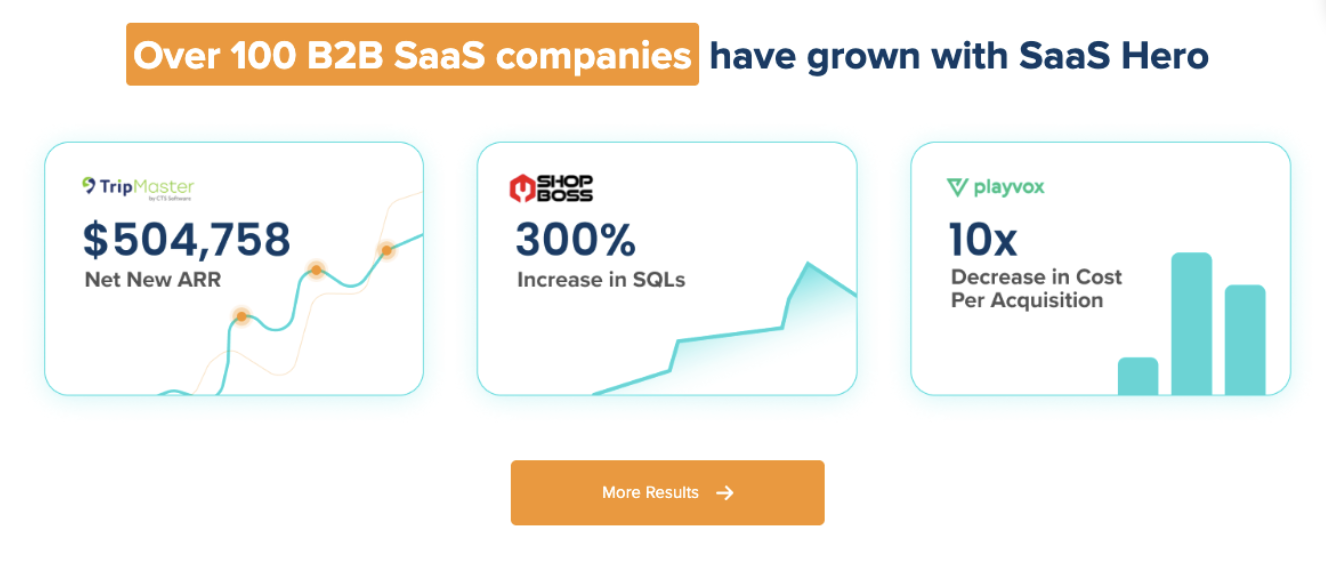
| SaaSHero | B2B SaaS paid media exclusively, tied to CRM revenue data | Only agency in this comparison that serves B2B SaaS exclusively, owns strategy through landing pages and reporting, and ties campaigns to CRM pipeline rather than form fills. G2 High Performer in Digital Marketing for 2+ consecutive years, ranked #20 of approximately 6,000 agencies. Google Premier Partner (top 3% of agencies). Published results include $504,758 in Net New ARR for TripMaster with 650% ROAS, 80-day CAC payback for TestGorilla, and 10x CPL reduction for Playvox. | Requires $15k+ monthly ad spend already in market. Serves B2B only, not pre-revenue or B2C companies. Does not provide organic social. |
| NinjaPromo | Full-service digital marketing across B2B tech, fintech, and SaaS | 4.9/5 rating from 87 verified Clutch reviews as of July 2026, which signals strong client satisfaction at scale. Offers broad channel coverage, including paid social and content. | Does not focus exclusively on B2B SaaS or proptech. Broad vertical coverage reduces depth in proptech-specific sales cycles and CRM attribution. Confirm whether reporting connects to CRM pipeline or stops at platform metrics. |
| PipeRocket Digital | B2B SaaS performance marketing and demand generation | 4.7/5 Clutch rating from 13 reviews, with named clients including Storylane, HyperVerge, Spendflo, and DevRev. Strong B2B SaaS orientation. | Smaller review volume than NinjaPromo. No published proptech-specific case studies in available data. Confirm landing page ownership and CRM integration depth before engaging. |
| Geekly Media | Property management marketing with HubSpot-centric inbound | Property management is its founding vertical, with a HubSpot Diamond partnership, proprietary frameworks (PMMA and PMOS), and native integrations with AppFolio, Buildium, Propertyware, Rent Manager, and Yardi. Strong domain knowledge in residential property management. | Primarily serves property management companies as buyers, not B2B SaaS companies selling to them. HubSpot-centric model may not fit every paid media attribution need. Confirm whether paid media is a core capability or secondary to inbound content. |
Questions to Ask About Attribution, CRM, and Landing Pages
A strong shortlist still needs pressure testing. Targeted questions reveal structural weaknesses that pitch decks hide. Use the questions below with any agency you consider for a B2B proptech SaaS engagement.
- “Are you optimizing campaigns around CRM data or just form submissions?” This question reveals the agency’s core operating model. Agencies that cannot answer with a live CRM walkthrough are optimizing to the wrong signal.
- “Who owns the landing pages?” If the agency only “recommends changes” for your team to implement, it cannot own conversion rate. Conversion rate usually represents the highest-leverage variable in the funnel.
- “How do you report on pipeline contribution?” Reporting should pull from your CRM, not the agency’s slides. Expect to see opportunities created, pipeline dollars by source, CAC, and payback where data supports it, surfaced in a live dashboard instead of a static monthly PDF.
- “What is your approach to multi-touch attribution?” Multi-touch attribution distributes credit across all touchpoints that influence a conversion, instead of assigning it to the first or last interaction. Proptech SaaS with 6–14 month cycles needs this approach. Last-click attribution consistently defunds the channels that create demand.
- “Who exactly touches our account week to week, and can I meet them before signing?” The weak answer to “Who runs my account day-to-day?” is “we have a team.”
Bring these questions to a discovery call with SaaSHero and get direct answers in one session.
Red Flags: When Agencies Report Form Fills Instead of Pipeline
Certain failure patterns repeat across underperforming engagements. These patterns come from how agencies scope work and price services, not from isolated mistakes.
- Celebrating cost-per-lead without showing SQLs. A campaign with a higher CPL can produce a lower true cost per opportunity when conversion rates improve. MQL reporting breaks down because it optimizes for lead volume instead of lead quality.
- Refusing ownership of landing pages. Agencies that only manage ad accounts cannot change the landing page headline, which often represents the single highest-leverage conversion variable. They also cannot own what happens after the click.
- Expecting the client to manage them. The Starr Conspiracy describes “tourists who pitch every vertical and prove none” as a core agency failure category. When the marketing leader generates test ideas, chases creative, and finds account problems first, the relationship has inverted.
- Reporting from agency tools instead of your CRM. Agencies that report from their own tools, on metrics they define, structure engagements so they never lose an argument.
- Charging a percentage of ad spend. Percentage-of-ad-spend pricing pays the agency more when you spend more, regardless of pipeline impact, which creates a conflict of interest.
How to Measure Success: Pipeline, CAC, and Payback
Define success before signing a contract. For B2B proptech SaaS, meaningful performance lives in pipeline and payback, not in clicks or impressions.
Strivelabs’ 2026 benchmarks for B2B SaaS place median marketing-sourced pipeline at 35% of total pipeline, with a healthy range of 25–45%. Cost per opportunity should stay under 20% of ACV. MQL-to-SQL conversion averages 18–22% for B2B SaaS, and top-quartile programs reach 25–35%.
For mid-market SaaS companies, median CAC ranges from $20K to $50K with a 12–18 month payback period. A healthy LTV:CAC ratio in SaaS sits at 3:1 or higher. SaaSHero holds client accounts to these thresholds. LTV:CAC of 3:1 and CAC payback under 12 months define a healthy paid acquisition channel.
Data infrastructure failure, such as inconsistent UTM conventions, missing GCLID capture, and attribution windows shorter than the sales cycle, often pushes teams back to MQL reporting within a quarter. Agencies that do not fix this in the first 30 days will never produce board-ready reporting.
How SaaSHero Runs Proptech Campaigns
SaaSHero operates as an outsourced inbound growth team for B2B SaaS companies. One team owns strategy, paid media, creative, landing pages, and reporting, and ties everything to CRM revenue data instead of form-fill counts. Designers, copywriters, and campaign managers all work as full-time employees.

The method centers on a single governing question: do campaigns optimize toward CRM data or toward form submissions? SaaSHero separates primary from secondary conversions and uses only primary conversions for account-wide optimization. The team pushes lifecycle stage events back into ad platforms so algorithms learn from qualified outcomes. The same team that runs campaigns also designs, builds, hosts, and A/B tests landing pages, which closes the most common accountability gap in standard agency models.
Published results from B2B SaaS engagements show this approach in practice:

- TripMaster (transit software): $504,758 in Net New ARR added over one year, with 650% ROAS and a 20% conversion rate from paid search.
- TestGorilla (HR tech): 80-day CAC payback period on paid acquisition, with 5,000+ new customers added following a $70M Series A.
- Playvox (CX software): 10x reduction in cost per lead alongside a 163% increase in lead volume.
- Shop Boss (automotive software): 305% increase in landing page conversion rate.
SaaSHero holds Google Premier Partner status (top 3% of agencies) and has remained a G2 High Performer in Digital Marketing for more than two years, currently ranked #20 of approximately 6,000 agencies. The firm manages roughly $16 million in annual advertising spend across more than 100 B2B companies served since 2018.
B2B proptech SaaS companies with $10M+ revenue and $15k+ monthly ad spend gain a partner that owns the entire acquisition engine and reports on pipeline, not just leads.
See how SaaSHero would approach your specific proptech SaaS challenge. Book a discovery call.
Frequently Asked Questions
How can I tell if a marketing agency is legitimate?
Start with verified reviews on independent platforms like Clutch and G2. Focus on recency, review volume, and whether reviewers describe specific outcomes instead of vague satisfaction. A profile with fewer than eight reviews after years of operation deserves direct questioning. Ask for references from companies in your exact vertical, such as B2B proptech SaaS instead of residential real estate. Call those references with structured questions about results, communication, and how the agency handled problems. Finally, request a live dashboard walkthrough that shows how ad spend connects to CRM pipeline data. Agencies that cannot produce this during a discovery call are not optimizing to revenue.
Can digital marketing drive revenue for proptech SaaS?
Digital marketing produces revenue for proptech SaaS when the agency tracks the right metrics. Agencies that report on form fills teach ad platforms to find people who fill out forms, such as students, competitors, and job seekers. Cost per lead falls while pipeline stays flat. Agencies that report on pipeline and revenue configure CRM-level attribution, push lifecycle stage events back into ad platforms, and optimize toward qualified opportunities that close. The channel works; the measurement layer determines whether it works for your company.
What separates real estate marketing from proptech marketing?
Real estate marketing serves agents and brokers with B2C or local business tactics. Individuals make fast, transactional decisions. Proptech marketing serves software companies selling to property managers, asset managers, REITs, and operators. This work requires a B2B SaaS approach with 6–14 month sales cycles, multi-stakeholder buying committees across operations, IT, finance, and legal, and CRM-level attribution that connects ad spend to closed revenue months after the first click. Agencies built for real estate brokerages usually apply the wrong measurement model, channel mix, and messaging cadence to proptech SaaS engagements.
How long does it take to see results from a proptech marketing agency?
B2B proptech SaaS companies with long sales cycles should expect validated pipeline signals within 90 days of a well-structured engagement. The first 30 days cover onboarding, conversion tracking setup, and campaign builds. Days 31–60 focus on narrowing the account based on early data, cutting underperformers, adjusting audiences, and running initial landing page tests. By day 90, you should have enough clean data to judge whether the channel, structure, and messaging thesis hold up. Agencies that promise immediate revenue ignore the sales cycle. Agencies that cannot show in-flight pipeline data by day 90 have not built the right measurement infrastructure.
What if I already work with a marketing agency?
Existing agency relationships often reveal their limits through reporting and ownership. If your current agency reports form fills instead of pipeline, or if you generate test ideas, chase creative, and find account problems before they do, the problem sits in the structure. The scope boundary usually ends at the ad platform while another team owns landing pages. That split creates the core issue. New campaign ideas will not fix a broken measurement layer or an agency that avoids the post-click experience. The switching moment often arrives when a slow decline meets a fixed date, such as a missed pipeline target before a board meeting, a contract renewal, or a new CRO asking for a clear cost-per-opportunity number.
Conclusion: Choose Agencies That Grow Pipeline, Not Just Leads
The wrong proptech marketing agency costs more than its retainer. It costs quarters of lost pipeline while weak signals train ad platforms toward the wrong audience, and it consumes executive time that should go toward strategy instead of vendor management.
The vetting framework in this guide highlights the structural traits that predict whether an agency can produce pipeline for a B2B proptech SaaS company. These traits include verified reviews from comparable clients, proof of CRM-level attribution, ownership of the post-click experience, and reporting that answers the questions a board actually asks. Many agencies that claim proptech experience miss at least one of these criteria, and some miss all four.
SaaSHero serves B2B SaaS companies that already commit to paid acquisition and want a partner that owns the entire engine. The team covers strategy, paid media, creative, landing pages, and CRM-connected reporting without forcing the marketing leader to act as strategist, project manager, and quality control. For proptech SaaS companies with $10M+ revenue and $15k+ monthly ad spend, SaaSHero stands out in this comparison as the only agency that serves B2B SaaS exclusively and treats CRM revenue data as a non-negotiable input.