




Written by: Aaron Rovner, Founder, Saas Hero
Key Takeaways
- Capital-efficient SaaS growth in 2026 depends on accurate ABM maturity diagnosis. Without it, teams waste budget on misaligned intent data and campaigns that fail to improve pipeline velocity, ACV, or NRR.
- The five-stage SaaS ABM maturity model (Experimentation, Structure, Alignment, Intent-Driven, Optimized) connects directly to board-level metrics: pipeline velocity, ACV, NRR, and payback period.
- Most programs stall at Stage 2 because percentage-of-spend agency models reward impressions over closed-won revenue. Flat-fee, results-aligned partners create pressure to progress.
- Stage progression requires sequential infrastructure: documented ICP and first-party intent, then third-party signals, followed by AI personalization and expansion ABM at later stages.
- Teams ready to diagnose their current stage and accelerate pipeline velocity can book a discovery call with SaaSHero for a live ABM maturity assessment tied to ARR goals.
Executive Summary: The 5-Stage SaaS ABM Maturity Model
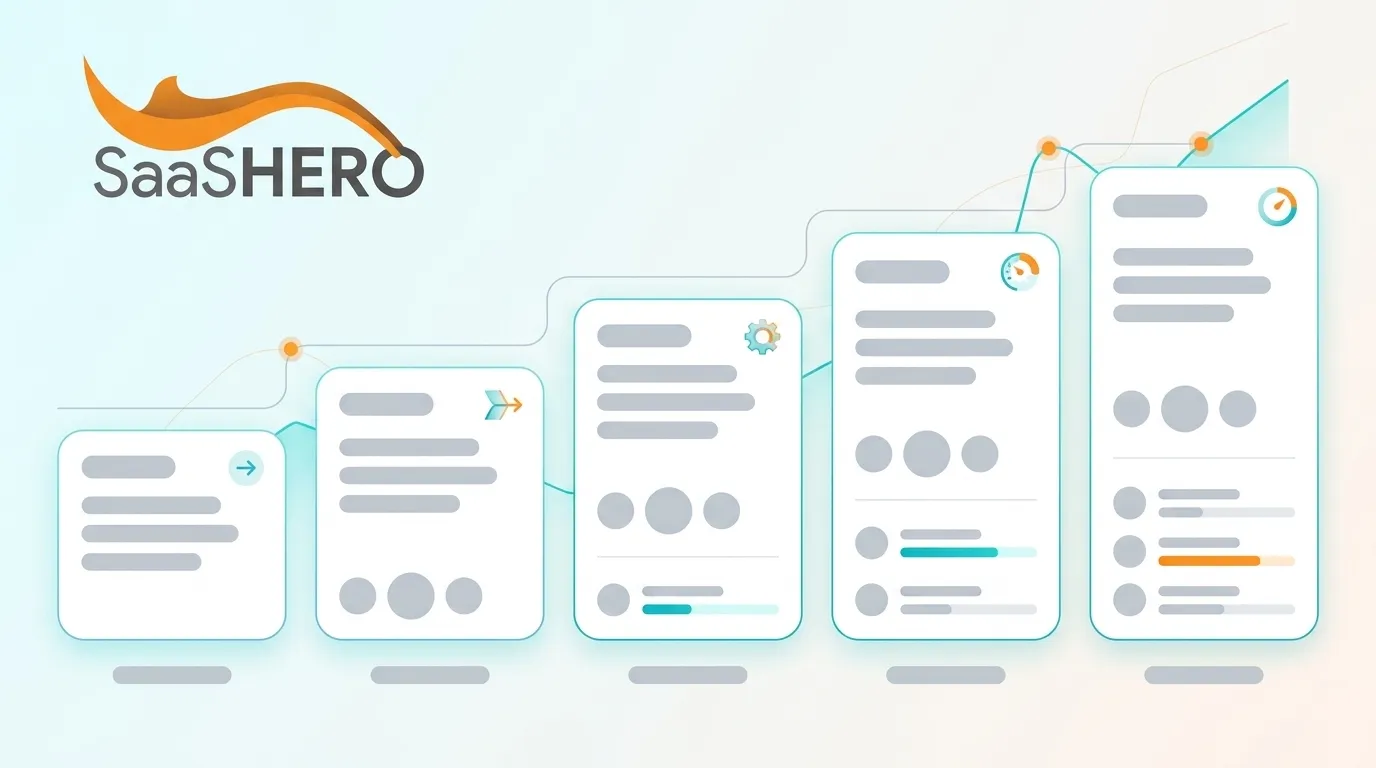
The model organizes ABM capability into five sequential stages: Experimentation, Structure, Alignment, Intent-Driven, and Optimized. Each stage is defined by four dimensions that directly affect SaaS revenue performance.
Pipeline Velocity measures how quickly qualified opportunities move through the funnel. Calculate it as opportunity count multiplied by win rate and ACV, then divided by average sales cycle length. Average Contract Value (ACV) reflects the annualized revenue per closed deal and acts as a primary lever for improving capital efficiency without increasing volume. Net Revenue Retention (NRR) captures expansion, contraction, and churn within the existing customer base, which separates durable SaaS businesses from leaky ones. Payback Period measures how many months of gross margin are required to recover the fully loaded cost of acquiring a customer, the number that investors use to evaluate scalability.
Advancing through the five stages is a revenue architecture decision, not a marketing project. It requires cross-functional ownership, tooling investment, and a partner model aligned to closed-won outcomes rather than impression volume.
10-Question SaaS ABM Maturity Self-Assessment
This self-assessment helps you identify your current stage before you dive into the stage playbooks. The ten questions test for the infrastructure and capabilities that define each level.
If you answer “no” to questions 1 or 2, you sit at Stage 1. If you cannot answer questions 4 or 7 with specific numbers, you have not reached Stage 3. Questions 5 to 7 highlight Stage 4 readiness, and questions 8 to 10 separate Stage 4 from Stage 5 programs.
1. Does your team have a documented ICP with at least five firmographic filters validated against closed-won data? If no, you are at Stage 1. If yes, continue.
2. Can you trace a closed-won deal back to a specific ABM campaign touch at the account level in your CRM? If no, your Stage 2 infrastructure is incomplete regardless of how sophisticated your campaigns appear.
3. Do sales and marketing share a single pipeline velocity target reviewed weekly? If no, you are operating at Stage 2 or below regardless of your intent data investment.
4. What is the ACV premium of deals sourced from your target account list versus non-ABM pipeline? If you cannot answer this, your attribution model is not yet at Stage 3.
5. Are third-party intent signals from a platform like 6sense or Bombora actively routing accounts to sales plays? If no, you have not yet reached Stage 4.
6. Do you have active competitor conquest campaigns with dedicated landing pages segmented by pricing, problem, and review intent? If no, you are leaving high-intent pipeline on the table at every stage above Stage 2.
7. What is your current payback period for ABM-sourced customers? If you cannot calculate this, your program is not yet generating the board-level evidence needed to justify Stage 4 investment.
8. Is your ABM program running expansion sequences against existing customers approaching renewal? If no, your program is acquisition-only and NRR is not yet a program metric, which signals a Stage 4 to 5 gap.
9. Does your agency or execution partner report on Net New ARR and pipeline velocity, or on impressions and click-through rate? If the latter, the partner model is structurally preventing your stage progression.
10. Does your ABM program inform product roadmap decisions based on intent topic clusters from target accounts? If yes, you are operating at or near Stage 5.
SaaS ABM Maturity Model Stages Overview
The table below maps each stage to its defining capabilities. It shows how intent-data sophistication and sales-marketing alignment advance together as programs mature.
| Stage | Key Capabilities | Intent-Data Usage | Sales-Marketing Interlock |
|---|---|---|---|
| 1 — Experimentation | ICP hypothesis defined, first target account list built manually, one channel activated | None or basic firmographic filtering | Ad hoc, no shared pipeline metric |
| 2 — Structure | Documented ICP, tiered account lists, repeatable campaign templates, basic CRM tagging | First-party web intent (page visits, form fills) | Shared MQL definition, weekly syncs begin |
| 3 — Alignment | Unified revenue target, multi-channel orchestration, account scoring model live | Third-party intent layered onto first-party signals | Joint pipeline review, shared SQL and pipeline velocity targets |
| 4 — Intent-Driven | Dynamic account prioritization, AI-assisted content personalization, competitor conquest sequences active | Real-time intent triggers routing accounts to sales plays | Revenue operations owns the interlock, SLA on account response time |
| 5 — Optimized | Predictive account scoring, full-funnel attribution to NRR, expansion ABM running alongside acquisition | Predictive intent models informing budget allocation | Single revenue number owned jointly, ABM informs product roadmap |
Stage 1: Experimentation — 90-Day Action Plan and ARR Timeline
Stage 1 teams have identified that ABM is the right motion but have not yet formalized the infrastructure to run it. The ICP exists as a shared intuition rather than a documented, data-validated profile. Target account lists come from founder memory or a single data source. One channel, typically LinkedIn or Google paid search, runs without a dedicated account-level measurement framework.
90-Day Action Plan: In the first 30 days, conduct a closed-won analysis of the last 12 months of deals to extract firmographic and technographic patterns, then document the ICP with at least five firmographic filters and two behavioral signals. This validated profile becomes the foundation for targeting. In days 31 to 60, use that documented ICP to build a Tier 1 target account list of 50 to 100 accounts using a tool such as Demandbase or LinkedIn Sales Navigator. In days 61 to 90, activate one paid channel against that list, establish CRM account-level tagging to track which accounts engage, and define a single North Star metric, pipeline velocity, calculated as opportunities per month from target accounts multiplied by average ACV.
ARR Timeline: Stage 1 programs are typically run by SaaS companies in their early growth phase. The primary goal is validation, confirming that the ICP hypothesis produces higher win rates and shorter sales cycles than non-ICP traffic. A successful Stage 1 exit produces at least three closed-won deals traceable to the target account list within 90 days.
2026 AI and Intent Tooling: At Stage 1, AI tooling should stay focused on ICP research acceleration, using tools like Clay or Apollo to enrich account lists with technographic data. Teams should avoid full intent data subscriptions until first-party signals are captured and acted upon.
Stage 2: Structure — 90-Day Action Plan and ARR Timeline
Stage 2 is where most SaaS ABM programs stall, and where the traditional agency model does the most damage. A documented ICP exists, campaign templates are repeatable, and CRM tagging is in place. The program still fails to generate compounding pipeline velocity because the sales-marketing interlock remains informal and revenue attribution stops at the MQL.
The structural failure at Stage 2 is often accelerated by percentage-of-spend agency models that are financially incentivized to report on impressions and click-through rates rather than pipeline and closed-won revenue. When the agency fee grows with budget rather than with results, no forcing function exists to advance the program to Stage 3.
90-Day Action Plan: Days 1 to 30, implement account-level tracking that passes click data through to CRM opportunity records, connecting Google Click IDs or LinkedIn Insight Tag data to HubSpot or Salesforce. This creates the attribution backbone. Days 31 to 60, establish a weekly sales-marketing pipeline review with a shared definition of a Sales Qualified Account so both teams work from the same criteria. Days 61 to 90, build a tiered account list (Tier 1, Tier 2, Tier 3) with differentiated spend and personalization levels per tier, which sets up scalable execution.
ARR Timeline: Stage 2 programs are typically run by SaaS companies that have moved beyond initial experimentation. The exit criterion is a measurable improvement in pipeline velocity, specifically a reduction in average sales cycle length of 10 to 15 percent for Tier 1 accounts compared to non-ABM pipeline.
2026 AI and Intent Tooling: Teams at Stage 2 should activate first-party intent capture such as high-value page visits, pricing page engagement, and competitor comparison page views. These signals should trigger sales alerts in Slack or CRM. This capability becomes the foundation for the third-party intent layer that Stage 3 requires.
Stage 3: Alignment — 90-Day Action Plan and ARR Timeline
Stage 3 marks the transition from a marketing-led program to a revenue-team program. Sales and marketing share a single pipeline number, a joint account scoring model is live, and multi-channel orchestration runs across paid search, LinkedIn, and direct outbound sequences against the same target account list.
90-Day Action Plan: Days 1 to 30, implement a third-party intent data layer from a platform such as 6sense or Bombora, overlaying buying-stage signals onto the existing account scoring model. Days 31 to 60, build account-specific landing pages for Tier 1 accounts, personalized by vertical, use case, or competitor displacement. Days 61 to 90, establish a joint pipeline velocity target as the primary program KPI reported to the board.

ARR Timeline: Stage 3 programs are typically run by SaaS companies in the growth phase. The exit criterion is a documented increase in ACV from ABM-sourced deals versus non-ABM deals, with an ACV premium serving as a useful indicator.
2026 AI and Intent Tooling: Teams at this stage can use AI-assisted content personalization to adjust landing page messaging dynamically based on the account’s detected intent topic cluster. Tools like Mutiny or Intellimize can execute this without engineering resources.

Stage 4: Intent-Driven — 90-Day Action Plan and ARR Timeline
Stage 4 programs use real-time intent signals to dynamically prioritize accounts and route them to the appropriate sales play without manual intervention. Competitor conquest sequences run continuously, so accounts showing intent on competitor keywords or visiting competitor review pages automatically enter a displacement campaign. Revenue operations owns the sales-marketing interlock with a formal SLA on account response time.
90-Day Action Plan: Days 1 to 30, build automated intent-triggered workflows. When an account crosses a defined intent threshold, a sales alert fires, a LinkedIn ad sequence activates, and a personalized email is queued. Days 31 to 60, launch competitor conquest landing pages targeting the three highest-overlap competitors, using pricing intent, problem intent, and review intent as distinct audience segments. Days 61 to 90, measure and improve the account response SLA, the time between an intent signal firing and a sales touch, targeting under four business hours for Tier 1 accounts.
ARR Timeline: Stage 4 programs are typically run by SaaS companies at a more advanced scale. The primary revenue metric is payback period improvement. Programs at this stage often target a payback period under 12 months, with best-in-class programs achieving strong results on this metric.

2026 AI and Intent Tooling: Teams can deploy AI-generated account briefs that synthesize intent signals, firmographic data, and CRM history into a one-page sales context document delivered to the account executive before the first call. This reduces sales cycle friction and increases first-call conversion rates.
Stage 5: Optimized — 90-Day Action Plan and ARR Timeline
Stage 5 programs have closed the loop between acquisition ABM and expansion ABM. Predictive account scoring informs budget allocation across both new logo and existing customer programs. Full-funnel attribution connects ad impressions to NRR, so the program can demonstrate its contribution to expansion revenue and churn prevention, not just new pipeline. ABM insights feed product roadmap decisions.
90-Day Action Plan: Days 1 to 30, build an expansion ABM program targeting existing customers in the 60 to 90 days before renewal, using intent signals to identify upsell readiness. Days 31 to 60, implement predictive budget allocation that uses historical performance data to shift spend automatically toward account segments showing the highest propensity to close. Days 61 to 90, establish a quarterly ABM-to-board reporting cadence that presents pipeline velocity, ACV, NRR contribution, and payback period as a unified revenue narrative.
ARR Timeline: Stage 5 programs are typically run by more mature SaaS companies. At this stage, the NRR threshold mentioned earlier becomes the defining success metric, proving that expansion revenue offsets churn without requiring proportional new logo acquisition spend.
2026 AI and Intent Tooling: Predictive intent models trained on the program’s own closed-won and churned account data replace generic third-party intent scores. This proprietary signal layer becomes a durable competitive advantage that competitors using the same off-the-shelf intent platforms cannot easily match.
Common ABM Pitfalls That Keep SaaS Teams at Stage 2
The most common reason SaaS ABM programs stall at Stage 2 is not a tooling gap. It is an incentive misalignment in the execution partner. Percentage-of-spend agency models create a structural conflict because the agency’s revenue grows when budget grows, not when pipeline velocity grows. As a result, the agency is financially incentivized to recommend higher spend rather than to advance the program’s capability maturity.
The second pitfall is reporting on vanity metrics. An agency that presents impressions, clicks, and CTR as primary KPIs obscures its inability to connect spend to closed-won revenue. SaaSHero anchors every engagement to Net New ARR and pipeline value instead, which requires CRM integration that passes click data through to opportunity records. That integration creates the attribution infrastructure that makes stage progression measurable rather than theoretical.
The third pitfall is the 12-month lock-in contract. When an agency cannot be replaced for a year, the urgency to deliver stage-advancing results disappears. SaaSHero’s month-to-month model creates a forcing function. The program must demonstrate pipeline impact every 30 days, which structurally accelerates the stage jump from 2 to 3.
The fourth pitfall is activating intent data before the sales-marketing interlock is formalized. Intent signals without a defined response workflow generate noise, not pipeline. The sequence matters, with interlock first, then intent data, then AI personalization.
Three SaaS Team Archetypes and Their Maturity Stages
The Overwhelmed Founder ($500K–$5M ARR, Stage 1): This founder runs Google Ads on weekends and has an intuitive ICP but no documented account list and no CRM attribution. The 90-day priority is ICP documentation and first-party intent capture, not intent data subscriptions. SaaSHero’s Dedicated Campaign Manager tier at a flat monthly fee removes the risk of a long-term agency commitment while building the Stage 1 infrastructure.
The Frustrated VP of Marketing ($5M–$20M ARR, Stage 2): This VP has campaigns running, a CRM in place, and a budget, but the agency sends a PDF of impressions while the CEO asks about pipeline. The program is structurally stuck because the execution partner cannot speak the language of pipeline velocity or ACV. The 90-day priority is replacing vanity-metric reporting with CRM-connected attribution and establishing a joint sales-marketing pipeline review.
The Post-Funding Scaler ($10M–$50M ARR, Stage 3–4): This team has fresh funding and aggressive growth targets and needs to compress the timeline from Stage 3 to Stage 4 without the three-month lag of building an in-house team. The 90-day priority is activating competitor conquest sequences and third-party intent routing simultaneously, the combination that drove TestGorilla to an 80-day payback period and a $70M Series A.
SaaS ABM Maturity Model FAQ
How much budget does a SaaS team need to advance from Stage 1 to Stage 3?
The budget threshold matters less than the allocation logic. Stage 1 to Stage 2 progression requires investment in CRM attribution infrastructure, typically a one-time setup cost, and a single paid channel running against a documented target account list. Stage 2 to Stage 3 requires adding a third-party intent data subscription and building account-specific landing pages. A team spending $10,000 to $25,000 per month on paid media with proper attribution and a performance-aligned execution partner can reach Stage 3 within six months. The structural barrier is rarely budget. It is usually the absence of a sales-marketing interlock and a partner model tied to pipeline outcomes rather than spend volume.
Who should own the ABM maturity roadmap, marketing, sales, or revenue operations?
At Stage 1 and Stage 2, marketing typically owns the program because the primary work is ICP definition and campaign infrastructure. At Stage 3, ownership should shift to a joint revenue team structure with a shared pipeline velocity target. At Stage 4 and Stage 5, revenue operations becomes the most effective owner because the program requires cross-functional SLA management, attribution modeling, and budget allocation logic that spans both acquisition and expansion. The transition of ownership from marketing to revenue operations is itself a reliable signal of Stage 3 to Stage 4 progression.
How long does it realistically take to advance one full stage in the SaaS ABM maturity model?
With a dedicated execution partner and an active sales-marketing interlock, a single stage jump typically takes 60 to 90 days. Without those conditions, such as when using a percentage-of-spend agency that reports on vanity metrics, programs can remain at Stage 2 for 12 to 18 months without measurable progression. The 90-day action plans in this guide serve as the minimum viable roadmap for a stage jump, assuming the execution partner aligns to pipeline velocity rather than spend volume.
What intent data tools are most relevant for mid-market SaaS ABM programs in 2026?
For Stage 2 programs activating first-party intent, the priority is capturing high-value page visits such as pricing pages, competitor comparison pages, and ROI calculator interactions, then surfacing them to sales in real time via CRM alerts. For Stage 3 programs adding third-party intent, 6sense and Bombora are the most widely adopted platforms for mid-market SaaS, with 6sense offering stronger predictive account scoring and Bombora offering broader topic coverage. For Stage 4 programs building AI-assisted personalization, Mutiny and Clay are the most operationally accessible tools for teams without dedicated engineering resources. The sequencing matters, with first-party capture before third-party subscription, and third-party signals before AI personalization.
How does NRR connect to ABM program maturity?
NRR becomes a primary ABM metric at Stage 4 and Stage 5, when expansion ABM sequences run alongside acquisition programs. At earlier stages, NRR functions as an outcome metric that reflects ICP quality. Teams with a well-validated ICP at Stage 2 will see higher NRR than teams running broad campaigns because ICP-fit customers expand and churn at lower rates. The direct connection between ABM maturity and NRR is the expansion sequence. Proactively targeting existing customers approaching renewal with intent-triggered campaigns is the mechanism that pushes NRR above 110 percent, the threshold that signals a self-sustaining SaaS growth engine.
Turn Your ABM Assessment Into a Revenue Roadmap
The SaaS ABM maturity model stages in this guide function as a diagnostic operating system for revenue leaders who need to move pipeline faster, increase ACV, and defend NRR in a capital-efficient environment. The five stages give you a precise location on the maturity curve, a 90-day action plan to advance, and the ARR benchmarks to validate that progression is real.
The most important decision is not which intent data platform to buy or which AI tool to activate. It is whether your execution partner is structurally aligned to your revenue outcomes. A flat-fee, month-to-month model that reports on Net New ARR and pipeline velocity creates the structural prerequisite for stage progression. A percentage-of-spend agency reporting on impressions creates the structural barrier that keeps programs at Stage 2.