




Written by: Aaron Rovner, Founder, Saas Hero | Last updated: September 3, 2026
Key Takeaways
- A SaaS GTM framework is a five-pillar decision chain: ICP, value proposition, pricing, motion, and metrics. Each pillar constrains the next.
- A poorly defined ICP cascades errors through messaging, pricing, and channel selection, which wastes budget and misaligns buying committees.
- Pricing and packaging choices set your ACV and determine which GTM motion is economically viable for your business.
- Tracking CAC payback, LTV:CAC, and NRR from day one creates a feedback loop that shows which pillar to revisit when metrics break.
- Schedule a free discovery call with SaaSHero to pressure-test your current GTM framework and turn strategy into a working demand engine.
Pillar 1: Market & ICP — Define Who You Can Win and Keep
Your ICP is an operational definition of the company most likely to buy, stay, and expand. It goes far beyond a simple demographic sketch and draws from three signal types:
- Firmographics: Industry, company size, revenue band, geographic region
- Technographics: Current software stack, integration requirements, platform investments
- Behavioral signals: Hiring patterns, funding events, regulatory changes, content consumption
| ICP Component | Example |
|---|---|
| Company profile | B2B software, $10M–$50M revenue, 100–500 employees |
| Department & role | VP Marketing reporting to CEO |
| Technographic trigger | Runs HubSpot, no paid media specialist on staff |
| Behavioral trigger | Current agency underperforming; board pressure on pipeline |
| Pain point | “We constantly have to tell our agency what to do” |
| Value driver | Pipeline sales accepts, not lead volume |
ICP choices shape which problems matter, which messages resonate, and which channels can reach your buyers. Skip this work and every downstream pillar inherits the ambiguity. The B2B customer journey involves multiple stakeholders — finance, accounting, procurement — and includes consensus-building at every stage, so an imprecise ICP produces misaligned messaging across the entire buying committee.
With your ICP defined, the next decision is what to say to them, which leads directly into Pillar 2.
Pillar 2: Value Proposition & Messaging — Say What Your ICP Actually Cares About
Your value proposition describes the specific outcome your ICP achieves by using your product, stated in their language. It does not read like a product spec sheet. Build a messaging matrix that maps directly to your ICP’s pain points:
- Problem: What does your ICP struggle with weekly? (e.g., “We have to babysit our agency”)
- Solution: How does your product resolve it? (e.g., “One team that owns strategy and execution”)
- Proof: What evidence supports the claim? (e.g., “Proven track record with B2B SaaS clients”)
- Differentiation: Why you versus alternatives? (e.g., “Optimized against CRM revenue data, not form fills”)
Messaging only lands when it speaks to the ICP you defined in Pillar 1. A generic value proposition usually signals an undefined or fuzzy ICP. B2B purchasing decisions focus on price, efficiency, productivity, and return on investment, so outcome-first messaging outperforms feature lists at every stage of the funnel.
Once you know who you serve and what you promise them, you can decide how to charge for that value in Pillar 3.
Pillar 3: Pricing & Packaging — Match Revenue to the Value You Deliver
Pricing is a GTM decision that determines which motion you can afford, which buyers you can reach, and whether your unit economics hold up. Common SaaS pricing models include:
- Flat rate: One price, all features. Simple but often leaves money on the table.
- Per-seat: Charged per user. Familiar but can penalize usage growth.
- Usage-based: Charged by consumption. Aligns with value delivered but creates revenue unpredictability.
- Tiered: Multiple packages (Starter, Pro, Enterprise). Most common for B2B SaaS.
The 3 3 2 2 2 rule helps structure tiers with clear constraints:
- 3 core features
- 3 differentiators
- 2 integrations
- 2 pricing tiers
- 2 add-ons
This rule limits choices so positioning and sales execution stay clear. Treat it as a starting point that keeps you out of the feature-bloat trap that makes tiers incomprehensible.
Pricing pressure is also intensifying structurally. Gartner projects that 40% of enterprise SaaS will shift to outcome-based pricing by 2030, and 83% of AI-native SaaS companies have already adopted outcome-based pricing models. AI-native vendors are moving faster than traditional SaaS toward monetizing results rather than licenses.
Your pricing model sets your ACV, which then dictates whether a sales-led, product-led, or hybrid motion is economically viable. A $5K ACV cannot support a high-touch sales motion, while a $100K ACV cannot rely on self-serve alone.
With ACV defined, you can now choose the GTM motion and channels that your economics can sustain in Pillar 4.
Pillar 4: GTM Motion & Channels — Turn Strategy into a Repeatable Path to Revenue
Your GTM motion answers a single idea: how a prospect becomes a customer from first touch to closed-won.
| Motion | Best When | Examples |
|---|---|---|
| Sales-led | ACV > $25K, complex buying committee, consultative sale | Enterprise software, vertical SaaS |
| Product-led | ACV < $5K, low complexity, self-serve onboarding | Collaboration tools, dev tools |
| Hybrid | $5K–$25K ACV, product-led acquisition with sales-led expansion | Modern B2B SaaS |
Channel selection follows the motion. Sales-led motions rely on outbound SDR teams, ABM platforms, field events, and partnerships. Product-led motions depend on in-product onboarding, viral loops, content marketing, and self-serve trials. Hybrid motions often combine paid search for demand capture, paid social for demand creation, and content for education.
The primary constraint for SaaS startups is now distribution rather than development, which makes channel selection and GTM motion execution more consequential than ever. A misaligned motion does more than slow growth; it misallocates budget against a structural ceiling.
A sales-led motion with a $50K ACV cannot justify broad paid social spend against cold audiences because CAC payback stretches past viability. A product-led motion cannot rely on outbound SDRs because the ACV cannot support the cost.
Talk to SaaSHero about your GTM motion to confirm which motion your ACV supports and where your current channel mix is out of sync.
Pillar 5: Metrics & Retention — Build the Feedback Loop That Keeps You Honest
The final pillar closes the loop and validates the first four. Your metrics show whether pillars 1–4 are working, and retention reveals whether the revenue you acquire is worth acquiring. These metrics work as a system: CAC payback shows how fast you recover spend, while NRR shows whether that spend compounds.
- CAC (Customer Acquisition Cost): Total sales and marketing spend ÷ new customers acquired
- LTV (Lifetime Value): ARPA × gross margin ÷ churn rate
- LTV:CAC ratio: 3:1 is the healthy benchmark for SaaS
- CAC payback period: Under 12 months is strong
- NRR (Net Revenue Retention): Above 100% means growth from existing customers alone
- Pipeline coverage: Pipeline ÷ target, typically 3–4x, with 3:1 to 5:1 common depending on win rate and segment
The RevOps mandate is a shared data foundation across marketing, sales, and customer success. When marketing optimizes to form fills and sales focuses only on SQLs, the disconnect produces a familiar pattern: lead volume rises while pipeline stays flat. B2B customers typically have a higher customer lifetime value because they make repeat purchases over time, often involving larger transaction values, so optimizing toward the wrong conversion event compounds cost across a long sales cycle.
Many B2B SaaS companies struggle to anchor campaigns on CRM data rather than form submissions. SaaSHero’s measurement architecture addresses this gap by separating primary from secondary conversions, pushing lifecycle stage events back into ad platforms, and building dashboards that connect ad spend to pipeline instead of raw form-fill counts.

Metrics act as a feedback loop, not a reporting chore. CAC payback stretched past 12 months points you back to pricing in Pillar 3 or motion in Pillar 4. NRR below 100% points you back to ICP in Pillar 1 because you are acquiring the wrong customers.
The decision chain holds even as the market shifts, which sets up the role of AI in modern GTM.
GTM in the Age of AI: Apply the Decision Chain to a Changing Market
AI is not killing SaaS as a model; it is exposing SaaS companies with undifferentiated products and inefficient GTM engines. Three structural shifts now shape how the five pillars operate:
- Buyer research: AI Overviews and ChatGPT now mediate a significant share of B2B software research. If your content is not AI-optimized and cited by these systems, you disappear from the consideration set before a sales conversation starts.
- Pricing pressure: As noted in the pricing pillar, outcome-based pricing is becoming the norm, and AI-native vendors are leading that shift.
- Distribution constraint: The distribution constraint discussed earlier now dominates GTM strategy, which makes execution quality a primary competitive advantage.
The sequence itself has not changed. ICP, value proposition, pricing, motion, and metrics still govern success. AI changes the tools and tactics within each pillar, not the order in which you make the decisions.
Is SaaS Still Profitable in 2026?
SaaS remains profitable in 2026 for companies that run disciplined GTM engines. The era of growth-at-all-costs has ended, and boards now ask about CAC payback, LTV:CAC, and NRR before they ask about top-line growth. Profitability in 2026 comes from discipline across four areas:
- Tighter ICP definition reduces wasted spend on the wrong prospects
- Value-based pricing captures what the product is actually worth
- Efficient motions match channel spend to ACV reality
- Retention focus compounds revenue instead of leaking it
Companies struggling with profitability usually run GTM frameworks where the pillars are disconnected. They acquire customers who churn, spend on channels that cannot pay back, and price below the value they deliver. The decision chain acts as a diagnostic: when a metric breaks, it points back to the pillar that produced it.
Build Your Decision Chain, Then Execute with Discipline
The five pillars of a SaaS GTM framework form a decision chain:
- Define your ICP precisely
- Build your value proposition around their pain
- Set pricing that matches the value you deliver
- Choose a motion your ACV can support
- Track metrics that show which pillar to revisit
Get the sequence right and you have a GTM engine that compounds. Get it wrong and every downstream decision inherits the error. Execution often creates the real failure point. The gap between a sound strategy and a working demand engine closes through disciplined execution across campaign structure, conversion tracking, landing page testing, and reporting that connects ad spend to CRM revenue data instead of form-fill counts.
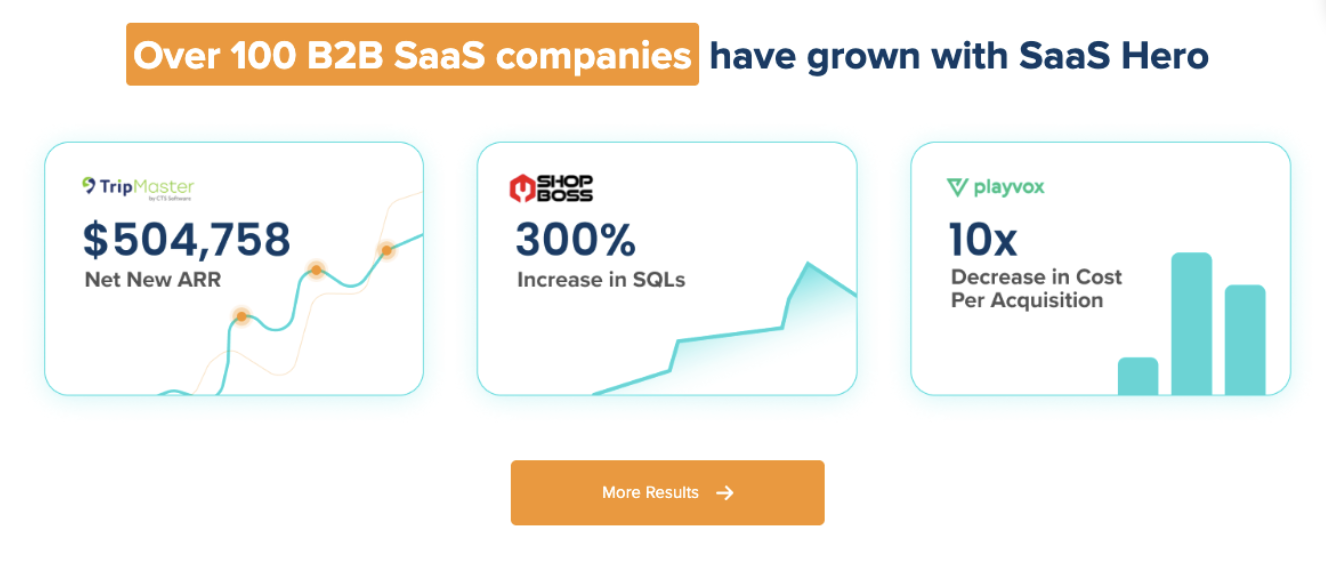
SaaSHero fills that execution gap. As the outsourced inbound growth team for B2B SaaS companies, SaaSHero owns strategy and execution across paid media, creative, landing pages, and reporting, and aligns everything to CRM revenue data. With over $60M in lifetime ad spend managed, 100+ B2B clients served, and Google Premier Partner status, SaaSHero brings the execution discipline your GTM framework requires.

Talk to SaaSHero about turning your GTM framework into a demand engine and translate this decision chain into predictable revenue.
Frequently Asked Questions
What is the 3 3 2 2 2 rule of SaaS?
The 3 3 2 2 2 rule is a pricing tier heuristic: 3 core features, 3 differentiators, 2 integrations, 2 pricing tiers, and 2 add-ons. It forces constraint in packaging, which makes positioning clearer and sales execution simpler. Treat it as a starting point that prevents the feature-bloat that makes tiers incomprehensible to buyers and sales teams. The underlying logic is that too many choices in a pricing menu create decision paralysis for prospects and positioning confusion for the sales team. Applying the rule forces a company to identify what actually matters to its ICP rather than listing every capability the product has shipped.
What is a GTM framework?
A GTM framework is a decision sequence that aligns product, marketing, sales, and customer success around a defined ICP, value proposition, pricing model, distribution motion, and revenue metrics. Each pillar depends on the previous one, so sequence matters. Most published GTM frameworks present these five pillars as parallel workstreams or a checklist. The decision-chain model treats them as sequential constraints: you cannot build a resonant value proposition without a defined ICP, cannot set viable pricing without understanding your value proposition, cannot choose an efficient motion without knowing your ACV, and cannot interpret your metrics without a motion to measure.
Is SaaS being replaced by AI?
AI is replacing SaaS companies with undifferentiated products and inefficient GTM engines, not the SaaS model itself. AI changes buyer research behavior, pricing model expectations, and distribution dynamics, but the core GTM decision chain of ICP, value proposition, pricing, motion, and metrics still governs success. The companies most at risk sell products that solve problems AI can now solve directly, or run GTM engines too inefficient to compete on distribution. Companies with strong NRR, healthy LTV:CAC ratios, and efficient motions continue to grow. The structural shift favors outcome-based pricing and AI-mediated buyer research, which reward precise ICP definitions and clear value propositions.
What is the SaaS apocalypse?
The “SaaS apocalypse” refers to the 2024–2026 market correction where SaaS companies with weak unit economics, high churn, and inefficient GTM engines faced valuation compression and consolidation. This period acts as a discipline filter rather than an industry death knell. Companies with strong NRR, healthy LTV:CAC ratios, and efficient motions continue to thrive. The correction exposed a common failure pattern: companies that grew on cheap capital without locking in ICP, pricing, or retention discipline discovered that their GTM frameworks were collections of disconnected tactics instead of a compounding system. The decision-chain model offers a structural answer to that failure pattern.
How does SaaSHero help B2B SaaS companies execute their GTM framework?
SaaSHero operates as the outsourced inbound growth team for B2B SaaS companies, with one team owning strategy and execution across paid media, creative, landing pages, and reporting. Measurement creates the critical difference from a conventional agency. SaaSHero optimizes against CRM outcomes such as qualified pipeline, lifecycle stage, and closed revenue rather than the form-fill counts ad platforms report by default. This approach trains the ad platforms’ bidding algorithms on the right signals, produces reporting that answers board-level questions about CAC payback and pipeline coverage, and frees the marketing leader from acting as strategist, project manager, and quality control for a vendor hired to hold those roles. With over $60M in lifetime ad spend managed across 100+ B2B companies and Google Premier Partner status, SaaSHero brings both pattern recognition and execution depth that mid-market SaaS GTM frameworks require.