




Written by: Aaron Rovner, Founder, Saas Hero
Key Takeaways
- Agency scope often stops at the ad platform, but accountability that stops there quietly kills pipeline in sales-led B2B motions.
- Ownership of ad accounts, pixels, and audiences is negotiable and belongs in the contract before campaigns launch.
- Optimizing toward form fills instead of CRM-qualified outcomes creates a self-fulfilling loop where cost per lead falls while pipeline stays flat.
- Client-owned accounts with agency partner access protect data history, algorithm learning, and offboarding speed when the relationship ends.
- SaaSHero closes these scope gaps by owning the full path from impression to CRM record under a flat retainer model.
Schedule Your Discovery Call With SaaSHero
Why An Agency’s Scope Usually Stops At The Ad Account
Three boundaries shape every paid media relationship. Scope defines where the agency’s responsibility ends, usually at the ad platform, and that is often legitimate. Ownership defines who holds admin access to the account, pixel, and audiences, which is negotiable and should be set in the contract. Accountability defines who owns the path from impression to CRM record, which is where real damage appears.
Most “hostage situation” stories come from one of these boundaries being misidentified as another. An agency that stops at the ad platform is often doing exactly what it was hired to do. An agency that holds admin access when the client should hold it is exercising a negotiable choice. An agency whose accountability ends before the CRM can quietly kill pipeline, because nobody owns the full path from click to qualified opportunity.
Talk With SaaSHero About Your Current Scope
The Three Boundaries Of A Paid Media Engagement
The table below shows how scope, ownership, and accountability differ, and which boundaries signal normal practice versus real risk.
| Boundary | What It Governs | Normal Or Warning Sign |
|---|---|---|
| Scope | Where the agency's responsibility ends | Normal, usually the ad platform, for structural reasons |
| Ownership | Who holds admin access to account, pixel, audiences | Negotiable, should be settled in the contract, never left to default |
| Accountability | Who owns the path from impression to CRM record | Warning sign when it stops at the ad platform, because this is where pipeline quietly dies |
Scope stopping at the ad platform reflects industry norms shaped by pricing, liability, and team structure. Ownership sitting with the agency reflects contract choices that can and should change. Accountability stopping at the ad platform is the real risk, because a sales-led B2B motion needs visibility and control that extend into the CRM.
Why The Scope Legitimately Ends At The Ad Platform
Understanding why scope normally stops at the ad platform helps separate healthy boundaries from harmful ones. The conventional paid media retainer is scoped to the ad account for structural reasons rather than conspiracies. Performance marketing agency statements of work are typically defined at the platform level, covering campaign setup, audience architecture, bid strategy, and reporting, because those are the levers the agency can directly control.
Four structural facts hold this boundary in place. First, per-channel pricing means the fee tracks channel count, so testing a new channel raises the client's cost before it returns anything. Under the prevailing per-channel pricing arrangement, the agency fee tracks how many channels an agency manages, so adding a channel raises the client's fees. Second, liability and platform terms sit with the account owner. The client remains responsible for policy compliance even when an agency manages their ad account. Third, the landing page usually belongs to the client's web team, and the CRM belongs to RevOps. Fourth, the conversion definitions often belong to whoever configured the tag manager years earlier, who may no longer be at the company.
Clear explanation of this legitimate boundary makes the harmful version easier to recognize. An agency hired to manage the ad platform and measured on platform metrics behaves normally when it stops there. An agency that stops at the ad platform and then reports form fills as if they were pipeline outcomes creates a structural gap that often results in a missed quarter.
What A Narrow Scope Actually Costs A B2B SaaS Company
A narrow scope can feel harmless on paper, yet it creates serious downstream cost for a VP of Marketing whose lead volume is up, cost per lead is down, and sales-accepted opportunities are flat.
In a sales-led B2B motion with a long cycle and a buying committee, an ad account scoped only to the platform optimizes toward whatever conversion event the platform can see, usually a form fill. Ad platforms track platform-level events detectable by their pixels, whereas CRMs only record a conversion after human review, qualification, and pipeline progression.
The bidding algorithm then finds more people who fill out forms, including students, job seekers, competitors, and existing customers. Ad platform algorithms optimize for whatever conversion event they are given by default. As a result, cost per lead falls and lead volume rises, but sales-accepted opportunities stay flat, so the quarterly pipeline number is missed anyway.
This pattern creates a self-fulfilling loop. Poor attribution data feeds directly back into ad platform algorithms, which then target audiences that look like reported conversions rather than actual customers. The longer this continues, the harder it becomes to unwind.
The agency cannot fully fix this from inside the ad account. It cannot change the landing page headline, which is often the most powerful lever for post-click conversion. It cannot redefine what the CRM counts as qualified. It can only improve the half of the equation it controls and report on that half. The real issue is that the standard agency scope is structurally too narrow for a sales-led B2B motion.
Review Your Scope And Data With SaaSHero
Who Should Own The Ad Account, Pixel, And Audiences
Ownership is negotiable, and the details matter because platforms and AI systems respond to specific configurations, not opinions.
Google Ads has five access levels: Email-only, Billing, Read-only, Standard, and Admin. Only Admin can grant or change access, accept or reject manager link requests, and unlink managers, while Standard users can edit campaigns and billing but cannot remove an agency. A Google Ads manager account (MCC) is only an access layer, because campaigns, conversion history, and billing sit in the client's own account. There is no legitimate operational reason for an agency to deny a client admin access to the client's own account.
Meta Business Manager uses a two-layer permission system. The correct method for granting an agency access is partner access by Business ID, where the owning business assigns exactly which assets the agency can touch. A business should own the Page, ad account, pixel or dataset, and catalog inside its own Business Manager. Agencies should receive revocable access, not ownership.
Genuinely non-transferable assets require clear expectations. When ownership sits with the agency and the relationship ends, the client typically loses the account's historical conversion data and accumulated Smart Bidding or Advantage+ learning. Pixel history, custom audience data, conversion history, Smart Bidding learning, and Quality Score signals are account-specific and do not transfer if a new account is started. The client should therefore hold the account itself so that these assets remain with the business that funded them.
When An Agency-Owned Account Gets Disabled
Many readers searching this topic are dealing with a disabled or suspended ad account and need clarity on who can act.
Who holds admin access determines how quickly the appeal is filed. If an agency creates the ad account or dataset inside its own portfolio, the client's spend history and learning are trapped when the relationship ends, and offboarding becomes a negotiation instead of a revocation. If the agency holds admin and the client holds read-only, the client cannot file the appeal, cannot see the enforcement notice, and must wait for the agency to move. Agencies with official Meta Business Partner status report recovering around 70% of suspended client accounts, partly because their structure and support channels are clean, yet that recovery still depends on the agency acting.
Access structure therefore determines whether a disabled account becomes a two-day problem or a two-week disruption.
What To Put In The Contract
Clear contract language prevents ownership disputes and protects pipeline when relationships change.
What The Client Should Hold
- Admin access to every ad account
- Billing and payment profile ownership
- The pixel and dataset inside the client's own Business Manager
- Custom audiences and conversion history
- The CRM connection and conversion event configuration
What The Agency Should Hold
- Standard or partner access sufficient to run the work
- No ownership of any asset the client paid to build
What To Put In Writing
- Ownership of all accounts and assets from day one
- Portability of data and files on exit
- Offboarding terms with a named deadline, not vague timing
- Responsibility for the appeal and reinstatement process if the account is disabled
Every analytics account, ad account, pixel, and data asset funded by a client's budget should be owned by the client's business in writing, because agency-owned infrastructure becomes a hidden switching cost when the relationship ends.
How To Raise The Scope Question With Your Agency
A productive conversation frames scope as a structural question about accountability, not as an accusation about intent. Most agencies operate inside a standard scope that is too narrow for sales-led B2B, and the pricing model keeps it that way.
Three sentences often work on the next call. “I want to make sure we are optimizing toward pipeline, not just form fills, so can we walk through what conversion events are feeding the bidding algorithm right now? I also want to confirm that our accounts and pixel sit under our Business Manager with your access granted as a partner. I would also like to understand what happens to our data and account history if we ever need to make a change.”
This approach opens a scope discussion rather than a termination notice. Most agencies will engage with it, and refusal to engage sends a clear signal.
What A Properly Scoped Engagement With SaaSHero Looks Like
A properly scoped engagement removes the artificial boundary at the ad platform. At SaaSHero, the same team owns the landing page the campaign points to and the CRM-connected measurement layer that defines what the account optimizes toward.

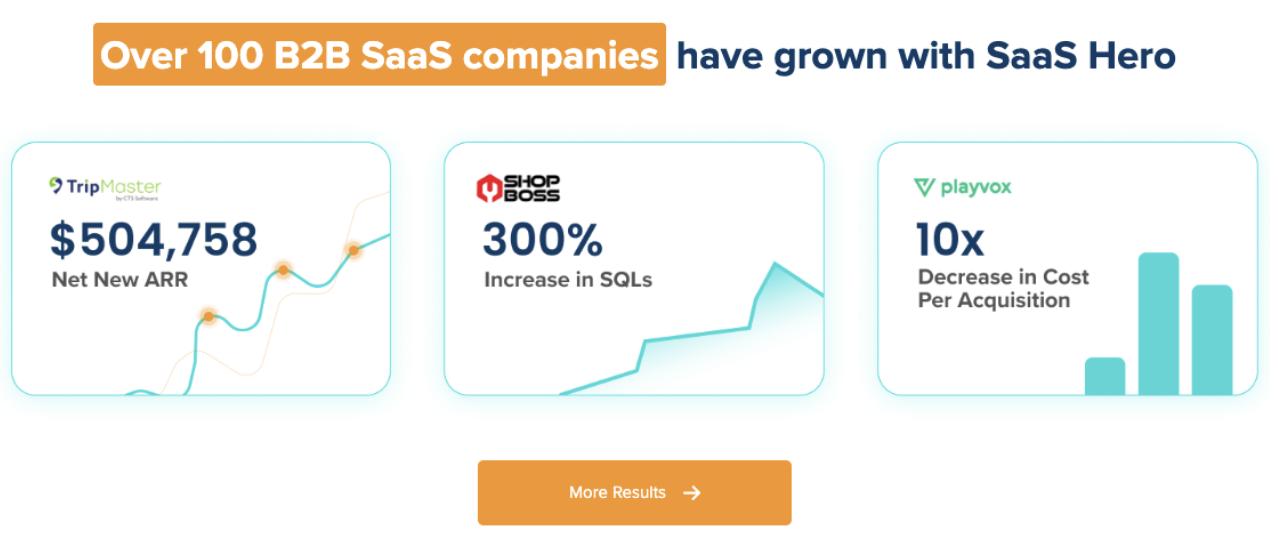
SaaSHero operates as an outsourced inbound growth team for B2B companies, with one team owning strategy and execution across paid media, creative, landing pages, and reporting. Founded in 2018, the firm has served more than 100 B2B companies and manages roughly $16 million in annual advertising spend, with more than $60 million managed over its lifetime. The team includes about 20 full-time specialists, including in-house designers and copywriters, and does not outsource execution. SaaSHero is a Google Premier Partner and a long-standing G2 High Performer in the digital marketing category.
The fee is a flat retainer indexed to total monthly ad spend rather than channel count. That structure makes a wider scope practical, because recommending a shift or a new test does not raise the client's cost. The percentage-of-ad-spend model gives agencies a financial incentive to grow the client's budget regardless of whether that growth is optimal, while SaaSHero's flat retainer removes that incentive.
SaaSHero optimizes against CRM outcomes such as qualified pipeline, lifecycle stage, and closed revenue, rather than the form-fill counts the ad platforms report. The client owns all accounts, assets, and files throughout the engagement and on exit. Offboarding follows a clear process instead of a negotiation.

Conclusion
Three boundaries define whether paid media supports or undermines a sales-led B2B motion. Scope stopping at the ad platform is structurally normal. Ownership sitting with the agency is negotiable and belongs in the contract before the first campaign launches. Accountability stopping at the ad platform is the real warning sign, because it quietly kills pipeline while dashboards show improving metrics.

The fix is a scope that owns the whole path from impression to CRM record, with one team accountable for the landing page, conversion architecture, measurement layer, and channel mix, and optimizing toward what the sales team actually closes rather than what the ad platform can see.
SaaSHero will review the account and share a direct assessment, including whether the existing relationship can be salvaged.
Get A Scope And Pipeline Review From SaaSHero