




Key Takeaways
- B2B SaaS companies grow more efficiently when they prioritize channels that drive pipeline and Net New ARR instead of vanity metrics like clicks or raw lead volume.
- Channel selection should match ACV and sales motion, with different mixes for product-led, mid-market, and enterprise sales models.
- Multi-touch attribution, longer lookback windows, and solid data infrastructure improve capital allocation and reveal the true impact of each channel.
- Avoiding vanity metrics, misaligned incentives, and underused AI tools reduces wasted spend and improves CAC payback periods.
- SaaSHero helps B2B SaaS teams design, execute, and measure capital-efficient performance marketing programs; schedule a discovery call to evaluate fit.
Why Strategic Performance Channels Matter For B2B SaaS Growth
B2B SaaS marketing now operates under tighter capital constraints and closer scrutiny of unit economics. Growth-at-all-costs tactics that favored volume over quality no longer hold up against CAC and payback targets.
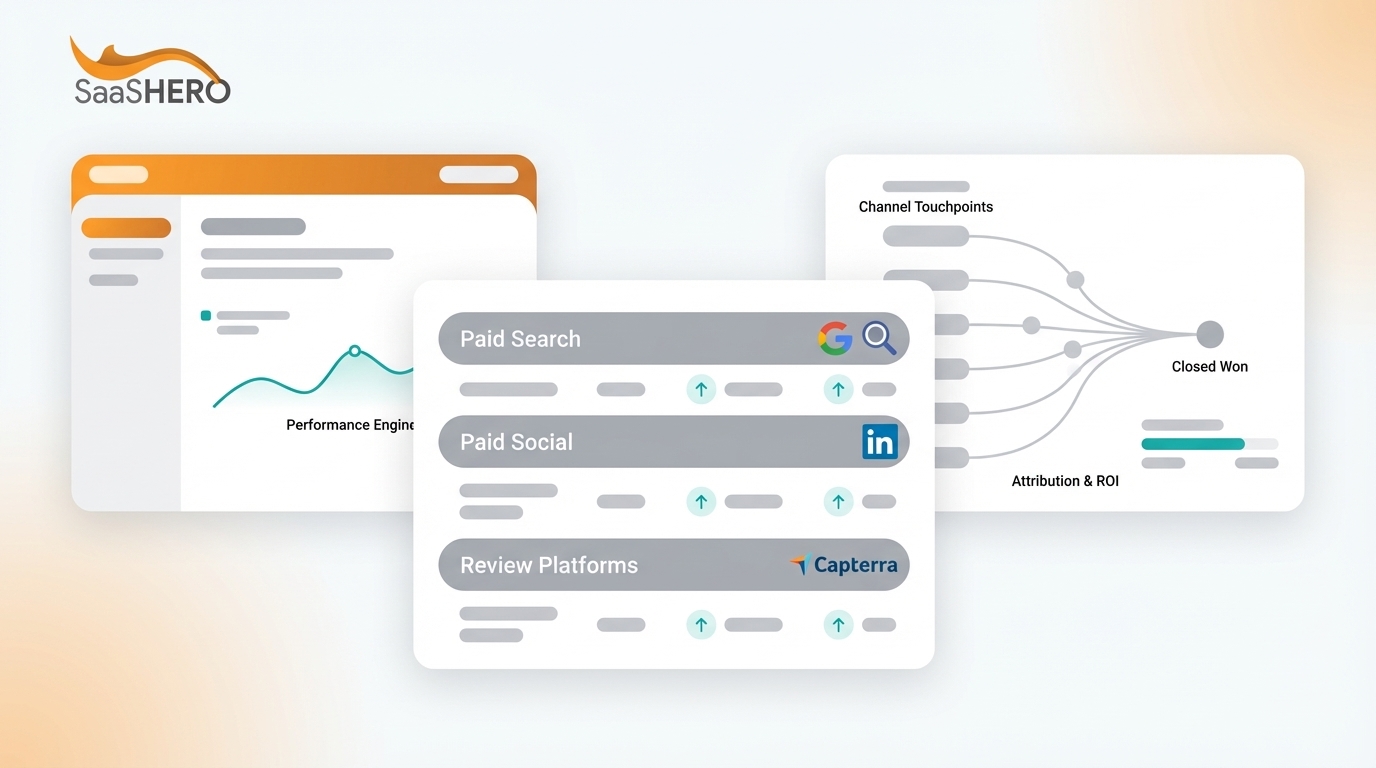
Modern performance marketing focuses on measurable revenue contribution. Effective programs connect each channel and campaign to pipeline, Net New ARR, and payback, not just impressions, clicks, or lead counts.
Teams that attribute revenue to specific activities, adjust budgets quickly, and refine their mix based on data tend to outperform peers that follow trends or competitors.

Core Performance Marketing Channels For B2B SaaS
Paid Search: Capturing High-Intent Buyers
Paid search meets prospects at the moment of active research. Queries like “CRM software,” “[competitor] alternatives,” or “project management tools” often signal commercial intent and near-term buying interest.
Effective programs focus on high-intent keywords, intent modifiers such as “pricing” or “compare,” and optimization for demo or trial requests instead of generic traffic. Competitor terms and problem-based queries can uncover incremental demand that fits your ICP.
Alignment between ads, landing pages, and sales follow-up gives paid search a direct line to pipeline and revenue, especially for clear, high-intent offers.
Paid Social: Reaching And Nurturing B2B Decision-Makers
LinkedIn Ads gives B2B marketers detailed control over audience segments, including job title, seniority, company size, and industry. This precision supports campaigns that speak directly to target personas and buying committees.
Meta platforms, including Facebook and Instagram, support retargeting, education, and light demand creation. Many decision-makers spend time there, so consistent messaging reinforces your positioning after initial engagement elsewhere.
Clear ICP definitions, tailored creative by segment, and consistent measurement against pipeline outcomes turn paid social into a reliable contributor instead of a pure awareness play.
Content Syndication And Partner Marketing: Extending Trusted Reach
Content syndication places your content in front of relevant audiences on third-party sites, often with lead capture baked into the distribution. Thought leadership pieces, calculators, and research reports tend to perform well.
Partner marketing with complementary SaaS providers or ecosystems expands reach through webinars, co-authored content, and marketplace listings. These activities benefit from built-in trust and context from the partner brand.
Successful programs set clear rules for lead quality, routing, and attribution. Consistent tracking and shared definitions prevent confusion and ensure that both sides understand impact on pipeline and revenue.
Review And Comparison Platforms: Supporting Late-Stage Decisions
Review sites like G2 and Capterra often appear on page one of search results for category keywords. Prospects use them to validate shortlists, compare options, and benchmark features and pricing.
Strong profiles, a steady flow of recent reviews, and clear positioning on these platforms can influence late-stage choices. Many buyers consult them shortly before booking a demo or signing a contract.
B2B SaaS teams can treat review sites as performance channels by directing high-intent traffic to review-focused landing pages and tracking how these visits influence win rates and deal velocity.
Choosing And Measuring Channels For Capital-Efficient Growth
Aligning Channels With ACV And Sales Motion
Low ACV products below roughly 10,000 dollars per year usually rely on volume and efficiency. Paid search, product-led motions, and scalable content often provide the best fit because they convert with limited sales involvement.
Mid-market products between about 10,000 and 100,000 dollars per year benefit from a mix of digital demand generation and sales assistance. LinkedIn, content syndication, and targeted search can feed inside sales teams with well-qualified opportunities.
Enterprise products above about 100,000 dollars per year typically require account-based strategies. Orchestrated campaigns across email, ads, content, events, and outbound focus on a named account list and a defined buying committee.
Using Multi-Touch Attribution To Improve ROI
Complex B2B deals involve multiple stakeholders and long cycles, so single-touch models understate the influence of early and mid-funnel interactions. Multi-touch attribution distributes credit across touchpoints and channels.
Time-decay models often fit B2B SaaS because they credit recent touchpoints more heavily while still valuing earlier engagement. Position-based and linear models support specific motions like product-led growth and content-heavy nurture programs.
|
Model |
Description |
Best Use Case |
SaaSHero Recommendation |
|
Time-Decay |
Gives more credit to recent touches |
Long, complex sales cycles |
Default for most B2B SaaS |
|
U-Shaped |
Splits credit between first and last touches |
Clear awareness and conversion events |
PLG with trial or freemium conversion |
|
Linear |
Distributes equal credit to all touches |
Content and nurture-driven journeys |
Content-led strategies |
|
Machine Learning |
Uses AI to assign probabilistic credit |
Large data sets and high deal volume |
Later-stage companies with 1,000+ deals |
Attribution windows of 90 days or more often make sense for mid-market and enterprise sales cycles. Connecting ad platforms, analytics, and CRM data creates a complete view from first touch through closed-won revenue.

Scaling Attribution From Early Stage To Growth Stage
Early-stage companies often start with simple first-touch tracking, UTM discipline, and self-reported attribution. These methods keep focus on what clearly works without heavy tooling.
As volume grows, teams can layer in multi-touch models, longer lookback windows, and more automation. The goal is useful insight, not complexity for its own sake.
SaaSHero often recommends a staged approach that starts with basic tracking, then adds multi-touch and revenue reporting as data quality and volume improve.
Building A B2B SaaS Performance Marketing Engine
Core Data Infrastructure For Reliable Measurement
Reliable performance marketing rests on clean, connected data. A well-implemented CRM, marketing automation platform, and analytics stack form the foundation.
Tag management, standardized events, and clear naming conventions prevent gaps and inconsistencies. A central data warehouse or reporting layer then aggregates channel, pipeline, and revenue data for analysis.
This structure allows teams to monitor CAC, pipeline value, and payback by channel in near real time and to make confident budget shifts when performance changes.

Avoiding Common Performance Marketing Pitfalls
Many B2B SaaS teams over-index on vanity metrics, such as clicks, impressions, and top-of-funnel lead volume. These metrics can look healthy while pipeline and revenue remain flat.
Misaligned incentives create additional risk. When marketing teams optimize for MQL counts instead of SQLs, pipeline, or revenue, programs may drift away from capital efficiency.
Clear shared goals around Net New ARR, CAC payback, and sales-qualified pipeline align stakeholders and reduce budget wasted on low-quality volume.
Using AI To Improve Channel Performance
AI now plays a practical role in bid strategies, budget allocation, and creative testing. Platforms can adjust bids in real time based on conversion probability and historical patterns.
Predictive lead scoring, propensity models, and dynamic creative support smarter routing and more personalized campaigns. These tools help teams focus spend where the chance of revenue is highest.
Marketing leaders gain the most value when AI-driven optimization sits on top of accurate tracking, clean data, and clear financial targets.
Practical Guidance On B2B SaaS Performance Marketing
Defining Your Performance Marketing Channel Mix
A practical starting point involves matching channels to ACV, sales motion, and where your ICP already spends time. Many SaaS companies begin with one or two core channels, usually paid search plus either paid social or content syndication, then expand once clear wins emerge.
Focusing On Metrics That Matter
Financial metrics such as Net New ARR from marketing, CAC, CAC payback period, sales-qualified pipeline, and LTV to CAC ratio provide the clearest view of effectiveness. Activity metrics remain useful only when they connect to these financial outcomes.
Making Attribution Work For Long Sales Cycles
Longer B2B cycles require multi-touch models, account-level tracking, and extended lookback windows. Combining digital data with CRM milestones such as meetings, demos, and proposals creates a fuller picture of what actually moves deals forward.
Deciding Between Outsourcing And In-House Execution
Early-stage teams often benefit from specialized agencies that already have proven playbooks, while later-stage teams may shift more execution in-house for tighter integration with product and sales. Hybrid models are common, with strategy owned internally and channel management supported by partners.
Keeping Marketing Spend Capital-Efficient
Capital efficiency comes from setting explicit CAC and payback targets, measuring every major initiative against those targets, and reallocating budget quickly from underperforming campaigns to proven ones. Controlled tests validate new channels before large investments.
Driving Predictable B2B SaaS Growth With Performance Marketing
B2B SaaS companies that treat performance marketing as a disciplined revenue engine, not a collection of disconnected tactics, tend to achieve more predictable and efficient growth.
Success rests on a few foundations: channels aligned with ACV and sales motion, multi-touch attribution that reflects real buyer journeys, clean data infrastructure, and incentives tied to revenue and payback instead of activity volume.
Once these elements are in place, teams can scale budgets, test new channels, and refine creative with confidence that each decision supports capital-efficient growth.
SaaSHero partners with B2B SaaS companies to design and run performance programs built on these principles. Schedule a discovery call to assess your current channel mix, attribution setup, and opportunities to improve ROI.