




Last updated: February 20, 2026
Key Takeaways
- RollWorks ranks first for small to mid-market B2B SaaS with $850/month pricing, 2-week setup, and native HubSpot/Salesforce integration.
- ABM delivers 137% average ROI, 28% faster sales cycles, and 35% higher close rates, which makes it a core CAC reduction lever in 2026.
- Apollo.io and HubSpot ABM give budget-conscious teams options at $49/user/month and $20/month with fast prospecting and native CRM tools.
- B2B SaaS companies under $10M ARR should avoid 6sense and Demandbase because costs of $15K–$25K/year and complexity rarely pay off.
- Teams that want help with ABM platform selection and launch can book a discovery call with SaaSHero for hands-on guidance.
Top 10 ABM Tools for B2B SaaS Teams in 2026
1. RollWorks: ABM Advertising for Growing SaaS
RollWorks leads this list for small to mid-market B2B SaaS companies that want account-based advertising with strong CRM integration. RollWorks offers mid-market ABM with accessible account-based advertising and maintains a 4.3/5 rating. The platform focuses on audience activation and ABM ad execution without the heavy enterprise setup.
Key Features: Account discovery, intent data, predictive scoring, engagement analytics, journey stages with pipeline tracking
Pricing 2026: Starting at $850–$1,200/month
Best For: Bootstrapped SaaS companies and mid-market teams that want scalable ABM
SaaS Integrations: Native HubSpot and Salesforce sync, sales alerts, shared engagement view
Pros: Affordable entry point, 2-week setup, strong CRM integration
Cons: Often needs extra tools for full ABM orchestration
2. Demandbase One: Enterprise ABM Orchestration
Demandbase One serves mature teams that need ads, personalization, intent data, and analytics in one platform. Demandbase offers all-in-one ABM with enterprise orchestration and AI-powered insights, rated 4.3/5. It includes website personalization and sales alerts for full-funnel engagement.
Key Features: Account identification, intent data, advertising, website personalization, sales enablement
Pricing 2026: Custom pricing starting at $15,000+/year
Best For: Enterprise SaaS teams with dedicated ABM staff
SaaS Integrations: Salesforce, HubSpot, Marketo, Pardot
Pros: Broad feature set, strong analytics, unified orchestration
Cons: High cost, complex rollout, enterprise-focused
3. 6sense Revenue AI: Predictive ABM for Complex Deals
6sense uses AI-driven predictive analytics to flag in-market accounts and forecast buying behavior with high accuracy. 6sense provides predictive analytics and AI-driven buying stage predictions with a 4.3/5 rating. It blends intent data with predictive scoring for precise account prioritization.
Key Features: Predictive analytics, intent data, account scoring, buying stage predictions, multi-channel orchestration
Pricing 2026: Custom pricing starting at $25,000+/year
Best For: Mid-to-large B2B SaaS with long sales cycles and complex buying committees
SaaS Integrations: Salesforce, HubSpot, Marketo, native CRM sync
Pros: Strong intent data, AI insights, predictive capabilities
Cons: Expensive, complex, needs dedicated resources
4. Terminus: Multi-Channel ABM Advertising
Terminus centers on multi-channel ABM advertising with granular targeting and native chat. Terminus offers ABM advertising with multi-channel capabilities and native chat, rated 4.4/5. Post-2024 merger updates simplified implementation and sharpened its mid-market focus.
Key Features: Multi-channel advertising, account progression tracking, granular targeting, native chat
Pricing 2026: Custom pricing with mid-market tiers
Best For: SaaS teams that prioritize advertising execution and account progression
SaaS Integrations: Salesforce and HubSpot integrations, CRM workflow automation
Pros: Multi-channel execution, clear account progression tracking, stronger mid-market focus
Cons: Higher cost for advanced feature sets
5. Apollo.io: Prospecting-Led ABM for SaaS
Apollo.io blends sales intelligence with engagement tools and offers a large contact database at accessible pricing. Apollo provides sales intelligence and engagement with sequencing tools, account scoring, and advanced filtering for targeted account lists at an accessible price point.
Key Features: Contact database, sequencing tools, account scoring, advanced filtering, engagement tracking
Pricing 2026: Starting at $49/user/month, custom enterprise pricing
Best For: Small to mid-market SaaS teams that want combined prospecting and ABM
SaaS Integrations: HubSpot, Salesforce, native CRM sync
Pros: Low entry price, large database, unified prospecting and ABM
Cons: Limited advanced ABM orchestration, outbound-heavy focus
6. HubSpot ABM: Native ABM Inside Your CRM
HubSpot ABM lives inside HubSpot’s CRM and marketing automation, which suits teams already committed to that ecosystem. HubSpot with Breeze AI provides all-in-one marketing automation with AI for content generation, predictive lead scoring, and workflow automation.
Key Features: Native CRM integration, marketing automation, AI insights, workflow automation
Pricing 2026: Free tier, paid plans from $45–$800/month
Best For: SaaS teams already using HubSpot for marketing and sales
SaaS Integrations: Native HubSpot ecosystem, Salesforce sync
Pros: No sync lag, unified data, low starting price
Cons: Fewer advanced ABM features, requires HubSpot commitment
7. ZoomInfo: Data-First ABM for SaaS
ZoomInfo offers high-quality B2B contact data with ABM features for teams that care most about data accuracy. ZoomInfo offers the best-in-class B2B contact database with custom pricing and a 4.4/5 rating, suitable for mid-market teams.
Key Features: Contact database, intent data, account scoring, prospecting tools, engagement tracking
Pricing 2026: Custom pricing starting at $14,995/year
Best For: Mid-market SaaS teams that need deep contact data plus ABM
SaaS Integrations: Salesforce, HubSpot, native CRM integrations
Pros: Rich contact data, strong intent signals, mature platform
Cons: High cost, complex pricing, enterprise-leaning features
8. Outreach: Sales-Led ABM Execution
Outreach combines sales engagement with ABM capabilities and centers on personalized outbound sequences and account-based plays. It connects sales execution with marketing orchestration for coordinated account engagement.
Key Features: Sales engagement, sequence automation, account-based plays, analytics
Pricing 2026: Starting at $100/user/month, enterprise custom pricing
Best For: SaaS teams with tight sales-marketing alignment and outbound focus
SaaS Integrations: Salesforce, HubSpot, CRM sync
Pros: Strong sales integration, proven engagement platform, account-based plays
Cons: Limited marketing automation, outbound-heavy, higher per-user cost
9. Marketo Engage: Advanced Automation With ABM
Adobe Marketo Engage supports advanced segmentation and ABM for mid-market SaaS companies that need sophisticated automation. Marketo offers advanced segmentation, lead scoring, ABM, and analytics for mid-market teams.
Key Features: Advanced segmentation, lead scoring, ABM orchestration, analytics, personalization
Pricing 2026: Starting at $1,195/month, custom enterprise pricing
Best For: Mid-market SaaS with complex automation needs
SaaS Integrations: Salesforce native, HubSpot via connectors, Adobe ecosystem
Pros: Powerful automation, strong ABM features, enterprise scalability
Cons: Complex setup, needs dedicated admins, higher cost
10. Salesloft: ABM Cadences for Sales Teams
Salesloft delivers sales engagement with ABM orchestration and focuses on personalized outreach and account-based cadences. It aligns sales execution with marketing coordination for unified account engagement.
Key Features: Sales engagement, account-based cadences, analytics, conversation intelligence
Pricing 2026: Starting at $75/user/month, enterprise custom pricing
Best For: SaaS teams that prioritize sales-led ABM with strong outbound programs
SaaS Integrations: Salesforce, HubSpot, native CRM integrations
Pros: Strong sales focus, conversation intelligence, account-based cadences
Cons: Limited marketing automation, sales-centric, per-user pricing
ABM Tools Comparison for B2B SaaS
|
Tool |
Starting Price |
Key Integration |
Best For |
|
RollWorks |
$850/month |
HubSpot/Salesforce |
Mid-market SaaS |
|
Demandbase |
$15,000+/year |
Salesforce/HubSpot |
Enterprise teams |
|
6sense |
$25,000+/year |
Salesforce/HubSpot |
Long sales cycles |
|
Terminus |
Custom pricing |
Salesforce/HubSpot |
Advertising focus |
|
Apollo.io |
$49/user/month |
HubSpot/Salesforce |
Small SaaS teams |
|
HubSpot ABM |
$20/month |
Native HubSpot |
HubSpot ecosystem |
RollWorks stands out for small to mid-market SaaS companies because it balances price, setup speed, and CRM integration. Its $850/month entry point and 2-week implementation keep it accessible for lean teams, while native HubSpot and Salesforce integration supports quick adoption.
Teams that want help choosing and rolling out an ABM platform can book a discovery call to match tools with budget and goals.
Best ABM Picks for Small SaaS Companies
B2B SaaS companies under $10M ARR get the most value from RollWorks and Apollo.io. RollWorks starts at $850 per month, making it more accessible and affordable for smaller businesses than enterprise platforms that demand $15,000+ per year.
Small SaaS teams should favor tools with HubSpot compatibility, 30-day or faster setup, and clear pricing below $5,000/month. Teams under $1M ARR should skip Demandbase and 6sense because complexity and cost usually outweigh the benefits at that stage.
Key ABM success metrics for small SaaS include 10x CPL reduction and 28% faster sales cycles. ABM reduces wasted ad spend by 22%, directly improving CAC efficiency for lean teams. Choose platforms that plug into your current stack instead of forcing a full rebuild.
ABM Implementation Steps for Net New ARR
Effective ABM in B2B SaaS follows four steps: intent scoring, competitor conquesting, conversion optimization, and CRM tracking. Start with intent data to surface high-value accounts that show buying signals, then run targeted ads that intercept competitor research and comparison searches.
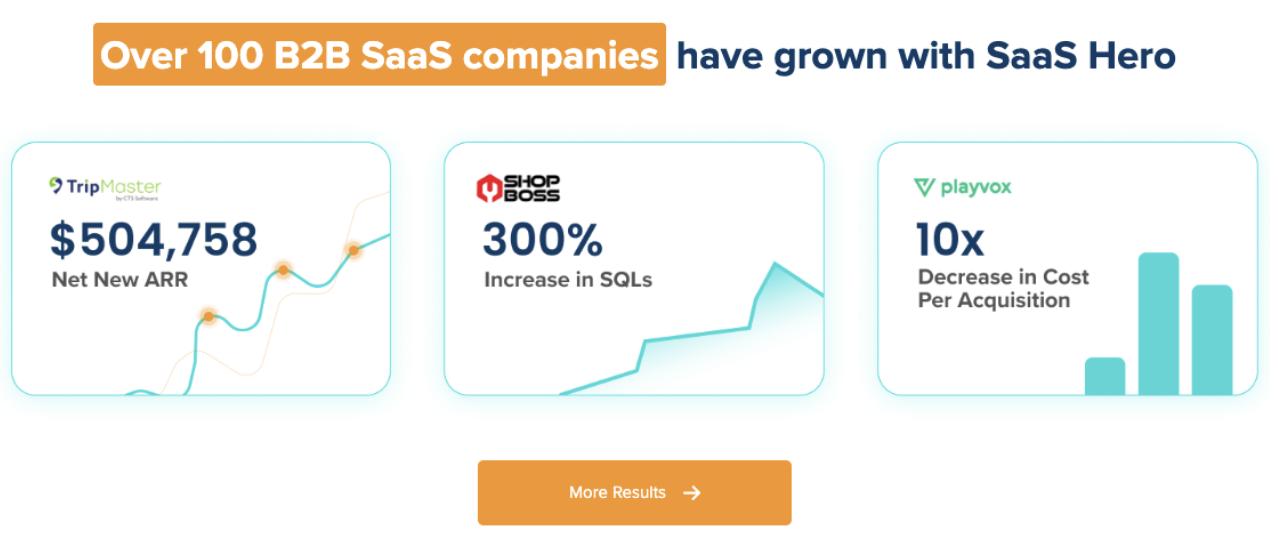
The SaaSHero approach uses flat-fee performance marketing instead of percentage-based models and focuses on measurable outcomes like TripMaster’s $504,758 in Net New ARR from coordinated paid search and social. Companies using ABM are 1.9x more likely to exceed revenue targets, so ABM becomes a core growth lever for scaling SaaS.

Conversion rate optimization should move in parallel with account targeting because stronger landing pages unlock more volume without higher CAC. Track pipeline metrics such as SQL volume, deal velocity, and closed-won revenue attribution so stakeholders see clear ABM ROI.

Frequently Asked Questions About ABM Platforms
What does an ABM platform do?
An account-based marketing platform helps B2B companies target specific high-value accounts with personalized campaigns instead of broad demographic audiences. ABM tools combine account identification, intent data, advertising, and CRM integration so marketing and sales can coordinate around named accounts. These platforms help SaaS teams focus budget and effort on prospects most likely to convert into larger deals.
What is the best ABM platform for small SaaS?
RollWorks and Apollo.io work best for small SaaS companies because they pair lower pricing with fast rollout and strong HubSpot or Salesforce integration. RollWorks offers dedicated ABM advertising from $850/month, while Apollo.io delivers combined prospecting and ABM from $49/user/month. Both avoid the heavy cost and complexity of tools like Demandbase or 6sense.
How do 6sense and Terminus compare?
6sense focuses on AI-powered intent data and predictive analytics that flag accounts entering buying cycles and forecast deal outcomes. Terminus focuses on multi-channel advertising and account progression tracking and offers stronger campaign management and native chat. 6sense fits teams that prioritize data-driven account identification, while Terminus fits teams that center ABM on advertising execution.
What does ABM pricing look like in 2026?
ABM pricing in 2026 ranges widely by company size and feature depth. Entry tools such as HubSpot ABM start at $20/month, while mid-market options like RollWorks begin around $850/month. Enterprise platforms such as Demandbase and 6sense start near $15,000–$25,000 per year on custom contracts. Small SaaS companies should plan for $1,000–$3,000 per month for effective ABM capabilities.
What are strong HubSpot ABM alternatives?
RollWorks and Outreach stand out as strong HubSpot ABM alternatives for teams that want more depth. RollWorks connects natively to HubSpot and adds dedicated ABM advertising and intent data that HubSpot’s native ABM lacks. Outreach pairs well with HubSpot by adding advanced sales engagement and account-based cadences for tighter marketing and sales coordination.
Teams ready to launch ABM with expert support on platform choice and campaign setup can book a discovery call and build a focused account-based strategy.

Conclusion: Picking the Right ABM Stack for SaaS
RollWorks, Demandbase, and 6sense lead the 2026 ABM market, and RollWorks stands out for small to mid-market B2B SaaS companies. Its pricing, native CRM integration, and 2-week setup match the needs of lean teams that want clear pipeline impact.
The comparison table highlights large pricing gaps, with enterprise tools often costing 15–25 times more than mid-market options. Bootstrapped SaaS companies should favor platforms with transparent pricing under $5,000/month and strong HubSpot or Salesforce integration to avoid long implementations and surprise costs.
SaaSHero helps B2B SaaS teams turn ABM into predictable growth. The flat-fee model removes percentage-based conflicts, and the senior-led team has delivered results such as $504k in Net New ARR growth. Teams can start month-to-month from a $1,250 entry point and join companies that have raised over $70M using these strategies. Book a discovery call to accelerate your ABM results.