




![Best Construction Tech SaaS Marketing Agencies [2026]](https://www.saashero.net/wp-content/uploads/2026/01/1769833572170-2de27951ae09.jpeg)
Key Takeaways
- The construction software market is projected to reach $11.78B in 2026 with 9.70% CAGR, and SaaS models now dominate BIM and project management tools.
- Top agencies blend SaaS unit economics expertise (CAC under $2,500, 80-day payback) with construction buyer psychology for multi-stakeholder decisions.
- SaaSHero ranks #1 with 650% ROAS, $504k Net New ARR, flat-fee month-to-month pricing, and aggressive competitor conquesting strategies.
- High-performing tactics include Procore alternative targeting, mobile-first experiences, and CRM-integrated attribution that supports 90+ day sales cycles.
- Partner with SaaSHero for a free construction tech SaaS marketing audit to accelerate revenue growth.
Agency Comparison Matrix: Construction Tech SaaS Marketing Partners
|
Agency |
Pricing Model |
Construction/SaaS Fit |
Key Strengths & Weaknesses |
|
SaaSHero |
$1,250-$4,500/mo flat retainer, month-to-month |
Strong – B2B SaaS specialists with construction as one vertical |
Pros: 650% ROAS, $504k Net New ARR cases, competitor conquesting Cons: Newer agency, limited brand recognition |
|
Kalungi |
$8,000-$15,000/mo, 6-12 month contracts |
Good – SaaS expertise, limited construction focus |
Pros: Proven SaaS methodology, fractional CMO Cons: High cost, long contracts, generalist approach |
|
Venveo |
% of spend + retainer, 12-month minimum |
Good – Construction expertise, limited SaaS metrics |
Pros: Deep construction buyer knowledge Cons: Focuses on leads vs. ARR, % of spend model |
|
Directive Consulting |
$10,000-$25,000/mo, annual contracts |
Fair – SaaS focus, no construction specialization |
Pros: Enterprise SaaS experience, pipeline focus Cons: Very expensive, no construction vertical knowledge |
SaaSHero: Revenue-First SaaS Partner With Construction Focus
SaaSHero leads this list as a B2B SaaS marketing specialist with proven results in construction and adjacent verticals. Their flat-fee, month-to-month model removes percentage-of-spend conflicts that often misalign incentives between agencies and clients.
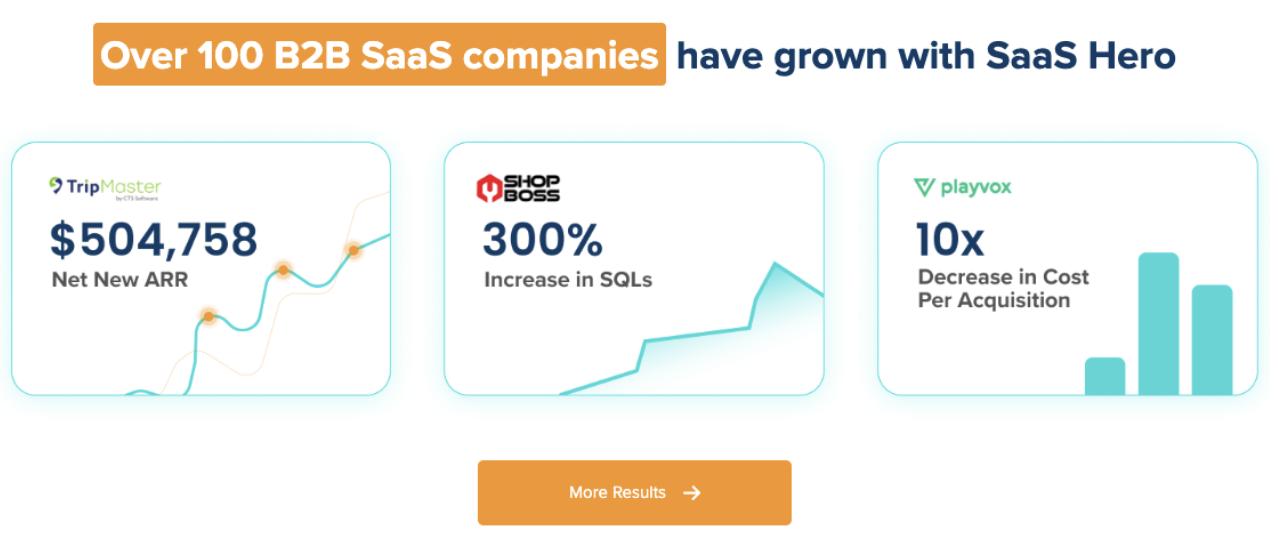
The team uses competitor conquesting on high-intent searches, heuristic conversion rate improvements, and HubSpot-integrated tracking that connects ad clicks directly to closed revenue. Their work has produced 650% ROAS and $504,758 in Net New ARR for clients like TripMaster.

SaaSHero serves construction, real estate tech, and other B2B SaaS categories while keeping the focus on SQL generation and payback periods that satisfy founders and investors. They avoid vanity metrics and report on revenue impact instead.
Book a discovery call to review your construction tech SaaS growth strategy with their team.
Kalungi & Directive: SaaS Revenue Specialists With Limited Construction Depth
Kalungi and Directive Consulting excel at SaaS demand generation but bring limited construction-specific experience. They understand product-led growth, long sales cycles, and ARR growth targets, yet often miss the nuances of construction buyer psychology.
General contractors and project managers care about job site efficiency, compliance, and clear ROI justification, which differ from typical SaaS buyer priorities. Without that context, campaigns can sound generic to field teams and executives in construction firms.
These agencies usually charge $8,000-$25,000 per month with 6-12 month contracts. Their SaaS playbooks are proven, but the lack of construction vertical knowledge can reduce relevance for field workers, superintendents, and construction executives.
Venveo & Builder Funnel: Construction Experts Without SaaS Economics
Construction-focused agencies like Venveo and Builder Funnel understand construction buyer psychology in detail. They run geo-targeted PPC, create content for job sites, and craft messaging that resonates with general contractors and trades.
However, traditional construction agencies often rely on PPC that stops working when spending stops, offering no long-term value. Many also lack deep experience with SaaS unit economics.
Their main gap appears around SaaS metrics such as Customer Lifetime Value, churn reduction, and Net New ARR, even though they can drive qualified construction leads. This gap can create friction with boards and investors who expect SaaS-grade reporting.
Refine Labs & NoGood: Demand Gen Leaders for Enterprise Construction Tech
Enterprise demand generation firms like Refine Labs and NoGood specialize in Account-Based Marketing for tech and SaaS companies. They use LinkedIn Ads, intent data, and complex marketing tech stacks to reach buying committees.
Most of these agencies lack construction vertical specialization and may not fully understand construction procurement cycles or non-technical buyer needs. That gap can slow adoption among field-driven organizations.
They fit best for established construction tech companies with more than $10M ARR that target large enterprise accounts. Their higher fees and complex attribution models can overwhelm smaller SaaS teams that need efficient, scrappy growth.
SimpleTiger: SEO and Paid Search Support for Construction Tech
SEO and PPC specialists like SimpleTiger help construction tech companies build long-term organic and paid visibility around core keywords. They create topical authority for phrases like “construction project management software” and “BIM tools” while supporting pipeline generation with integrated SEO and paid media.
These firms work best as complementary partners rather than primary growth drivers. They are especially useful once a construction tech company enters the critical 18-month window where investors expect clear unit economics and a predictable pipeline.
Competitor Conquesting: Winning Over Procore & Autodesk Users
Competitor conquesting has become one of the most effective strategies for construction tech marketing teams. This approach targets Procore alternatives, Autodesk competitors, and other incumbent platforms to capture high-intent users who already feel pain with current tools.
Core tactics include building comparison pages for “Procore vs [Your Solution]” searches and targeting complaint keywords such as “Procore pricing” and “Procore alternatives.” Smart use of negative keywords helps filter out navigational searches and protects budgets.
Effective conquesting requires tight compliance, clear positioning, and strict cost control to improve quality scores and unit economics. Agencies that master this approach often see faster payback periods and stronger SQL quality.
Tech Stack Design for 90-Day Construction Procurement Cycles
Construction tech marketing works best with a tech stack built for 90+ day sales cycles and multi-stakeholder decisions. Core tools usually include Google Ads and LinkedIn Ads for demand generation, plus HubSpot or Salesforce for CRM and pipeline tracking.
Attribution tools should connect ad clicks and website activity to closed revenue, not just form fills. The stack also needs to support mobile-first experiences for field workers, demo scheduling for project managers, and ROI calculators for executives.
Leading agencies track Customer Acquisition Cost with 2026 targets near $2,500 per customer, compared to industry benchmarks of $5,000-$15,000 for high-touch B2B enterprise sales. This discipline keeps growing efficiently and investor-ready.
Construction Tech Buyer Roles and What Each One Cares About
Construction tech marketing succeeds when campaigns speak clearly to each stakeholder group inside a general contracting firm. Field workers want mobile-first tools that reduce manual tasks and show immediate productivity gains.
Project managers focus on scheduling, budget tracking, and collaboration features that keep jobs on time and under budget. Executives evaluate the total cost of ownership, integration with existing systems, and ROI strong enough for board approval.
Effective campaigns build separate messaging tracks for each role while keeping a consistent core value proposition. Adoption by small and midsize contractors is accelerating due to SaaS options that reduce up-front costs and improve usability. This shift opens the door for targeted campaigns that address budget limits and implementation risk.
FAQs: Construction Tech SaaS Marketing
What metrics matter most for construction tech marketing success?
Revenue-based metrics provide the clearest picture of performance. Net New ARR, Sales Qualified Leads, and Customer Acquisition Cost should sit at the center of reporting.
Many construction tech companies target an 80-day payback period and CAC below $2,500 to keep growth sustainable. Teams also track pipeline velocity and conversion rates from demo requests to closed deals, since sales cycles often run longer than 90 days and involve several stakeholders.
How do SaaS agencies differ from construction lead generation firms?
SaaS agencies focus on unit economics such as Lifetime Value to Customer Acquisition Cost ratios and Monthly Recurring Revenue growth. They design campaigns around subscription revenue, product-led growth, and faster time-to-value for new customers.
Construction lead generation firms usually emphasize lead volume and cost-per-lead without measuring revenue quality or churn. That gap can hide poor-fit customers and unstable growth.
What is the best way to evaluate agency ROI for construction tech companies?
CRM-integrated tracking gives the clearest view of agency ROI. Connect marketing touchpoints to closed revenue and measure Return on Ad Spend using actual customer value instead of only initial contract size.
Many teams aim for an LTV:CAC ratio of 3:1 or better while monitoring pipeline velocity, demo-to-close conversion rates, and expansion revenue. Avoid agencies that only report impressions, clicks, or unqualified leads without revenue context.
What construction tech marketing strategies work best in 2026?
Competitor conquesting that targets Procore alternatives and other incumbents consistently generates high-intent leads. AI and VDC-focused content aligns with emerging buyer interests in the growing cloud construction software market.
Mobile-first landing pages support field worker research habits, and executive-facing ROI calculators help C-suite teams make confident decisions. Account-based marketing fits enterprise targets, while product-led growth tactics work well for smaller contractors.
How does SaaSHero compare to other construction tech marketing agencies?
SaaSHero blends B2B SaaS expertise with construction vertical knowledge and supports clients with flat-fee pricing and month-to-month contracts. This structure removes many conflicts that appear with percentage-of-spend models.
Their focus on Net New ARR and SQL quality aligns with SaaS business models and investor expectations. Their work also reflects a strong grasp of construction buyer psychology and procurement cycles, which supports both immediate pipeline gains and long-term revenue growth.
Choosing a Construction Tech Marketing Partner
The rapid expansion of the construction software market rewards SaaS companies that choose revenue-aligned marketing partners. Avoid agencies that chase vanity metrics or lack either SaaS experience or construction vertical depth.
Prioritize partners that offer transparent pricing, month-to-month flexibility, and a track record of generating Net New ARR for construction tech companies. This combination supports both control and accountability.
SaaSHero’s hybrid model addresses the specific challenges of selling to construction buyers while keeping a tight focus on SaaS unit economics. Their competitor conquesting playbooks, conversion improvements, and construction portfolio position them as a strong choice for founders and CMOs who want sustainable growth.

Book a discovery call to build a construction tech SaaS marketing strategy that drives measurable revenue.