




Key Takeaways
- Fractional CMOs give B2B SaaS companies senior marketing leadership that is tightly aligned with revenue, without the fixed cost of a full-time CMO.
- Different providers specialize in distinct models, from strategic advisory to fully managed execution, so fit depends on stage, budget, and in-house capabilities.
- A structured evaluation framework based on SaaS expertise, accountability, pricing, and integration helps reduce risk and improve return on investment.
- Scenario-based selection, including your ARR range and team maturity, is more reliable than choosing by brand or price alone.
- SaaS companies that want revenue-focused paid acquisition and clear accountability can schedule a discovery call with SaaSHero to discuss fit.
Why Fractional CMOs Are Essential for B2B SaaS Growth in 2026
B2B SaaS companies need marketing leaders who understand recurring revenue, long sales cycles, and investor expectations. Fractional CMOs act as part-time C-level leaders inside the executive team, owning pipeline and go-to-market execution for growth-stage SaaS businesses. This model keeps focus on revenue, not activity volume.
SaaS firms also face pressure to prove efficient unit economics. Specialized fractional CMOs track metrics such as CAC, MRR, and LTV at a detailed level and link marketing decisions directly to these numbers. One benchmark places typical fractional CMO fees around $12,000 per month, which can be roughly $230,000 less per year than a full-time CMO once salary and overhead are considered, which frees budget for campaigns, tools, or additional hires.
Defining the Fractional CMO Landscape for B2B SaaS
The fractional CMO category includes experienced marketing executives who work on a part-time or contract basis. Leading B2B SaaS providers emphasize executives who have operated inside growth-stage software companies and understand SaaS sales motions. This background reduces ramp-up time and misalignment.
Most relationships cover strategy, demand generation, lifecycle programs, positioning, and funnel optimization. Common pricing falls between $8,000 and $25,000 per month, depending on scope and company complexity. Some firms now bundle full execution teams for paid media, content, and marketing operations with the fractional CMO, which reduces internal hiring needs but increases dependency on the provider.
Our Evaluation Framework: What Matters in a Fractional CMO for SaaS
This comparison uses seven dimensions that directly affect SaaS growth and ROI.
- SaaS specialization: Depth of B2B SaaS experience and fluency with subscription metrics.
- Service scope: Balance between high-level strategy and hands-on execution.
- Accountability: Ownership of revenue-linked KPIs, reporting cadence, and transparency.
- Pricing model: Fees, contract terms, and fit with SaaS cash flow and runway.
- Implementation speed: Time to first campaigns, first wins, and steady-state performance.
- Team integration: Ability to collaborate with founders and in-house teams without friction.
- Scalability: Capacity to support higher ARR tiers and more complex go-to-market motions.
Book a discovery call to map these criteria to your pipeline, budget, and current marketing gaps.
Methodology and Data Sources
This overview uses publicly available information, including provider websites, published case studies, reference pricing, and third-party analyses, as of January 2026. Engagements are often customized, so use this as a starting point and confirm details with each provider.
Fractional CMO Service Provider Comparison Summary (2026)
The matrix below highlights how selected fractional CMO providers position their SaaS focus, pricing, and delivery model.
|
Provider |
SaaS Focus |
Pricing Range |
Service Model |
|
SaaSHero |
Exclusive B2B SaaS |
$1,250-$4,500/mo |
Execution + Strategy |
|
Kalungi |
B2B SaaS Specialist |
Not publicly specified; varies by scope |
Full-Service Agency |
|
SmartYeti |
B2B SaaS Focus |
$8,000-$15,000/mo |
Strategy + Mentorship |
|
GigCMO |
B2B SaaS Ready |
$12,000-$18,000/mo |
Fractional Leadership |
Providers with a tight B2B SaaS focus often move faster and price more flexibly, while full-service agencies tend to cost more but offer broader execution. Strategy-first partners usually require internal teams or additional vendors, and execution-heavy partners can ship quickly but may not solve deeper positioning or product marketing issues.
Deep Dive: Leading Fractional CMO Service Providers for B2B SaaS
SaaSHero: Revenue-Focused Paid Growth for B2B SaaS
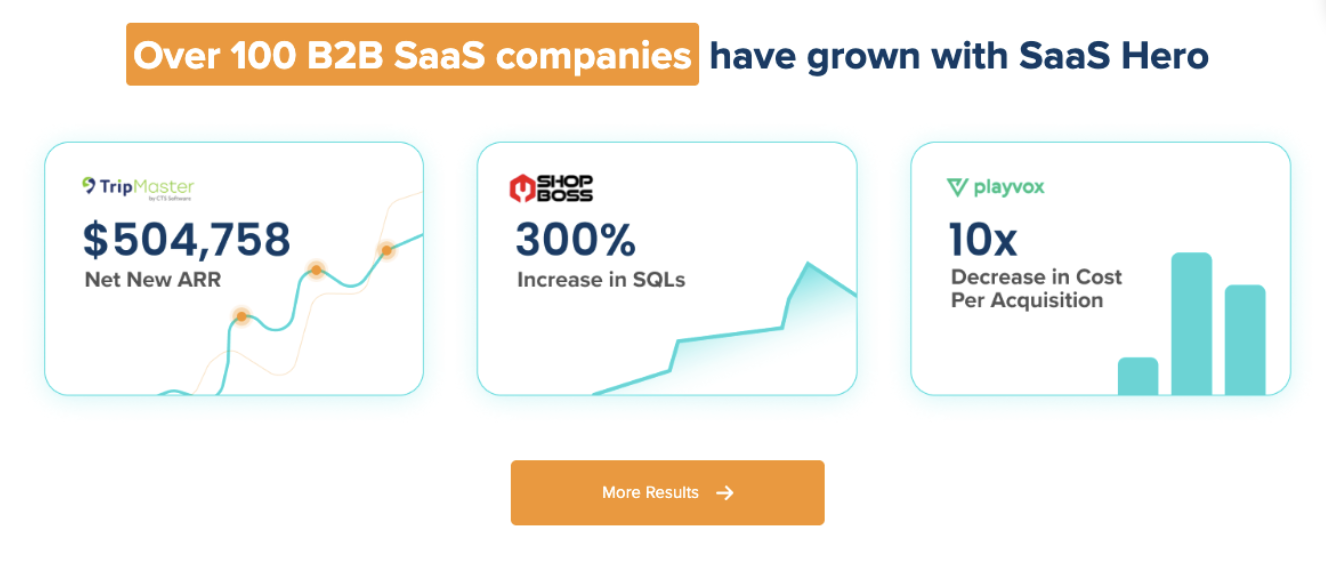
SaaSHero focuses on turning paid media into measurable Net New ARR for B2B SaaS companies, with clear reporting on pipeline and revenue rather than vanity metrics. Pricing uses flat monthly fees and month-to-month agreements at two tiers.
- Best for: SaaS companies between roughly $500,000 and $10 million ARR that want paid acquisition, CRO support, and low-commitment contracts.
- Key strengths: Exclusive B2B SaaS focus, structured competitor campaigns on Google Ads and LinkedIn Ads, and frequent performance updates tied to revenue goals.
- Service model: Dedicated campaign management for lean or founder-led teams, and a full marketing team tier for companies that need both strategy and execution.
Kalungi: Full-Funnel Marketing Leadership for Funded SaaS
Kalungi operates as a fractional CMO plus full-service agency for B2B SaaS, covering positioning, demand generation, content, and revenue operations. Pricing is scoped to each engagement and fits better for well-funded teams.
- Best for: Series A and later companies that want a comprehensive external marketing department.
- Key strengths: Documented frameworks, end-to-end funnel coverage, and support for building internal marketing operations.
- Considerations: Higher cost and broader scope than many early-stage teams require.
SmartYeti: Strategic B2B SaaS Guidance and Mentorship
SmartYeti centers on strategic planning for B2B SaaS, with CMOs who have held senior roles at growth-stage software firms. Engagements often focus on audits, roadmaps, and leadership support.
- Best for: SaaS companies with an existing execution team that need a clear strategy and senior oversight.
- Key strengths: Strong SaaS metric literacy, focus on conversion rates and pipeline velocity, and collaborative work with sales and product.
- Considerations: May require additional execution support for teams without in-house marketing capacity.
GigCMO: Data-Driven Fractional Leadership for Scaling SaaS
GigCMO offers fractional CMOs who connect marketing activity to sales KPIs, often pairing strategic leadership with hands-on guidance for teams and vendors.
- Best for: Scaling SaaS companies entering new markets or fixing misalignment between marketing and revenue.
- Key strengths: Emphasis on customer journey mapping, data-informed decisions, and help with hiring or vendor selection.
- Pricing: Typical retainers fall between $12,000 and $18,000 per month for broad engagements.
Book a discovery call to discuss how these models compare to your current team structure and growth targets.

Scenario-Based Recommendations: Choosing Your Ideal Fractional CMO Service Provider
Matching provider type to your current situation reduces risk and improves outcomes.
- Early-stage startup under about $1 million ARR: A lower-cost, month-to-month model such as SaaSHero’s campaign management tier can drive early pipeline while preserving runway.
- Growth-stage scale-up between about $2 million and $10 million ARR: Strategy-led partners like SmartYeti or execution-oriented leaders like GigCMO fit companies that already have some in-house marketing talent.
- Enterprise or late-stage SaaS with complex go-to-market motions: Kalungi’s full-funnel model suits teams that want a near-complete external marketing department.
- Turnaround or underperforming channels: A provider that reports directly on Net New ARR, CAC, and payback period, such as SaaSHero, can help reset expectations around performance.
Total Value and Ownership Considerations When Comparing Fractional CMOs
Monthly fees tell only part of the story. Factor in setup time, internal hours, tool costs, and the opportunity cost of delayed improvements. Faster onboarding and early wins often justify higher retainers if they shorten payback periods.
Some fractional CMO firms also offer outcome-based pricing tied to metrics such as qualified pipeline or net revenue retention. These models can align incentives but may include performance premiums and more complex contracts.
Protect long-term flexibility by confirming data ownership, access to ad accounts, and control over key assets. Providers that document processes and coach in-house staff reduce dependence over time and make future transitions smoother.
Your Decision Framework: Selecting the Right Fractional CMO Partner
Use a simple, structured process instead of relying on brand familiarity or referrals alone.
- Step 1: Define goals, ARR targets, budget range, and timeline for visible impact.
- Step 2: Prioritize criteria such as SaaS focus, price flexibility, execution depth, and speed.
- Step 3: Shortlist two or three providers that match your stage, vertical, and budget.
- Step 4: Run discovery calls to assess strategic thinking, collaboration style, and KPI alignment.
- Step 5: Compare proposals on scope, milestones, reporting, and definitions of success.
- Step 6: Check references for results, communication quality, and ease of working together.
- Step 7: Start with a contained scope or initial 90-day plan before expanding engagement.

Frequently Asked Questions
How quickly can a fractional CMO produce results?
Most SaaS-focused fractional CMOs can ship initial improvements in 30 to 60 days, especially on paid channels and funnel diagnostics. Deeper brand or positioning work usually takes longer.
How does a fractional CMO differ from a marketing agency?
A fractional CMO owns strategy and revenue-linked KPIs as part of the leadership team, while agencies usually focus on channel execution. Some providers combine both in one engagement.
Can a fractional CMO work with an existing marketing team?
Yes. Many engagements are designed to guide, upskill, and prioritize work for in-house marketers rather than replace them. Alignment with sales and product teams remains essential.
Conclusion: Make an Informed Choice for Your B2B SaaS Growth
Selecting a fractional CMO provider is a high-impact decision for your pipeline, CAC, and growth efficiency. The right partner matches your stage, budget, and internal resources, and accepts clear accountability for revenue-related outcomes.
SaaSHero suits SaaS teams that want revenue-focused paid growth with flexible contracts, while providers like Kalungi, SmartYeti, and GigCMO offer broader leadership and strategic depth for specific stages. Take time to compare models, talk with references, and align on metrics before you commit.
Book a discovery call to evaluate whether SaaSHero is the right partner to support your next phase of B2B SaaS growth.