




Written by: Aaron Rovner, Founder, Saas Hero | Last updated: August 1, 2026
Key Takeaways for SaaS Feedback Loops
- Most B2B SaaS companies collect feedback yet rarely turn it into GTM decisions tied to ARR because feedback stays siloed and unscored.
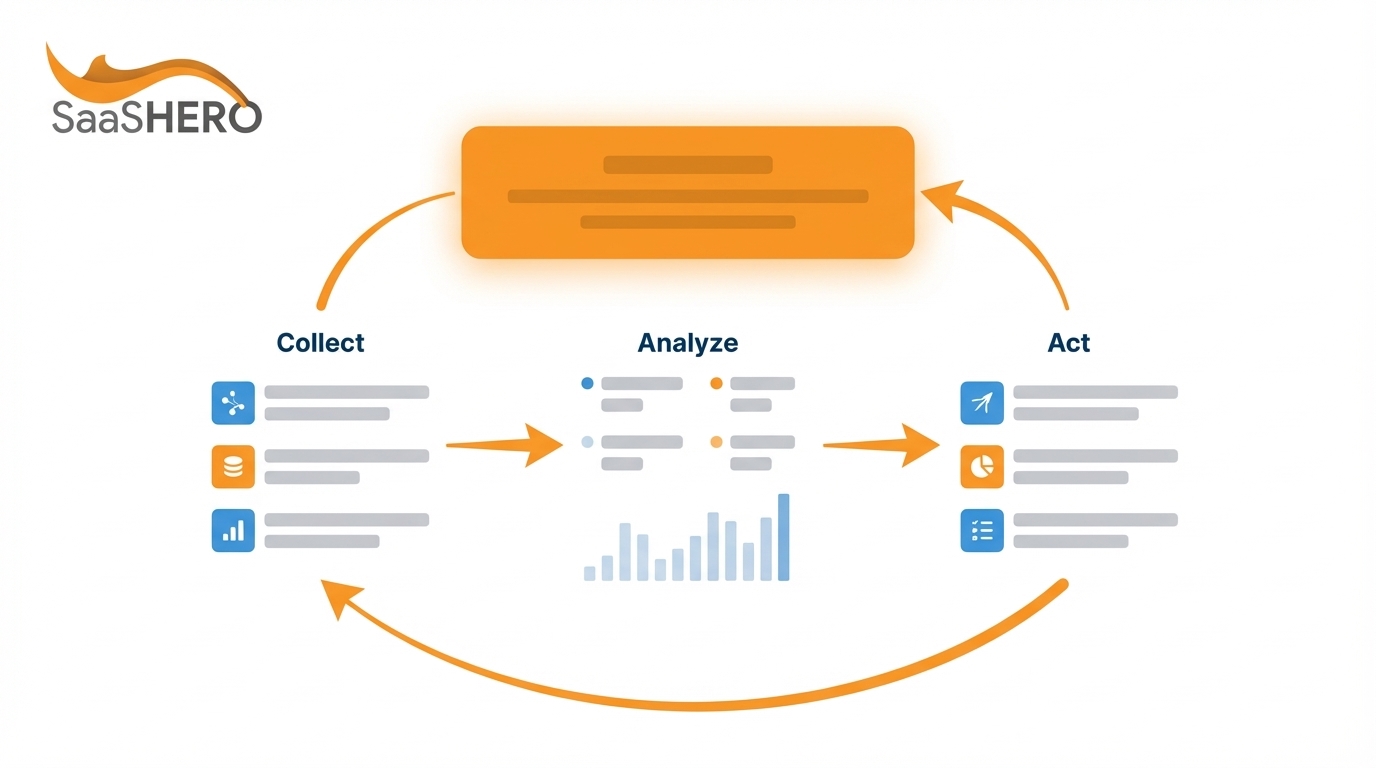
- The four-stage operating system (Collect, Analyze, Act, Close) creates a repeatable monthly cycle that connects customer insights to messaging, onboarding, pricing, and churn reduction.
- ARR-weighted ICE scoring with an ICP filter pushes high-impact themes from target accounts into quarterly roadmap reviews instead of letting volume bias dominate.
- Closed-loop completion above 80% and themes-to-roadmap conversion above 30% are the key metrics that separate mature feedback programs from passive data collection.
- Ready to turn your existing feedback into GTM decisions tied to ARR? Schedule your feedback audit to review your current customer feedback loops in SaaS go-to-market.
Prerequisites and Core Definitions for This Framework
Confirm these foundations before you run the framework.
- CRM access: You need to join feedback records to account ARR, renewal date, and segment tier. HubSpot and Salesforce are the most common systems.
- Stakeholder buy-in: At minimum, assign an owner from Product, Customer Success, and GTM (Marketing or Revenue). Teams with a joint CS-Product prioritization ritual usually see less conflict over roadmap decisions.
- Baseline pipeline data: Capture current activation rate, NRR, and average payback period so you can measure change.
- Lightweight PM tool: Use Productboard, Linear, or a shared spreadsheet to track feedback disposition.
Use these definitions consistently across the operating system.
- ICP (Ideal Customer Profile): The firmographic, technographic, and behavioral profile of accounts most likely to activate, expand, and renew. Track feedback from non-ICP accounts separately and exclude it from scoring so GTM decisions stay focused on target segments.
- ARR weighting: Attach contract value, renewal proximity, and churn signal strength of each requesting account to a feedback theme before prioritizing it. Feature requests with ARR weight attached reach quarterly roadmap reviews more often than requests logged without revenue context.
- Activation event: The specific in-product action that correlates with long-term retention for a given ICP segment.
- Payback period: The number of days from customer acquisition to gross-margin recovery of CAC.
The Four-Stage Feedback Framework at a Glance
- Stage 1 — Map: Define the exact GTM decisions that feedback must inform. Input: ICP definition, current messaging, pipeline data. Output: a decision register with named owners and feedback questions mapped to each GTM decision point.
- Stage 2 — Collect: Gather signals across the full prospect-to-churned lifecycle. Input: survey tools, CRM call notes, support tickets, win/loss data. Output: a tagged, structured feedback repository linked to account ARR and segment.
- Stage 3 — Analyze: Centralize and score themes by revenue impact using ARR-weighted ICE and ICP scoring. Input: raw feedback repository. Output: a prioritized shortlist of themes with composite scores, named PM owners, and GTM implications.
- Stage 4 — Act and Close: Run GTM experiments, close the loop with customers, and measure outcomes against NRR, activation, and payback. Input: prioritized theme shortlist. Output: shipped experiments, customer notifications, and a tracked closed-loop completion rate.
Stage 1: Map the GTM Decisions Your Feedback Will Inform
Purpose: Feedback needs a clear decision target. This stage forces the GTM team to name the specific decisions such as messaging headline, onboarding step, pricing tier, or ICP segment that customer evidence will inform before collection starts.
Actions:
- List five to seven GTM decisions currently made on assumption, such as homepage headline, demo CTA copy, onboarding email sequence, pricing page structure, or ICP firmographic criteria.
- Write one falsifiable question for each decision that customer feedback can answer. Example: “Series B SaaS buyers cite forecast credibility or pipeline visibility as the primary pain driving evaluation.”
- Assign a named owner and a decision deadline to each question.
Decision point: If you cannot express a GTM decision as a falsifiable question, it is not ready for feedback input. Deprioritize it until you scope the decision.
B2B SaaS example: A revenue intelligence SaaS company interviewed customers about their buying journeys and learned that the main pain centered on defending forecasts to leadership. That mapping exercise shifted the value proposition and increased monthly pipeline.
Validation criteria: Every GTM decision in the register has a named owner, a falsifiable feedback question, and a deadline. No orphaned decisions remain.
Common mistake: Teams often map too many decisions at once. Limit the first cycle to five questions. Product managers reject VoC inputs that exceed 10 themes; beyond ten, the brief becomes a quote dump and gets archived unread.
Stage 2: Collect Feedback Across the Prospect-to-Churned Lifecycle
Purpose: Single-source VoC programs miss many high-impact themes because they over-weight whichever channel is loudest that quarter. This stage sets a multi-channel collection cadence tied to lifecycle stage.
Collection cadence by channel: Match feedback frequency to the signal’s urgency and volume. High-volume, time-sensitive channels need weekly review, while strategic insights from churned customers work well on a quarterly rhythm.
- Weekly: Support tickets, G2/Capterra reviews, sales call notes tagged in CRM.
- Monthly: CSM QBR notes, win/loss interview summaries, in-app NPS verbatims.
- Quarterly: Churned customer interviews, prospect research surveys, ICP validation interviews.
Tagging requirements at capture: Tag every signal with signal type (feature request, workflow gap, messaging confusion, pricing objection), account tier, ARR, renewal date, and lifecycle stage. Tagging feedback with customer segment, journey stage, feature area, and sentiment at capture supports prioritization aligned with ICP and ARR impact.
Decision point: Event-triggered AI interviews usually achieve higher completion rates than cold-emailed NPS surveys. Trigger collection from product events and lifecycle milestones instead of batch email blasts.
Validation criteria: Every feedback item in the repository includes account ARR, tier, and lifecycle stage. No untagged submissions advance to Stage 3.
Ready to turn your existing feedback into GTM decisions tied to ARR? Schedule a SaaSHero feedback loop review to audit your current customer feedback flows in SaaS go-to-market.
Stage 3: Centralize Feedback and Prioritize by Revenue Impact
Purpose: Raw feedback volume creates squeaky-wheel bias. This stage applies ARR-weighted scoring so themes with the highest retention risk and expansion opportunity for ICP accounts rise to the top.
ARR-weighted ICE scoring method:
- Pull all accounts that flagged a theme and join them to CRM for ARR and renewal date.
- Apply renewal proximity factors: 1.5x for renewals within 90 days, 1.0x for 90–180 days, and 0.5x for beyond 180 days.
- Apply tier weights: 3x for enterprise accounts, 2x for mid-market, and 1x for SMB.
- Score Impact from 1 to 4, ranging from minor inconvenience to critical churn risk, and score Frequency from 1 to 4, ranging from one-off to daily mentions.
- Calculate composite score as ARR at risk multiplied by renewal proximity, tier weight, Impact, and Frequency.
- Rank themes by composite score and advance the top three to Stage 4 in the current cycle.
Features prioritized with ARR-weighted models tend to improve enterprise retention more than features prioritized by vote count. The scoring discipline matters more than perfect precision, and consistency across cycles is the real goal.
Prioritization ritual: Run a 60–75 minute quarterly batch session with the PM lead, VP of CS, and CS Ops data owner. Add a monthly 30-minute triage for urgent churn-risk signals. Urgent churn-risk signals tied to product gaps with imminent renewals bypass the quarterly cadence and route directly to the relevant PM within 48 hours via a one-page brief containing account name, ARR, renewal date, verbatim quote, and the specific decision needed.
ICP filter: Track feedback from accounts outside the defined ICP in a separate log and exclude it from the scoring model. Excluding non-ICP feedback from scoring prevents the roadmap from drifting toward non-target segments.
Validation criteria: Every theme advancing to Stage 4 has a composite ARR-weighted score, a named PM owner, and a documented GTM implication such as a messaging change, onboarding fix, pricing experiment, or ICP refinement.
Stage 4: Act on Feedback, Close the Loop, and Measure Results
Purpose: Many organizations collect customer feedback yet never act on it or follow up with customers. This stage turns prioritized themes into GTM experiments and closes the loop with the accounts that generated the signal.
GTM experiment types by theme category: Each feedback theme maps to a specific GTM lever such as messaging, onboarding, pricing, or retention. Each lever needs a different experiment design and success metric. Match the theme category to the right experiment type.
- Messaging confusion: Rewrite the homepage headline or demo CTA. Run a pilot cell of 5–10 ICP accounts with the new message across email, calls, and ads. Measure reply rate and meeting conversion against baseline.
- Onboarding friction: Identify the drop-off step and ship a targeted fix. Measure activation rate at day 14 and day 30 for the exposed cohort versus control. Adoption at least 1.5x baseline validates the feedback as a reliable signal.
- Pricing objection: Test a packaging change or a new tier with a segment-specific pilot. Measure trial-to-paid conversion and ACV for the variant cohort. Separate self-serve revenue from AE-assisted closes before you attribute the lift.
- Retention risk: Route detractor signals mentioning a competitor to a prompt CSM churn-save call. Timely outreach on these signals can reduce churn risk significantly.
Closing the loop with customers: Every account whose feedback drove a shipped change receives a direct CSM notification within five business days of the internal PM-to-CS handoff. Customers who see their feedback lead to a shipped feature usually provide more detailed input in the next cycle.
Validation criteria: Track closed-loop completion rate as a key operational metric. Every experiment has a named owner, a target metric, and a minimum detectable effect defined before launch.
Measurement and Validation of Feedback Impact
The framework creates value only when you connect outcomes to revenue metrics. Track these indicators monthly.
- Net Revenue Retention (NRR): Compare NRR for accounts that received closed-loop intervention against a control group. Companies that close the loop consistently can reduce churn.
- Activation rate: Measure day-14 and day-30 activation for cohorts exposed to onboarding experiments versus baseline.
- Payback period: Track whether messaging and ICP refinements shorten the sales cycle and reduce CAC. Customer interview insights have helped some companies shorten their sales cycles.
- Closed-loop completion rate: Measure the percentage of feedback items with a logged disposition (built, declined, or queued) within 60 days of submission. Target 80% or above for basic completion and 90% or above for best-in-class programs.
- Themes-to-roadmap conversion rate: Target 30% or above. Lower conversion suggests that the scoring model is surfacing themes that are not actionable.
Attribution gaps and long sales cycles: In B2B SaaS with multi-quarter sales cycles, direct attribution of a messaging change to closed-won revenue takes time. Use leading indicators such as reply rate, meeting conversion, pipeline velocity, and win rate by ICP segment as proxies during the first two quarters. Maintain a shared experiment tracking system that stores the hypothesis, exposure rules, and final revenue outcome so results tie to qualified pipeline and closed-won deals rather than top-of-funnel volume alone.
Advanced Variations for Scaling SaaS Teams
Teams at $10M+ ARR or operating across multiple products can scale the framework in two directions. First, segment-based feedback squads assign a dedicated feedback coordinator to each ICP segment. Segment-based squads with dedicated coordinators can reduce feedback response times and improve retention.
Second, connect the feedback operating system to a formal experimentation program. Maintain one shared backlog of tests across Marketing, Sales, Product, and CS. Reserve a fixed percentage of capacity for experiments each quarter. Run weekly reviews to kill underperforming variants and monthly reviews to promote winners to standard plays.
For multi-product funnels, run separate scoring models per product line but consolidate the closed-loop completion rate and NRR delta into a single executive dashboard. This approach prevents product-line feedback from cannibalizing each other’s roadmap priority while keeping a unified revenue view for the board.
Sales-alignment cadences extend the impact further. Share the monthly VoC brief with the sales team so AEs can reference specific customer verbatims in outbound sequences and objection handling. Refining outbound templates with customer interview insights can increase email response rates and meeting conversion.
Want SaaSHero to operationalize this framework inside your GTM motion? Request a GTM Feedback Audit for your SaaS go-to-market and get hands-on support.
Quick-Start Checklist and First 30 Days
Use this checklist to assess readiness and plan your first 30 days.
- Define five GTM decisions that feedback must answer this quarter and assign a named owner to each.
- Audit existing feedback channels and confirm every source tags account ARR, tier, and lifecycle stage.
- Build or validate the ARR-weighted ICE scoring model in a shared spreadsheet.
- Schedule the quarterly prioritization ritual of 60–75 minutes with PM lead, VP of CS, and CS Ops.
- Define the closed-loop notification SLA, such as CSM outreach within five business days of a shipped change.
- Set baseline metrics for current NRR, day-14 activation rate, and payback period.
- Launch one GTM experiment in the first 30 days using the top-scored feedback theme.
By team maturity:
- Seed to $3M ARR: Start with Stage 1 and Stage 2. Run five customer interviews per month and use a shared Google Sheet for scoring.
- $3M–$10M ARR: Implement all four stages. Focus on the monthly triage cadence and the closed-loop notification SLA.
- $10M–$50M ARR: Add segment-based squads, a formal experimentation backlog, and board-level NRR reporting tied to feedback outcomes.
Turn Feedback Into Predictable GTM Wins with SaaSHero
The Collect-Analyze-Act-Close framework provides the operating system. Running it inside a live GTM motion while managing paid acquisition, messaging experiments, and sales alignment at the same time is where many teams stall. SaaSHero functions as an embedded growth team for B2B SaaS companies at $1M–$50M ARR, working inside existing Slack channels and CRM workflows instead of sending monthly PDF reports.
SaaSHero’s revenue-first reporting model anchors every engagement to Net New ARR, pipeline value, and sales-qualified leads, which match the metrics this feedback operating system aims to move. The team’s competitor-conquesting experience means that feedback themes surfacing competitive objections translate into conquesting landing pages and ad campaigns, not just roadmap tickets. The month-to-month retainer structure means SaaSHero re-earns the engagement every 30 days, creating the same accountability the feedback framework expects from internal teams.
The GTM Feedback Audit is the starting point. You receive a structured review of your current feedback sources, scoring gaps, and closed-loop completion rate, along with a prioritized action plan tied to your ARR, activation, and churn baselines.
Book a discovery call to start your GTM Feedback Audit and build customer feedback loops in SaaS go-to-market that connect directly to ARR.
Frequently Asked Questions
How long does it take to set up a working customer feedback loop for SaaS go-to-market?
A functional first cycle that covers Stage 1 through Stage 3 usually fits into 30 days for teams at $1M–$10M ARR. The prerequisites are CRM access, a named owner from Product and Customer Success, and an existing feedback source such as NPS verbatims or support tickets. The first closed-loop experiment in Stage 4 typically ships in the second month. A fully instrumented operating system with segment-based squads, a formal experimentation backlog, and board-level NRR reporting takes two to three quarters to mature. The most common delay comes from misalignment on the ARR-weighted scoring model and the closed-loop notification SLA before the first prioritization ritual.
Which roles are required to run this framework, and can a small team do it?
The minimum viable team includes three named owners. One owner from Product or GTM manages the decision register and scoring. One owner from Customer Success manages signal capture and customer notification. One owner from Revenue or Marketing manages experiment design and measurement. A founder can cover all three roles at seed stage and run the framework in roughly four to six hours per month. At $5M+ ARR, a dedicated CS Ops or RevOps resource speeds up the ARR-weighting step. The framework fits into existing CRM workflows, weekly standups, and quarterly business reviews, so you do not need a separate feedback team.
How does the framework adapt for smaller teams versus larger multi-product organizations?
Teams under $3M ARR usually start with Stages 1 and 2. Define five GTM decisions, run five customer interviews per month, and tag every signal with ARR and lifecycle stage in a shared spreadsheet. Scoring can stay informal at this stage, and the discipline of tagging matters more than composite score precision.
Teams at $10M–$50M ARR with multiple products or ICP segments scale by running separate scoring models per product line and assigning segment-based feedback coordinators. They then consolidate outcomes into a unified NRR dashboard. The quarterly prioritization ritual expands to include RevOps and a VP of Sales, and the experimentation backlog becomes a shared cross-functional artifact instead of a PM-only document.
What are the most common risks when building customer feedback loops in SaaS GTM, and how are they mitigated?
The four most common failure modes are collecting without acting, squeaky-wheel bias, loop closure neglect, and attribution impatience. Collecting without acting means feedback accumulates in tools while GTM decisions stay unchanged, which erodes customer trust and internal credibility. Squeaky-wheel bias occurs when a single loud enterprise account dominates prioritization without ARR-weighted scoring to normalize its influence. Loop closure neglect appears when changes ship but customers who provided the original signal never receive an update, which reduces future survey response rates and trust. Attribution impatience shows up when teams abandon the framework after one quarter because closed-won revenue has not moved yet, even though leading indicators improved.
Each risk has a structural mitigation in the framework. The decision register prevents passive collection. ARR-weighted ICE scoring neutralizes volume bias. The closed-loop notification SLA enforces customer communication. Leading-indicator dashboards for reply rate, pipeline velocity, and activation rate provide evidence before revenue metrics move.
How often should the feedback operating system be revisited and updated?
Re-validate the scoring model and ICP definition quarterly using win/loss data and churn patterns. Refresh the GTM decision register at the start of each quarter to reflect new strategic priorities. Review the collection cadence by channel every six months to confirm that no high-signal channel has been added or deprecated. Monitor closed-loop completion rate and themes-to-roadmap conversion rate monthly as operational health metrics. If the themes-to-roadmap conversion rate stays below 30% for two consecutive months, the scoring model is likely surfacing themes that are not actionable, so revisit the ICP filter and ARR-weighting parameters before the next prioritization ritual.