




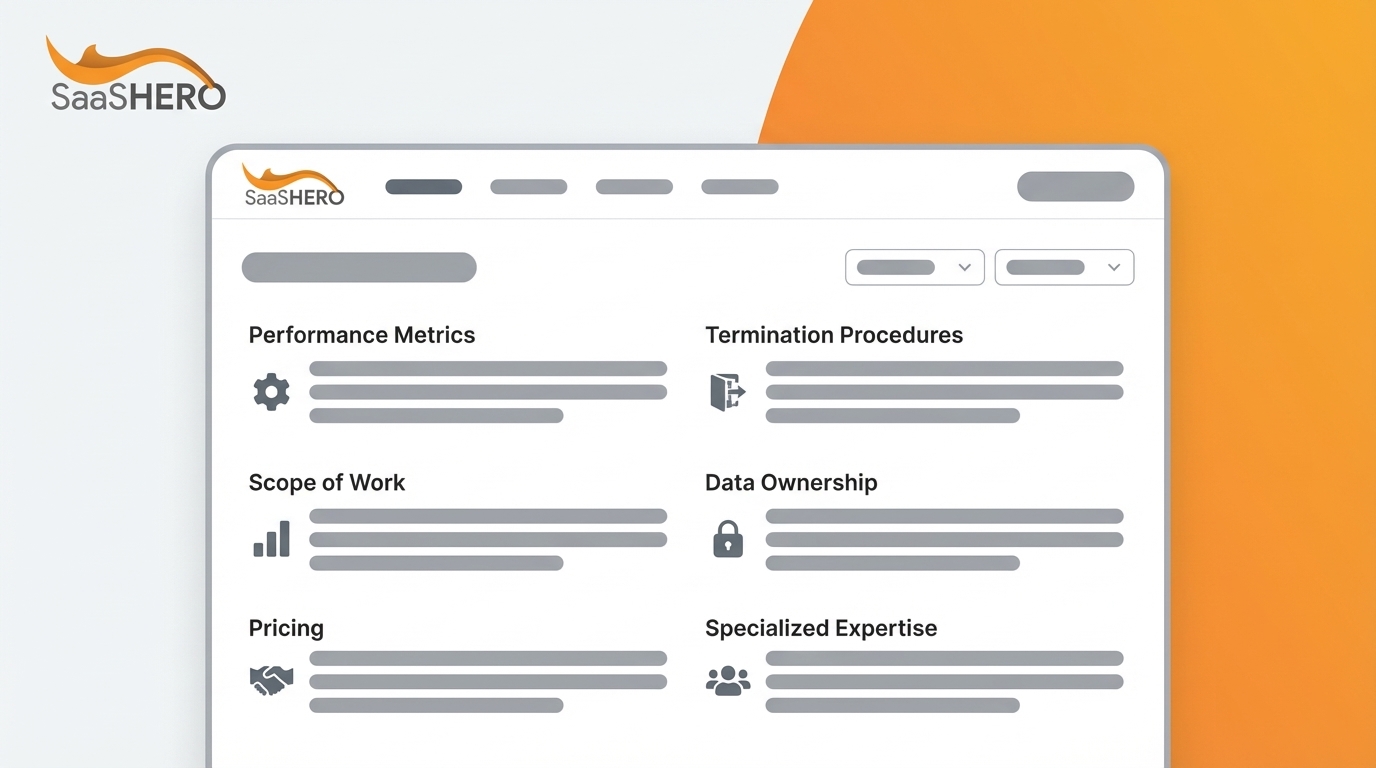
Key Takeaways
- Month-to-month agency agreements give B2B SaaS companies flexibility to adjust spend and partners based on performance, not contract length.
- Clear performance metrics tied to revenue, such as Net New ARR, CAC, and SQL volume, keep agency incentives aligned with business outcomes.
- Well-defined scope of work, transparent flat-fee pricing, data ownership, and termination terms reduce risk and prevent misunderstandings.
- Agencies that specialize in B2B SaaS and provide senior-level involvement, proactive communication, and CRM integration usually deliver stronger results.
- B2B SaaS teams that want performance-focused month-to-month support can work with SaaSHero; book a discovery call to explore fit.

1. Performance Metrics Aligned with SaaS Revenue Goals
B2B SaaS agencies should report on revenue-linked outcomes, not surface-level ad metrics. Your agreement needs KPIs that track the path from first touch to closed-won revenue using your CRM.
Set specific, measurable targets for SQLs, CAC, payback period, and pipeline value. Define these terms in the contract and agree on a monthly reporting cadence based on them.
Key Success Criteria
- Define target CAC payback period with clear, realistic timelines.
- Establish precise SQL criteria and MQL-to-SQL conversion goals.
- Agree on pipeline value growth targets that tie back to marketing.
- Confirm CRM integration experience for full-funnel attribution.
Red Flags to Watch
- Reports limited to impressions, clicks, and basic lead counts.
- No clear plan or capability to integrate with your CRM.
- Exclusive reliance on last-click attribution for complex B2B journeys.
2. Clearly Defined Scope of Work and Deliverables
Clear scope of work prevents misunderstandings and scope creep. Your month-to-month agreement should spell out what is included, what is excluded, and how work connects to performance goals.
List specific deliverables such as ad creative volumes, landing pages, reporting cadence, and meeting frequency. Clarify responsibilities for CRO, tracking, and stakeholder reviews so everyone understands who owns each step.
Essential SOW Inclusions
- List all managed platforms such as Google Ads, LinkedIn Ads, and Meta.
- Specify creative asset volumes, formats, and revision limits.
- Outline reporting frequency, formats, and core metrics.
- Clarify website and CRO responsibilities on both sides.
Pitfalls to Avoid
- Vague service descriptions that invite constant “out of scope” disputes.
- Deliverables that do not clearly support agreed performance targets.
3. Transparent, Flat-Fee Pricing and Aligned Payment Terms
Flat-fee pricing avoids the conflict of interest created by percentage-of-spend models. Your contract should make total monthly costs and payment expectations simple to understand.
Define the monthly retainer, payment timing, accepted methods, and any setup fees. If fees vary by spend range, document the bands so you can plan budgets cleanly.
Key Pricing and Payment Elements
- Use a flat monthly retainer, with optional tiers by ad spend range.
- Define payment schedule, such as payment in advance on a set date.
- List any one-time setup or onboarding fees in writing.
- Clarify late payment policies and any service pause rules.
|
Feature |
Traditional Agency |
Performance-Based Agency |
|
Pricing basis |
Percent of ad spend |
Flat monthly retainer |
|
Primary incentive |
Increase spend |
Improve ROI and efficiency |
|
Budget predictability |
Variable |
High |
|
Cost transparency |
Often limited |
Clear |
B2B SaaS teams that want simple, predictable pricing and a focus on efficiency can book a discovery call to review SaaSHero’s month-to-month retainer options.

4. Flexible Termination and Offboarding Procedures
Clear termination terms create accountability and keep both sides focused on performance. A genuine month-to-month agreement should allow an orderly exit without long lock-ins or penalties.
Document the notice period, asset ownership, and handover process. Include how ad accounts, creatives, tracking setups, and data will transfer if the partnership ends.
Must-Have Termination Clauses
- Notice period of 30 days or less.
- Client ownership of ad accounts, creatives, and tracking assets.
- Defined data export format, scope, and timing.
- No early termination fees for ending after the notice period.
Warning Signs
- Notice periods of 60–90 days labeled as “month-to-month.”
- Automatic renewals that require extra steps to cancel.
- Agency control of ad accounts or data after termination.
5. Data Ownership, Privacy, and AI Disclosure
Strong data and privacy terms protect your company and customers. Your agreement should state that your SaaS business owns all campaign data, leads, and audiences.
Include clauses for privacy law compliance, confidentiality, and AI usage. Agencies should explain which AI tools they use, how data flows through those tools, and any impact on intellectual property.
Essential Data and Privacy Provisions
- Clear client ownership of all campaign data and creative outputs.
- Confidentiality and NDA terms that cover strategy and internal data.
- Compliance commitments for regulations such as GDPR and CCPA.
- Full disclosure of AI tools and their data handling practices.
|
Aspect |
Requirement |
|
Data ownership |
Client retains full rights to all campaign data |
|
Privacy compliance |
Agency aligns with relevant data protection laws |
|
Confidentiality |
NDA in place for sensitive information |
|
AI transparency |
Documented AI use and data implications |
6. Specialized Expertise in B2B SaaS and Your Niche
Specialized SaaS agencies usually outperform generalists because they understand recurring revenue models and long sales cycles. Your ideal partner will already work with metrics like MRR, churn, and CAC.
Look for case studies and experience in your vertical, such as HR tech or cybersecurity. Confirm that the team understands multi-touch attribution, complex buying committees, and the difference between SQLs and basic leads.
Indicators of Specialized Expertise
- Documented B2B SaaS case studies and references.
- Fluency in SaaS metrics such as ARR, CAC, LTV, and payback period.
- Experience in your niche or closely related markets.
- Ability to design strategies for multi-step, multi-stakeholder journeys.
|
Aspect |
Generalist Agency |
Specialized B2B SaaS Agency |
|
Primary metrics |
Impressions, clicks |
Net New ARR, CAC, LTV |
|
Buyer journey model |
Simple, linear |
Complex, multi-stakeholder |
|
Language |
Generic marketing terms |
MRR, churn, SQL, PLG |
|
Strategic fit |
Broad and general |
Built around SaaS growth |

7. Hands-On Senior Leadership and Integrated Communication
Consistent access to senior experts improves strategy and execution. Your agreement should outline who leads your account and how often you will collaborate.
Set expectations for meeting cadence, communication channels, and response times. A focused client-to-manager ratio and direct access to decision-makers help your team move quickly.
Communication and Leadership Expectations
- Named point of contact with clear experience and role.
- Defined communication channels such as Slack, email, and video calls.
- Regular check-ins, such as weekly performance reviews and monthly strategy sessions.
- Visibility into the full account team and their responsibilities.
|
Benefit |
Traditional Agency |
Performance-Driven Approach |
|
Strategic oversight |
Often shifted to junior staff |
Senior strategists stay involved |
|
Responsiveness |
Infrequent, formal updates |
Frequent and proactive communication |
|
Collaboration style |
Detached and siloed |
Embedded and collaborative |
|
Problem solving |
Reactive |
Proactive risk and issue management |
B2B SaaS teams that value direct access to senior talent can book a discovery call with SaaSHero to review support options.
Key Points about Month-to-Month Digital Marketing Agency Agreements
Benefits of month-to-month contracts for B2B SaaS companies
Month-to-month contracts reduce long-term financial risk, increase accountability, and allow faster changes to strategy or partners. They support capital-efficient growth by letting you scale budgets up or down based on actual performance.
Ways to ensure an agency focuses on revenue goals
Flat-fee retainers, revenue-linked KPIs, and CRM-based attribution keep attention on SQLs, pipeline, and Net New ARR. Agencies that agree to these structures show a commitment to business impact, not just media spend.
Elements of an effective termination clause
Strong termination clauses use short notice periods, protect client ownership of assets and data, and specify handover steps and final reporting. These terms give you flexibility without sacrificing continuity of campaigns and insights.
Conclusion: Use Flexible Partnerships to Support SaaS Growth
Month-to-month digital marketing agreements give B2B SaaS companies a practical way to link agency relationships directly to performance. Clear KPIs, scoped deliverables, transparent pricing, and defined offboarding processes make these partnerships easier to manage and evaluate.
Working with a specialized SaaS agency that offers senior involvement and strong data practices turns that flexibility into predictable pipeline. SaaS leaders who want this approach can book a discovery call with SaaSHero to assess fit.
Recap of essential elements for month-to-month digital marketing agency agreements:
- Performance metrics tied to SaaS revenue outcomes.
- Clear scope of work and deliverables.
- Transparent, flat-fee pricing and fair payment terms.
- Flexible termination clauses and clean offboarding.
- Explicit data ownership and privacy protections.
- Specialized B2B SaaS expertise and niche familiarity.
- Hands-on senior leadership and defined communication rhythms.