




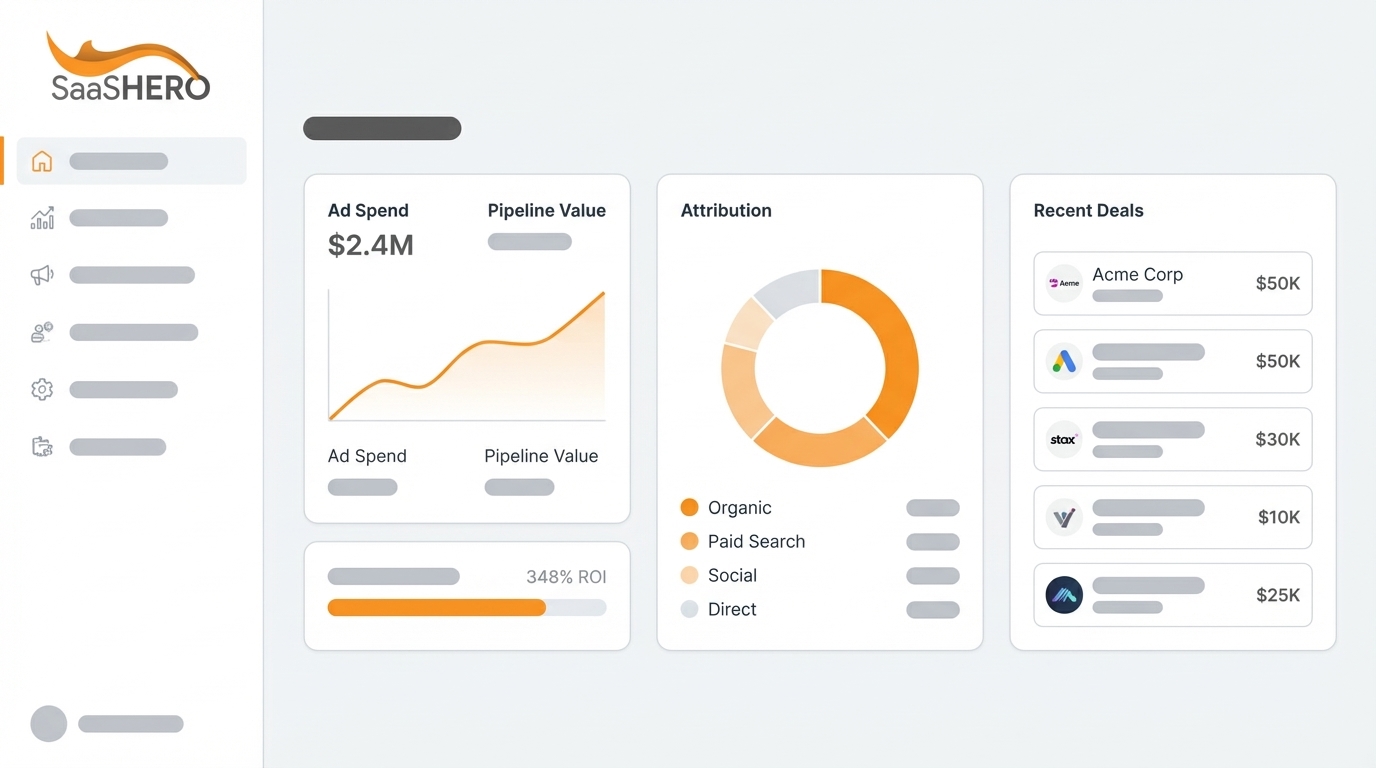
Key Takeaways
- B2B SaaS ad spend optimization in 2026 centers on Net New ARR, CAC payback, and NRR, not vanity metrics like impressions or generic MQL counts.
- Specialized B2B SaaS growth agencies that use AI for optimization, testing, and budget allocation provide more predictable performance than generalist, spend-based models.
- Revenue-first reporting, multi-touch attribution, and strong RevOps integration make agency impact on pipeline, payback, and retention visible and measurable.
- Bootstrapped startups, scaling Series B companies, and enterprise launches each require different agency structures, pricing models, and channel strategies to use ad budgets efficiently.
- SaaSHero helps B2B SaaS teams convert paid media into predictable revenue with SaaS-specific strategy, attribution, and benchmarks; Book a discovery call to assess your current ad spend.

The Imperative of Ad Spend Optimization in B2B SaaS: Why 2026 Is Different
From Growth-at-All-Costs to Capital Efficiency
B2B SaaS leaders in 2026 evaluate every ad dollar against efficiency and revenue impact. Macroeconomic pressure has shifted focus from pure acquisition toward retention, expansion, and payback.
Marketing teams now justify spend using Net Revenue Retention, CAC payback, and Lifetime Value, not impressions or form fills. CFOs expect clear proof that paid programs create profitable, retained revenue, which raises the bar for how agencies plan, execute, and report on campaigns.
The AI Evolution: Autonomous Optimization and Experimentation
AI now manages large portions of campaign execution, budget allocation, and testing. Leading growth agencies use AI for audience discovery, bid optimization, creative iteration, and cross-channel budget shifts in near real time.
Agencies that still rely on manual changes and static plans struggle to keep pace. AI-driven workflows allow faster experimentation and better matching of spend to segments, offers, and messages that produce revenue, not just clicks.
The Failure of Traditional Agency Models
Percentage-of-spend billing and channel-specific vanity metrics create misaligned incentives. Agencies paid more when clients spend more have little reason to slow or reallocate budgets when performance declines.
Generalist shops that lack SaaS expertise often optimize for surface metrics and short-term lead volume. B2B SaaS companies gain more value from partners that understand recurring revenue models, sales cycles, and payback expectations, and that structure fees around work and outcomes rather than ad volume.
Defining Success: Revenue-First Metrics for B2B SaaS Ad Spend Optimization
Beyond MQLs: Shifting to Financial Outcomes
Effective growth agencies align reporting with finance and board expectations. Core metrics include Net New ARR, CAC payback, LTV:CAC, Net Revenue Retention, and pipeline coverage by segment and region.
Lead volume still matters, but only when tied to conversion, deal size, and retention. Revenue-first metrics prevent over-investment in channels that generate cheap leads but weak opportunities or poor-fit customers.
The Criticality of Multi-Touch Attribution and Identity Resolution
Non-linear SaaS buying journeys with multiple stakeholders require multi-touch attribution. Single-touch or last-click models underrepresent early-stage and mid-funnel channels that influence deals.
Specialized agencies implement identity resolution across ads, website, CRM, and product data to connect first-touch campaigns with closed-won revenue. This integration supports smarter budget shifts toward channels and messages that influence high-quality pipeline over time.
Benchmarking for Growth: What Good Looks Like
Benchmarks help leaders judge whether ad spend and agency performance are competitive for their stage. Many early-stage companies target CAC payback within 6 to 12 months, while later-stage companies often aim for 3 to 6 months.
Best-in-class B2B SaaS organizations frequently exceed 120 percent Net Revenue Retention when expansion and cross-sell motions work well. Clear benchmarks by stage and ACV allow more objective discussions with agencies about targets and acceptable time-to-results. Book a discovery call to align your paid media benchmarks with your current growth phase.
Navigating the Growth Ecosystem: In-House, Traditional, or Specialized Growth Marketing Agency?
The Rise of Specialist Growth Agencies
Specialist growth agencies focus on B2B SaaS economics. These teams build campaigns around metrics such as Monthly Recurring Revenue, Annual Contract Value, Net Revenue Retention, and customer health.
Domain-specific experience allows more accurate messaging, better offer strategy, and more realistic expectations for timelines and pipeline creation. This focus also improves feedback loops between marketing, sales, and customer success.
Strategic Trade-Offs: Build, Buy, or Partner
In-house teams offer deep product knowledge and direct control but often develop more slowly and require higher fixed costs. Traditional agencies deliver quick capacity but may not understand SaaS funnels or RevOps structures.
Specialized growth agencies combine SaaS expertise with flexible engagement models. Many companies adopt a hybrid approach, keeping strategy and key hires in-house while using a specialist agency for paid media, experimentation, and analytics.
The Influence of AI and the Dark Funnel
AI-driven search and recommendation environments reduce visible clicks and form fills. Many buyers research, compare, and shortlist vendors before visiting a site or requesting a demo, creating a large dark funnel.
Modern agencies measure impact across this hidden activity using intent data, engaged account lists, and downstream pipeline metrics, not just last-touch leads. Hyper-personalization and tight RevOps coordination help convert this invisible demand into revenue.
Partnering for Performance: Selecting Your Growth Marketing Agency for Ad Spend Optimization
Red Flags: Misaligned Incentives and Vanity Metrics
Percentage-of-spend pricing, long lock-in contracts, and reports that highlight impressions or clicks without revenue context signal risk. These models usually protect agency revenue more than client outcomes.
Healthy partnerships emphasize flexible terms, clear exit paths, and dashboards that connect campaigns to pipeline stages, ARR, and payback periods.
The Extension of Team Philosophy
High-performing agencies operate as embedded partners. They join forecast calls, contribute to quarterly planning, and collaborate with sales and RevOps on targeting, offers, and qualification criteria.
This level of integration requires shared systems, transparent data access, and joint ownership of goals. The agency becomes responsible not only for generating leads but for supporting revenue and retention.
Operational Alignment: Data Integration and RevOps
Unified data is now a baseline requirement. Agencies need access to CRM, marketing automation, and product usage data to prioritize accounts, refine audiences, and improve attribution.
Companies that align marketing, sales, and customer success under a single RevOps motion give agencies clearer feedback on performance. This structure enables faster optimization of creative, spend, and channel mix based on real revenue outcomes.
Strategic Models for Growth Marketing Agency Ad Spend Optimization
Scenario 1: The Bootstrapped SaaS Startup
Challenges: Small budgets must generate qualified opportunities quickly while building a data foundation. High retainers and spend-based fees can consume scarce capital.
Agency Solution: Flexible, flat-fee engagements with narrow channel focus and fast testing cycles help prove payback. Clear reporting on opportunities and pipeline per dollar spent allows founders to decide when to scale or pause campaigns.
Scenario 2: The Scaling Series B SaaS Company
Challenges: Series B teams need efficient scale, strong pipeline coverage, and clear visibility for board reporting. Underperforming channels or regions can delay next-round milestones.
Agency Solution: Growth agencies that integrate deeply with CRM and revenue dashboards can show direct impact on Net New ARR, opportunity creation, and payback by segment. These partners help reallocate budgets toward channels that consistently support 3x to 5x pipeline coverage on quota.
Scenario 3: Enterprise SaaS Launching a New Product
Challenges: Enterprise launches require precise targeting across defined account lists and buying groups. Budgets are larger, but expectations for measurement and coordination are higher.
Agency Solution: Agencies with account-based marketing experience orchestrate coordinated campaigns across display, search, social, and outbound. Intent-driven targeting, tailored messaging, and sales collaboration help ensure ad dollars reach the right roles within priority accounts. Book a discovery call to match your ad spend model to your product, ACV, and sales motion.
Frequently Asked Questions (FAQ) about Growth Marketing Agency Ad Spend Optimization
How should B2B SaaS companies budget for growth marketing agency fees in 2026?
Value-based or flat-fee pricing usually aligns incentives more closely than percentage-of-spend models. Predictable fees make it easier to evaluate CAC, payback, and Net New ARR impact without pressure to increase budgets solely to raise agency compensation.
What are the key performance indicators (KPIs) a B2B SaaS company should demand from an agency for ad spend optimization?
Essential KPIs include Net New ARR, Net Revenue Retention, Gross Revenue Retention, CAC payback, LTV:CAC, MQL-to-SQL conversion, cost per opportunity, and pipeline coverage. These indicators connect marketing activity to revenue quality and sales efficiency.
How can I ensure my growth marketing agency’s ad spend is driving revenue, not just leads?
Robust integrations between ad platforms, marketing automation, and CRM allow full-funnel tracking from first touch to closed-won. Regular reviews of opportunity creation, win rates, and payback by channel provide a clear view of which campaigns generate real revenue.
What role does AI play in optimizing ad spend with a growth marketing agency?
AI supports audience expansion, bid strategies, creative testing, and lead scoring at scale. Agencies that combine AI tools with SaaS-specific strategy can respond faster to performance signals and keep budgets focused on segments that show strong revenue potential.
How important is specialization for a growth marketing agency focused on B2B SaaS ad spend optimization?
Specialization is highly important. Agencies that understand SaaS pricing models, sales cycles, retention dynamics, and expansion motions design campaigns that support both acquisition and long-term value, not just first-purchase conversion.
Conclusion: Partnering for Capital-Efficient B2B SaaS Growth in 2026
Growth marketing agency ad spend optimization now depends on revenue alignment, SaaS-specific expertise, and integrated data. The most effective agencies act as extensions of internal teams, share accountability for ARR, and report against board-level metrics.
B2B SaaS leaders that choose partners with transparent pricing, strong analytics, and proven SaaS experience gain clearer visibility into how each channel contributes to pipeline and payback. This clarity makes it easier to protect capital while still meeting growth targets.

B2B SaaS companies that want to improve capital efficiency from paid channels can benefit from a focused, revenue-first partner. SaaSHero works with growth-minded teams to align ad spend, attribution, and creative with pipeline and ARR goals. Book a discovery call to review your current paid strategy and identify the fastest paths to more predictable, efficient growth.