




Written by: Aaron Rovner, Founder, Saas Hero | Last updated: August 6, 2026
Key Takeaways
- Landing page changes to headlines, forms, social proof, and offers can tie directly to measurable ARR lifts in B2B SaaS.
- High-intent targeting and message match between ads and landing pages consistently drive the largest revenue outcomes, with some clients achieving six-figure ARR gains from this single change.
- Persona-specific pages and competitor-conquest content outperform generic pages by addressing buyer objections and intent in the first viewport.
- Quick-win tests such as reducing form fields, swapping CTA copy, and building dedicated comparison pages can produce conversion lifts within weeks.
8 B2B SaaS Landing Page Examples That Drove Revenue
1. TripMaster: High-Intent Targeting Drives Net New ARR
TripMaster, a transit software platform, was sending paid search traffic to a generic homepage that did not reflect the visitor’s query. SaaSHero shifted the focus to high-intent accounts and signals, then aligned ad copy and landing page messaging. The result was $504K in Net New ARR in 12 months. Takeaway: Message match between ad and landing page is often the highest-impact heuristic fix available.

2. TestGorilla: Landing Pages That Support Unit Economics and Series A
TestGorilla entered a hyper-growth phase and needed to prove unit economic efficiency to institutional investors. Landing pages and campaigns were tuned around payback period and revenue efficiency, not just raw conversion rate. The company raised a $70M Series A. Takeaway: Framing landing page performance in terms of payback period speaks the language that moves investors and boards.
3. Playvox: Lead Quality Gains From Page and Account Restructuring
Playvox, a CX software platform, was buying clicks from broad, low-intent keywords and sending them to pages with no qualification mechanism. SaaSHero tightened negative keyword lists and built landing pages around specific use cases and buyer needs. This combination reduced cost per lead and increased qualified lead volume. Takeaway: Lowering page friction while improving upstream traffic quality compounds conversion gains faster than either tactic alone.
4. Shop Boss: Why a Visual Redesign Alone Was Not Enough
Shop Boss, an automotive shop management platform, was investing in paid media without a landing page that could convert the traffic it purchased. The redesign focused on branding, logo, messaging, and dark-mode visuals. No public evidence shows Shop Boss achieved any conversion increase after its website redesign. Takeaway: Pages that lead with buyer outcomes instead of product features consistently outperform feature-first layouts in B2B SaaS.
5. Leasecake: Job-Title Pages That Helped Fuel a $3M VC Round
Leasecake, a real estate lease management platform, needed credibility in a niche where buyers are skeptical of new vendors. Generic landing pages did not address the specific concerns of CFOs and real estate operations managers. SaaSHero built LinkedIn-targeted pages with job-title-specific headlines, switching-cost objection handlers, and testimonials from similar companies. The campaign contributed to a $3M VC round and a record growth quarter, with founder Taj Adhav describing the team as “part of our team.” Takeaway: Persona-specific landing pages beat generic pages in multi-stakeholder B2B deals.
6. HR Tech Client: Competitor Pricing Page Captures Renewal Searches
A mid-market HR Tech platform was losing high-intent searches for “[Competitor] pricing” to the competitor’s retargeting ads. SaaSHero created a dedicated pricing comparison page with a total cost of ownership table, a clear value-gap explanation, and a “Switch & Save” CTA. Negative keywords removed navigational-intent searches so only evaluative traffic reached the page. Competitor-conquest pages then improved conversion rates from this segment. Takeaway: Pricing-intent traffic is one of the highest-converting segments, so a dedicated page is essential to capture it.
7. CX Software Client: Problem-Solution Page Converts Competitor Churners
A CX software company discovered that many demo requests came from searches like “[Competitor] alternatives” and “[Competitor] support problems.” These visitors landed on a generic homepage that ignored their frustration. SaaSHero launched a problem-solution page that opened with a direct reference to the competitor’s support issues, then featured switched-customer testimonials and a free migration offer. The page cut bounce rate by addressing intent in the first viewport. Takeaway: Complaint-intent visitors convert at higher rates when the page validates their frustration before presenting your alternative.
8. Cybersecurity SaaS: Review-Focused Page Controls Comparisons
A cybersecurity SaaS platform was losing consideration-stage traffic to third-party review sites because its own site lacked structured comparison content. Visitors searching “[Competitor] vs [Client]” left to read G2 reviews and often did not return. SaaSHero built a review-focused comparison page that aggregated G2 High Performer badges, Capterra ratings, and a side-by-side feature matrix highlighting the client’s USPs. Hosting this comparison on the client’s domain reduced reliance on aggregators and increased demo requests from comparison-intent traffic. Takeaway: Owning the “[Competitor] vs [You]” page on your domain creates a durable asset that compounds over time.
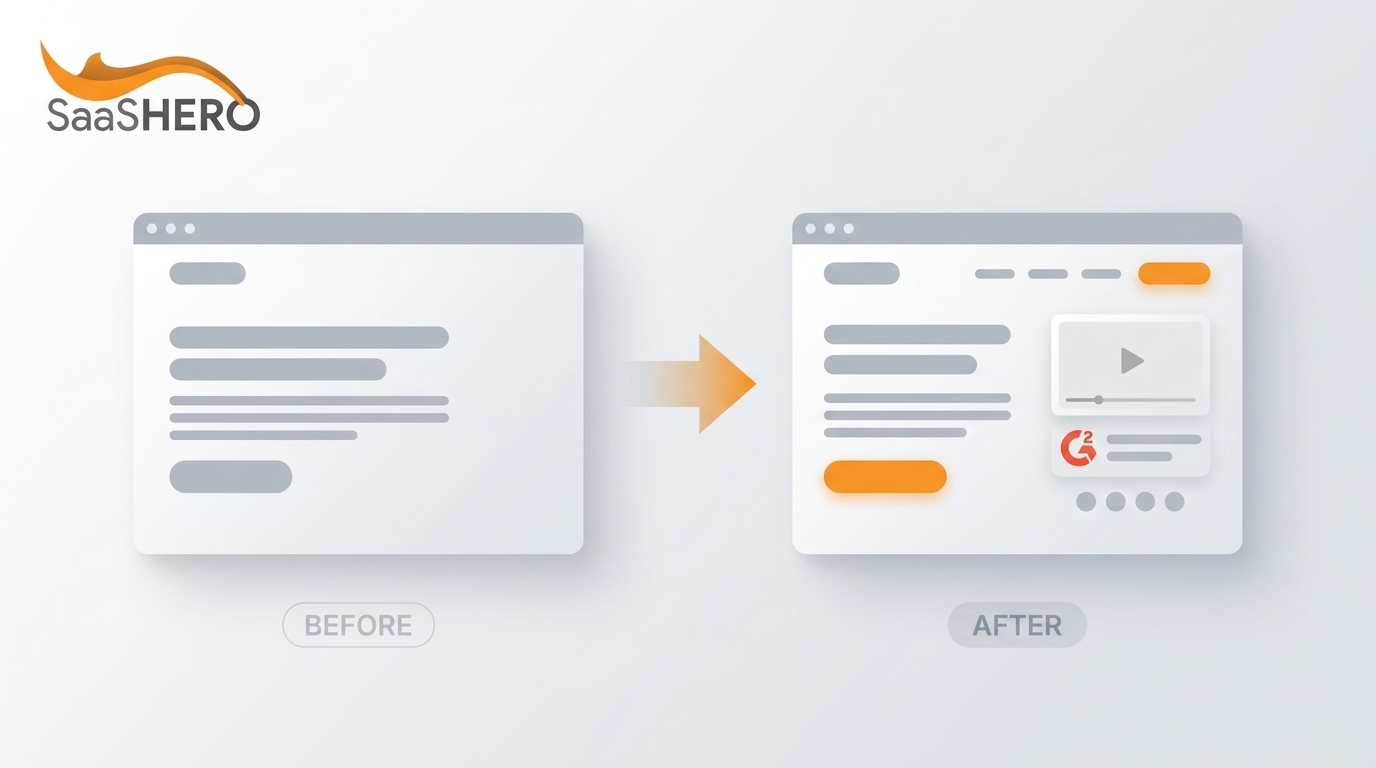
The case studies above show how targeted landing page changes can move real revenue, not just vanity metrics. If you want faster gains that do not require a full rebuild, the next three tests can deliver measurable conversion lifts within weeks.

Ready to build competitor-conquest pages for your highest-value search terms? Book a discovery call.
Quick-Win Test: Reduce Form Fields to Cut Friction
Shorter forms usually convert better on B2B SaaS landing pages because every extra field creates a new exit point. Contentsquare’s UX benchmark data consistently shows form friction as a leading cause of abandonment on lead gen pages. Start by removing every field your sales team does not use within the first 48 hours of receiving a lead. For most demo request forms, keep first name, work email, and company name, then move qualification questions to the discovery call. Run this as an A/B test in a tool like Optimizely for at least two business weeks before you call a winner.
Quick-Win Test: Swap CTA Copy for Clear Outcomes
Outcome-focused CTA copy outperforms generic labels like “Submit” or “Contact Us” because it tells hesitant buyers what they get next. Replacing vague CTAs with options such as “Get My Free Audit,” “See a Live Demo,” or “Calculate My ROI” reduces perceived risk. The test structure uses a single-variable swap of the CTA button text while keeping all other page elements constant. This isolation makes any conversion change easier to attribute to the CTA copy. When you review results, track demo requests instead of total clicks so the change ties to pipeline, not vanity engagement metrics.
Quick-Win Test: Launch a Dedicated Competitor-Conquest Page
Dedicated competitor pages often deliver the highest quick-win impact because they capture high-intent traffic you already receive. Sending competitor-intent visitors to a generic homepage is one of the most expensive landing page mistakes in B2B SaaS paid search. SaaSHero’s competitor-conquest methodology segments this traffic into three buckets: pricing, problem or complaint, and review or validation, then routes each to a page built for that mindset. Start by creating one competitor page for your highest-volume competitor keyword cluster and compare its conversion rate against your current destination over 30 days. The improved message match alone usually produces a visible lift within the first two weeks.

The Heuristic Audit Framework
SaaSHero’s heuristic analysis framework evaluates every landing page against five principles. Relevance checks whether the page matches the ad. Clarity asks if the value proposition is legible in five seconds. Trust looks for social proof above the fold. Friction examines form fields and navigation for unnecessary complexity. Intent alignment verifies that the CTA matches the visitor’s stage in the buying journey. This structured audit surfaces conversion killers before you scale media spend and produces a prioritized list of fixes ranked by revenue impact.
To receive a customized heuristic audit checklist for your landing pages, book a discovery call below.
Book a discovery call to receive a heuristic audit of your top three landing pages at no cost.
Frequently Asked Questions
How much does B2B SaaS landing page optimization cost, and what does SaaSHero charge?
SaaSHero’s landing page design is available as a flat-fee add-on at $750 per page, with CRO included in the monthly retainer. Retainer pricing starts at $1,250 per month for a Dedicated Campaign Manager managing up to $10,000 in monthly ad spend on a month-to-month basis, with no long-term contract. Full Marketing Team retainers begin at $2,500 per month for the same spend band. A one-time setup fee of $1,000–$2,000 covers the initial heuristic audit, tracking configuration, and strategy build. This flat-fee model removes the percentage-of-spend conflict of interest that often pushes traditional agencies to increase budget regardless of performance.
Who owns the landing pages and creative assets SaaSHero builds?
The client owns all landing pages, copy, and creative assets produced during the engagement. SaaSHero works as an embedded growth team, building deliverables inside the client’s CMS, ad accounts, and design systems. Because SaaSHero uses month-to-month agreements, clients keep full access to everything built, even if they end the retainer. There are no proprietary platform lock-ins or asset-withholding clauses.
How long does it take to see measurable conversion lifts from landing page changes?
Quick-win fixes from a heuristic audit, such as headline rewrites, CTA copy swaps, and form-field reductions, can change conversion rates within a few weeks if traffic volume is sufficient. More complex work, such as building a full competitor-conquest architecture or restructuring a multi-step funnel, often needs several months to reach statistical significance. SaaSHero client engagements show that the timeline to revenue impact depends on deal velocity and average contract value as much as on page performance.
How does SaaSHero measure whether landing page changes actually drove ARR?
SaaSHero connects ad click data, usually via Google Click ID, through the landing page and into the client’s CRM, typically HubSpot or Salesforce. This setup lets every closed-won deal map back to the originating campaign and page variant. Reporting focuses on Net New ARR, pipeline value, and Sales Qualified Leads instead of impressions or click-through rates. Looker Studio dashboards provide weekly visibility from first ad impression to closed revenue, giving CMOs the data they need to defend marketing spend at the board level.
What tools does SaaSHero use for A/B testing and CRO, and do clients need to purchase them separately?
SaaSHero is platform-agnostic and works within the client’s existing tools whenever possible. For A/B testing, the team often uses Optimizely or native CMS testing features. Heuristic audits rely on structured expert review rather than a dedicated testing platform, so quick-win fixes can roll out before any testing software purchase. Clients do not need to buy proprietary SaaSHero tools because the methodology runs on standard martech infrastructure.
What is the risk of switching to SaaSHero from an existing agency mid-campaign?
The main risk in any agency transition is a short-term disruption in campaign performance during the handoff, usually two to four weeks while historical data is reviewed and the new account structure is implemented. SaaSHero reduces this risk through a structured onboarding process that includes a full heuristic audit, tracking verification, and a 30-day quick-win sprint before major structural changes. Because SaaSHero works on month-to-month agreements, clients avoid signing a second long-term contract during the transition. The setup fee of $1,000–$2,000 is the only financial commitment before the first full month of managed service.
Conclusion
The landing page examples in this article all follow the same pattern: specific, intent-matched changes to headlines, forms, social proof, or competitor pages produced measurable revenue outcomes. For B2B SaaS companies, where pipeline quality matters more than raw lead volume, the heuristic audit framework and competitor-conquest methodology that SaaSHero uses provide a repeatable, senior-led process for turning ad spend into Net New ARR. The month-to-month retainer structure and flat-fee pricing model described above reduce contractual risk for CMOs and remove the spend-inflation incentive that often distorts traditional agency advice.