




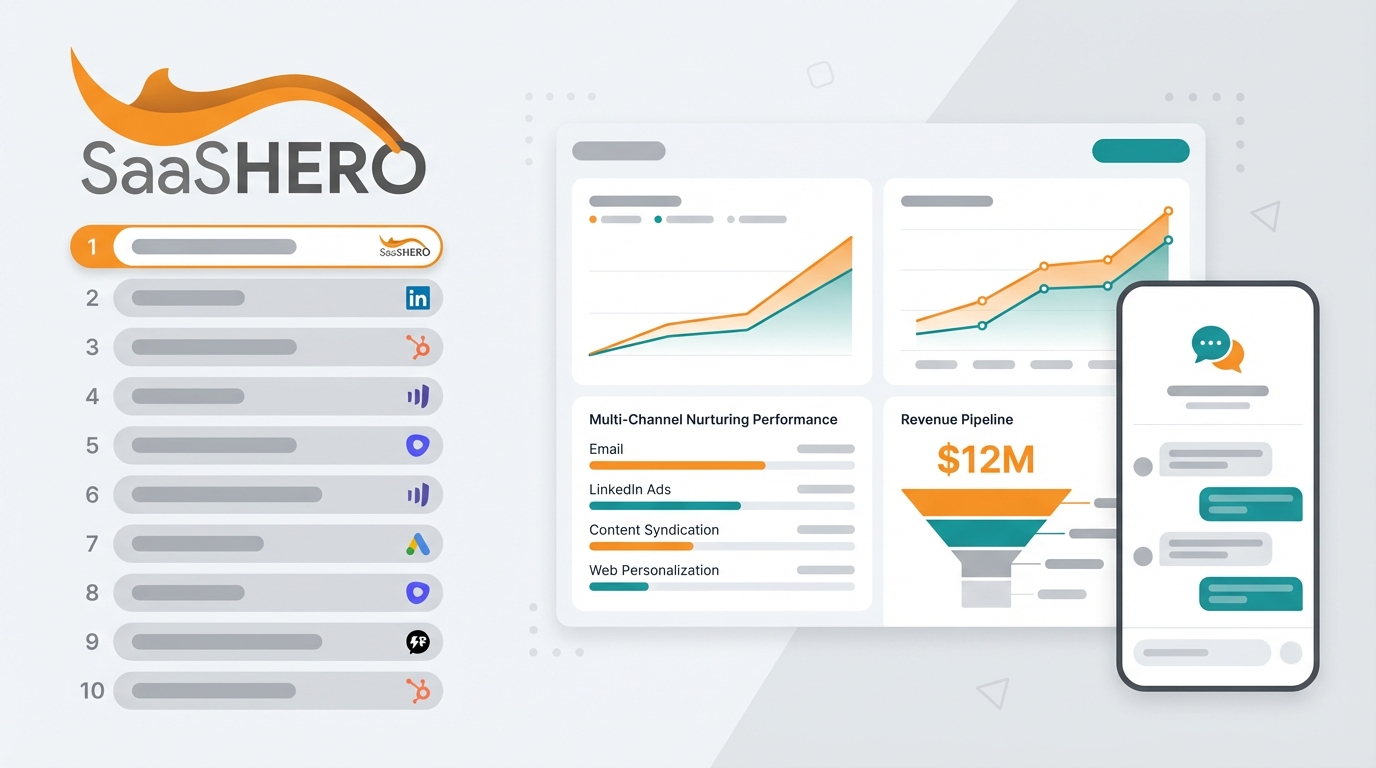
Key Takeaways for B2B SaaS Leaders
- Multi-channel lead nurturing across email, LinkedIn, ABM, and paid ads reduces cost-per-lead by 31% and generates warmer sales-ready leads for B2B SaaS.
- Agencies like Callbox and Belkins offer generalist services but lack SaaS-specific metrics like Net New ARR and flexible month-to-month pricing.
- Platforms such as Outreach, HubSpot, and Marketo provide powerful tools but require internal expertise rather than full-service revenue-aligned nurturing.
- SaaSHero delivers proven results including $504K Net New ARR, flat-fee pricing from $1,250-$7,000 per month, and exclusive B2B SaaS focus across key verticals.
- 2026 trends emphasize AI personalization, hyper-targeted ABM, and multi-touch attribution, and booking a discovery call with SaaSHero helps teams apply these for scalable revenue growth.

10. Callbox: Multi-Channel Generalist with ABM Focus
Callbox runs multi-channel campaigns across email marketing, cold calling, and account-based marketing for a wide range of industries. Their approach blends phone outreach with digital touchpoints, which supports broad coverage but limits SaaS-specific depth. Pricing follows subscription models billed per quarter with minimum commitments that vary by industry and complexity. They provide solid ABM capabilities, yet reporting rarely includes SaaS metrics such as Net New ARR or payback period. Long-term contracts and limited flexibility make Callbox a weaker fit for SaaS teams that iterate quickly and prefer month-to-month agreements.
9. Belkins: LinkedIn-Centric Lead Generation
Belkins focuses on LinkedIn outreach and email sequences aimed at B2B decision-makers through social selling tactics. Their strength lies in LinkedIn advertising and connection-based prospecting that works well for top-of-funnel engagement. They also offer cold calling, phone outreach, and ABM, but these services do not fully cover complex SaaS nurturing across long sales cycles. The agency works with many B2B sectors and lacks deep SaaS knowledge around churn, MRR, and sales cycle compression. Six-month contract requirements limit agility for SaaS companies that need to test, learn, and adjust quickly.
8. CIENCE: Data-Driven Outbound Specialists
CIENCE blends human researchers with AI prospecting tools to run targeted outbound campaigns across email and phone. Their data platform identifies high-intent prospects and supports large-scale outreach. Their model favors volume and activity, which can conflict with the slower, more deliberate nurturing motions required in complex B2B SaaS deals. Reporting centers on activity metrics such as calls and emails rather than revenue attribution and Net New ARR. Pricing structures suit larger enterprises and often stretch budgets for Series A or early-growth SaaS companies that need efficient nurturing at lower cost.
7. Leadfeeder: Intent-Based Website Visitor Identification
Leadfeeder identifies anonymous website visitors and triggers follow-up sequences through email and LinkedIn outreach. Their intent data helps SaaS teams prioritize accounts that show buying signals and revisit key pages. Nurturing execution depends heavily on integrations with other tools, which adds complexity for lean teams. The platform excels at top-of-funnel identification but does not cover full-funnel nurturing on its own. SaaS companies see the strongest results when they plug Leadfeeder into a broader multi-channel strategy that includes paid media and structured email programs.
6. Terminus: Enterprise ABM Platform for Target Accounts
Terminus delivers account-based marketing through coordinated display advertising, email campaigns, and sales enablement tools. Their platform connects with major CRMs and supports personalized experiences across many touchpoints. ABM delivers 81% higher ROI compared to other tactics, which positions Terminus as a strong choice for enterprise SaaS with defined target account lists. Implementation requires significant time, budget, and internal resources, which slows deployment for mid-market SaaS teams. Their enterprise focus and heavier setup make them less suitable for companies that want fast launch cycles and flexible engagement.
Book a discovery call to compare Terminus-style ABM with more agile SaaS-specific nurturing programs.
5. Outreach: Sales Engagement Automation Platform
Outreach offers sales engagement automation across email, phone, and social channels with advanced sequencing features. Teams build multi-touch campaigns with behavioral triggers, A/B tests, and detailed activity tracking. Deep integrations with Salesforce and HubSpot support pipeline visibility and sales productivity. Outreach functions as a powerful tool rather than a managed service, so success depends on internal strategy and operations talent. SaaS companies gain strong automation capabilities but still need an agency or in-house experts to design revenue-focused nurturing programs.
4. Drift: Conversational Marketing for SaaS Websites
Drift combines chatbots, email, and targeted on-site messaging to create conversational experiences across web and mobile. Real-time engagement and qualification work especially well for SaaS products with self-service trials or freemium models. Integrations with marketing automation platforms allow teams to build nurturing workflows based on chat and conversation data. Drift focuses on conversational marketing and does not cover full multi-channel orchestration across LinkedIn, ABM, and paid media. SaaS companies often pair Drift with other tools or agencies to manage complete funnel nurturing.
3. Marketo Engage: Enterprise-Grade Marketing Automation
Marketo Engage delivers advanced marketing automation with lead scoring, email nurturing, and multi-channel campaign orchestration. The platform supports complex SaaS use cases with behavioral triggers, progressive profiling, and revenue attribution. Integrations with major CRMs and sales tools provide strong pipeline visibility for revenue teams. Marketo requires significant implementation work, technical configuration, and ongoing management. Enterprise SaaS companies with dedicated marketing operations teams benefit most, while smaller organizations often find the platform heavy for their needs.
2. HubSpot Marketing Hub: Unified Growth Platform
HubSpot Marketing Hub combines email, social media, landing pages, and CRM in a single platform. Workflows support multi-channel nurturing with detailed analytics and attribution. Native connections with HubSpot Sales Hub and Service Hub create a full customer lifecycle view for SaaS companies. HubSpot operates as a flexible toolkit rather than a done-for-you agency solution. Teams still need internal expertise or a partner to build strategy, manage campaigns, and align programs with revenue targets.
1. SaaSHero: Revenue-First Multi-Channel Nurturing Specialists
SaaSHero focuses exclusively on B2B SaaS and runs coordinated campaigns across LinkedIn advertising and paid search with transparent flat-fee pricing and month-to-month flexibility. Their programs align every channel with revenue metrics instead of surface-level engagement numbers.

Multi-Channel Execution for SaaS Pipelines: SaaSHero builds workflows that connect LinkedIn advertising, competitor conquesting on Google Ads, and paid social into a single revenue engine. Integrations with HubSpot, Salesforce, and Looker Studio provide clear attribution from first touch through closed-won deals. Revenue teams see which campaigns create pipeline, shorten sales cycles, and expand accounts.
Proven SaaS Revenue Outcomes: Case studies show $504,758 in Net New ARR for TripMaster, an 80-day payback period for TestGorilla’s $70M Series A motion, and a 10x cost-per-lead reduction for Playvox. Reporting centers on Net New ARR, CAC, and payback period instead of vanity metrics. This focus aligns directly with SaaS board expectations and investor updates.

Flat-Fee Pricing and Flexible Contracts: SaaSHero uses flat monthly retainers that range from $1,250 for single-channel management to $7,000 for full multi-channel programs. They avoid percentage-of-spend fees that reward higher ad budgets without tying back to performance. Month-to-month contracts reduce risk and keep the agency accountable for results every cycle.
Deep B2B SaaS Vertical Expertise: SaaSHero works only with B2B SaaS across HR Tech, Cybersecurity, Transportation, and MarTech. Their team understands SaaS metrics such as churn, MRR, LTV, and sales cycle length and uses this language in planning and reporting. This specialization replaces generic marketing talk with revenue conversations that resonate with founders, CROs, and finance leaders.
2026-Ready AI and Human Oversight: SaaSHero combines advanced tracking and AI-enhanced testing with senior strategic guidance. Automation supports targeting and sequencing, while experienced strategists handle positioning, messaging, and relationship building. Their exclusive SaaS focus and senior-led model mean they accept a limited number of clients to maintain quality.
Book a discovery call to see how SaaSHero’s revenue-aligned approach can improve your multi-channel performance.
How We Ranked These Multi-Channel Nurturing Options
The evaluation process covered more than 50 multi-channel lead nurturing providers against criteria specific to B2B SaaS. Core factors included proven Net New ARR attribution, flat-fee pricing that avoids percentage-of-spend conflicts, senior-level execution, and month-to-month flexibility. Providers that could not connect campaigns to revenue or required long-term contracts ranked lower for SaaS use cases.
SaaS leaders can apply a simple vetting checklist. Require Net New ARR reporting tied to CRM data, avoid percentage-of-spend pricing, and confirm that senior strategists manage your account. Verify month-to-month contract options and ask about AI-driven personalization capabilities that support 2026-level competitiveness.
Key 2026 Trends in Multi-Channel SaaS Nurturing
Three trends now shape multi-channel nurturing for B2B SaaS. AI-powered lead scoring and adaptive sequencing increase conversion rates by up to 30% and enable personalization at scale. Hyper-personalized ABM delivers 81% higher ROI as teams use intent data and behavioral triggers to focus on high-value accounts. Multi-touch attribution connects upper-funnel activities to revenue so SaaS companies can improve entire journeys instead of isolated channels. SaaSHero combines attribution tracking, personalized workflows, and revenue reporting through their performance marketing practice.
Frequently Asked Questions
Core Channels in Multi-Channel Nurturing for B2B SaaS
Multi-channel nurturing for B2B SaaS uses coordinated touchpoints across email automation, LinkedIn advertising and outreach, ABM campaigns, paid search including competitor conquesting, and retargeting display. Effective programs keep messaging consistent and build profiles over time so each touch feels relevant. Behavioral triggers guide channel selection and timing for every stage of the buyer journey.
Vetting Agencies and Avoiding Vanity Metrics
SaaS companies should require agencies to show Net New ARR attribution through CRM integration and clear links between campaigns and closed-won revenue. Ask for case studies that include revenue impact, pipeline velocity, and CAC improvements. Avoid partners that focus on impressions, clicks, or MQL counts without SQL and revenue data. Strong agencies send weekly pipeline reports and explain how each program affects MRR growth and churn.
Pricing Models That Align with SaaS Revenue Goals
Flat monthly retainers align agency incentives with client performance more effectively than percentage-of-spend models. Typical SaaS nurturing retainers range from $1,250 per month for single-channel programs to $7,000 for full multi-channel management, with tiers based on ad spend bands. Month-to-month contracts support rapid iteration, while optional six-month prepay plans often include discounts. Long-term locked contracts and percentage fees create misaligned incentives and deserve caution.
SaaSHero vs Generalist Agencies Like Callbox and Belkins
SaaSHero’s exclusive B2B SaaS focus supports deeper expertise in Net New ARR, LTV, and sales cycle optimization than generalist agencies usually provide. Flat-fee pricing removes the budget inflation incentives that come with percentage-of-spend models. Month-to-month contracts offer flexibility that 6 to 12 month agreements from traditional agencies rarely match. Case studies highlight specific revenue outcomes such as $504,758 in Net New ARR instead of generic lead volume claims.
AI Capabilities to Expect from Nurturing Agencies in 2026
Modern nurturing agencies now use AI for predictive lead scoring, adaptive email sequencing, and dynamic content personalization across channels. Machine learning refines send times, channel mix, and frequency for each prospect, while natural language tools support chatbots and personalized outreach at scale. The strongest partners combine AI automation with human strategy so complex B2B SaaS deals still receive thoughtful guidance and relationship-focused support.
Conclusion: Choosing a Revenue-Aligned Nurturing Partner
The 2026 multi-channel nurturing landscape rewards agencies that understand B2B SaaS revenue mechanics, not just marketing metrics. SaaSHero stands out through exclusive SaaS focus, flat-fee pricing, and documented Net New ARR impact across multiple verticals. Month-to-month flexibility and AI-enhanced capabilities make them a strong choice for SaaS teams that want both immediate performance and long-term alignment.

SaaS leaders should prioritize partners that speak in revenue terms, prove pipeline impact, and share risk through aligned pricing. Book a discovery call to explore how specialized multi-channel nurturing can support predictable, scalable SaaS growth.