




Key Takeaways
- B2B SaaS growth slowed to 11% CAGR in 2026, so competitor benchmarking now directly supports efficiency and Rule of 40 compliance.
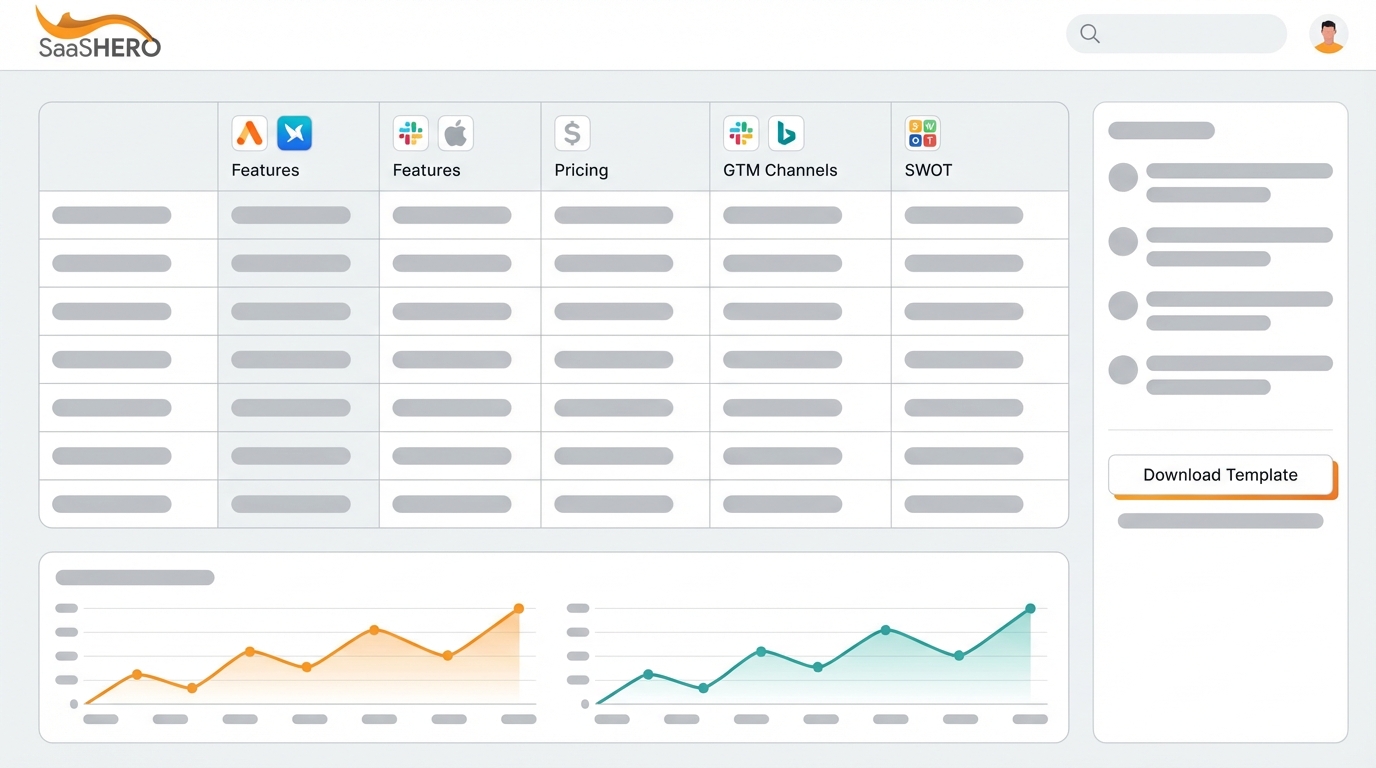
- A free downloadable template walks you through a 6-step analysis: competitor ID, business overview, features and pricing, GTM tactics, SWOT, and conquest planning.
- You can uncover pricing gaps, feature advantages, and high-intent keywords like “[rival] pricing” that lower CAC and increase ARR.
- A quarterly refresh using tools like Ahrefs and Similarweb keeps your insights current as the market shifts.
- Ready to execute today, not six months from now, book a discovery call with SaaSHero for proven campaign execution and 650% ROI.
Context Before You Start Your Analysis
Set yourself up with Google Sheets or Excel, a list of 3-5 direct competitors, and a working grasp of ARR, CAC, and churn. Competitor conquesting targets high-intent keywords such as “[rival] pricing” or “[competitor] alternatives” so you reach buyers who already compare options. GTM analysis reviews advertising channels, positioning, and acquisition tactics to show where competitors win deals.
Plan for 30 minutes to set up the template and about 1 hour for a full first pass. Companies with AI deeply incorporated into products grow 70% faster in the $1-5M ARR range, so feature comparison in 2026 directly affects your competitive position.
Six-Part Framework For SaaS Competitor Analysis
This 6-step framework breaks down competitor strategy into clear, repeatable pieces. The steps cover competitor identification, business overview comparison, features and pricing, GTM and marketing tactics, SWOT using reviews, and a conquest opportunity map. Each step feeds the next so you can make confident decisions on pricing, roadmap priorities, and paid acquisition.
|
Step |
Focus Area |
Key Output |
|
1 |
Competitor ID |
Target list with funding and ARR estimates |
|
2 |
Business Overview |
Market positioning comparison |
|
3 |
Features/Pricing |
Competitive pricing matrix |
|
4 |
GTM/Marketing |
Channel strategy analysis |
|
5 |
SWOT/Reviews |
Strengths and weaknesses mapping |
|
6 |
Conquest Plan |
Keyword targeting strategy |
Download Links: Excel Template | Google Sheets | PowerPoint | Word | PDF
Step-by-Step Instructions For Using The Template
Step 1: Build Your Competitor Shortlist
Start by listing direct competitors that serve your target market with similar products. Run Google searches for your core keywords, review industry reports, and scan G2 or Capterra category pages. Include funded startups and established vendors, so you see both emerging threats and entrenched leaders.
|
Competitor |
Estimated ARR |
Last Funding |
Source |
|
Competitor A |
$5M-10M |
Series A $15M |
Crunchbase |
|
Competitor B |
$1M-3M |
Seed $2M |
Industry report |
|
Competitor C |
$20M+ |
Series B $40M |
Public filings |
|
Competitor D |
$500K-1M |
Bootstrap |
LinkedIn research |
Step 2: Capture Each Competitor’s Business Profile
Document core positioning, target segments, and market focus for every competitor. This snapshot becomes the base for later steps and highlights positioning gaps you can claim.
|
Metric |
Competitor 1 |
Competitor 2 |
Competitor 3 |
|
Target Audience |
Enterprise HR |
SMB Operations |
Mid-market Finance |
|
G2 Score |
4.3/5 (127 reviews) |
4.1/5 (89 reviews) |
4.5/5 (203 reviews) |
|
Employee Count |
150-200 |
25-50 |
300-500 |
|
Geographic Focus |
North America |
Global |
US + EU |
Step 3: Compare Features And Pricing Tiers
Map each product’s feature set against its pricing tiers so you can see clear value gaps. Usage-based pricing models yield 10% higher net revenue retention and 22% lower churn, so hybrid pricing details matter for 2026 planning.
|
Feature/Pricing Tier |
Your Product |
Competitor A |
Competitor B |
|
Starter Plan |
$29/user/month |
$39/user/month |
$25/user/month |
|
AI-Powered Analytics |
✓ (Pro tier) |
✓ (Enterprise only) |
✗ |
|
API Access |
✓ (All plans) |
✓ (Pro+) |
✓ (Enterprise) |
|
Usage-Based Add-ons |
$0.10/transaction |
Fixed pricing |
$0.15/transaction |
Step 4: Analyze GTM Channels And Marketing Tactics
Review each competitor’s marketing channels, keyword themes, and acquisition tactics to see where they spend and win. PPC intelligence reveals competitors’ Google Ads strategies, ad copy, bidding keywords, and estimated monthly spend, which exposes specific conquest targets.
|
Marketing Channel |
Target Keywords |
Estimated CAC |
Monthly Spend |
|
Google Ads |
“HR software”, “employee management” |
$150-200 |
$15K-25K |
|
LinkedIn Ads |
Job titles: HR Director, CHRO |
$300-400 |
$10K-15K |
|
Content Marketing |
“HR best practices”, “compliance guide” |
$50-75 |
$5K-8K |
|
Partner Channel |
HRIS integrations |
$100-150 |
Revenue share |
If your template reveals clear gaps, SaaSHero can turn them into live conquest campaigns with 650% ROI. Book a discovery call to turn this analysis into a pipeline.
Step 5: Run A SWOT Using Real Customer Reviews
Combine G2, Capterra, and forum reviews to map strengths, weaknesses, opportunities, and threats for each competitor. This view uncovers messaging angles and feature gaps that you can highlight in campaigns and sales calls.
|
SWOT Element |
Competitor A |
Competitor B |
Competitor C |
|
Strengths |
Strong enterprise features |
Simple UI, fast setup |
Comprehensive integrations |
|
Weaknesses |
Complex pricing, slow support |
Limited reporting |
Expensive for SMBs |
|
Opportunities |
SMB market expansion |
Enterprise feature gaps |
International markets |
|
Threats |
New AI-native competitors |
Feature commoditization |
Economic downturn impact |
Step 6: Build Your Competitor Conquest Keyword Plan
Create a keyword plan that targets buyers who research your competitors by name. Prioritize modifiers such as “pricing,” “alternatives,” and “vs [your brand]” so you reach prospects in active evaluation.
|
Keyword Type |
Examples |
Negative Keywords |
Landing Page Focus |
|
Pricing Intent |
“[competitor] pricing”, “cost” |
“free”, “trial” |
Pricing comparison |
|
Alternative Seeking |
“[competitor] alternatives” |
Brand name only |
Feature comparison |
|
Problem/Complaint |
“[competitor] problems”, “issues” |
“support”, “help” |
Solution-focused |
|
Comparison |
“[competitor] vs [your brand]” |
Unrelated products |
Head-to-head analysis |
How To Measure And Validate Conquest Performance
Track performance with keyword ranking gains, CAC changes, and pipeline attribution from conquest traffic. Aim for 10 or more ranking position improvements on target terms and a 20% CAC reduction against your baseline. Maintain LTV:CAC ratios of 3-5x for sustainable unit economics. Use Google Sheets formulas for competitive scoring and connect HubSpot for attribution.
Refresh your analysis every quarter so you catch pricing changes, feature launches, and new entrants. Watch funding news and product announcements that signal shifts in strategy and adjust your plan accordingly.
Advanced Ways To Extend This Framework
Level up your analysis with Similarweb for traffic data and Ahrefs for keyword gaps. Pair those insights with conversion rate audits so your conquest landing pages convert the traffic you win. Advanced teams can automate monitoring through APIs and alerts that flag major changes.
Connect these findings to revenue operations by tying competitor weaknesses to sales objection handling and customer success playbooks. This shift turns a static spreadsheet into a living competitive intelligence system that supports marketing, sales, and CS.
Summary And Practical Next Steps
This competitor analysis template gives you a clear base for data-backed positioning and conquest campaigns. Next, fill in competitor data, pick your top three positioning gaps, launch focused conquest campaigns, and set a quarterly review rhythm. SaaSHero’s flat-fee model at $1,250+ per month has already driven outcomes such as TripMaster’s $504K ARR growth.

Download every template format and pair it with SaaSHero’s execution support. Book a discovery call and turn competitor analysis into measurable revenue growth.
Frequently Asked Questions
How do I download and customize the Excel template?
Use the Google Drive links above to access Excel, Google Sheets, PowerPoint, Word, and PDF versions. The Excel file includes pre-built formulas for competitive scoring and accepts your own industry metrics and competitor list. Replace the placeholder data with your research and adjust weights as needed.
Can this template be adapted for specific verticals like HR Tech?
The framework works across B2B SaaS categories with light customization. For HR Tech, emphasize compliance features, payroll and HRIS integrations, and employee experience metrics. TestGorilla’s results show how vertical-specific benchmarks can support investor confidence and sharpen positioning.
How quickly can I expect results from competitor conquest campaigns?
You usually see initial data within 2-4 weeks and clearer conversion trends by the second month. SaaSHero clients often reach 80-day payback periods when they pair deep competitor analysis with expert campaign build and management. The template gives you the intelligence you need for fast deployment.
How does this integrate with SaaSHero’s services?
This template acts as the strategy layer for SaaSHero’s conquest execution. Our flat-fee retainer starts at $1,250 per month with no long-term contracts and focuses on Net New ARR, not vanity metrics. We turn your competitor insights into focused landing pages and tightly targeted ad campaigns.

What’s the difference between direct and indirect competitors in this analysis?
Direct competitors sell similar solutions to the same customer segments. Indirect competitors solve the same problem in a different way or serve adjacent markets. Include both types in your template. Direct competitors guide pricing and feature decisions, while indirect competitors highlight expansion paths and alternative threats.