




Written by: Aaron Rovner, Founder, Saas Hero
Key Takeaways
- Traditional Facebook reporting fails B2B SaaS because it focuses on CTR and impressions instead of long sales cycles and dark funnel impact.
- Meta Conversions API with CRM integration connects ad clicks to Net New ARR and SQLs for accurate revenue attribution.
- Extended 7-day view and 30-day click windows with multi-touch models reveal Facebook’s true impact on long B2B sales cycles.
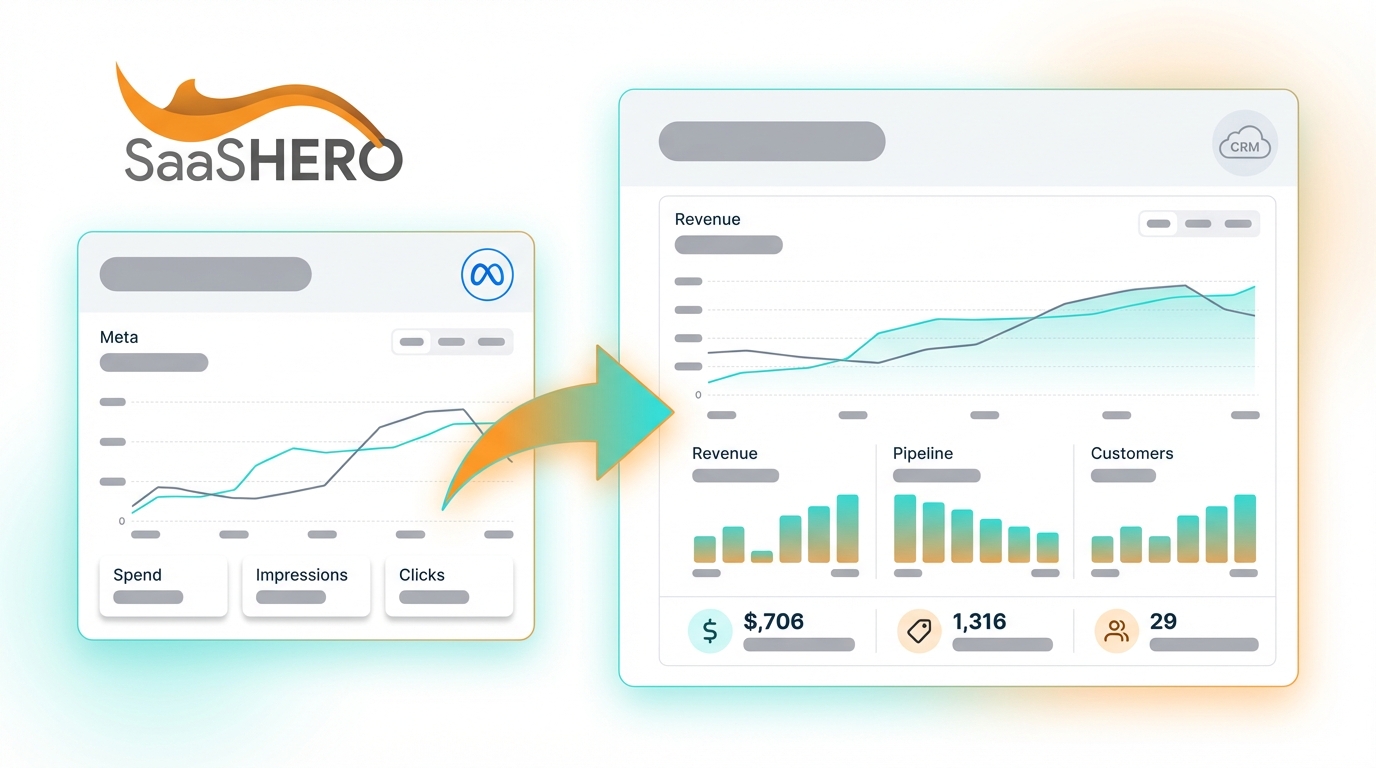
- Unified Looker Studio dashboards that combine ad data and CRM pipeline data enable clear weekly revenue reporting.
- SaaSHero delivers transparent reporting with $500k+ ARR case studies through flat-fee partnerships; schedule a discovery call to implement this framework.
Executive Summary: A Five-Pillar Reporting Framework
Transparent Facebook ad reporting for B2B SaaS rests on five pillars that keep every decision tied to revenue. These pillars are revenue-focused metrics, robust CRM integration, accurate attribution tools, clear industry benchmarks, and aligned agency partnerships. Net New ARR, SQLs, pipeline velocity, and LTV:CAC replace impressions and CTR as primary success measures. The framework follows five stages: audit current attribution gaps, integrate CRM with Facebook through CAPI, track revenue-tied conversions, visualize performance in unified dashboards, and optimize based on closed-won data. Book a discovery call to apply this framework with proven B2B SaaS specialists.
Why Native Facebook Metrics Mislead B2B SaaS Teams
Facebook’s native reporting creates major blind spots for B2B SaaS companies. Average B2B CTR of 0.78% says nothing about pipeline quality or revenue. Impression counts also ignore the 80-day sales cycles common in SaaS. Post-iOS 14.5 privacy changes worsen the problem because browser tracking can miss up to 50% of conversions. Percentage-of-spend agency models often push volume metrics that justify higher budgets instead of focusing on revenue efficiency.
|
Metric Type |
Vanity (FB Manager) |
Revenue-Tied |
B2B Impact |
|
Top-Funnel |
Impressions, CTR (0.78%) |
SQLs, MQLs |
Hides dark funnel attribution |
|
Bottom-Funnel |
Clicks, CPC |
Net New ARR |
Proves actual ROAS impact |
|
Attribution |
1-day view, 7-day click |
30+ day custom windows |
Captures long sales cycles |
The gap becomes clear when you compare reported performance with independent benchmarks. Meta ROAS for B2B averages only 29% while LinkedIn reaches 113%, yet many agencies still claim success using click metrics alone.
Four Building Blocks of Revenue-Tied Reporting
Revenue-tied Facebook reporting depends on four components that work together across the full funnel. First, implement click-to-CRM attribution that tracks users from initial Facebook click to closed-won deals in your CRM. Meta’s Conversions API paired with pixel data improves Event Match Quality and captures more of the customer journey despite privacy limits.
Second, build unified dashboards in tools like Looker Studio that merge Facebook ad data with CRM pipeline metrics. Third, run weekly revenue reporting cycles that connect ad spend to closed deals instead of only form submissions. Fourth, use negative keyword strategies and audience exclusions to cut wasted spend on low-intent or navigational traffic.
|
Benchmark |
B2B SaaS Facebook Ads 2026 |
|
CPL |
$150-300 |
|
ROAS |
1.6x (with proper attribution) |
|
Payback Period |
80 days |
|
LTV:CAC Ratio |
1.8:1 (social ads) |
Five-Step CRM Integration Checklist for Facebook Ads
Proper CRM integration turns Facebook from a lead generator into a revenue attribution engine that sales and finance can trust. Use this five-step checklist to structure implementation.
Step 1: Install Meta Conversions API and Verify Your Domain
Set up server-side tracking through CAPI to recover conversions lost by browser tracking. CAPI implementation with Pixel provides more accurate tracking despite cookie limits and supports offline sales tracking for long B2B cycles.
Step 2: Map Facebook Events to CRM Revenue Stages
Configure custom conversions that match each sales stage. Use events for Lead, MQL, SQL, Opportunity, and Closed-Won revenue. Pass value data from each stage back to Facebook so the algorithm can prioritize higher quality outcomes.
Step 3: Test GCLID and Event Match Quality Tracking
Implement Google Click ID parameters and monitor Event Match Quality scores above 8.0. Dual tracking with Pixel and CAPI maximizes performance and data match quality for B2B teams that optimize from leads to qualified opportunities.
Step 4: Build a Revenue Attribution Dashboard
Create Looker Studio reports that connect Facebook campaign data with CRM pipeline metrics. Include assisted conversions, multi-touch attribution views, and revenue per campaign to show impact beyond last-click models.
Step 5: Validate and Test Campaign Attribution
Validate attribution by comparing Facebook’s reported conversions with CRM closed-won deals. Proper multi-touch attribution reveals 40-60% more pipeline value from Facebook campaigns than native platform reporting suggests.
Tools and Agencies That Support Transparent Reporting
The Facebook-to-CRM tool stack for B2B SaaS is now mature and battle-tested. LeadsBridge supports lead integration with real-time syncing and full-funnel tracking from lead to closed-won revenue. Cometly focuses on attribution and ROI with direct CRM integrations, while Zapier connects workflows across more than 8,000 apps.
|
Tool/Agency |
Pricing |
Transparency |
B2B SaaS Proofs |
|
SaaSHero |
$1,250-5k/mo flat |
Month-to-month, revenue reporting |
$504k ARR case studies |
|
Cometly |
Subscription based |
Attribution focused |
General performance marketing |
|
LeadsBridge |
Starts at $29/mo |
Real-time sync |
CRM integration specialist |
|
Zapier |
$20+/mo |
Automation workflows |
Multi-platform connections |
Agency pricing models also influence reporting quality and incentives. Percentage-of-spend retainers reward higher media budgets, while SaaSHero’s flat-fee structure removes that bias and supports month-to-month accountability.

SaaSHero Case Studies With Revenue-Tied Reporting
SaaSHero clients show how transparent reporting converts Facebook into a predictable revenue channel. TripMaster, a transit software company, generated $504,758 in Net New ARR using integrated paid search, paid social, and focused CRO. The team prioritized closed-won revenue instead of lead volume and reached 650% ROI with a 20% paid search conversion rate.

TestGorilla, an HR tech platform, used transparent reporting to achieve an 80-day blended payback period across channels. This performance supported their $70M Series A raise and gave investors clear visibility into marketing efficiency. Book a discovery call to explore similar revenue-tied reporting for your growth and fundraising goals.
Playvox improved attribution quality and saw a 10x decrease in Cost Per Lead while increasing lead volume by 163%. This outcome came from negative keyword refinement and tighter audience controls that cut waste without limiting scale.

Common Attribution Pitfalls and Practical Fixes
Default attribution windows create the most damaging Facebook-CRM reporting errors. Facebook’s 1-day view and 7-day click window does not fit B2B SaaS and should shift to at least 7-day view and 30-day click. Last-click models then undervalue Facebook’s role in multi-touch journeys and understate its contribution to pipeline.
Other pitfalls include chasing lead volume over quality, skipping deduplication across channels, and failing to document attribution rules. Using multiple tools without centralization causes over-reporting and fragmented views that hide true channel performance.
Best practices focus on unified measurement and consistent tracking. Implement CAPI alongside pixel tracking, apply UTM parameters on every campaign, and build custom audiences from CRM data. Run weekly reporting cycles that connect ad metrics to pipeline stages and closed-won revenue.
Conclusion: Turning Facebook Into a Revenue Channel
Transparent Facebook ad reporting turns B2B SaaS marketing into a measurable revenue driver instead of a cost center. The five-stage framework of Audit, Integrate, Track, Visualize, and Optimize gives teams a clear path from spend to closed-won deals. Execution requires CAPI expertise, CRM integration skills, and multi-touch attribution modeling that many internal teams cannot support alone. Book a discovery call to implement this reporting framework with B2B SaaS specialists who have delivered $500k+ ARR through flat-fee, month-to-month partnerships.
Frequently Asked Questions
What are the key differences between vanity metrics and revenue-tied metrics for Facebook ads?
Vanity metrics such as impressions, CTR, and clicks show surface-level engagement but rarely match real business outcomes. Revenue-tied metrics track SQLs, Net New ARR, pipeline velocity, and LTV:CAC, which connect directly to profit. For B2B SaaS with long sales cycles, a campaign with high CTR but weak SQL volume underperforms, while a lower CTR campaign that produces more qualified leads creates stronger business value.
How does Meta’s Conversions API improve attribution accuracy for B2B SaaS?
Meta’s Conversions API sends secure, hashed first-party data from your server to Meta and avoids browser tracking limits from iOS privacy changes. This server-side setup captures offline conversions and long-cycle revenue events that pixels often miss. For B2B SaaS teams, CAPI supports tracking from initial Facebook click through demo requests, trials, and final closed-won deals in the CRM, which delivers full-funnel visibility.
What attribution window should B2B SaaS companies use for Facebook ads?
B2B SaaS companies should use at least 7-day view and 30-day click attribution windows instead of Facebook’s 1-day view and 7-day click default. Many B2B buyers research for weeks and involve several stakeholders before converting. Custom windows between 30 and 90 days capture more of Facebook’s influence on complex journeys and reveal additional pipeline value.
Which CRM integration tools work best for connecting Facebook ads to revenue data?
LeadsBridge supports real-time lead syncing and full-funnel tracking from Facebook ads to closed-won revenue in CRMs such as Salesforce and HubSpot. Cometly specializes in attribution and ROI measurement with direct CRM connections. Zapier offers broad automation across many platforms. The right mix depends on your CRM, technical stack, and attribution needs, and many teams combine tools for complete tracking.
How can B2B SaaS companies avoid common Facebook attribution pitfalls?
B2B SaaS companies avoid major pitfalls by extending attribution windows, moving beyond last-click models, and enforcing clean data practices. Use 30-day or longer windows, adopt multi-touch attribution, and apply UTM parameters consistently. Build unified dashboards so no single platform claims full credit and document attribution rules clearly. Validate those rules against closed-won deals in your CRM on a regular schedule.