




Written by: Aaron Rovner, Founder, Saas Hero
Key Takeaways
- Align your Facebook ads agency with in-house teams through unified Meta Pixel and CRM tracking to close attribution gaps and lift lead quality by 30%.
- Replace vanity metrics like CTR with shared revenue KPIs such as CPQL under $100 and MQL-to-SQL rates of 20-30% for real accountability.
- Use weekly Slack syncs and clear role matrices to remove silos, speed campaign improvements by 20%, and strengthen collaboration.
- Adopt B2B-focused creative workflows and testing that prioritize SQL quality and pipeline velocity instead of short-term clicks.
- Scale with SaaSHero’s flat-fee, ARR-focused model that has delivered 20% ROAS gains; schedule a discovery call with SaaSHero to reset your agency relationship.
Tools and Context You Need Before You Start
Set up a basic tech stack before you roll out this alignment playbook.
|
Tool Category |
Required Platforms |
Purpose |
|
Ad Management |
Meta Business Manager |
Campaign execution and tracking |
|
CRM System |
HubSpot or Salesforce |
Lead management and revenue attribution |
|
Communication |
Slack or Microsoft Teams |
Real-time collaboration |
|
Analytics |
Looker Studio or Tableau |
Unified reporting dashboard |
B2B buyer journeys, CAC to LTV ratios, and Net New ARR metrics must be familiar to your team. Expect 2-4 weeks for setup with about 2 hours of weekly maintenance. Data silos remain the main risk because they block accurate attribution.
Nine-Step Alignment Framework at a Glance
Follow this sequence to align your agency and internal team.
- Audit current silos and attribution gaps
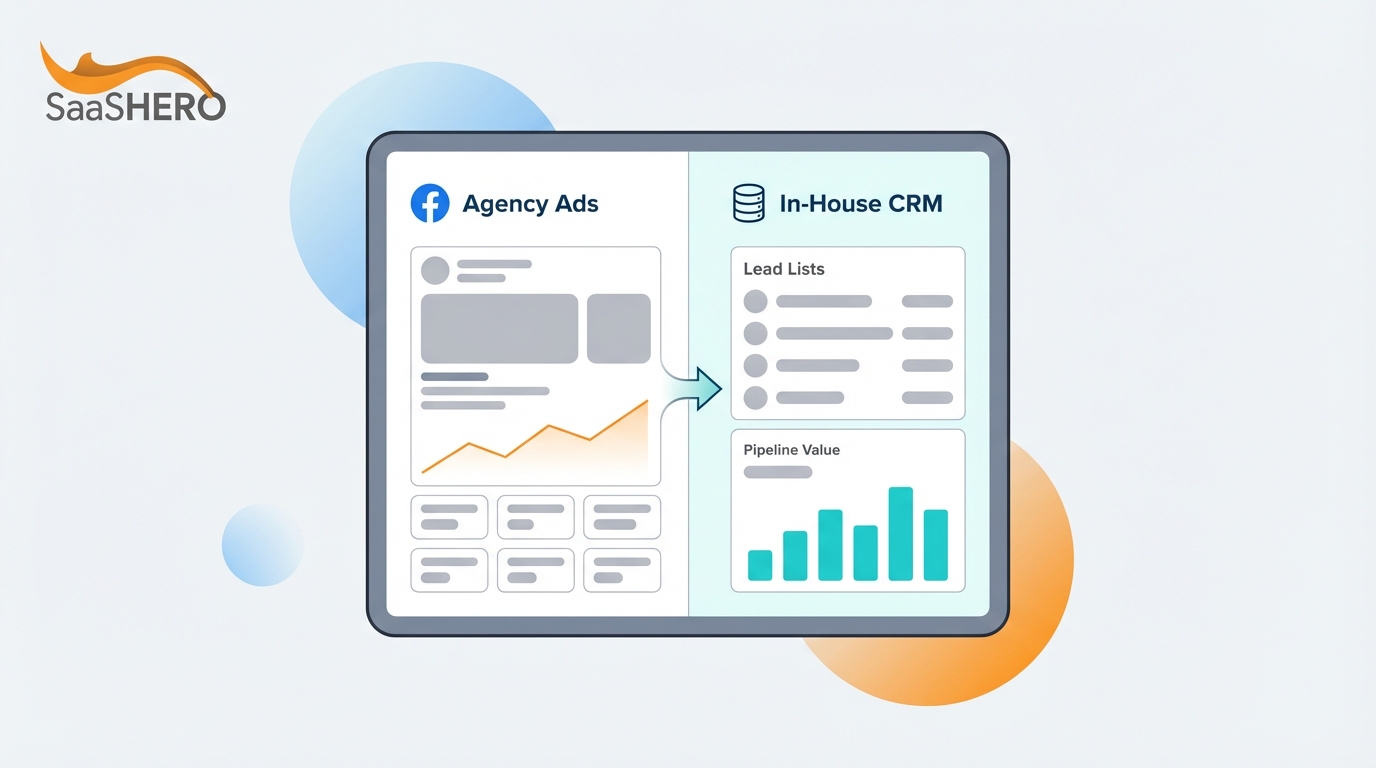
- Unify Meta Pixel with CRM tracking
- Define shared revenue-focused KPIs
- Create a role clarity matrix
- Establish weekly sync cadences
- Align creative collaboration workflows
- Implement testing and optimization protocols
- Build escalation procedures
- Scale with an aligned agency partner
|
Step |
Primary Action |
Expected Outcome |
|
1-2 |
Technical integration |
30% improvement in lead quality tracking |
|
3-4 |
KPI and role alignment |
Removal of blame games and silos |
|
5-7 |
Operational workflows |
20% faster campaign optimization |
|
8-9 |
Scaling and partnerships |
Sustainable revenue growth |
Step 1: Audit Silos and Attribution Gaps
Objective: Find disconnects between Facebook ad performance and actual revenue.
Actions: Review attribution models, inspect lead quality from Facebook campaigns, and map handoff steps between agency and internal teams. 65.7% of organizations face data integration difficulties, so this audit becomes a critical first move.
Common Issues: Agencies report CTR and CPC while internal teams track SQLs and pipeline. Standard 1-day view and 7-day click windows rarely fit B2B cycles. GCLID or similar click IDs often fail to pass from ads into CRM records.
Verification Checklist:
- Confirm you can trace a closed deal back to its original Facebook ad.
- Confirm agency reports include SQL and pipeline metrics.
- Confirm lead sources are accurately captured in your CRM.
- Confirm you have visibility into multi-touch attribution.
Step 2: Connect Meta Pixel Directly to Your CRM
Objective: Build a clean data path from Facebook clicks to closed revenue.
Actions: Run Meta Conversions API alongside Pixel tracking. Connect Facebook lead events to your CRM through Zapier or native HubSpot integrations. Use JavaScript and localStorage to retain first-touch attribution data so Facebook still receives credit when users later return through direct visits.
Technical Setup: Configure custom attribution windows with at least 7-day view and 30-day click for B2B cycles. Default attribution windows are inadequate for B2B SaaS because consideration periods run longer.
Integration Checklist:
- Meta Pixel fires on all key pages such as pricing, demo, and signup.
- Conversions API sends server-side events reliably.
- CRM captures Facebook click IDs (FBCLID).
- Lead source fields populate automatically on every record.
Step 3: Lock In Shared Revenue KPIs
Objective: Replace vanity metrics with revenue metrics that both teams pursue together.
Shared KPI Framework:
|
Metric |
Target Range |
Agency Role |
In-House Role |
|
CPQL |
<$100 |
Campaign optimization |
Lead qualification |
|
MQL-to-SQL Rate |
20-30% |
Targeting refinement |
Lead nurturing |
|
SQL-to-Demo Rate |
60-80% |
Landing page CRO |
Sales follow-up |
|
Demo-to-Close Rate |
15-25% |
Audience quality |
Sales process |
Companies with aligned teams using shared KPIs experience 24% faster revenue growth and 67% more effective deal closing. Prioritize pipeline contribution, opportunity-to-deal conversion, and customer acquisition cost instead of impressions or clicks.
2026 Benchmarks: Meta Ads average CPL is $27.66, while B2B SaaS should aim for CPQL under $100 for qualified prospects. Lead generation CTR benchmarks are 2.53% for solid campaigns.
Step 4: Clarify Agency and In-House Roles
Objective: Remove confusion about ownership for every part of Facebook ad performance.
Role Matrix Template:
|
Function |
Agency Responsibility |
In-House Responsibility |
Shared Responsibility |
|
Campaign Strategy |
Targeting and bidding |
ICP definition |
Audience insights |
|
Creative Development |
Ad copy and design |
Brand guidelines |
Messaging alignment |
|
Landing Pages |
CRO recommendations |
Content creation |
A/B testing |
|
Lead Qualification |
Traffic quality |
Lead scoring |
Feedback loops |
Communication Protocols: Define escalation paths when performance dips. Set response times for creative requests at 48 hours and campaign adjustments at 24 hours. Document approval rules for budget shifts and new campaign launches.
Step 5: Run Weekly Performance Syncs
Objective: Keep everyone aligned through consistent performance reviews and planning.
Weekly Sync Agenda:
- Review performance against shared KPIs for 15 minutes.
- Discuss lead quality and feedback for 10 minutes.
- Analyze creative performance for 10 minutes.
- Plan upcoming campaigns for 10 minutes.
- Confirm budget allocation decisions for 5 minutes.
Slack Integration: Create dedicated channels for the account. Share daily performance snapshots and instant alerts for major swings. This level of visibility builds trust and supports quick action.
Book a discovery call to review how top agencies structure these workflows for speed and clarity.

Step 6: Build a B2B-Ready Creative Workflow
Objective: Produce Facebook creative that speaks to B2B buyers and stays on brand.
Creative Process: Hold monthly creative planning sessions where agencies present concepts grounded in performance data. In-house teams add industry context and review for brand compliance. Full-funnel creative strategies with video, carousel, and lead forms boost conversions by 63%.
B2B Creative Guidelines:
- Lead with business outcomes instead of product features.
- Include social proof and recognizable customer logos.
- Address specific pain points by industry vertical.
- Test problem-agitation messages against solution-focused messages.
Testing Framework: Run creative tests for at least 7-14 days to match B2B cycles. Measure impact on SQL quality, not only CTR. Capture winning elements in a shared library for future campaigns.
Step 7: Standardize Testing and Optimization
Objective: Improve campaigns through a structured, revenue-based testing process.
Testing Priorities:
- Audience segments such as job titles, company size, and industry.
- Creative messaging such as pain point versus solution focus.
- Landing page elements such as forms, CTAs, and social proof.
- Bidding strategies such as cost cap versus bid cap.
Optimization Cadence: Hold weekly performance reviews and implement changes every two weeks. Advertisers not using modern targeting see 14.8% higher CPA, so regular optimization becomes non negotiable.
Success Metrics: Track CPQL trends, SQL quality scores, and pipeline velocity. Confirm changes in Facebook metrics with CRM data before you react.
Step 8: Set Clear Escalation Procedures
Objective: Handle performance issues and disagreements quickly and predictably.
Escalation Triggers:
- CPQL rises more than 25% week over week.
- SQL quality scores fall below your agreed threshold.
- Campaign performance drifts away from projections.
- Communication gaps or missed deadlines appear.
Response Framework: Use three levels. Level 1 goes to the Account Manager. Level 2 involves Agency Leadership. Level 3 moves to Executive Review. Define response times and resolution targets for each level and log every issue for pattern analysis.
Step 9: Scale with a Revenue-Focused Agency Partner
Objective: Work with agencies that naturally support B2B SaaS revenue growth.
Why SaaSHero Fits This Model: Flat-fee pricing between $1,250 and $5,000 per month removes incentives to inflate ad spend. Month-to-month contracts keep pressure on performance. Senior-led teams with a maximum of eight clients per manager bring strategic depth. ARR-focused reporting links every dollar of ad spend to revenue.
Proven Results: TestGorilla reached 80-day payback periods. TripMaster generated $504,000 in Net New ARR. These outcomes reflect tight alignment between agency work and client revenue goals.

Partnership Criteria: Prioritize agencies with B2B SaaS focus, transparent pricing, strong CRM integration skills, and case studies that highlight revenue impact instead of vanity metrics.
Three-Step Quickstart for Faster Alignment
Use this quickstart if you want immediate traction.
- 24-Hour Setup: Connect Meta Pixel to your CRM through Zapier or a native integration.
- Joint Dashboard: Build a shared Looker Studio report that shows CPQL, SQLs, and pipeline.
- First Sync: Schedule weekly Slack check-ins with a clear performance review agenda.
2026 Benchmarks: B2B Facebook CPM typically ranges from $15 to $25 with target CPQL under $100 for qualified prospects. B2B SaaS CTR benchmarks sit between 0.5% and 1.0% for effective campaigns.
Measurement and Continuous Optimization
Success Indicators: Aim for a 30% CPQL reduction, 25% more SQLs, and at least 20% of ARR attributed to Facebook campaigns. Build Looker Studio dashboards that connect ad data directly to CRM revenue.
Ongoing Reviews: Run bi-weekly performance reviews and monthly strategy sessions. Fix ICP mismatches quickly through audience refinement and negative keyword updates.
Troubleshooting: Expect issues such as attribution delays, weaker lead quality, and creative fatigue. 56% of B2B marketers struggle to connect efforts to ROI, so unified tracking becomes essential.
SaaSHero as Your Alignment Partner
Turn Facebook ads from a cost center into a revenue channel with SaaSHero’s embedded growth model. SaaSHero joins your Slack workspace and CRM directly, which shortens feedback loops. Flat fees replace percentage-of-spend pricing so recommendations stay focused on performance.
Pricing Transparency:
|
Monthly Spend |
1 Channel |
2 Channels |
3+ Channels |
|
Up to $10k |
$1,250 |
$2,500 |
$3,750 |
|
$10k-$25k |
$1,750 |
$3,000 |
$4,250 |
|
$25k-$50k |
$2,250 |
$3,500 |
$4,750 |
B2B SaaS Specialization: SaaSHero has delivered results across HR Tech, Cybersecurity, and Logistics. Case studies include TestGorilla’s $70M Series A raise and TripMaster’s $504k ARR growth.

Start on a month-to-month basis with alignment from day one. Book a discovery call to walk through your alignment challenges and revenue targets.
Frequently Asked Questions
How long does the alignment setup process take?
The full nine-step alignment process usually takes 2-4 weeks. Technical integration in Steps 1 and 2 often finishes within the first week. Operational workflows in Steps 3 through 7 then mature over the next 2-3 weeks. Start with unified tracking and shared KPIs, then layer in collaboration habits.
What roles should agency and in-house teams own?
Agencies should handle campaign execution, targeting improvements, and creative production. In-house teams should own ICP definition, lead qualification, and brand compliance. Both sides share audience insights, messaging alignment, and A/B testing coordination. Written documentation keeps ownership clear for each metric.
Can small B2B SaaS teams use this framework?
Small and founder-led teams can apply this framework effectively. Begin with unified tracking, shared CPQL goals, and weekly performance reviews. Many agencies offer entry pricing near $1,250 per month for lean teams. Keep attention on revenue metrics instead of vanity metrics at every stage.
How should we handle performance issues with our agency?
Use defined escalation protocols with clear triggers such as CPQL jumps above 25% or falling SQL quality. Apply a three-level response structure with Account Manager, Agency Leadership, and Executive Review. Set response and resolution timelines for each level and log every issue to prevent repeats.
What performance benchmarks are realistic for aligned Facebook campaigns?
For 2026, aim for CPQL under $100, MQL-to-SQL conversion between 20% and 30%, and ROAS between 4x and 6x for B2B SaaS. Lead generation CTR should exceed 2.5% with conversion rates above 3%. Companies that achieve strong alignment often see 20% ROAS gains and 67% better closing rates within 90 days.
Book a discovery call to apply this alignment framework with a proven B2B SaaS growth partner.