





Written by: Aaron Rovner, Founder, Saas Hero | Last updated: August 17, 2026
Key Takeaways
- Most B2B SaaS teams lose visibility into true CAC because GA4 and CRM data never align. A five-phase measurement system closes this gap by connecting ad impressions to closed-won ARR.
- Phase 1 requires a signed metric contract that defines every funnel stage and owner before any technology is implemented.
- Phases 2–3 build a four-layer first-party attribution architecture and enforce UTM/GCLID persistence so every lead carries its original source through long sales cycles.
- Phases 4–5 quantify pipeline velocity and surface channel-level CAC, payback, and expansion revenue so budget decisions are driven by Net New ARR data.
- Talk with SaaS Hero to implement this end-to-end measurement system inside your Slack and CRM on a flat monthly retainer.
Phase 1: Lock Funnel Stages and Revenue Metrics in a Metric Contract
Objective: Establish a single lifecycle model with one definition per stage and one owner per metric before touching any technology.
The most common reason GA4 and CRM data diverge is that marketing and sales use different stage definitions. B2B SaaS companies often lose revenue at handoff seams between marketing, sales, and customer success. A signed, CRM-enforced metric contract among sales, marketing, and CS leadership closes those seams and anchors every report to the same funnel.
The table below defines each funnel stage with its primary metric and benchmark conversion rates. Use these definitions as the starting point for your metric contract.
| Funnel Stage | Definition | Primary Metric | Benchmark Conversion Rate |
|---|---|---|---|
| Visitor | Any session on a tracked domain | Sessions by source/medium | — |
| Lead | Form fill or gated-content download | Lead volume by channel | Visitor-to-Lead: 1.5%–2.5% (avg), 3%–5% (top quartile) |
| MQL | Lead meeting ICP score threshold | MQL volume and MQL rate | MQL-to-SQL: 13%–15% median |
| SQL | Sales-accepted lead with documented business problem and named economic buyer | SQL volume, SQL-to-Opp rate | SQL-to-Opportunity: 50%–60% (avg) |
| Opportunity | Qualified deal with budget range and decision timeline confirmed | Pipeline value, stage velocity | Qualified = documented problem, named buyer, budget, timeline |
| Closed-Won | Signed contract, revenue recognized | Net New ARR by channel | Opportunity-to-Close: 30% (avg), with healthy rates of 15–35% depending on segment, top quartile 32%+ |
Quality check: Lead-to-MQL rates around 30% are common; rates significantly below this may signal the need to review the MQL definition. To determine whether your MQL threshold is too strict or too loose, audit the subsequent MQL-to-SQL rate. A low MQL-to-SQL rate indicates the MQL definition needs tightening, while a high rate suggests it may be too permissive.
Schedule a stage-definition audit and SaaS Hero will benchmark your current funnel against these conversion rates in the first two weeks.

Phase 2: Design the Four-Layer Data Architecture and Source-of-Truth Rules
Objective: Implement a four-layer first-party attribution architecture that survives cookie loss, consent changes, and dark social.
The minimum first-party B2B attribution architecture consists of four layers: identification, stitching, storage, and activation. These layers connect ad platforms, web analytics, and CRM systems for full-funnel revenue attribution in 2026. Here is how each layer functions.
- Identification: Persist visitor identity through form fills, email clicks, and reverse-IP matching while surviving cookie loss and consent changes.
- Stitching: Connect anonymous sessions to identified records and roll up multiple leads from the same company to a single account record in Salesforce or HubSpot.
- Storage: Hold touchpoint records on leads or contacts, attached to the account and retrievable by opportunity, not in a separate dashboard tool.
- Activation: Push closed-won revenue data back to ad platforms via Google Enhanced Conversions for Leads, LinkedIn Conversions API, and Meta CAPI so bidding algorithms optimize toward revenue instead of form fills.
Once the four-layer architecture is in place, the next decision is which attribution model to apply to the touchpoint data it collects.
Attribution model selection: Attribution model selection for B2B SaaS should be based on monthly conversion volume: last-click for under 50 conversions, linear or time-decay multi-touch for 50–100 conversions, and full-funnel or position-based models for 100+ conversions with sales cycles exceeding 90 days. For most Series B–C teams, the 2026 default model is W-shaped attribution. First touch, lead conversion, and opportunity creation each receive 30% weight, with data-driven attribution used as a validation layer once data volume supports it, typically 500+ deals per year.
Quality check: Nearly 40% of GA4 properties have misconfigured events compromising their data, such as duplicate events from enhanced measurement and GTM both firing. Run a parallel tracking period of two to four weeks before cutting over to the new system.
Phase 3: Push UTM and Acquisition Data into the CRM
Objective: Ensure every lead carries its original acquisition source from first click through to closed-won, regardless of sales cycle length.
B2B SaaS sales cycles lasting three months to a full year routinely exceed the seven-day or 28-day attribution windows of major ad platforms. Campaigns that build pipeline then show zero conversions and trigger premature budget cuts. A three-part UTM persistence protocol fixes this gap.
- UTM hygiene: Auditing and fixing UTM hygiene across paid and organic channels can resolve a substantial portion of reporting problems in typical B2B SaaS marketing organizations. Enforce a taxonomy with locked values for source, medium, campaign, content, and term across every team and vendor.
- GCLID persistence: Capture Google Click ID on form submission and write it to a hidden CRM field on the Contact and Lead object. This setup enables offline conversion imports that feed Google’s bidding algorithms with closed-won signals.
- Server-side sync: Server-side tracking via Meta Conversion API and Google Enhanced Conversions improves reliability over long time horizons by sending event data directly from the server or CRM. This approach bypasses browser cookie expiration, ad blockers, and privacy restrictions that break client-side pixels during multi-month buying journeys.
Quality check: Event deduplication using unique event IDs is required when running both browser pixels and server-side Conversion APIs. Without it, ad platforms double-count conversions and distort optimization signals. Validate deduplication before scaling spend.
See how SaaS Hero implements this inside your existing HubSpot or Salesforce instance, including UTM persistence and server-side sync.

Phase 4: Measure Stage Conversion Rates and Pipeline Velocity
Objective: Quantify where deals stall, how fast revenue flows, and which lever, opportunities, win rate, deal size, or cycle length, to pull first.
The pipeline velocity formula is:
Pipeline Velocity = (O × W × A) ÷ C
O is the number of qualified opportunities, W is win rate measured against qualified pipeline, A is average deal size as first-year new ARR (ACV), and C is sales cycle length in days from opportunity creation to contract signature.
To see how this formula translates into actionable insight, consider a worked example. Using 50 qualified opportunities, an $80,000 average deal size, a 25% win rate, and a 120-day sales cycle, the formula (50 × 0.25 × $80,000) ÷ 120 yields $8,333 per day. That figure represents the daily revenue throughput of the pipeline. Improving win rate by five percentage points, from 25% to 30%, raises daily velocity to $10,000, a 20% increase without adding a single new opportunity.
The benchmark table below helps you pinpoint which stage transition underperforms and where to intervene first.
| Stage Transition | Average Benchmark | Top-Quartile Benchmark | Action Threshold |
|---|---|---|---|
| Visitor → Lead | 1.5%–2.5% | 3%–5% | Below 1% — audit landing page and offer |
| Lead → MQL | 31% | 40%–50%+ | Below 25% — review ICP targeting |
| MQL → SQL | 13%–15% | 25%–30% | Below 50% SQL-to-Opp signals SQL definition needs tightening |
| SQL → Opportunity | 50%–60% | 55%–70% | Below 50% — review sales handoff SLA |
| Opportunity → Closed-Won | 30% | 32%+ | Any stage below 30% requires immediate attention |
Quality check: Track quarter-over-quarter trends in pipeline velocity rather than absolute values. Consistent increases signal healthy acceleration. Companies with clear stage exit criteria often report shorter sales cycle lengths than peers at the same stage without such criteria.
Phase 5: Build Account-Level and Channel-to-Revenue Dashboards
Objective: Surface CAC, payback period, and expansion revenue by channel so the next $100k budget decision is data-driven, not political.
Achieving that objective requires a single report that connects every closed-won deal back to its original marketing source and calculates the full cost of acquisition. B2B SaaS teams should build a report that filters closed-won deals by marketing source and sums the associated revenue to produce the marketing-sourced revenue figure, then track it monthly and quarterly as a percentage of total revenue. The channel-to-revenue table below shows the structure of that report. Each row represents a channel, and the formulas in each column show how to calculate blended CAC, payback period, and expansion contribution from your own CRM data.
| Channel | Blended CAC | CAC Payback Period | Expansion Revenue Contribution |
|---|---|---|---|
| Paid Search (Google Ads) | Calculate: total channel spend ÷ new customers sourced | CAC ÷ (ACV × gross margin %) | Track upsell/expansion ARR from cohort by source |
| Paid Social (LinkedIn Ads) | Calculate: total channel spend ÷ new customers sourced | CAC ÷ (ACV × gross margin %) | Track upsell/expansion ARR from cohort by source |
| Organic Search (SEO) | Calculate: content + ops cost ÷ new customers sourced | CAC ÷ (ACV × gross margin %) | Content-acquired customers churn less in the first 90 days and expand at higher rates than paid-acquired customers |
| Referral / Partner | Calculate: partner cost ÷ new customers sourced | CAC ÷ (ACV × gross margin %) | Referrals convert at top of funnel at 3.9% vs. 2.1%–2.6% for organic search |
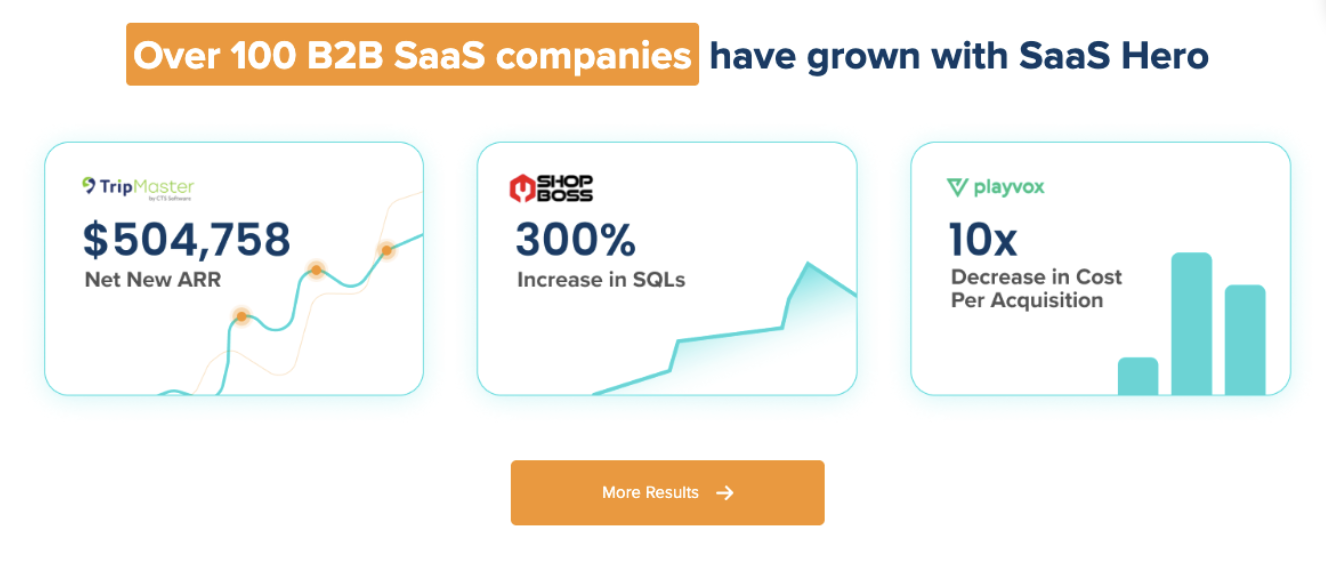
Populate CAC and payback figures from your own CRM data using the formulas above. A healthy LTV-to-CAC ratio for B2B SaaS is 3:1 or better. CAC payback under 18 months is the benchmark for mid-market motions. SaaS Hero’s work with TestGorilla achieved an 80-day payback period, a figure that directly supported their $70M Series A raise. SaaS Hero’s work with TripMaster produced $504,758 in Net New ARR in 12 months.

Quality check: Finance validation of the attribution model is required before rolling out closed-won revenue insights, because without CFO alignment even accurate data gets dismissed as marketing spin and fails to influence budget allocation.
Request a live dashboard demo to see a channel-to-revenue view built inside Looker Studio and connected to your CRM.
Common Attribution Gaps in B2B SaaS Funnels
The three most frequent breaks between ad platforms and closed-won revenue in B2B SaaS:
- Attribution window mismatch: As noted in Phase 3, B2B sales cycles routinely exceed ad-platform attribution windows, which undercounts channel contributions to revenue.
- Dark funnel blindness: Approximately 38% of pipeline in the median B2B SaaS company originates in the dark funnel, including podcasts, communities, dark social, Slack groups, and word of mouth, which browser-side tracking and GA4 cannot capture. Shares above 40% routed to Direct or (none) in purchase reports typically indicate measurement gaps.
- Last-click over-crediting: Last-click attribution can misattribute a significant portion of SaaS marketing budget by over-crediting closing channels such as retargeting while under-crediting awareness channels like content and SEO.
Month-to-Month Accountability with SaaS Hero
Most agencies protect mediocrity with 12-month contracts. SaaS Hero operates on flat monthly retainers with no long-term lock-in, which creates a structural forcing function: the agency must re-earn the client’s business every 30 days. This model eliminates the percentage-of-spend conflict of interest, so when SaaS Hero recommends increasing budget, the pipeline-velocity data supports scaling rather than a higher spend band raising the agency’s fee. Every plan includes a senior account strategist, dedicated campaign manager, bi-weekly strategy calls, board-ready CAC and LTV dashboards, and revenue-first reporting anchored to Net New ARR and SQLs, all delivered inside the client’s Slack. The incentives stay aligned because SaaS Hero’s retention depends entirely on the client’s revenue growth.
Frequently Asked Questions
The five-phase framework raises predictable implementation questions about timeline, team ownership, and scaling. The answers below address the most common concerns from B2B SaaS marketing and RevOps leaders.
How long does it take to implement a full-funnel measurement system?
A structured implementation follows a predictable timeline. Weeks one and two cover audit, discovery, and stage-definition alignment across marketing, sales, and CS. Weeks two through five cover the technical build: conversion tracking, tag management, CRM field mapping, and cross-platform integrations. Weeks four through eight involve parallel validation, running the old and new systems simultaneously and reconciling outputs against CRM and actual closed-won revenue.
Week seven is reserved for team training, and week eight is the final cutover to the new system as the single source of truth. Early directional insights typically appear in months two and three. Confident budget allocation decisions based on channel-level CAC and payback arrive in months three through six. Mature measurement that captures seasonal patterns and full long-cycle attribution matures at months six through twelve.
The timeline extends for companies with sales cycles above 90 days because the system must accumulate enough closed-won data to produce statistically stable attribution weights. Organizational alignment, involving finance, analytics, and leadership from the start, is the single biggest accelerator because a large part of the measurement challenge involves people and process rather than technical setup.
Which team roles own each phase?
Phase 1, stage definitions and the metric contract, is owned jointly by RevOps and Sales leadership, with Marketing Ops as the enforcing party in the CRM. Phase 2, data architecture, is owned by Marketing Ops or a dedicated analytics engineer, with input from the CRM administrator. Phase 3, UTM persistence and server-side sync, is owned by Marketing Ops and the web development or engineering team responsible for tag management.
Phase 4, pipeline velocity and conversion rate analysis, is owned by RevOps, with weekly reporting shared to Sales Ops and the CMO. Phase 5, dashboards, is owned by Marketing Ops for build and maintenance, with the CMO and CFO as the primary consumers for board-facing reporting. When an internal team lacks capacity in any phase, SaaS Hero operates as the embedded execution layer, sitting in the client’s Slack, owning the integrations, and delivering the reports, without displacing the internal team’s strategic ownership.
How does the model scale from $10k to $50k+ monthly spend?
The measurement architecture stays constant as spend scales; the reporting granularity changes. At $10k per month in ad spend, the priority is establishing a clean single source of truth with UTM hygiene, GCLID persistence, and a basic W-shaped attribution model in HubSpot or Salesforce. At $25k per month, channel-level CAC and payback tables become actionable because there is sufficient closed-won volume to segment by source.
At $50k per month and above, the system supports incrementality testing on the highest-spend channels by running controlled budget holdouts to measure true causal lift rather than correlational attribution. SaaS Hero’s flat-fee retainer tiers match this progression. The fee increases modestly as spend bands rise, but the agency’s incentive to recommend higher spend is removed because the fee is fixed within each band. Every budget recommendation is driven by pipeline-velocity data, not agency revenue goals.
How often should the attribution model be revisited?
The attribution model should be reviewed on a quarterly cadence at minimum. Business conditions that trigger an immediate review include a significant change in average deal size or sales cycle length, the addition of a new channel or campaign type, a transition between funding stages such as Series A to B or B to C, and any CRM migration or marketing automation platform change.
On a quarterly basis, the review should confirm that the attribution window still matches the actual median sales cycle, that stage definitions have not drifted due to CRM hygiene gaps or sales rep non-adoption, and that the model’s output still aligns with finance’s closed-won revenue records. Annually, the full measurement framework should be audited to determine whether the initial design still fits the business, including whether data volume now supports graduating from W-shaped to data-driven attribution, which requires sufficient closed-won opportunities per year with consistent journey patterns before producing stable weights.
Conclusion: Turn Every Ad Dollar into Closed-Won ARR
The gap between GA4 and CRM is not a data problem; it is a system design problem. The five-phase roadmap above closes that gap by establishing shared stage definitions, a four-layer first-party attribution architecture, UTM and GCLID persistence into the CRM, pipeline-velocity formulas that quantify where deals stall, and channel-to-revenue dashboards that answer the budget question that matters most: where should the next $100k go.
SaaS Hero is the only agency that builds and operates this measurement system end-to-end inside your Slack and CRM, on a flat monthly retainer, with month-to-month terms that keep every incentive aligned to your Net New ARR. The results are not theoretical. The TestGorilla and TripMaster outcomes detailed in Phase 5, plus a 10x reduction in cost per lead for Playvox, are the outputs of this exact system applied to real B2B SaaS businesses.
Map your funnel to the five-phase framework and SaaS Hero will identify the highest-impact attribution gap and show you what a channel-to-revenue dashboard looks like inside your own CRM data.