




Written by: Aaron Rovner, Founder, Saas Hero
Key Takeaways
- Target multi-stakeholder personas with clear ROI hooks that address security, integrations, ease of use, and strategic alignment for each buyer role.
- Use benefit-focused headlines with specific metrics like “Reduce sales cycle by 40%” to grab attention in 5 seconds and increase engagement.
- Structure tri-fold layouts with scannable visuals, social proof, competitor comparisons, and low-friction CTAs, including QR codes for interactive demos.
- Apply 2026 design trends such as “perfectly imperfect” visuals, color psychology, and AI tools to create authentic, trustworthy designs that convert.
- Test brochure prototypes, track ROI with UTM parameters and QR scans, then book a discovery call with SaaSHero to refine your brochure strategy for 20–30% demo lifts.
Messaging Foundation: Trust-First SaaS Brochure Strategy
Practice 1: Define SaaS Personas and ROI Hooks
Effective B2B SaaS brochures start with precise persona targeting across the full buying committee. Global buyers rank integrations as #3 on their list of priorities when evaluating new software, behind security (#1) and ease of use (#2). Your brochure needs to address each stakeholder’s specific concerns.
Create a stakeholder checklist for your brochure content:
- VP/Executive: Strategic alignment, competitive advantage, revenue impact
- IT/Security: Integration capabilities, compliance certifications, data protection
- Procurement: Total cost of ownership, contract flexibility, vendor stability
- End Users: Interface simplicity, training requirements, daily workflow impact
Include specific ROI hooks for every persona. Finance teams need TCO calculators and payback period data. IT teams look for security badges and integration lists. End users respond to workflow screenshots and time-saving metrics. This targeted structure prevents the generic messaging that sends brochures straight to the trash.
Practice 2: Write Benefit-Driven Headlines With Proof
Your brochure headline decides whether prospects keep reading or move on within 5 seconds. Benefit-focused headlines that quantify value outperform feature-heavy alternatives. Replace “Advanced CRM Platform” with “Reduce Sales Cycle by 40% with Automated Lead Scoring.”
Test headline variations that highlight different value angles. A/B testing consistently shows that headlines with specific metrics such as percentages, time savings, or cost reductions generate higher engagement. Place your strongest ROI claim in the main headline, then back it up with customer proof in the subheading.
Use clear language instead of jargon that hides value. 58% of B2B buyers say they are more likely to buy from reps who understand their business context, which reinforces the need for contextual messaging tailored to specific industries and use cases.
Book a discovery call to refine brochure headlines that convert more pipeline.
Content Structure: Scannable SaaS Brochure Layouts
Practice 3: Essential Content for a B2B SaaS Brochure
Strategic content order shapes how quickly prospects understand your value. Include these elements in priority sequence:
- Problem statement that reflects your target persona’s daily challenges
- Solution overview with 3–5 key benefits supported by metrics
- Feature comparison table that highlights clear competitive advantages
- Integration showcase that addresses the #3 buyer priority
- Security and compliance badges that reassure IT stakeholders
- Customer case studies with specific ROI outcomes
- Pricing transparency or “starting at” ranges
- Implementation timeline and support resources
Align content with your sales team’s most frequent objections. If prospects often question integrations, feature that section early. If security concerns slow deals, lead with compliance and data protection proof.
Practice 4: Tri-Fold SaaS Brochure Panel Plan
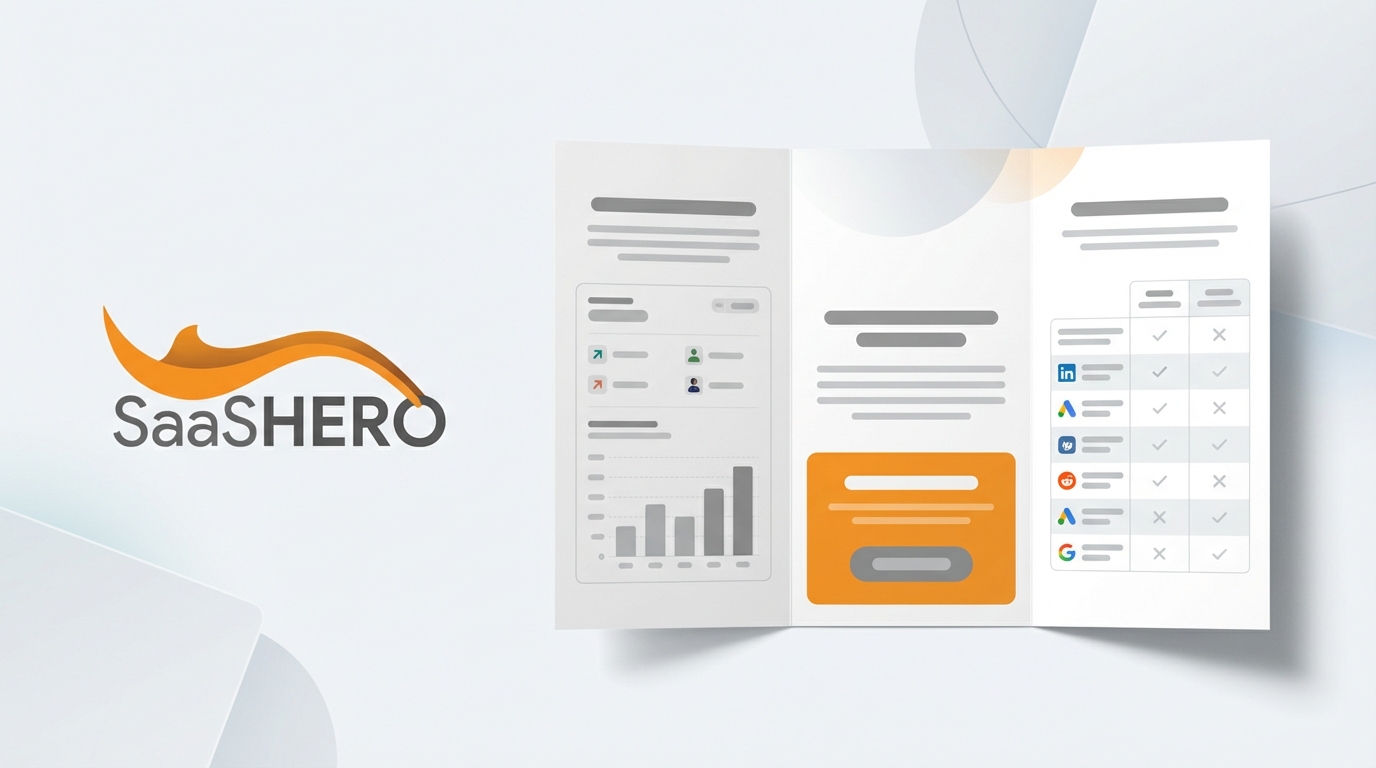
The tri-fold format supports a clear information hierarchy for B2B SaaS. Panel 1 (cover) should feature your benefit-driven headline and primary value proposition. Panel 2 (inside left) explains the problem and the cost of inaction. Panel 3 (inside center) presents your solution with key features and benefits.
Panel 4 (inside right) highlights social proof with customer logos, testimonials, and case study snapshots. Panel 5 (back left) houses technical specs, integrations, and security details for IT stakeholders. Panel 6 (back cover) presents clear next steps with multiple contact options and QR codes that link to interactive demos.
81% of B2B buyers prefer interactive content over static content, so QR codes that connect to demos, ROI calculators, or tailored trials now play a central role in brochure performance.
Visual Design: 2026-Ready SaaS Brochure Aesthetics
Practice 5: Skimmable Visuals and 2026 AI Design Tools
Visual hierarchy directs prospect attention through your brochure. Use contrasting colors to spotlight key benefits, white space to reduce cognitive load, and consistent typography to signal professionalism. 2026 design trends favor intentional imperfections in layouts and illustrations to convey human care, which increases perceived authenticity and engagement over uniform AI output.
Use AI design tools such as Canva’s AI features for rapid prototyping while keeping a “perfectly imperfect” feel that builds trust. Create visuals that support quick scanning:
- Icons that communicate key benefits without heavy text
- Progress bars or timelines that show implementation phases
- Before-and-after visuals that show clear transformation
- Infographic-style feature and benefit comparisons
Apply color psychology with intent. Blue signals trust and stability. Green suggests growth and efficiency. Orange creates urgency for calls to action. Avoid heavy use of red, which often signals errors in software interfaces.
Practice 6: Frictionless Calls to Action
CTA design has a direct impact on conversion rates. Reducing demo request form fields from ten to four can increase qualified leads by over 50% for a B2B SaaS company. Apply the same logic in your brochure by removing friction and clarifying the next step.
Use action verbs that create urgency, such as “Get Demo,” “Start Free Trial,” or “Calculate ROI.” Avoid vague phrases like “Learn More” or “Contact Us.” Offer multiple CTA paths to match buyer preferences, including phone, online scheduling, and self-service trials.
Place CTAs throughout the brochure instead of only at the end. Add a primary CTA on the cover panel, secondary CTAs after major benefit sections, and a final CTA with complete contact details on the back panel.
Book a discovery call to create CTAs that consistently drive qualified demo requests.
Proof and Differentiation: Social Evidence That Sells
Practice 7: Social Proof and Case Study Highlights
Social proof lowers perceived risk in B2B SaaS decisions. Include customer logos, G2 badges, industry awards, and specific case study outcomes. Quantified testimonials such as “Increased productivity by 35%” carry more weight than generic praise.

Feature case studies that match your prospect’s industry, size, and use case. For example, if you target mid-market manufacturers, show a similar customer’s implementation journey, obstacles, and measurable results. Include metrics such as time saved, costs reduced, or revenue gained.

Third-party validation from analyst reports, certifications, and compliance badges builds trust with IT and procurement. Display security certifications prominently, since global buyers rank security as their #1 priority when evaluating new software.
Practice 8: Clear Competitor Comparison Tables
Ethical competitor comparisons help prospects see your differentiation without extra research. Build comparison tables that show advantages in features, pricing, implementation time, or support quality.
Stick to verifiable facts instead of vague claims. Replace “better customer service” with “24/7 phone support vs. email-only.” Quantify gaps when possible, such as “30-day implementation vs. 90-day average.” This approach builds trust while positioning your product as the practical choice.
Address switching concerns directly by highlighting migration support, data import options, and contract flexibility. Two out of five B2B professionals feel that integrating a new CRM into their existing systems is a major roadblock to implementation, so strong migration support becomes a key differentiator.
Production and Distribution: From Prototype to Pipeline
Practice 9: Prototype, Test, and Refine
Systematic testing steadily improves brochure performance. Create multiple versions that test different headlines, value angles, or visual layouts. Track engagement through QR scans, visits to brochure-specific URLs, and demo requests tied to print campaigns.
Run a heuristic review before large print runs. Check relevance, clarity, trust, and friction. Confirm that content matches your persona, value is clear within 5 seconds, credibility signals stand out, and the next step feels obvious and easy.
Share draft brochures with current customers and active prospects. Ask for feedback on clarity, visual appeal, and completeness. This qualitative input often reveals issues that raw metrics miss.
Practice 10: Hybrid Print and Digital Distribution
Hybrid distribution that blends print and digital touchpoints delivers stronger results. Interactive content generates 2x more conversions and 5x more pageviews than static content, so linking print to digital experiences creates a measurable lift.
Place QR codes that send prospects to tailored landing pages, interactive demos, or ROI calculators. This approach connects physical brochures to digital engagement and provides trackable metrics for campaign analysis.
Distribute brochures at trade shows, sales meetings, and industry events where your personas gather. Train sales teams to use brochures as conversation tools instead of simple leave-behinds, which increases meaningful interactions.
Book a discovery call to build a brochure program that fits your broader digital funnel.
Quick-Start Checklist
Use this checklist to confirm your B2B SaaS brochure includes every core element:
- ✓ Defined personas with specific ROI hooks for each stakeholder
- ✓ Benefit-driven headline with quantified value proposition
- ✓ Strategic content order that reflects buyer priorities
- ✓ Tri-fold layout with clear information hierarchy
- ✓ Skimmable visuals that reinforce key messages
- ✓ Low-friction CTAs with multiple contact options
- ✓ Social proof through logos, badges, and case studies
- ✓ Ethical competitor comparisons that show differentiation
- ✓ Testing plan for ongoing performance gains
- ✓ Hybrid distribution with QR-enabled digital journeys
Frequently Asked Questions
What software should I use for designing SaaS brochures?
Canva’s AI-powered design tools provide a strong balance of professional quality and ease of use for B2B SaaS brochures. The platform includes templates for technology brands, AI-assisted layout suggestions, and collaboration features for team reviews.
For complex layouts with custom illustrations or advanced typography, Adobe InDesign remains the professional standard. Many SaaS teams still achieve excellent results with Canva’s business-tier features, especially when they apply “perfectly imperfect” design trends that support authenticity and trust.
How do I measure brochure ROI and effectiveness?
Measure brochure performance through QR scans, unique landing page URLs, and demo requests tagged to print campaigns. Use UTM parameters on all brochure links so you can track traffic and conversions in Google Analytics.
Capture sales team feedback on prospect engagement and objections when brochures are used in meetings. Calculate ROI by comparing design and printing costs against pipeline value from brochure-attributed leads. High-performing B2B SaaS brochures often generate 3–5x their production cost in qualified pipeline within 90 days.
Should I use print or digital brochures for B2B SaaS marketing?
Hybrid brochures that combine print and digital elements deliver the strongest results for B2B SaaS. Print pieces create tangible credibility and work well at trade shows, sales meetings, and events where face-to-face conversations happen. Purely print assets, however, limit tracking and interactivity.
The most effective approach uses premium print brochures with QR codes that connect to demos, ROI tools, or personalized trial sign-ups. This strategy blends the trust of physical materials with the engagement and measurement power of digital content.
What are the most common brochure design mistakes to avoid?
The most damaging mistake is generic messaging that ignores specific stakeholder concerns. Other frequent issues include overwhelming readers with technical detail, using feature-led instead of benefit-led headlines, skipping mobile-friendly design for digital versions, and omitting clear next steps or contact details.
Many teams also treat brochures as static assets instead of testing and iterating based on performance data. Avoid stock photography that looks staged or does not reflect your real customers, since authenticity strongly influences trust in B2B relationships.
How often should I update my SaaS brochure content?
Update brochure content quarterly to keep information accurate and relevant. Technology companies should refresh case studies, feature lists, and competitor comparisons every 3–4 months as markets shift quickly. Core messaging and design can often stay consistent for 6–12 months unless major product or market changes occur. Monitor competitor moves, customer feedback, and sales input to decide when updates are necessary. Always refresh brochures before major trade shows or campaigns so all details feel current and compelling.
Conclusion: Turning Brochures Into Revenue Assets
These ten practices for B2B SaaS brochures address modern software sales challenges such as buying committees, risk aversion, and ROI pressure. Persona-specific messaging, scannable layouts, strong social proof, and hybrid distribution can deliver 20–30% demo lifts and measurable Net New ARR growth.
Prioritize practices based on your current stage and main bottlenecks. Early-stage companies should focus on credibility through social proof and clear value stories. Growth-stage teams gain more from competitor comparisons and structured testing programs.
Book a discovery call to apply these practices with expert support and proven templates.