




Written by: Aaron Rovner, Founder, Saas Hero | Last updated: July 4, 2026
Key Takeaways for B2B SaaS Attribution
- B2B SaaS attribution should connect every touchpoint across long, multi-stakeholder journeys to closed-won revenue instead of relying on last-click models that undervalue early content.
- Companies switching to multi-touch attribution report 15–30% CAC reductions and up to 40% ROI improvement by reallocating spend that was previously misallocated.
- Attribution requirements differ sharply between PLG and SLG motions, so the right model and window length depend on ACV, sales cycle, and buying-committee size.
- Most Series B teams should target Stage 2–3 maturity, with rule-based or algorithmic multi-touch and clean CRM foundations, instead of jumping to predictive incrementality testing.
- Schedule your free attribution audit with SaaSHero to receive a tailored implementation roadmap.
1. Why Revenue Attribution Matters for B2B SaaS
A HockeyStack study found that B2B SaaS companies require an average of 266 touchpoints to close a deal. That figure alone shows the flaw in crediting a single click. B2B SaaS sales cycles have lengthened 22% since 2022, with a median of 84 days and enterprise deals above $100K ACV often exceeding 180 days, which shortens effective cookie windows and erases many mid-funnel signals.
The financial stakes are concrete. B2B SaaS companies often spend around 8% of revenue on marketing, meaning a $50M ARR company spends roughly $4M annually, with 30–40% potentially wasted without proper attribution. For a Series B company accountable to a board, that is $1.2M–$1.6M in annual waste, not a rounding error.
Proper multi-touch attribution directly improves CAC payback. B2B companies switching from single-touch to multi-touch attribution models report 15–30% CAC reduction and up to 40% ROI improvement, with some discovering 60% of spend was previously misallocated. Those outcomes translate into board-ready numbers.
Get your free attribution audit from SaaSHero to identify misallocated spend.
2. Legacy Last-Click vs. Modern Revenue-Attribution Platforms
67% of B2B marketing teams still rely on last-touch attribution, which systematically undervalues early-stage content such as thought leadership and educational guides in long sales cycles. Last-click does not just undercount, it actively misdirects, as noted in the misallocation figures above.
Modern revenue-attribution platforms replace arbitrary single-touch rules with multi-touch models such as W-shaped, full-path, and data-driven approaches that distribute credit across the entire journey. The 2026 frontier is warehouse-native attribution. Warehouse-native analytics eliminates sync delays by keeping all marketing, CRM, and website data in one warehouse such as Snowflake, BigQuery, or Redshift, which makes lead status updates and conversions queryable within seconds instead of hours.
This power comes with implementation complexity. CRM-native solutions such as Heeet can go live in hours with native Salesforce and HubSpot integrations, while warehouse-native or API-based tools often require weeks to months of schema mapping, data validation, and custom development. For teams without dedicated data engineering, CRM-native tools provide faster time-to-insight. For teams with a mature data stack, warehouse-native solutions deliver higher accuracy and lower long-run total cost of ownership as data volume scales.
Key platforms by category in 2026:
- CRM-native: Heeet (Salesforce/HubSpot), HubSpot Revenue Attribution (Enterprise tier)
- Purpose-built B2B multi-touch: HockeyStack, Dreamdata, Factors.ai
- Warehouse-native: CaliberMind (BigQuery-based), custom CDP stacks with SegmentStream
- AI-powered full-funnel: RevSure (Markov Chain probabilistic models)
3. PLG vs. SLG Attribution Requirements and Decision Tree
Choosing the right platform from the categories above depends on your go-to-market motion. The single biggest gap in existing attribution listicles is the failure to distinguish product-led growth (PLG) from sales-led growth (SLG) requirements, even though the data needs differ completely.
PLG targets simple products with ACV under $10K where individual users adopt without training, while SLG targets complex products with ACV above $25K requiring multi-stakeholder buying committees and human negotiation. Attribution architecture must reflect this split.
If your motion is primarily PLG: Attribution centers on product usage telemetry such as event streams, feature adoption rates, and trial-to-paid conversion events. A significant share of B2B pipeline comes from dark-funnel sources, with higher shares often seen in product-led growth motions. Recommended tools include Mixpanel or Amplitude feeding into HubSpot, or a CDP that unifies product and marketing data. Attribution windows of 30–90 days usually work well.
If your motion is primarily SLG: Attribution must operate at the account level, not the contact level. Offline interactions comprise a significant portion of B2B buyer journeys in sales-led companies and require structured CRM event logging schemas for trade shows, sales calls, and executive dinners to avoid significant attribution error rates. Tools such as Dreamdata or HockeyStack support account-level multi-touch, and attribution windows of 90–180 days are usually the minimum. Sales-led B2B SaaS typically uses W-shaped attribution for 6–9 month cycles or full-path attribution for 9–12+ month cycles.
If your motion is hybrid PLG + SLG: A CDP or warehouse-native layer becomes essential to merge Product-Qualified Leads (PQLs) with Marketing-Qualified Leads (MQLs) into a unified scoring model. HubSpot attribution is sufficient for companies under $30M ARR with 1–3 stakeholders per deal and marketing activities primarily within the HubSpot ecosystem. Beyond that threshold, purpose-built platforms justify their cost.
Get your PLG/SLG attribution recommendation tailored to your ARR and sales motion.
4. How Series A–C Teams Are Adopting Attribution
Multi-touch attribution adoption reached 47% in 2026, up from 31% in 2023. The gap between adopters and laggards keeps widening, and performance gaps widen with it. Companies adopting multi-touch attribution report more accurate ROI measurement and better budget allocation compared to single-touch models.
Implementation timelines vary significantly by team maturity. A full multi-touch attribution implementation connecting GA4, HubSpot, or Salesforce typically takes 16–24 weeks, including discovery, model configuration, CRM integration, testing, and training. Cross-functional ownership usually creates the main bottleneck, not tooling. Marketing teams spend many hours per week manually updating Salesforce campaigns when using non-automated data pipelines instead of analyzing which channels drive pipeline.
Only 11% of RevOps teams rate their data quality as excellent, while 99% report facing data challenges that affect GTM execution. For Series B companies, a practical benchmark is Stage 2–3 attribution maturity, with rule-based or algorithmic multi-touch and clean CRM data foundations, rather than a full incrementality-testing stack that requires $50M+ ARR and dedicated data science resources.
5. Four-Stage Attribution Maturity Model for B2B SaaS
Stage 1 — Foundational: Single-touch CRM attribution, either first-touch or last-touch, with basic UTM tagging. This stage costs $5–15K annually and takes 2–4 weeks to implement. Before moving to Stage 2, verify two requirements. Confirm that all campaigns are tagged consistently so you can trust source data. Ensure contact-to-deal associations are clean in the CRM, because every later multi-touch model depends on accurate relationship mapping.
Stage 2 — Integrated: Rule-based multi-touch attribution, usually W-shaped or full-path, with cross-channel data feeds from Google Ads, LinkedIn, and HubSpot or Salesforce. This stage costs $20–50K annually and takes 6–12 weeks. At this stage, confirm that offline touchpoints are logged in CRM and that your attribution window equals at least 1.5 times the average sales cycle length so late-stage influence is captured.
Stage 3 — Automated: Algorithmic multi-touch attribution that requires a data warehouse. This stage costs $80–150K annually and takes 3–6 months. Success at this level depends on working account-level identity resolution across all buying committee members and automated pipeline influence reports that run without manual intervention.
Stage 4 — Predictive: Incrementality-tested attribution with Marketing Mix Modeling for annual budgeting. This stage costs $150–300K+ annually and takes 6–12 months. It suits $50M+ ARR companies with dedicated data science resources. Teams at this stage run causal tests that validate whether spend drives outcomes instead of merely correlating with them.
Most Series B SaaS companies should target Stage 2 while planning for Stage 3. Jumping to Stage 4 too early wastes engineering resources and produces unreliable models on insufficient data volume.
6. Five Common Attribution Pitfalls and Diagnostic Questions
1. Misaligned incentives between marketing and sales. Marketing often optimizes for MQLs while sales ignores them. Diagnostic: Confirm whether marketing and sales share a single definition of a qualified opportunity and whether that definition is enforced in the CRM.
2. Poor CRM hygiene. A Salesforce study found that the average customer's contact database is composed of 90% incomplete contacts. This incompleteness directly undermines attribution accuracy because connecting touchpoints to closed-won revenue requires complete opportunity data, contact associations, and deal stage dates, which are often missing in those records. Diagnostic: Measure what percentage of closed-won opportunities have at least two contact roles attached.
3. Over-reliance on last-click. Privacy changes such as iOS 14.5 tracking opt-outs and third-party cookie deprecation have made browser-based UTM tracking unreliable. Attribution data may miss 60–80% of the B2B customer journey because of dark funnel and pre-engagement activities. Diagnostic: Compare platform-reported conversions with CRM-recorded pipeline sources and quantify the gap.
4. Ignoring offline touchpoints. These offline touchpoints vanish from attribution models unless explicitly logged in CRM, which reflects the structured logging requirement mentioned earlier. Diagnostic: Check whether your sales team logs every meaningful offline interaction as a CRM activity within 24 hours.
5. Choosing tools without an implementation partner. Implementing tools like Dreamdata can require substantial marketing ops time for setup before reliable attribution data appears. Most mid-market teams underestimate this effort. Diagnostic: Identify who owns attribution implementation and whether that person has dedicated capacity for 16–24 weeks.
7. Three Anonymized Attribution Scenarios
Scenario A — The Overwhelmed Founder-Led Team: A $2M ARR SaaS company runs Google Ads on weekends. The founder suspects LinkedIn works but cannot prove it. Last-click in HubSpot credits branded search for every closed deal. The fix uses Stage 1 attribution with consistent UTM governance, a “How did you hear about us?” field on the demo form, and a dedicated campaign manager who reports on pipeline sourced instead of clicks. Cost stays under $2,000 per month including management.
Scenario B — The Frustrated VP Migrating from a Traditional Agency: A Series B VP at $8M ARR receives monthly PDF reports showing impressions and CTR while the board asks about CAC payback. The agency goes silent. The fix involves migrating to a flat-fee partner who implements W-shaped attribution in HubSpot Enterprise, connects Google Ads GCLID data to closed-won opportunities, and reports weekly on sourced pipeline and blended CAC by channel. Companies with robust attribution report 15–20% improvements in marketing ROI by redirecting spend toward higher-performing channels.
Scenario C — The Post-Series A Growth Team Needing Board-Ready Metrics: A freshly funded team spends $30K per month on ads and faces a 90-day board review. Investors want CAC payback under 12 months. The fix requires account-level attribution in Dreamdata or HockeyStack within the first 60 days, baseline CAC by channel, and monthly attribution reviews tracking which channels drive assisted pipeline versus sourced pipeline. SaaSHero's TestGorilla engagement achieved an 80-day CAC payback period, which supported a $70M Series A.
Find your scenario match and get your recommended attribution stack from SaaSHero.
8. Frequently Asked Questions on B2B SaaS Attribution
What is the difference between warehouse-native and CRM-native attribution, and which is right for my stage?
CRM-native attribution tools live entirely inside Salesforce or HubSpot and use native app integrations to create attribution records without external data pipelines. They implement faster, sometimes in hours, and require no data engineering resources. Warehouse-native tools pull data from every source into a central warehouse such as Snowflake or BigQuery, which enables more sophisticated modeling and removes sync latency, but they require SQL expertise and dedicated data engineering time to build and maintain. For Series B companies under $20M ARR without a data team, CRM-native tools usually deliver faster and more reliable results. Warehouse-native solutions become the right choice when you run multiple GTM motions, have a data team, and need to reconcile ad, CRM, and product data in a single model.
How long does it realistically take to implement multi-touch attribution in HubSpot or Salesforce?
The 16–24 week timeline mentioned earlier breaks down into several phases. Teams start with discovery and UTM governance setup, then move into CRM data cleanup and model configuration. Integration testing and team training follow. Most teams underestimate this work because they focus on tool configuration and ignore the data quality effort that must come first. CRM hygiene, including clean contact-to-deal associations, consistent campaign naming, and standardized lifecycle stages, determines whether any attribution model produces trustworthy output. Plan for 40–60 hours of marketing operations time beyond the software subscription cost for most purpose-built platforms.
Is HubSpot's native attribution sufficient, or do I need a dedicated platform like HockeyStack or Dreamdata?
HubSpot's native attribution works well within the thresholds discussed earlier, such as under $30M ARR with smaller buying committees. HubSpot Marketing Hub Enterprise supports seven attribution models including full-path, and its Revenue Attribution reports connect touchpoints to closed deal value. Gaps appear when you manage buying committees of four or more stakeholders, handle significant offline touchpoints, spread ad spend across multiple platforms, or require account-level rather than contact-level attribution. In those cases, purpose-built platforms like HockeyStack or Dreamdata provide account-level attribution that connects touchpoints across all buying committee members to closed revenue, which HubSpot cannot do natively.
How do I handle the dark funnel, where attribution software cannot track touchpoints?
No attribution software alone solves the dark funnel. A practical approach uses a blended model that weights roughly 70% toward digital multi-touch attribution for trackable channels and 30% toward self-reported attribution captured through a “How did you hear about us?” field on demo request forms, deal-close surveys, and win or loss interviews. This hybrid model surfaces podcast recommendations, Slack shares, and peer referrals that digital tracking misses. For sales-led companies, structured CRM logging of every offline interaction, including trade shows, executive dinners, and sales calls, remains equally critical and recovers a large share of the journey that happens offline.
What role does an agency partner play in attribution implementation?
An agency partner bridges the gap between purchasing attribution software and actually connecting it to closed-won revenue. Most teams have budget for the tool but lack bandwidth to execute the 16–24 week implementation correctly while running live campaigns. A specialized partner handles UTM governance, CRM data cleanup, tracking setup including GCLID passthrough to the CRM, model configuration, and ongoing monthly attribution reviews that turn data into budget decisions. A revenue-focused partner reports on pipeline sourced and CAC payback instead of impressions, which aligns directly with board-level metrics. Work with SaaSHero as your revenue-focused attribution partner to close this gap.
9. How SaaSHero Builds Attribution Stacks That Drive Net New ARR
SaaSHero is a B2B SaaS-exclusive growth agency that implements, integrates, and improves marketing attribution stacks for Series A through Series C companies. Every engagement uses a flat monthly retainer with no percentage-of-spend billing and no long-term lock-in contracts, so the agency earns the relationship every 30 days.
The implementation process follows a clear sequence. It starts with a tracking audit that connects Google Ads GCLID data through landing pages into HubSpot or Salesforce, establishes UTM governance, and cleans the CRM data foundations that attribution models depend on. Next, SaaSHero configures the attribution model appropriate to the client's sales motion, such as W-shaped for 6–9 month SLG cycles, full-path for longer enterprise cycles, and hybrid models for PLG and SLG combinations. Reporting then shifts from impressions and CTR to sourced pipeline, influenced pipeline, and blended CAC by channel.
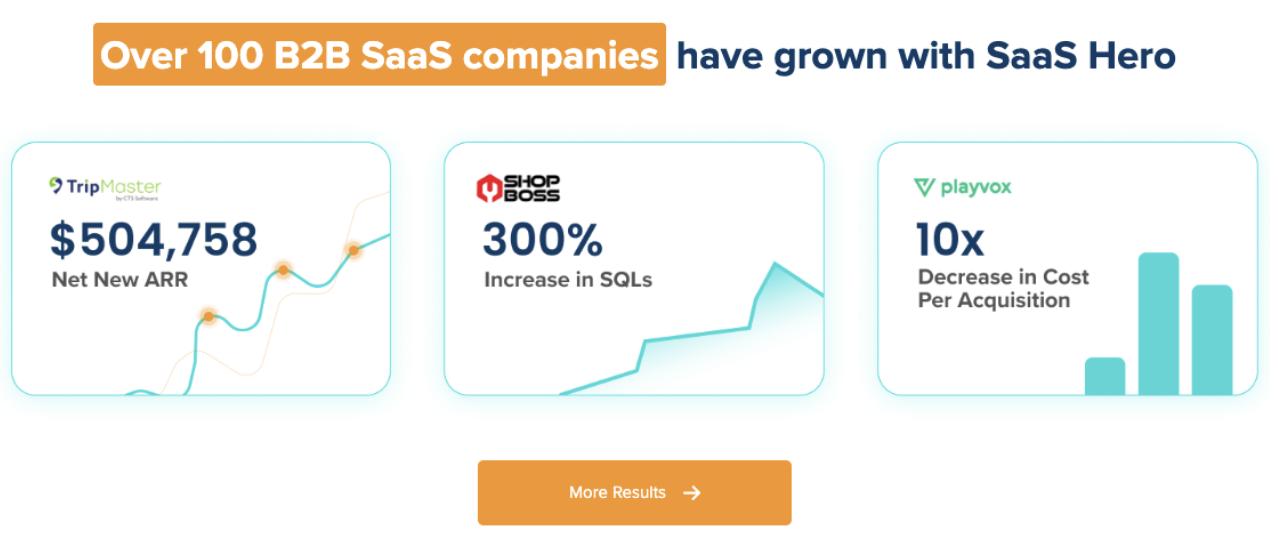
The results are documented. TripMaster added $504,758 in Net New ARR in 12 months. TestGorilla achieved an 80-day CAC payback period that supported a $70M Series A raise. Playvox reduced cost per lead by 10x while increasing lead volume 163%. These outcomes reflect closed revenue, not vanity metrics.

Senior strategists stay hands-on throughout the engagement. SaaSHero avoids junior handoffs and black-box reporting and limits each manager to 8–10 clients to preserve depth of engagement. The team integrates directly into client Slack channels and runs bi-weekly strategy calls, functioning as an embedded growth team rather than an external vendor.

For VPs of Marketing and Heads of Growth accountable to a board for Net New ARR, the real issue is whether the current setup connects ad spend to closed revenue or produces a dashboard of impressions that cannot defend a budget.
Request your revenue attribution audit and implementation roadmap tailored to your ARR stage.