




Written by: Aaron Rovner, Founder, Saas Hero | Last updated: July 29, 2026
Key Takeaways
- Intent data programs fail when poor-fit accounts consume SDR capacity, signals decay within days, and attribution gaps block ROI proof to revenue leadership.
- A six-stage framework that gates signals by ICP fit, weights sources by reliability, applies recency decay, automates routing, personalizes messaging, and enforces speed-to-lead produces measurable pipeline velocity and Net New ARR.
- Stage 1 and Stage 2 (ICP filtering plus source categorization) remove noise before scoring, while Stage 3 recency-weighted scoring and Stage 4 CRM automation ensure high-intent accounts reach reps within hours, not days.
- Stage 5 topic-to-messaging alignment and Stage 6 signal-expiration policies keep outreach relevant and prevent stale accounts from occupying rep capacity, driving reply rates 25% higher than non-intent sequences.
- SaaSHero implements and operates the entire six-stage system on a flat monthly retainer; book a discovery call to accelerate time-to-pipeline without hiring an in-house RevOps team.
Foundations: Tools, Metrics, and Shared Definitions
Three platform categories must exist before any stage goes live. You need a CRM with custom scoring fields and workflow automation (HubSpot or Salesforce), at least one intent data provider (Bombora, 6sense, Demandbase, or G2 Buyer Intent), and ad platforms connected via offline conversion imports so closed-won revenue flows back to campaign reporting.
Baseline metrics required before launch include current CAC, LTV, CAC payback period, and MQL-to-SQL conversion rate by source. Internal stakeholders who must align on definitions before go-live span three functions, each controlling a critical dependency. RevOps owns scoring and routing logic, which determines which accounts reach reps. Sales leadership owns SLA acceptance, since the framework fails if high-intent accounts sit unworked. Demand Gen owns personalization triggers and ad audience sync, ensuring messaging matches the research topics driving each account’s score.
Key terms used throughout this playbook are defined as follows. First-party intent signals are behaviors observed on a company’s own properties, such as pricing page visits, demo request page views, repeated sessions, case study downloads, and email replies. Third-party intent signals are behaviors aggregated across external publisher networks and review sites, such as Bombora topic surges, G2 Buyer Intent flags, and TechTarget purchase intent scores. Trigger events are contextual signals such as funding rounds, executive hires, job postings for relevant roles, and earnings call language that indicate organizational readiness to buy. Net New ARR is recurring revenue from new logos only, excluding expansion or renewal, and is the primary financial output this framework is designed to grow.
The business case for this system is substantial. Intent-sourced leads often close at higher rates than cold ICP-match outreach, and that conversion advantage compounds when combined with the deal-size premium covered in Stage 3. The six-stage framework below turns that advantage into a repeatable operating model.

The Six-Stage Intent-to-Pipeline Framework
The six stages form a sequential operating system. Each stage has a defined input, a defined output, and a validation criterion that confirms the stage is functioning before the next one activates. Teams with limited RevOps capacity should implement one stage per two-week sprint instead of attempting a full deployment at once.
Stage 1: ICP + Intent Filter
Purpose: Remove poor-fit accounts before they consume scoring capacity or rep time. Intent signals from companies that cannot buy because of industry, size, geography, or tech stack are noise regardless of signal strength.
Actions:
- Define a firmographic ICP using at minimum five attributes: industry vertical, employee count range, annual revenue range, geography, and primary tech stack (CRM, MAP, or data warehouse).
- Build a suppression list in the CRM that automatically disqualifies any account failing two or more ICP criteria.
- Configure the intent platform to apply the ICP filter at the account-list level before signals pass downstream, not after scoring has already run.
- Document the ICP definition in a shared RevOps wiki so sales and marketing apply identical criteria when manually reviewing accounts.
Anonymized example: A mid-market SaaS company received about 2,400 intent signals per month from Bombora. After applying a five-attribute ICP filter for B2B SaaS companies with 50–500 employees, $5M–$50M revenue, North America headquarters, and Salesforce usage, the active universe dropped to 180 accounts. That 92% reduction removed noise before scoring and freed SDR capacity for real buyers.
Validation criterion: The filtered account list should represent no more than 5–10% of the raw intent feed. If the filtered list exceeds 20% of the raw feed, the ICP definition is too broad and must be tightened.
Stage 2: Source Categorization for Reliable Signals
Purpose: Assign a reliability tier to every signal source so the scoring model in Stage 3 applies accurate weights instead of treating a Bombora topic surge and a pricing page visit as equivalent inputs.
Actions:
- Classify all active signal sources into three tiers. Tier 1, the highest weight, covers first-party signals such as pricing page visits, demo request page views, repeated sessions within 7 days, and bottom-of-funnel content downloads. Tier 2 covers second-party signals from review platforms such as G2 Buyer Intent flags, TrustRadius comparison page views, and Capterra category research. Tier 3 covers third-party topic surges from publisher networks such as Bombora.
- Document each source’s historical signal-to-qualified-opportunity conversion rate using 90 days of CRM data. This rate becomes the empirical basis for the weights applied in Stage 3.
- Build a source taxonomy table in the CRM with a field for signal source, tier classification, and last-validated conversion rate.
Why this matters: Third-party topic surge signals from providers such as Bombora often contain significant noise. Weighting first-party signals more heavily keeps the composite score grounded in real buying behavior.
Validation criterion: Every signal entering the scoring model in Stage 3 must have a documented source tier and a conversion rate on file. Any signal source without 90 days of conversion data receives Tier 3 weight by default until sufficient data accumulates.
Stage 3: Recency-Weighted Scoring and Revenue Impact
Purpose: Produce a single composite account score from 0–100 that reflects both ICP fit and the recency-adjusted strength of buying signals, so reps receive a ranked list instead of an undifferentiated feed.
Actions:
- Apply the weighted formula: Total Score = (Fit Score × 0.4) + (Engagement Score × 0.3) + (Intent Score × 0.3). This structure explicitly separates ICP fit, engagement, and intent dimensions and provides a practical framework for balancing recency-sensitive behavior signals against stable ICP fit factors.
- Apply time-decay multipliers to the Intent Score component. Assign maximum priority to signals 0–7 days old, high weight to 8–14 days old, medium weight to 15–30 days old, and low weight to signals older than 30 days.
- Score behavioral depth on a separate axis within the Engagement Score. Assign a blog article view a score of 5, a resource download 10, a webinar registration 15, a product page visit 20, a pricing page visit 30, and a demo request 50.
- Set routing thresholds so accounts scoring 80–100 (Tier A) receive immediate sales outreach within 24 hours, 50–79 (Tier B) enter targeted ABM campaigns, 25–49 (Tier C) enter nurture programs, and 0–24 (Tier D) receive passive monitoring only.
- Schedule a monthly recalibration session where scoring weights are adjusted against the previous month’s closed-won account data. Teams that review and reweight the model monthly achieve 2–3x better pipeline efficiency than those that set it once.
This recalibration discipline directly drives measurable revenue outcomes. The median sales cycle for intent-flagged accounts is compressed by 28 days versus baseline, and intent-sourced opportunities often carry higher average contract value because they enter the pipeline later in the buying journey.
Stage 4: CRM Routing, SLAs, and Decay Rules
Purpose: Turn composite account scores into automated rep assignments, SLA timers, and decay-mitigation rules so that high-intent accounts never sit unworked in a queue.
Actions:
- Build score-threshold routing rules in HubSpot or Salesforce. Accounts scoring 85+ route immediately to an AE for same-day outreach, 60–84 route to an SDR within 24 hours, 40–59 enter lower-touch nurture, and below 40 receive only paid awareness.
- Enrich every routed record with the triggering signal context, including researched topics, visited pages, engaged contacts, and the account’s current buying stage classification. This context is written into a dedicated CRM field so reps do not need to log into the intent platform to prepare for outreach.
- Implement a decay-mitigation rule so any account that has not refreshed its intent signals within 14 days is automatically deprioritized from the active outreach queue and moved to a monitoring workflow. Automated hygiene rules should flag accounts where intent signals have not refreshed within a set timeframe and deprioritize them from active outreach queues.
- Configure owner-notification alerts for existing pipeline accounts that show renewed research activity so AEs can re-engage stalled deals with relevant context.
- Log every routing decision with a timestamp and the score that triggered it, creating an audit trail that sales leadership can review during weekly pipeline calls.
Validation criterion: Zero Tier A accounts should remain uncontacted after 24 hours. Pull a weekly report from the CRM showing time-to-first-touch by tier. If Tier A response time exceeds 24 hours, the routing automation has a configuration gap that must be fixed before scaling spend.
Stage 5: Topic-Based Messaging and Buying Stage Alignment
Purpose: Match outreach messaging to the specific research topics and buying stage signals driving each account’s score so the first touch feels contextually relevant instead of generic.
Actions:
- Define a topic taxonomy of 10–20 intent topics that map to genuine buying interest. Include both category-level topics such as “CRM platform” and problem-level topics such as “lead scoring” or “email deliverability,” then assign each topic to a buying stage and messaging variant.
- Build four messaging variants aligned to Buska’s four-level buyer-intent framework. Level 1 (Research, 3–9 months to purchase) receives educational content. Level 2 (Comparison, 1–3 months) receives competitive differentiation. Level 3 (Evaluation, 2–6 weeks) receives ROI calculators and case studies. Level 4 (Purchase, 0–4 weeks) receives direct demo offers and pricing context.
- Sync high-intent account lists to paid ad audiences in LinkedIn and Google so that accounts in active evaluation see relevant display and retargeting ads at the same time as SDR outreach, creating a coordinated multi-channel signal that can improve pipeline velocity versus single-channel response.
- Write the triggering research topic into the email subject line or opening sentence of every SDR sequence. An account surging on “contract management software alternatives” receives a different opening than one surging on “contract management implementation cost.”
Validation criterion: Reply rates on intent-triggered sequences should exceed reply rates on non-intent sequences by at least 25%. If they do not, the topic-to-message mapping requires revision.
Stage 6: Speed-to-Lead and Signal Decay Enforcement
Purpose: Execute outreach within the 48–72-hour window during which intent signals retain maximum predictive value, before competing vendors saturate the account with their own outreach.
Actions:
- Set a hard SLA of sub-4-hour response for all Tier A accounts with a score of 80 or higher. Companies that respond to leads within 5 minutes see approximately 9x higher conversion rates than those who wait 24 hours.
- Configure real-time Slack or email alerts to the assigned rep the moment a Tier A account crosses the routing threshold, including the enriched context from Stage 4.
- Implement a signal-expiration policy that enforces the decay-mitigation rule from Stage 4. First-party signals such as pricing page visits and demo page views expire after 7 days without re-engagement, second-party signals such as G2 comparisons expire after 14 days, and third-party topic surges expire after 30 days. These expiration windows automatically reduce composite scores and ensure the 14-day threshold triggers correctly so stale accounts do not occupy rep capacity.
- Run a weekly decay audit to enforce these expiration rules. The audit identifies accounts whose scores have dropped below their routing threshold due to signal expiration and moves them to the appropriate lower-tier workflow automatically. This process catches accounts that have gone cold and prevents them from consuming high-priority rep capacity.
Why the window is narrow: Buying signals create a short action window of 48–72 hours after which response rates drop sharply because the account becomes saturated with competing outreach. Speed-to-lead in this framework functions as a structural requirement, not a nice-to-have best practice.
Validation criterion: Tier A median time-to-first-touch should be under 4 hours. Tier B median time-to-first-touch should be under 24 hours. Both metrics are tracked weekly in the CRM pipeline dashboard.
How to Measure Success Across the Six Stages
Four metrics form the measurement core of this framework. Pipeline velocity, calculated as (number of opportunities × average deal value × win rate) / sales cycle length, is the strongest leading indicator of future Net New ARR. SQL-to-close rate, tracked separately for intent-sourced versus non-intent-sourced opportunities, quantifies the conversion premium the framework delivers. CAC payback period measures how quickly closed revenue recoups the combined cost of intent platform licenses, SDR time, and ad spend. Net New ARR from intent-sourced closed-won deals is the lagging indicator that validates the entire system.
Attribution in B2B SaaS with 60–120-day sales cycles works best with a two-touch model. Capture the first-touch source at lead creation and the opportunity-creation source when a deal enters the pipeline. Marketing-influenced pipeline credits opportunities where marketing had a meaningful touchpoint even if it was not the first touch, recognizing the non-linear buyer journeys common in B2B SaaS. Sync opportunity records back to the intent platform and ad platforms via offline conversion imports so that campaign decisions use closed-won data, not just lead volume.
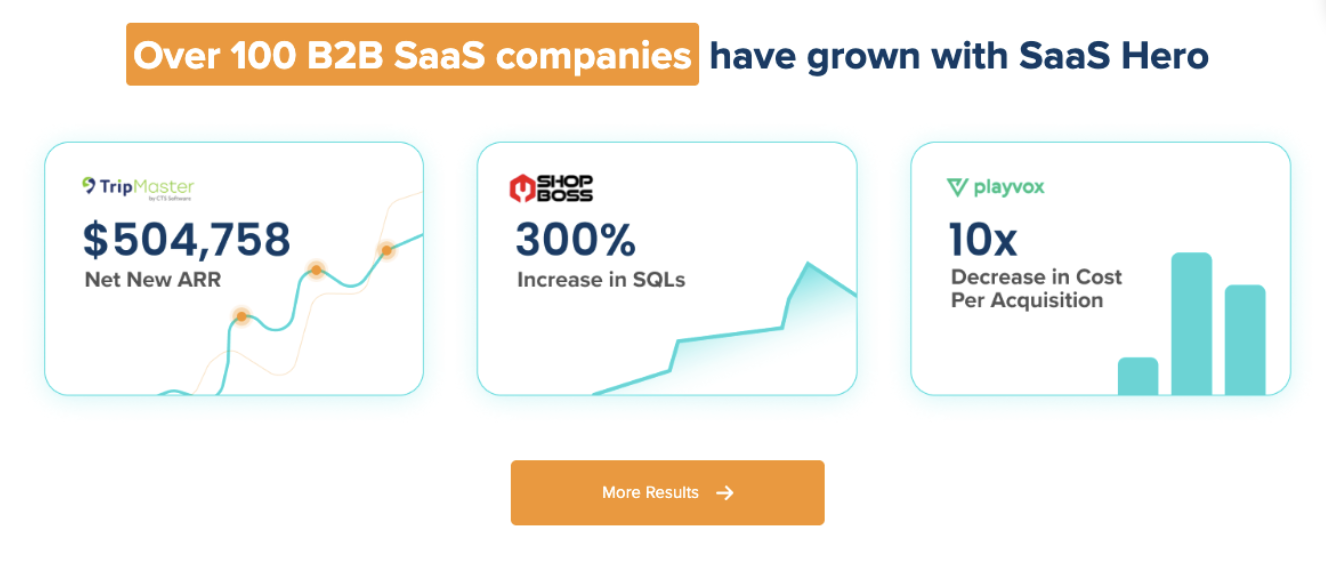
SaaSHero’s client results provide concrete benchmarks for this framework in production. TripMaster, a transit SaaS, generated $504,758 in Net New ARR within 12 months. TestGorilla achieved an 80-day CAC payback period, which directly supported a $70M Series A raise by demonstrating unit economic efficiency to investors. These outcomes come from the same six-stage system described in this playbook, implemented and refined on a flat monthly retainer.

Advanced Variations for Scaling and ABM
Teams that have validated the core six-stage framework across at least one full sales cycle can extend the system in two directions. For multi-channel scaling, replicate the Stage 5 personalization logic across LinkedIn Ads, Google Display, and retargeting campaigns so that every channel an account encounters reinforces the same topic-matched message. Many B2B marketers who integrate intent data into their demand generation strategies see an increase in qualified leads when that integration spans channels instead of remaining siloed in SDR sequences.
For ABM program adaptation, promote the top 50 Tier A accounts into a named ABM program with dedicated landing pages, executive-level outreach sequences, and custom content mapped to each account’s specific research topics. Teams using a multi-signal approach that combines first-, third-, and contextual signals often achieve higher conversion rates and shorter sales cycles than teams relying on single-source intent data. The ABM layer adds contextual signals such as job postings, funding events, and executive changes as a fourth signal tier that elevates accounts showing organizational buying readiness alongside topic research activity.
Quick-Start Checklist and Next Steps
The six stages of this framework, in implementation order, are as follows:
- Define and document the ICP using five or more firmographic attributes and build a CRM suppression list for non-qualifying accounts.
- Classify all active signal sources into three tiers by predictive reliability and document each source’s historical conversion rate.
- Configure the composite scoring formula with fit, engagement, and intent dimensions, apply recency decay multipliers, and schedule monthly recalibration.
- Build CRM routing rules with score-threshold assignments, SLA timers, signal-context enrichment fields, and decay-mitigation hygiene automation.
- Map intent topics to buying stages, write four messaging variants, and sync account lists to paid ad audiences for coordinated multi-channel activation.
- Set sub-4-hour SLAs for Tier A accounts, configure real-time rep alerts, and implement signal-expiration policies with automated score reduction.
Teams at early maturity with no intent platform and no scoring model should start with Stage 1 and Stage 2 using only first-party signals from their existing CRM and website analytics before purchasing a third-party intent feed. Teams at mid maturity with an active intent platform but no routing automation should prioritize Stage 4 and Stage 6, because speed-to-lead and decay mitigation produce the fastest measurable lift. Teams at advanced maturity with routing and scoring operational should focus on Stage 5 personalization and the ABM variation to increase average contract value.
SaaSHero implements this full system on a flat monthly retainer starting at $1,250/month with no long-term contract. Every engagement is month-to-month, so the agency re-earns the relationship every 30 days against the same pipeline velocity and Net New ARR metrics this playbook defines.
Book a discovery call to get a custom implementation roadmap for your ARR stage and tech stack.
Frequently Asked Questions
How long does it take to see qualified pipeline from an intent data program?
Many B2B SaaS teams see their first intent-sourced SQLs within the first few months of activating the core stages, assuming an intent platform is already contracted and CRM routing automation is in place. The median time from intent platform contract execution to first qualified pipeline contribution is 94 days. Teams that engage SaaSHero with an existing intent feed and CRM can often accelerate time to pipeline because the scoring logic, routing rules, and personalization triggers are deployed in the first sprint rather than built iteratively over months.
Who owns the intent data program, marketing, sales, or RevOps?
Effective intent programs require shared ownership with clearly divided responsibilities. RevOps owns the scoring model, routing rules, CRM field architecture, and monthly recalibration cadence. Demand Generation owns the topic taxonomy, personalization messaging variants, and ad audience synchronization. Sales leadership owns SLA enforcement, rep training on signal context, and the feedback loop that informs scoring recalibration. Without explicit ownership at each layer, intent programs default to a single team, usually marketing, that lacks the authority to enforce SLAs or modify CRM routing logic. SaaSHero operates as an embedded extension of all three functions, which is why implementation timelines are often shorter than internal builds.
What are the biggest risks of an intent data program, and how are they mitigated?
The three primary risks are signal noise, score staleness, and attribution gaps. Signal noise is mitigated by Stage 1’s ICP filter, which eliminates poor-fit accounts before scoring begins, and by Stage 2’s source tiering, which prevents low-reliability third-party surges from inflating composite scores. Score staleness is mitigated by the signal-expiration policies in Stage 6 and the monthly recalibration in Stage 3, which reset weights against current closed-won data rather than assumptions made at launch. Attribution gaps are mitigated by the two-touch attribution model in the measurement section, which captures both first-touch source and opportunity-creation source and syncs closed-won data back to ad platforms via offline conversion imports. Teams that skip the attribution infrastructure investment typically cannot defend intent program spend to the CFO after the first quarter.
How often should the scoring model be recalibrated?
Monthly recalibration is the minimum cadence for teams with active pipeline, as described in Stage 3. Quarterly recalibration is acceptable for teams with fewer than 20 closed-won deals per month, where the sample size is too small for monthly statistical significance. The ICP definition itself should be reviewed quarterly, because product positioning, pricing changes, and new vertical expansions can shift which firmographic attributes correlate with high LTV customers. Teams that have not recalibrated their scoring model in more than 90 days are effectively operating on stale assumptions and should treat their current pipeline velocity numbers with caution.
When does it make sense to engage an external partner rather than building this system in-house?
Three conditions indicate that an external partner will deliver faster and more capital-efficient results than an internal build. First, when the RevOps team is already at capacity managing existing CRM hygiene, reporting, and tooling, adding a six-stage intent infrastructure on top of existing responsibilities usually produces a partial implementation that delivers neither the speed-to-lead performance nor the attribution clarity the system requires. Second, when the company has raised growth capital and needs to demonstrate pipeline velocity and CAC payback within a defined investor timeline, internal builds often take 3–6 months to reach full operational maturity, while an experienced external team can compress that to 4–6 weeks. Third, when previous intent data investments have failed to produce measurable pipeline, the root cause almost always sits in scoring logic, routing automation, or personalization rather than in the intent data itself, and an external audit can identify and fix the gap faster than an internal post-mortem. SaaSHero’s flat-fee, month-to-month model is structured to be a low-risk answer to all three conditions.