




Written by: Aaron Rovner, Founder, Saas Hero | Last updated: August 25, 2026
Key Takeaways for Revenue-First Tracking
- B2B SaaS paid campaigns work best with a four-level metric hierarchy: Activity, Acquisition, Quality, and Business Outcome. This structure connects every ad dollar to Net New ARR instead of relying on last-click attribution.
- Level 1 and 2 metrics (CTR, CPC, CPL, Cost per Demo) act as diagnostic signals and should be reviewed weekly. Level 3 and 4 metrics (MQL-to-SQL rate, Pipeline ROAS, CAC Payback) work better as monthly or quarterly trends.
- Quality metrics such as MQL-to-SQL rate (target 25–35%) and ICP-Fit Rate separate high-performing campaigns from vanity-metric campaigns by confirming sales readiness before budgets scale.
- Business Outcome metrics like Pipeline ROAS (≥3×) and CAC Payback (≤9 months) stand up in board meetings. Calculate them with a 90-day attribution window that matches typical B2B sales cycles.
- SaaS Hero implements this exact system for clients on flat-fee, month-to-month retainers. Schedule a discovery call to get the 10-metric executive dashboard template and see how your paid campaigns map to Net New ARR.
The Four-Level Metric Hierarchy for B2B SaaS
The hierarchy organizes every paid campaign metric into four levels, and each level answers a specific question for a specific audience. The table below maps each level to its primary metrics, required tools, and review cadence.
| Level | Name | Primary Metrics | Review Cadence |
|---|---|---|---|
| 1 | Activity | CTR, CPC, Impression Share, Spend Pacing | Weekly |
| 2 | Acquisition | CPL, Cost per Demo, Conversion Rate, Volume by Channel | Weekly |
| 3 | Quality | MQL-to-SQL Rate, Cost per SQL, Sales Accepted Lead Rate, ICP-Fit Rate | Weekly (leading); Monthly (trend) |
| 4 | Business Outcome | Pipeline ROAS, CAC Payback Period, Net New ARR, LTV:CAC | Monthly / Quarterly |
Full implementation requires Google Ads, LinkedIn Ads, HubSpot or Salesforce, Looker Studio, and GCLID-to-CRM tracking. Because these tools must be connected through custom data pipelines, implementation requires dedicated effort to wire everything correctly before the dashboard produces reliable numbers.

Four terms anchor every level of the hierarchy:
- Pipeline ROAS: Pipeline value created ÷ Ad spend. This measures revenue leverage before deals close. A healthy B2B SaaS target is ≥3×.
- MQL-to-SQL Rate: SQLs ÷ MQLs. This measures lead quality handed from marketing to sales.
- CAC Payback Period: CAC ÷ Monthly Gross Margin per Customer. This measures how many months it takes to recover acquisition cost.
- Net New ARR: New ARR added in a period, excluding expansion or renewal revenue. This is the ultimate board-level outcome metric.
Level 1: Activity Metrics That Keep Traffic Efficient
Activity metrics show whether the campaign delivers enough qualified traffic at an efficient cost to feed the funnel. They act as diagnostic signals, not final judgments. A high CTR on a poorly targeted audience becomes a warning sign, not a win.
The core Level 1 formulas are:
- CTR = Clicks ÷ Impressions
- CPC = Spend ÷ Clicks
- Impression Share = Impressions received ÷ Eligible impressions
- Spend Pacing = Actual spend ÷ Planned spend for the period
B2B SaaS Google Ads benchmarks for 2025–2026 include CTR of ~3.6%, CPC of ~$13.75 (non-brand search), and conversion rate of ~3.94%. Client accounts track non-branded CTR and CPC closely for mid-market SaaS keywords.
Decision rules at Level 1:
- Pause: CTR below 2% for 14+ days on a non-branded campaign with sufficient impressions, which indicates creative or targeting misalignment.
- Scale: Impression Share lost to budget exceeds 20% while downstream Quality metrics are on target, which indicates constrained spend on a proven campaign.
These decision rules become concrete when applied to real campaigns. An anonymized SaaS Hero client in the HR Tech vertical was running a LinkedIn campaign with a 1.1% CTR and $62 CPC. A creative refresh and audience narrowing to Director-level titles at companies with 200–1,000 employees lifted CTR to 4.8% and dropped CPC to $31 within three weeks, without any budget change.
Level 2: Acquisition Metrics That Control Lead Cost
Acquisition metrics show the cost and volume of conversions entering the funnel. This level is where most agencies stop and where the most dangerous optimization errors occur. When teams optimize only for low CPL without tracking lead quality, they mistake cheap leads for qualified leads and increase volume while pipeline value stalls.
The core Level 2 formulas are:
- CPL = Spend ÷ Total Leads
- Cost per Demo = Spend ÷ Demo Requests
- Conversion Rate = Conversions ÷ Clicks
- Cost per Qualified Lead = Spend ÷ MQLs
For B2B lead generation, the core funnel model connects metrics as Spend → Clicks → Conversions → Qualified Leads → Sales. Mid-market SaaS clients target competitive Cost per Demo on paid search and LinkedIn, adjusted to match ACV.
Decision rules at Level 2:
- Pause: CPL running 40% or more above target for two consecutive weeks with no improvement trend, which signals a need to reallocate budget to a stronger channel.
- Scale: Cost per Demo is on target and demo volume is below plan, which signals that budget should increase before deeper investigation.
A SaaS Hero client in the Cybersecurity vertical celebrated a $95 CPL from a broad-match paid search campaign. After the team connected GCLID data to HubSpot, the MQL rate on those leads was 6%, which pushed effective Cost per MQL to $1,583. Switching to exact-match competitor conquesting keywords raised CPL to $210 but lifted MQL rate to 38%, which dropped Cost per MQL to $553.
Level 3: Quality Metrics That Prove Sales Readiness
Quality metrics show whether the leads entering the funnel are worth sales follow-up. This level separates revenue-first agencies from vanity-metric agencies. High-quality MQLs with strong SQL conversion can match the pipeline value of larger volumes of low-quality MQLs while using less budget.

The core Level 3 formulas are:
- MQL-to-SQL Rate = SQLs ÷ MQLs
- Cost per SQL = Spend ÷ SQLs
- Sales Accepted Lead Rate = Sales Accepted Leads ÷ MQLs passed to sales
- ICP-Fit Rate = ICP-qualified leads ÷ Total leads
B2B SaaS companies in 2026 have a median MQL-to-SQL conversion rate of 18–22% (cross-industry median is 13%) and a top-quartile rate of 25–35%. Top-performing campaigns often reach MQL-to-SQL rates above 30%.
Decision rules at Level 3:
- Pause: MQL-to-SQL rate drops below 15% for a rolling 30-day window, which indicates targeting drift or ICP misalignment at the campaign level.
- Scale: MQL-to-SQL rate exceeds 30% and Cost per SQL is within target, which shows that the campaign produces qualified pipeline efficiently.
A SaaS Hero client in the Real Estate Tech vertical had a 9% MQL-to-SQL rate on a LinkedIn Lead Gen Form campaign. Sales feedback showed that the form attracted individual agents rather than property managers with 50+ units. Switching to a Conversation Ad with a qualifying question about portfolio size lifted MQL-to-SQL to 31% within 60 days. This type of targeting refinement, guided by Level 3 quality metrics, becomes clear and actionable inside the executive dashboard.
Level 4: Business Outcome Metrics That Satisfy the Board
Business Outcome metrics answer the core CFO and board question: did paid spend create durable revenue. These metrics require CRM data, closed-won deal records, and at least one full sales cycle before they stabilize. For most B2B businesses, reliable attribution data requires one full sales cycle of 60-180 days (2-6 months), and 90+ days or longer for enterprise cycles.
The core Level 4 formulas are:
- Pipeline ROAS = Pipeline value created ÷ Ad spend
- CAC = Total marketing + sales spend ÷ Closed-won customers in the period
- CAC Payback Period = CAC ÷ (ACV × Gross Margin %)
- Net New ARR = Sum of ACV from new logos closed in the period
- LTV:CAC = (ACV × Gross Margin % ÷ Churn Rate) ÷ CAC
B2B SaaS companies track blended paid ROAS as a key metric. Healthy CAC Payback benchmarks are under 12 months for SMB, under 18 months for mid-market, and under 24 months for enterprise. Targeting CAC payback of 9 months or less for SMB and mid-market SaaS places clients in the top quartile.
Decision rules at Level 4:
- Pause: Pipeline ROAS falls below 2× for two consecutive months, which should trigger a full attribution audit before any new spend.
- Scale: Pipeline ROAS exceeds 4× and CAC Payback is under 9 months, which signals that budget can increase aggressively.
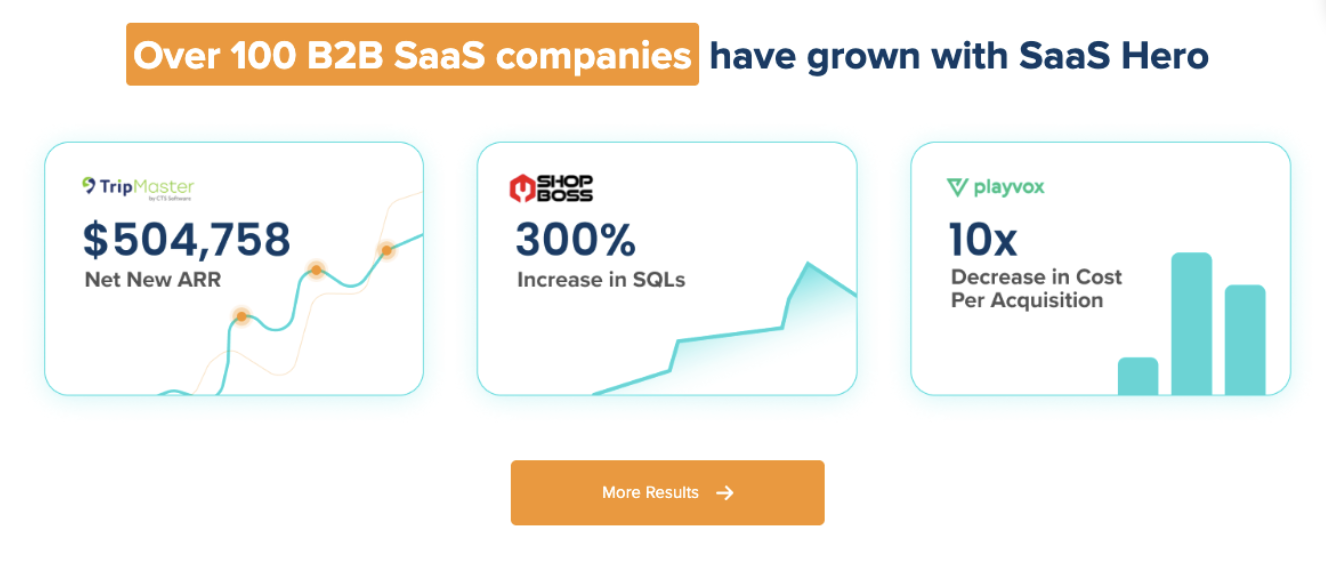
SaaS Hero’s TripMaster engagement produced $504,758 in Net New ARR in 12 months from paid search and paid social, with a 650% ROI. This result created a Pipeline ROAS that placed the account firmly in the top quartile of the 2026 benchmark range.

Waterfall Example: Turning $50k in Spend into Incremental ARR
This waterfall uses SaaS Hero’s 2026 mid-market client benchmarks to show how $50,000 in incremental monthly ad spend translates to closed-won ARR. All conversion rates reflect median performance for accounts that hit the ≥3× Pipeline ROAS target.
- Ad Spend: $50,000
- Clicks (at $20 blended CPC): 2,500
- Leads (at 5% conversion rate): 125
- MQLs (at 39% lead-to-MQL rate per Pepper Effect 2026 median): 49
- SQLs (at 25% MQL-to-SQL rate): 12
- Opportunities (at 54% SQL-to-opportunity rate per Pepper Effect 2026 median): 6
- Closed-Won Deals (at 27% opportunity-to-close rate): 2
- Net New ARR (at $30,000 ACV): $60,000
- Pipeline Created (6 opportunities × $30,000 ACV): $180,000
- Pipeline ROAS: $180,000 ÷ $50,000 = 3.6× ✓
- CAC: $50,000 ÷ 2 = $25,000
- CAC Payback (at 75% gross margin): $25,000 ÷ ($30,000 × 0.75 ÷ 12) = 13.3 months
This baseline scenario clears the ≥3× Pipeline ROAS threshold but sits above the ≤9-month CAC payback target. Closing the gap requires either improving MQL-to-SQL rate from 25% to the top-quartile 35%+ cited earlier or increasing ACV through better ICP targeting. Both moves are realistic within 90 days when you apply the Level 3 quality interventions described above.
Weekly Review Cadence and the SaaS Hero Dashboard
A revenue-first dashboard functions as a weekly decision engine rather than a static report. A repeatable review cadence for B2B SaaS paid campaigns includes weekly tactical reviews focused on spend pacing and tracking health, monthly strategic reviews comparing channel performance, and quarterly structural audits of attribution models and KPI targets.
The 10-metric executive dashboard SaaS Hero delivers to every client contains:
- Spend vs. Plan (pacing %)
- Cost per MQL by channel
- MQL-to-SQL Rate (rolling 30 days)
- Cost per SQL by channel
- Opportunities Created (this period)
- Pipeline Created ($) by campaign
- Pipeline ROAS (rolling 90 days)
- CAC (rolling 90 days)
- CAC Payback Period (months)
- Net New ARR (closed-won, this period)
The dashboard lives in Looker Studio, connects to HubSpot or Salesforce via GCLID-to-CRM tracking, and refreshes daily for pipeline and lead volume metrics. Conversion rates and velocity metrics refresh weekly.
The 84-day median B2B SaaS sales cycle is the figure most commonly cited as the root of attribution gaps. First-touch attribution on short windows usually shows lower ROAS than pipeline-attributed ROAS that covers the full sales cycle. To account for the median 84-day sales cycle discussed earlier, SaaS Hero uses a 90-day attribution window and syncs offline conversion events, specifically SQL creation and opportunity creation, back to Google Ads and LinkedIn Ads so the platforms optimize toward quality rather than form fills.
See how this dashboard connects to your CRM pipeline by scheduling a discovery call with SaaS Hero.
Advanced Measurement Variations for Mature Teams
Teams that have stabilized the core hierarchy can layer two advanced measurement approaches.
Competitor-Conquesting Segmentation: SaaS Hero segments competitor campaigns by psychological intent: pricing, problem or complaint, and review or validation. The team tracks Pipeline ROAS separately for each segment. Pricing-intent campaigns typically produce shorter sales cycles and higher close rates because the prospect already evaluates options. Reporting these segments separately prevents blended averages from hiding the highest-performing intent bucket.
ABM Pipeline Metrics: For clients running Account-Based Marketing alongside paid campaigns, the relevant additions to the Level 4 dashboard are:
- Account Engagement Rate = Engaged target accounts ÷ Total target accounts in campaign
- Pipeline Influenced by ABM = Pipeline from target accounts with two or more marketing touchpoints
- Buying Committee Coverage = Unique decision-maker contacts engaged per target account
The ZenABM 2026 LinkedIn ABM Performance Benchmarks Report, which analyzed $5.5M in ad spend across 211 B2B companies, found a median influenced pipeline per dollar spent of $5.21, with top performers reaching $15.20. ABM pipeline metrics belong on the monthly board report alongside Net New ARR, not on the weekly tactical dashboard.
Implementation Checklist and Next Steps by Spend Level
This checklist applies regardless of budget size and should be completed in sequence. Skipping tracking setup to launch campaigns faster is the most common reason agencies cannot defend spend to clients.
- Audit existing conversion tracking and confirm that GCLID passes to the CRM on every form submission.
- Define MQL and SQL criteria in writing with the sales team before the first campaign launches.
- Set up offline conversion imports and push SQL creation events from HubSpot or Salesforce back to Google Ads and LinkedIn Ads.
- Build the Looker Studio dashboard with all 10 metrics connected to live CRM data.
- Establish baseline benchmarks for each metric using the prior 90 days of data.
- Set weekly review appointments with the client instead of monthly meetings.
- Run the first Pipeline ROAS calculation at 90 days and compare it to the ≥3× target.
Next actions by spend level:
- $10k–$25k/month: Focus on one channel, usually paid search, one ICP segment, and the core 10-metric dashboard. Avoid splitting budget across channels until Pipeline ROAS exceeds 3× on the primary channel.
- $25k–$50k/month: Add LinkedIn Ads for awareness and consideration. Track Pipeline ROAS separately by channel and begin competitor-conquesting campaigns.
- $50k+/month: Layer ABM pipeline metrics, incrementality testing with 5–10% holdout groups, and buying committee coverage tracking. Holdout groups of 5–10% of the target audience are commonly used for always-on campaigns to calculate incremental lift after the campaign concludes.
Frequently Asked Questions
How long does implementation take, and which roles are involved?
Full implementation, from GCLID setup through a live Looker Studio dashboard connected to CRM pipeline data, requires focused senior strategist time. The required roles are a paid media strategist who understands CRM data structures, a RevOps or marketing operations contact on the client side with HubSpot or Salesforce admin access, and a reporting specialist to build and maintain the Looker Studio dashboard. SaaS Hero includes all three roles in every flat-fee, month-to-month retainer, so clients do not need to hire separately for tracking infrastructure. The setup fee covers the initial audit and wiring work before the retainer begins.
How does this framework scale from $10k–$15k to $75k+ monthly spend?
At $10k–$15k monthly spend, the framework simplifies to one channel, one ICP segment, and the core 10-metric dashboard with a 90-day attribution window. The four-level hierarchy still applies, but Level 4 Business Outcome metrics take longer to stabilize because deal volume is lower. Agencies at this spend level should report Pipeline ROAS as the primary board metric and treat closed-won ARR as a lagging confirmation.
At $75k+ monthly spend, the framework expands to include channel-level Pipeline ROAS segmentation, ABM pipeline metrics, and incrementality testing with holdout groups. SaaS Hero’s tiered flat-fee model matches this progression. The retainer scales with spend bands rather than a percentage of spend, so the agency’s incentive to recommend budget increases stays tied to performance data instead of fee growth.
What are the biggest risks when rolling out this system?
The three most common failure modes are GCLID data not passing to the CRM, usually caused by form redirects that strip URL parameters, MQL and SQL definitions that differ between marketing and sales, which makes MQL-to-SQL rates meaningless, and attribution windows that are shorter than the average sales cycle, which makes Pipeline ROAS appear negative for the first 60–90 days. SaaS Hero avoids all three through a data reconciliation audit during onboarding, written MQL and SQL definitions agreed upon by both teams before launch, and a 90-day attribution window set as the default. The month-to-month retainer structure creates a forcing function, because broken tracking shows up immediately and the agency must fix it before the next billing cycle.
How often should metric targets and benchmarks change?
Level 1 and Level 2 targets should be reviewed monthly as campaign data accumulates. Level 3 Quality targets work best on a quarterly review cycle, because MQL-to-SQL rate reacts to ICP definition changes and sales feedback loops. Level 4 Business Outcome targets, including Pipeline ROAS, CAC Payback, and Net New ARR, should be reviewed at the start of each quarter against the prior quarter’s actuals and updated annually against published benchmarks. SaaS Hero conducts a formal quarterly attribution audit for every client to confirm that the chosen attribution model still reflects the buyer journey, especially as new channels enter the mix. The month-to-month model keeps these audits driven by data rather than contract renewals.
What should an agency do if Pipeline ROAS is below 3× after 90 days?
A Pipeline ROAS below 3× at 90 days serves as a diagnostic signal rather than a verdict. The first step is to isolate which level of the hierarchy is breaking down. If Level 1 and Level 2 metrics are on target but Level 3 MQL-to-SQL rate is below 15%, the problem is lead quality, so the team should tighten targeting, add qualifying questions to forms, or implement intent-signal scoring.
If Level 3 is on target but Level 4 Pipeline ROAS is low, the issue is either deal size, where ACV is lower than modeled, or sales cycle length, where the 90-day window is too short for the actual cycle. If Level 2 Cost per Demo is above target, the problem is acquisition efficiency, so the team should test new creative, landing page copy, or audience segments. SaaS Hero’s month-to-month accountability model keeps this diagnostic process active in real time, with weekly reviews and bi-weekly strategy calls, instead of waiting for a quarterly report that surfaces a problem after three months of wasted spend.
Conclusion: From Impressions to Defensible ARR
The four-level hierarchy of Activity, Acquisition, Quality, and Business Outcome creates the structural difference between an agency that reports impressions and an agency that defends ARR. Every metric in the framework answers a specific question for a specific audience, from the campaign manager reviewing CTR on Monday morning to the CFO reviewing CAC Payback in a board meeting.
A metric qualifies as a KPI only if it drives a decision, can be reproduced consistently, and connects directly to revenue. The 10-metric executive dashboard described here meets that standard at every level. The waterfall calculation keeps the math transparent. The weekly review cadence keeps accountability real.
SaaS Hero delivers this system on flat-fee, month-to-month retainers, with no percentage-of-spend billing, no 12-month lock-in, and no junior account managers. The agency re-earns every client’s business every 30 days, which means the dashboard must tell the truth every week.