




Written by: Aaron Rovner, Founder, Saas Hero | Last updated: August 26, 2026
Key Takeaways
- Performance-based lead generation metrics such as CPL, CAC, MQL-to-SQL conversion rate, Lead Velocity Rate, LTV:CAC, CAC payback period, and pipeline velocity connect ad spend directly to Net New ARR for B2B SaaS teams.
- Segment-specific benchmarks matter: SMB CAC payback typically lands between 6–12 months, while enterprise teams should plan for 18–24 months, with top-quartile performers reaching the faster end of that range.
- Speed-to-lead strongly influences conversion outcomes, as sub-5-minute responses deliver ~21% close rates versus 2.3% for next-day follow-up, so SLA compliance becomes a critical efficiency lever.
- Organic channels usually deliver higher-quality conversions than paid, while paid search captures high-intent buyers and paid social builds early-stage pipeline, so each channel requires different evaluation criteria.
- Book a discovery call to implement a revenue-first executive dashboard that maps every ad dollar to Net New ARR for $5M–$50M ARR B2B SaaS teams.
1. CPL and CAC Targets by Segment for B2B SaaS
CPL and CAC act as the first efficiency checkpoints for your go-to-market motion. Cost Per Lead (CPL) measures the cost of generating a single lead from a defined channel, and Customer Acquisition Cost (CAC) measures the total sales and marketing spend required to close one new customer. The formulas are:
- CPL = Total Channel Spend ÷ Total Leads Generated from That Channel
- CAC = (Total Sales Spend + Total Marketing Spend) ÷ New Customers Acquired in the Period
Segment-specific targets matter because SMB motions rely on high-volume, low-touch digital acquisition, while enterprise motions carry longer cycles and higher close costs. The table below shows how CAC payback expectations expand with deal size, so enterprise teams should expect payback windows roughly three times longer than SMB teams, which makes blended benchmarks misleading for both extremes. The table uses 2026 Aleph and Benchmarkit SaaS and AI Performance Benchmarks and GSquared CFO 2026 SaaS Benchmarks for payback figures, and Dual Entry 2026 mid-market benchmarks for LTV:CAC.
| Segment | Typical ACV Band | Median CAC Payback (2026) | Healthy LTV:CAC |
|---|---|---|---|
| SMB | Under $5,000 | 6–12 months | 3:1+ |
| Mid-Market | $5,000–$50,000 | 14–18 months | 3:1+ |
| Enterprise | $50,000–$100,000 | 18–24 months | top quartile CAC payback roughly 14-22 months |
The overall median CAC payback across 342 B2B SaaS and AI-native companies is 16 months. Benchmarking against the blended median instead of the matching ACV band produces misleading conclusions for both SMB and enterprise teams.
2. Funnel Conversion Rates: MQL-to-SQL and Lead Velocity Rate
CAC and CPL measure acquisition cost, but they do not show whether those leads convert efficiently once they enter the funnel. MQL-to-SQL conversion rate measures the percentage of Marketing Qualified Leads that sales accepts as Sales Qualified Leads. Following up on MQLs within one hour lifts MQL-to-SQL conversion to 53%, while a 24-hour delay drops it to 17%. The formula is:
- MQL-to-SQL Rate = SQLs Accepted ÷ MQLs Submitted × 100
Lead Velocity Rate (LVR) tracks the month-over-month percentage growth in qualified leads and serves as a leading indicator that predicts future MRR growth 12–18 months ahead, per Jason Lemkin of SaaStr. The formula is:
- LVR = (Qualified Leads This Month − Qualified Leads Last Month) ÷ Qualified Leads Last Month × 100
Healthy LVR benchmarks vary by stage and usually run higher for early-stage companies that grow faster. A falling LVR acts as an early warning of top-of-funnel weakness that will appear in revenue numbers one full sales cycle later.
3. Revenue Ratios: LTV:CAC and CAC Payback Period
LVR predicts future revenue volume, but it does not show whether that revenue will be profitable. LTV:CAC measures the return generated per dollar of acquisition cost, and CAC Payback Period measures how many months of gross margin are required to recover that acquisition cost. The formulas are:
- LTV:CAC = Customer Lifetime Value ÷ Customer Acquisition Cost
- CAC Payback (months) = CAC ÷ (ACV × Gross Margin %)
Using the segment-specific payback windows from Section 1, teams can evaluate whether their current CAC remains sustainable. A $50,000 ACV enterprise deal with a 30-month payback underperforms the 18–24 month benchmark, which signals a go-to-market efficiency problem. Top-quartile performers reach the faster end of the benchmark range shown in Section 1, roughly 35–40% faster than the median, by improving both lead quality and sales cycle length. For LTV:CAC, mid-market B2B SaaS teams target 3:1 or higher. A ratio below 3:1 shows that the go-to-market motion consumes value faster than it creates it.
4. Speed-to-Lead and Pipeline Velocity
Speed-to-lead captures the time between a lead entering the system and receiving a first meaningful engagement. The median first response time across B2B companies is roughly 42–47 hours, yet B2B inbound leads contacted within five minutes convert at approximately 21% versus 2.3% for a next-day reply. The conversion advantage of sub-5-minute response appears across multiple studies, and even the conservative 21% figure represents a dramatic lift over next-day follow-up, which makes speed-to-lead one of the highest-ROI operational changes available.
To turn this advantage into a repeatable process, teams can tier leads by intent signal and apply different SLAs, reserving the strictest standard for the highest-intent actions where the conversion lift justifies the operational cost. Recommended speed-to-lead SLAs by lead tier:
- Tier 0/1 (demo or pricing requests with qualified context): under 5 minutes
- Tier 2 (high-intent content downloads): within 1 business hour
- Tier 3 (low-intent sources): nurture sequence only
Pipeline velocity quantifies how much expected revenue moves through the funnel per day. The formula, as recommended in the 2026 Ivris Tech B2B marketing metrics guide, is:
- Pipeline Velocity = (Opportunities × Avg Deal Size × Win Rate) ÷ Sales Cycle Length in Days
A 20% reduction in sales cycle length improves pipeline velocity by 25% when all other variables remain constant. This effect makes cycle compression one of the highest-leverage tools available to revenue operations teams.
5. Channel Quality Differences: Organic vs. Paid
Pipeline velocity measures how fast deals move through the funnel, but not all pipeline carries the same quality. A deal sourced from organic search behaves differently than one sourced from paid social. Channel source shapes lead quality as much as volume. A 2026 analysis of Google Analytics 4 data from multiple B2B SaaS clients found organic channels converted at substantially higher rates than paid channels overall. Within paid, paid search usually converts at higher rates than paid social.
These top-of-funnel conversion differences compound further down the funnel. Comparing organic versus paid channels on revenue outcomes requires tracking lead-to-close rates and customer lifetime value by source, because overall close rates can hide differences such as paid search leads closing at higher rates than certain organic or webinar-sourced leads. Teams that chase CPL alone without tracking source-level close rates often over-invest in channels that generate cheap but low-quality leads.
The practical implication is clear. Paid search and paid social play different funnel roles. Paid search captures high-intent, in-market buyers and justifies a higher CPL because downstream close rates are stronger. Paid social builds pipeline earlier in the buying cycle and should be evaluated on influenced pipeline and assisted conversions instead of direct conversion rate alone.
6. Executive Dashboard Metrics That Close the Loop
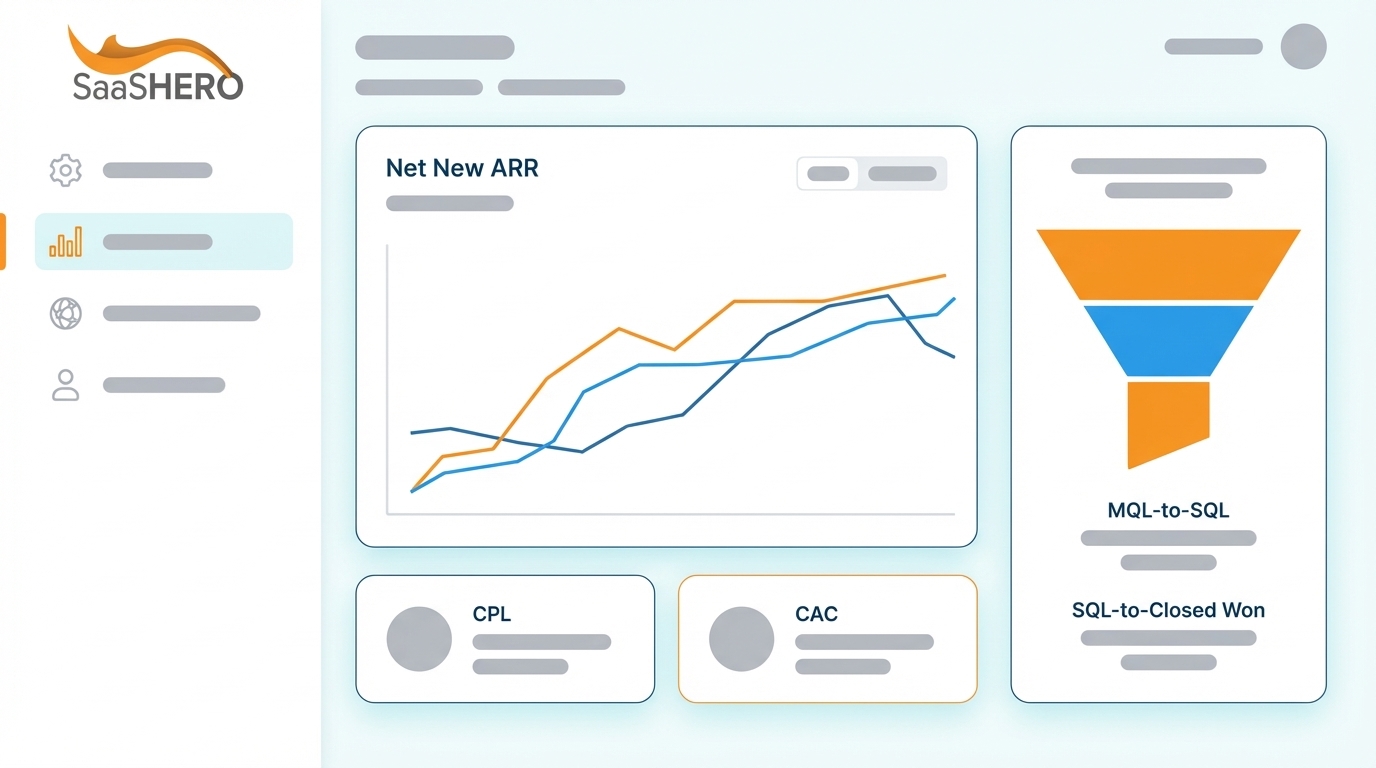
An effective B2B SaaS executive dashboard tracks 5–7 metrics per audience layer and keeps the focus on revenue. Research on decision-making from the Nielsen Norman Group indicates that cognitive overload occurs beyond 7±2 chunks of information, so many SaaS design guidelines recommend 5–7 core metrics per dashboard for a single audience. The seven metrics below form a closed loop: the first three measure lead generation efficiency, the middle two measure revenue quality, and the final two measure speed, so together they connect every ad dollar to Net New ARR without requiring the executive to leave the dashboard. The list is structured for weekly CMO and Head of Growth review.
- Marketing-Sourced Pipeline, qualified pipeline value attributed to marketing, reviewed weekly as the North Star metric
- MQL-to-SQL Conversion Rate by Channel, which separates channel quality from channel volume
- CPL and CAC by Segment, with SMB, Mid-Market, and Enterprise tracked independently against the 2026 benchmarks above
- CAC Payback Period, with a healthy range of 14–22 months for mid-market and faster performance for top-quartile enterprise teams
- Lead Velocity Rate (LVR), month-over-month growth in qualified leads as a 12–18 month revenue predictor
- Pipeline Velocity, dollars of expected revenue per day, segmented by rep and segment
- Speed-to-Lead P90, the 90th-percentile response time, which ensures SLA compliance is measured at the tail, not the average
Vanity metrics such as impressions or CTR belong only in Tier 3 channel dashboards where specialists can act on them daily, and they have no place in an executive view. Once the dashboard is scoped to these seven revenue-focused metrics, a weekly review with the CFO and Head of Sales shortens the time between metric breakage and intervention compared with monthly or quarterly reviews.
SaaS Hero builds board-ready dashboards in Looker Studio and HubSpot that surface all seven metrics above, connected directly to CRM closed-won data. Book a discovery call to get a dashboard template mapped to your segment benchmarks.
Frequently Asked Questions
What is the difference between CPL and CAC, and which should B2B SaaS teams prioritize?
CPL measures the cost of generating a single lead from a specific channel and functions as a channel-level efficiency metric. CAC measures the total sales and marketing investment required to close one new customer and functions as a business-level efficiency metric. B2B SaaS teams should track both, but CAC connects directly to board-level conversations about payback period and LTV. CPL acts as an input that helps diagnose why CAC rises or falls by channel. Teams that chase CPL in isolation often drive down lead costs while increasing CAC by attracting lower-quality leads that consume more sales resources to close.
Who owns performance-based lead generation metrics, marketing or revenue operations?
Ownership is shared but structured. Marketing owns CPL, MQL volume, LVR, and MQL-to-SQL conversion rate through the handoff stage. Revenue operations owns pipeline velocity, CAC, and CAC payback period because these metrics require CRM data that spans both marketing and sales. The executive dashboard usually sits with the Head of Growth or CMO and is reviewed jointly with the CRO or VP of Sales. Without a shared data layer, usually HubSpot or Salesforce connected to ad platforms via GCLID tracking, each team optimizes its own slice and the handoff between MQL and closed-won revenue remains a black box.
How long does it take to see meaningful data from a performance-based lead generation program?
Timeline depends on sales cycle length and traffic volume. For SMB motions with sub-$5,000 ACV and short cycles, statistically meaningful CPL and MQL-to-SQL data usually appears within 60–90 days. For mid-market motions with 3–6 month cycles, CAC and payback data require at least one full sales cycle, which means 90–180 days before closed-won attribution becomes reliable. LVR becomes readable within 30 days because it measures qualified lead growth, not closed revenue. Pipeline velocity becomes meaningful once there are at least 20–30 qualified opportunities in the funnel. Teams that judge performance-based programs on 30-day revenue outcomes for enterprise motions will consistently draw incorrect conclusions.
What is a realistic MQL-to-SQL conversion rate benchmark for B2B SaaS in 2026?
MQL-to-SQL conversion rates vary significantly by lead source, speed of follow-up, and how tightly teams define MQL criteria. Teams with a strict MQL definition and a sub-one-hour follow-up SLA reach conversion rates in the 40–53% range. Teams with loose MQL criteria and slow follow-up often see rates below 20%. Response speed usually matters most, because following up within one hour versus waiting 24 hours can create a gap between a 53% and a 17% conversion rate on the same lead volume. Segment also matters, since enterprise MQLs carry higher disqualification rates because buying committees are larger and evaluation cycles are longer.
How does SaaS Hero connect paid ad spend to Net New ARR?
SaaS Hero implements end-to-end tracking that passes the Google Click ID (GCLID) from the ad click through the landing page form and into the CRM, either HubSpot or Salesforce. This setup allows campaign optimization based on closed-won revenue instead of form fills. Every client receives a Looker Studio dashboard that surfaces Net New ARR, SQL volume, CAC by channel, and CAC payback period, updated in near real-time. Reporting stays anchored to revenue outcomes, not impressions or CTR, so the agency’s performance is evaluated on the same metrics the board uses to evaluate the business.
Conclusion
For B2B SaaS teams at $5M–$50M ARR, the seven metrics in this article, CPL, CAC, MQL-to-SQL conversion rate, LVR, LTV:CAC, CAC payback period, and pipeline velocity, form the minimum viable performance framework for connecting ad spend to Net New ARR. Earlier-stage SMB teams should prioritize CPL, MQL-to-SQL rate, and speed-to-lead SLA first, because these levers move fastest and provide the shortest feedback loops. Mid-market and enterprise teams should layer in pipeline velocity and CAC payback as the primary board-level efficiency signals, benchmarking against the segment-specific 2026 figures in the table above instead of blended industry averages.
The executive dashboard template in Section 6 is designed for immediate implementation, with seven metrics, one weekly 30-minute review, and a direct line from lead generation activity to CAC payback and ARR. Teams that instrument this framework stop reporting on what happened and start predicting what will happen. Book a discovery call with SaaS Hero to build a revenue-first dashboard that ties your paid media directly to Net New ARR.