





Written by: Aaron Rovner, Founder, Saas Hero | Last updated: August 6, 2026
Key Takeaways for B2B Tech Founders
- Selecting a lead generation agency protects CAC payback and Net New ARR for Series A–B B2B tech founders.
- A 3-stage decision model (filter, score, validate) removes agencies that lack B2B SaaS focus and revenue attribution.
- Twelve criteria, including flat-fee pricing, month-to-month contracts, and account load limits, protect capital efficiency.
- Structured 60–90-day pilots with clear SQL, CAC payback, and Net New ARR thresholds reduce risk before scaling spend.
- Apply this checklist with a SaaSHero strategist in a working session.
Executive Summary: 12 Criteria and a 3-Stage Decision Model
This checklist organizes agency selection into a simple 3-stage decision model.
- Stage 1 – Filter: Remove agencies that lack B2B SaaS specialization or cannot prove closed-loop revenue attribution.
- Stage 2 – Score: Compare contract flexibility, account-load limits, and fee structure using the weighted scorecard.
- Stage 3 – Validate: Run a 60–90-day pilot with explicit SQL, CAC payback, and Net New ARR targets before scaling budget.
The 12 criteria in this model are:
- Vertical specialization in B2B SaaS
- Revenue attribution capability (CRM-connected)
- Flat-fee or spend-band pricing
- Month-to-month contract terms
- Senior account manager load (max 8–10 clients)
- SQL-to-opportunity conversion reporting
- CAC payback period tracking
- Net New ARR as a north-star metric
- Transparent onboarding and setup fees
- Embedded communication model (Slack/real-time)
- CRO and landing page capability included
- Pilot exit criteria defined in writing before launch
Criterion 1: Vertical Specialization in B2B SaaS
Specialized B2B SaaS agencies understand churn, MRR, demo funnels, and multi-stakeholder buying cycles. Generalist agencies reuse e-commerce and local services playbooks and miss these nuances. An agency that cannot define “SQL” without prompting will misalign targeting from day one.
Use this diagnostic prompt: Name three B2B SaaS verticals you managed in the last 12 months and the ARR outcomes achieved.
SaaSHero operates exclusively in B2B SaaS and technology, across HR Tech, Cybersecurity, Transportation, and Marketing Tech. This focus removes the cognitive switching cost that weakens generalist performance.
Criterion 2: Revenue Attribution Capability
Effective attribution in 2026 connects ad click identifiers (such as GCLID) through the landing page into CRM opportunities and closed-won revenue. Agencies that rely on Google Analytics last-click defaults undervalue top-of-funnel demand and over-credit brand search. That pattern hides weak incremental pipeline creation.
Use this diagnostic prompt: Show a report that ties a specific campaign to closed-won ARR in HubSpot or Salesforce.
SaaSHero’s reporting anchors to Net New ARR, pipeline value, and SQLs, not impressions or CTR. Looker Studio and CRM integrations provide a clear view of full-funnel impact.
Criterion 3: Flat-Fee or Spend-Band Pricing
Pricing that takes a percentage of ad spend (often 10–20%) rewards higher budgets regardless of efficiency. This model gives agencies a clear incentive to spend as much money as possible, which erodes ROAS and stretches CAC payback.
Use this diagnostic prompt: Does your fee increase if I increase spend by $5,000 within the same spend band?
SaaSHero uses fixed monthly retainers tiered by spend band. A move from $12k to $15k within the $10k–$25k band does not change the fee, so budget recommendations stay grounded in performance data.
Criterion 4: Month-to-Month Contract Terms
Month-to-month contracts keep performance risk balanced between client and agency. A 12-month lock-in transfers that risk entirely to the client. An agency that knows it cannot be dismissed for 12 months loses urgency to deliver immediate results, which many founders describe as “the kiss of death” for the relationship.
Use this diagnostic prompt: What is the minimum notice period to exit this engagement?
SaaSHero works on month-to-month agreements, so the team must re-earn the engagement every 30 days. This structure ties agency survival directly to client revenue outcomes.
Criterion 5: Senior Account Manager Load (Max 8–10 Clients)
Account performance depends on the person who runs it each week. Many agencies sell with senior strategists, then hand accounts to junior managers carrying 30 or more clients. At that load, no account receives real strategic attention. SaaSHero caps senior manager loads at 8–10 clients to prevent burnout and neglect.
Use this diagnostic prompt: Who will manage my account day-to-day, and how many other accounts do they manage right now?
Criterion 6: SQL-to-Opportunity Conversion Reporting
Lead volume only matters when paired with conversion quality. An agency that delivers 200 leads at 2% SQL-to-opportunity conversion underperforms one that delivers 50 leads at 25%. Reporting should include SQL definition, SQL volume, and conversion rate to pipeline.
Use this diagnostic prompt: How do you define an SQL, and how do you track its progression to a sales opportunity in the CRM?
Criterion 7: CAC Payback Period Tracking
CAC payback period, measured in days to recover acquisition cost from gross margin, determines whether growth creates or consumes cash. SaaSHero achieved an 80-day CAC payback period for TestGorilla, which helped support a $70M Series A by proving strong unit economics.
Use this diagnostic prompt: Show a client example where you tracked and improved CAC payback period over a 90-day engagement.
Criterion 8: Net New ARR as North-Star Metric
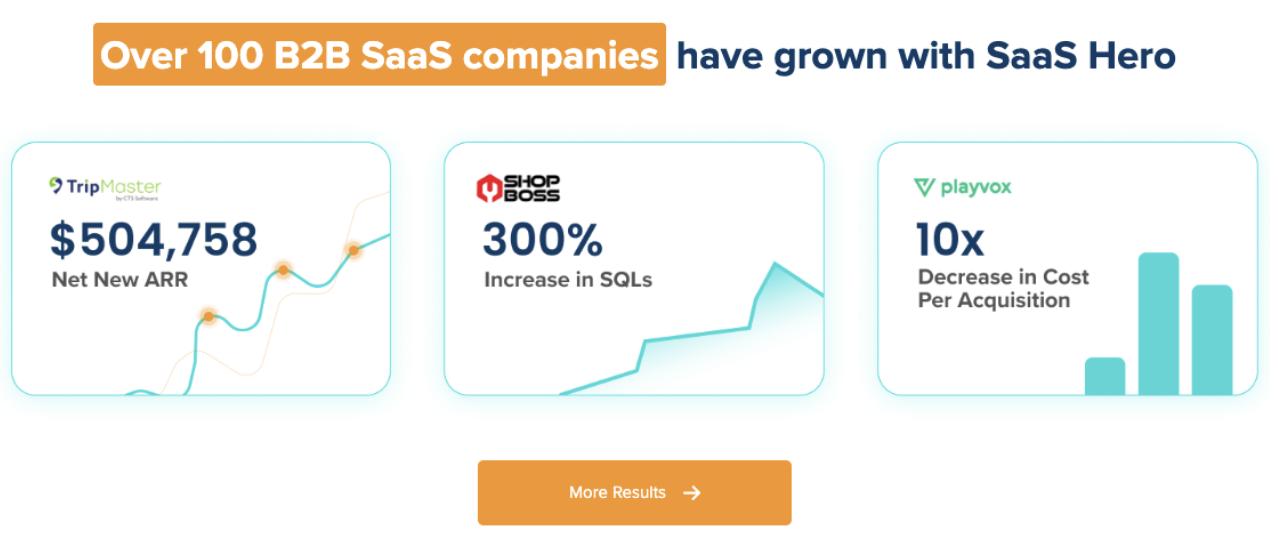
Net New ARR is the outcome that appears on your P&L, while pipeline value remains a leading indicator. Agencies that stop at pipeline reporting stay one step removed from revenue accountability. SaaSHero added $504,758 in Net New ARR for TripMaster in 12 months, which at a 5x SaaS valuation multiple represents more than $2.5M in enterprise value.

Use this diagnostic prompt: What Net New ARR did you generate for your last three B2B SaaS clients?
Criterion 9: Transparent Onboarding and Setup Fees
Clear fee structures protect your runway. Hidden setup fees, creative surcharges, and platform costs inflate the real price of an engagement. SaaSHero publishes a one-time setup fee of $1,000–$2,000 that covers audit, tracking configuration, and strategy build. Landing page design sits at a flat $750, and five ad creative assets cost $300, with every cost disclosed before signature.
Use this diagnostic prompt: Provide a complete fee schedule, including setup, creative, platform, and reporting costs.
Criterion 10: Embedded Communication Model
Real-time communication keeps campaigns responsive. Monthly PDF reports do not qualify as a communication model. B2B SaaS campaigns need fast adjustments to budget pacing, bid strategies, and landing pages.
SaaSHero integrates into client communication via dedicated Slack or Google Chat channels, with weekly performance updates and bi-weekly strategy calls.
Use this diagnostic prompt: What is your standard communication cadence, and how do you handle urgent campaign issues outside scheduled calls?
Criterion 11: CRO and Landing Page Capability Included
Conversion rate work must sit inside the engagement, not as an add-on. Sending qualified traffic to weak landing pages wastes budget. SaaSHero includes heuristic analysis and landing page design within its service model, applying a structured 7-principle usability review before scaling media spend.

Use this diagnostic prompt: Is landing page testing and CRO included in the retainer or billed separately?
Criterion 12: Pilot Exit Criteria Defined in Writing
Clear pilot exit criteria protect you from open-ended retainers. A pilot without pre-agreed success metrics behaves like a standard retainer with extra steps. Exit criteria should document minimum SQL volume, CAC payback thresholds, and Net New ARR contribution expected by day 90.
Use this diagnostic prompt: What specific metrics, at what thresholds, would you recommend as exit triggers at the 90-day mark?
Weighted Scorecard: Comparing Traditional Agencies and SaaSHero
This scorecard assigns weights to each criterion based on impact on Net New ARR and capital efficiency. Traditional Agency reflects percentage-of-spend, long-contract, junior-led models. SaaSHero Benchmark reflects flat-fee, month-to-month, senior-led models as documented in SaaSHero’s operational model. Scores use a qualitative 1–5 scale derived from each model’s structure, not audited financials.
| Criterion | Weight | Traditional Agency Score (1–5) | SaaSHero Benchmark Score (1–5) |
|---|---|---|---|
| Vertical specialization in B2B SaaS | 15% | 2 | 5 |
| Revenue attribution (CRM-connected) | 15% | 2 | 5 |
| Flat-fee or spend-band pricing | 12% | 1 | 5 |
| Month-to-month contract terms | 12% | 1 | 5 |
| Senior account manager load ≤10 clients | 10% | 2 | 5 |
| SQL-to-opportunity conversion reporting | 10% | 2 | 5 |
| CAC payback period tracking | 8% | 1 | 5 |
| Net New ARR as north-star metric | 8% | 1 | 5 |
| Transparent setup and ancillary fees | 5% | 2 | 5 |
| Embedded real-time communication | 5% | 2 | 5 |
| CRO and landing page capability included | 5% | 2 | 5 |
| Pilot exit criteria defined in writing | 5% | 1 | 5 |
Score your agency against this framework in a strategy session with SaaSHero.
Red Flags to Watch During Agency Evaluation
These patterns signal structural risk. Each one pairs with a direct diagnostic prompt you can use in conversations.
- Vanity metric reporting (impressions, CTR, clicks). Diagnostic: Show the last client report you sent. What is the primary metric on page one?
- 12-month lock-in contracts. Diagnostic: What is the earliest exit date if performance targets are not met in the first 90 days?
- Percentage-of-spend billing. Diagnostic: Does your fee increase if my ad spend increases by $10,000?
- Junior account handoff after the sale. Diagnostic: Will the person who presented this proposal manage my account? If not, who will, and what is their current client load?
- No CRM integration in reporting. Diagnostic: Can you pull a report showing which specific campaigns generated closed-won revenue in the last quarter?
- Undefined pilot success criteria. Diagnostic: What metrics, at what thresholds, would you use to recommend ending this engagement at 90 days?
60–90-Day Pilot Template for Revenue Validation
A structured pilot removes ambiguity and protects capital. Use this template to define inputs, milestones, and exit criteria for a revenue-validated pilot.
| Metric | Definition | Minimum Threshold (Day 90) | Measurement Source |
|---|---|---|---|
| SQL-to-Opportunity Conversion Rate | Percentage of SQLs that progress to a sales opportunity in the CRM | ≥20% (benchmark: the TripMaster engagement detailed earlier) | CRM (HubSpot / Salesforce) |
| CAC Payback Period | Days from first ad impression to gross margin recovery of acquisition cost | ≤120 days for Series A–B SaaS (benchmark: the TestGorilla result cited earlier) | CRM + Finance |
| Net New ARR Contribution | Closed-won ARR from new logos sourced by paid campaigns in the pilot period | ≥3x retainer cost in attributed pipeline; ≥1x in closed ARR | CRM closed-won stage |
| Cost Per SQL | Total ad spend plus retainer fee divided by number of SQLs generated | Declining month-over-month by ≥10% | Ad platform + CRM |
Pilot steps in sequence:
- Week 1–2: Audit the existing account, configure CRM-to-ad-platform tracking, and define SQL criteria in writing with the sales team.
- Week 3–4: Launch campaigns with dedicated landing pages and establish baseline CPL and SQL volume.
- Day 30: Run the first performance review against SQL-to-opportunity conversion rate and adjust targeting or creative if results sit below threshold.
- Day 60: Review CAC payback projections. If the trajectory does not support a ≤120-day payback, restructure the channel mix.
- Day 90: Complete a full pilot debrief against all four metrics and decide whether to continue, scale, or exit based on the pre-agreed thresholds.
Frequently Asked Questions
What contract length should a B2B SaaS startup require from a lead generation agency in 2026?
Month-to-month terms align agency incentives with startup performance needs. Long-term contracts create the risk described in Criterion 4: guaranteed agency revenue regardless of results, which removes urgency. Month-to-month agreements force the agency to re-earn the engagement every 30 days. Some agencies offer a modest discount, often around 20%, for a 6-month prepay. That structure works only after a pilot validates performance and should not serve as the starting point for a new relationship.
How many clients should a senior account manager at a B2B SaaS agency handle?
A senior account manager handling more than 10 active clients cannot provide the strategic depth that B2B SaaS campaigns need. At 20–30 clients, which many high-volume agencies accept, accounts receive reactive maintenance instead of proactive improvement. The threshold mentioned in Criterion 5 represents the limit at which a manager can run weekly performance reviews, join bi-weekly strategy calls, and still respond to real-time campaign events. During evaluation, ask for the current client count of the specific manager who will own your account.
What attribution setup is required before a lead generation agency can report on Net New ARR?
Closed-loop revenue attribution depends on three connected layers. First, ad platform click identifiers, such as Google’s GCLID, must pass through to the landing page and into the CRM contact record at form submission. Second, the CRM must associate that contact’s opportunity and closed-won deal back to the originating campaign. Third, reporting should pull from the CRM’s closed-won stage, not from ad platform conversion events that only track form fills and cannot separate qualified from unqualified leads. Agencies that cannot explain this setup in technical detail before onboarding are not ready for Net New ARR reporting.
What metrics should trigger an exit from a 90-day pilot?
Three conditions justify an early exit from a pilot. SQL-to-opportunity conversion rate falls below 15% at day 60 with no improving trend. CAC payback period projects beyond 180 days based on closed-won data at day 60. Cost Per SQL rises month-over-month instead of declining. A single weak metric may reflect a learning phase. Two or more weak metrics, without a credible remediation plan, signal a structural mismatch between the agency’s approach and your ICP or sales motion. Exit criteria should be documented and agreed upon before launch, not debated after underperformance appears.
How does the flat-fee model protect capital efficiency compared to percentage-of-spend billing?
Flat-fee or spend-band pricing removes the conflict of interest created by percentage-of-spend billing. In a percentage model, every budget increase raises agency revenue whether or not ROAS or CAC improves. In a flat-band model, the fee stays fixed within a spend range, so a recommendation to move from $12,000 to $18,000 per month reflects campaign data, not revenue motives. For a Series A startup spending $25,000 per month on ads, the gap between a 15% percentage-of-spend fee and a flat-band retainer can reach $18,000 or more per year, which flows directly into better CAC payback.
Conclusion: Using This Checklist to Protect Net New ARR
The 3-stage model of filtering, scoring, and validating provides a structured way to protect Net New ARR in a 2026 environment where every ad dollar must stand up to board scrutiny. Agencies that miss any of the 12 criteria introduce structural risk, such as misaligned incentives, vanity metric reporting, or disappearing senior talent after the sales call. The weighted scorecard and pilot template make those risks visible before you sign a contract, not after a quarter of budget has disappeared.
Apply this 12-point checklist to your current or future agency in a free discovery call with SaaSHero, led by a senior strategist who manages fewer than 10 accounts and reports directly on Net New ARR.