




Written by: Aaron Rovner, Founder, Saas Hero | Last updated: July 3, 2026
Key Takeaways for SaaS Leaders Under Capital Pressure
- 2026 capital-efficiency pressure pushes $1M–$20M ARR SaaS companies to review agency pricing models that reward spend inflation instead of revenue outcomes.
- Flat-retainer structures with clear spend bands create strong incentive alignment by removing the agency’s financial motivation to increase budgets.
- Percentage-of-spend, auto-renewal, and minimum-spend contracts create structural misalignments that threaten CAC payback and Net New ARR targets.
- Closed-loop GCLID-to-CRM attribution is now a non-negotiable requirement for any agency claiming revenue-based performance.
- Schedule a benchmark call to evaluate your current agency model against 2026 capital-efficiency standards and identify the right flat-retainer structure for your stage.
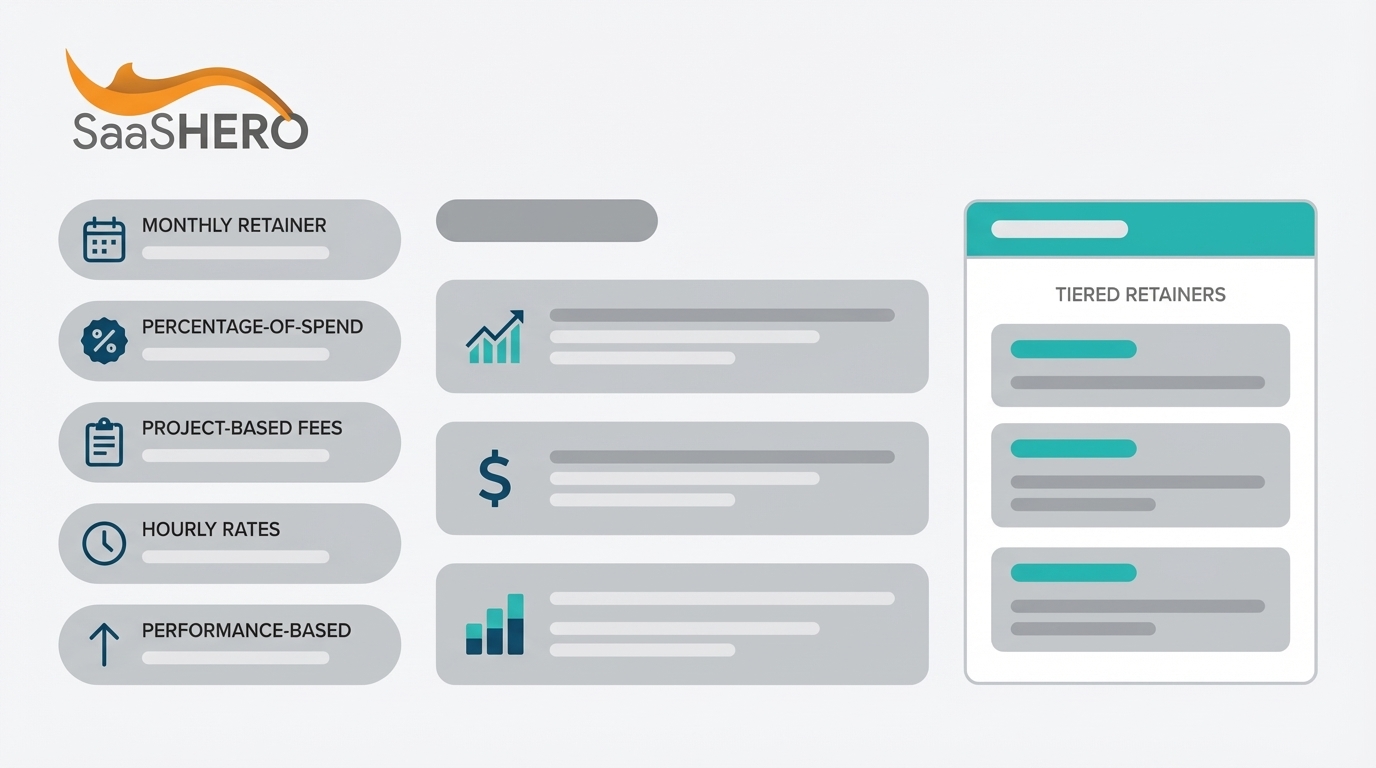
Six Common Agency Pricing Models for B2B SaaS
Percentage-of-Spend: The agency charges 10–20% of total monthly ad spend. The fee scales with budget size, not performance outcomes. A $50k/month spend generates $5k–$10k in agency fees even if no SQL ever closes.
Flat Retainer: A fixed monthly fee, often tiered by spend band or service scope. The fee does not change when spend increases within a band. This structure removes the financial incentive to inflate budgets.
Hybrid: A base retainer combines with a percentage-of-spend or performance bonus layer. This approach reduces pure spend-inflation risk but keeps partial misalignment, depending on how the variable component works.
Performance-Based: Fees tie to a defined output, such as cost per lead, cost per SQL, or a percentage of attributed revenue. Alignment looks strong on paper. Execution becomes difficult without airtight attribution from GCLID to CRM close.
Project-Based: A fixed fee covers a defined deliverable, such as a campaign build, landing page audit, or channel launch. The model creates no ongoing management incentive and fits discrete initiatives, not continuous pipeline generation.
Equity: The agency takes a stake in the company instead of or in addition to cash fees. This model is rare and high-commitment. Agencies typically reserve it for very early-stage companies where cash is tight and conviction is high.
Model Comparison: Incentive Alignment and SaaS Outcome Linkage
The table below compares each model across five dimensions that matter for SaaS unit economics. Incentive alignment scores from 1 to 5 show how closely the agency’s financial interest matches your Net New ARR objective. All cost ranges are illustrative for a company running $10k–$50k in monthly ad spend.
| Model | Typical Monthly Cost ($10k–$50k Ad Spend) | Incentive Alignment (1–5) | Contract Length Risk | SaaS Outcome Linkage |
|---|---|---|---|---|
| Percentage-of-Spend | $1,000–$7,500 (10–15% of spend) | 1 | High, fee rises with spend, not results | None, focuses on spend volume, not ARR |
| Flat Retainer (SaaSHero) | $1,250–$4,750/mo (Dedicated Manager) or $2,500–$6,000/mo (Full Team), month-to-month | 5 | Low, month-to-month available | Direct, fixed fee within spend bands, budget recommendations driven by data, not fee growth |
| Hybrid | $1,500–$6,000 (base + variable) | 3 | Medium, variable layer retains partial misalignment | Partial, depends on how the variable component is defined |
| Performance-Based | Highly variable, $0–$10,000+ depending on lead volume | 4 | Low to medium | High in theory, requires closed-loop attribution to function correctly |
| Project-Based | $2,000–$15,000 per project | 2 | Low, no ongoing commitment | Minimal, no continuous optimization loop |
| Equity | Reduced cash fee, equity stake negotiated | 4 | High, equity is illiquid and long-term | High alignment but illiquid, rarely practical above Seed stage |
SaaSHero Dedicated Campaign Manager Pricing (Monthly Retainer) serves founder-led teams or pilot programs:

| Monthly Ad Spend | 1 Channel (Month-to-Month) | 1 Channel (6-Mo Prepay) | 2 Channels (Month-to-Month) | 3+ Channels (Month-to-Month) |
|---|---|---|---|---|
| Up to $10k | $1,250 | $1,000 | $2,500 | $3,750 |
| $10k–$25k | $1,750 | $1,400 | $3,000 | $4,250 |
| $25k–$50k | $2,250 | $1,800 | $3,500 | $4,750 |
| $50k+ | $3,250 | $2,600 | $4,500 | $5,750 |
SaaSHero Full Marketing Team Pricing (Monthly Retainer) supports scale-ups that need strategy and execution:
| Monthly Ad Spend | 1 Channel (Month-to-Month) | 1 Channel (6-Mo Prepay) | 2 Channels (Month-to-Month) | 3+ Channels (Month-to-Month) |
|---|---|---|---|---|
| Up to $10k | $2,500 | $2,000 | $3,750 | $5,000 |
| $10k–$25k | $3,000 | $2,400 | $4,250 | $5,500 |
| $25k–$50k | $3,500 | $2,800 | $4,750 | $6,000 |
| $50k+ | $4,500 | $3,600 | $5,750 | $7,000 |
Pricing Recommendations by SaaS Stage
| Stage | ARR Range | Recommended Model | Monthly Budget Band | Primary Success Metric |
|---|---|---|---|---|
| Seed | $0–$1M | Flat Retainer (Dedicated Manager) or Project-Based | $5k–$15k ad spend | CAC payback period |
| Series A | $1M–$5M | Flat Retainer (Dedicated Manager or Full Team) | $10k–$30k ad spend | Net New ARR per channel |
| Series B | $5M–$20M | Flat Retainer (Full Team, multi-channel) | $25k–$75k ad spend | Pipeline value and SQL-to-close rate |
| Growth/Enterprise | $20M+ | Hybrid or embedded team model | $75k+ ad spend | Net New ARR and LTV:CAC ratio |
Contract Structures: Five Red Flags to Avoid
1. Auto-Renewal Clauses: Contracts that renew automatically without affirmative consent lock clients into another full term before underperformance becomes visible. By the time renewal triggers, the exit window has already closed.
2. 90-Day Notice Requirements: A 90-day termination notice extends a poor engagement by a full quarter. During that period, the agency has no financial incentive to improve performance.
3. Percentage-of-Spend Escalators: Clauses that increase the percentage fee as spend scales mean the agency earns more simply by recommending budget increases. These increases can occur even when revenue does not grow proportionally.
4. Minimum-Spend Commitments: Contractual floors on ad spend transfer budget risk entirely to the client. This structure prevents the revenue leader from pulling back during underperforming periods without triggering a financial penalty, so the agency still gets paid for the minimum commitment regardless of results.
5. Junior-Team Handoff Language: Vague language about “account management” or “team support” without naming seniority levels enables a bait-and-switch. Senior strategists close the deal, while junior generalists run the account.
Attribution and Reporting Requirements for Revenue Alignment
Any agency model that claims revenue alignment must prove it through a closed-loop attribution stack. The minimum viable reporting infrastructure for a $1M–$20M ARR SaaS company includes the following elements.

Required Integrations: Start with GCLID passed through landing page forms into HubSpot or Salesforce, which creates the link between ad clicks and CRM records. Add the LinkedIn Insight Tag on all conversion pages to capture LinkedIn-sourced conversions that do not pass GCLID. Standardize UTM parameters across all paid channels so non-Google sources stay trackable. Finally, map CRM opportunity stage to ad source at the deal level to track pipeline progression by channel, not just initial lead source.
Three North-Star Metrics:
Net New ARR: Closed-won revenue attributable to paid channels within a defined period. This metric directly validates agency spend against business outcomes.
Pipeline Value: Total open opportunity value sourced from paid channels, segmented by stage. This value provides a leading indicator of future ARR before deals close.
SQL-to-Close Rate: The percentage of Sales Qualified Leads that convert to closed-won revenue. A declining rate signals either lead quality degradation or a sales process issue, and both require agency-level visibility to diagnose correctly.
Get a free attribution audit to identify gaps in your current reporting stack before your next budget cycle.
Buyer-Archetype Scenarios for Common SaaS Situations
The Overwhelmed Founder: A SaaS founder at $800k ARR runs Google Ads on weekends. The founder has no time to improve campaigns and feels nervous about a $5k retainer on a 12-month contract that equals 7.5% of annual revenue. Start with the entry-level Dedicated Manager tier on a month-to-month basis to remove both financial and contractual risk. The founder offloads execution while keeping strategic oversight, and the flat fee keeps every budget recommendation data-driven instead of fee-driven.
The Frustrated VP of Marketing: A VP at a Series B company spending $50k/month receives monthly PDF reports showing impressions and CTR while the CEO demands pipeline and CAC data. The current agency earns $7,500/month on a 15% percentage-of-spend model with no CRM integration. Switch to the Full Marketing Team tier to replace vanity metrics with Net New ARR reporting, reduce monthly fees, and remove the structural incentive to inflate spend.
The Post-Funding Scaler: A marketing lead at a freshly funded Series A company has $30k/month to deploy and aggressive Q1 growth targets. Hiring an in-house team would take three months. Deploy a Full Marketing Team immediately to activate campaigns across channels with closed-loop attribution configured from day one, drawing on the rapid payback periods documented in SaaSHero’s case studies.
Seven-Question Buyer Evaluation Checklist
Use the following questions as a single framework when you evaluate any B2B marketing agency against the comparison table above. Together, they cover pricing, contracts, attribution, accountability, and fit.
1. Does the agency’s fee structure stay fixed when ad spend increases within a defined band, or does it scale with every additional dollar?
2. Is the contract truly month-to-month, or does it include auto-renewal, minimum-spend commitments, or 90-day notice requirements?
3. Can the agency demonstrate closed-loop attribution from GCLID to CRM opportunity at the deal level, not just the lead level?
4. Are North-Star metrics defined as Net New ARR and pipeline value, or as impressions, clicks, and CTR?
5. Who will manage the account day-to-day, and what is that person’s client-to-manager ratio?
6. Does the agency have documented case studies in your SaaS vertical with outcome metrics expressed in ARR, payback period, or LTV:CAC?
7. Is the agency willing to integrate into your Slack or project management environment, or do they communicate only through monthly reports?
Conclusion and Next Step
The pricing model an agency uses signals whose interests the agency is structurally designed to serve. Percentage-of-spend models reward budget inflation over revenue efficiency. Long-term lock-in contracts protect agency revenue at the expense of client accountability. Vanity metric reporting hides the CAC and payback period data that boards and investors require.
A tiered flat-retainer structure with month-to-month terms, spend-band pricing, and closed-loop GCLID-to-CRM attribution removes each of those misalignments. SaaSHero’s documented outcomes — $504,758 in Net New ARR for TripMaster, an 80-day payback period for TestGorilla, and a 10x reduction in CPL for Playvox come from that structural alignment.

For $1M–$20M ARR SaaS companies operating under 2026 capital-efficiency pressure, the evaluation framework stays simple. Choose a model that fixes fees within spend bands, requires closed-loop attribution, and earns renewal every 30 days. That model ties agency survival directly to your Net New ARR.
Frequently Asked Questions
These five questions address the most common concerns SaaS buyers raise when comparing agency pricing models and contract structures.
What is the main difference between a percentage-of-spend model and a flat retainer for SaaS companies?
A percentage-of-spend model charges a fee equal to 10–20% of total monthly ad spend. Under this model, the agency’s income rises automatically with every budget increase, creating a structural incentive to recommend higher spend regardless of performance. A flat retainer fixes the fee within a defined spend band, so the agency’s income does not change when spend moves from $12k to $18k within the same tier. For SaaS companies focused on CAC and payback period, this distinction determines whether budget recommendations follow data or self-interest. SaaSHero’s tiered flat-retainer model removes that conflict.
How should a SaaS company at Series A evaluate agency contract terms?
At Series A, a company typically deploys $10k–$30k per month in paid media and faces investor-level scrutiny on CAC and payback period. The highest-risk contract terms at this stage include auto-renewal clauses, 90-day notice requirements, and minimum-spend commitments. These terms transfer risk to the client and reduce the agency’s accountability for performance. A month-to-month flat retainer, such as SaaSHero’s Dedicated Campaign Manager or Full Marketing Team tiers, fits this stage because it forces the agency to re-earn the relationship every 30 days. This structure creates a direct forcing function for performance that long-term lock-in contracts remove.
What attribution infrastructure is required to measure Net New ARR from paid channels?
Measuring Net New ARR from paid channels requires passing the Google Click ID (GCLID) from the ad click through the landing page form submission and into the CRM, such as HubSpot or Salesforce, so closed-won opportunities can be traced back to their originating ad. Without this connection, the agency can only report on leads or conversions at the platform level, which does not reflect actual revenue. The three metrics that matter at the board level are Net New ARR attributed to paid channels, total pipeline value sourced from paid media, and SQL-to-close rate by channel. SaaSHero configures this attribution stack during onboarding, which is why its case study outcomes appear in ARR and payback period rather than impressions or CTR.
Is a performance-based agency pricing model better than a flat retainer for SaaS?
Performance-based models create strong theoretical alignment because the agency earns more when the client generates more qualified pipeline. In practice, they become difficult to execute correctly without airtight GCLID-to-CRM attribution, agreed SQL definitions, and a clear method for attributing multi-touch deals. When attribution remains incomplete, performance models create disputes over credit and can push agencies to favor easily attributable conversions instead of high-quality pipeline. A flat retainer with mandatory closed-loop attribution reporting achieves similar alignment without constant attribution disputes, because the agency’s continued engagement depends on demonstrable revenue outcomes rather than a contractual formula.
How does SaaSHero’s pricing compare to hiring an in-house paid media team?
A single mid-level in-house paid media manager in the United States typically costs $70k–$100k per year in base salary, plus benefits, recruiting fees, and 60–90 days of onboarding time. SaaSHero’s Full Marketing Team tier starts at $2,500 per month for up to $10k in ad spend and scales to $4,500 per month for $50k+ in spend. This structure provides a senior-led team with B2B SaaS vertical expertise, CRO capabilities, and attribution infrastructure at a fraction of the fully loaded cost of a single hire. For companies between $1M and $10M ARR that cannot yet justify a full in-house growth team, this approach delivers immediate access to specialized execution without the fixed overhead of headcount.