




Written by: Aaron Rovner, Founder, Saas Hero
Key Takeaways
- Use a 7-step framework that prioritizes ICP clarity, high-intent channels, and competitor conquesting for capital-efficient B2B SaaS growth.
- Allocate about 70% of budget to high-ROI channels such as Google Search at 40% and LinkedIn Ads at 30% to capture in-market prospects.
- Run competitor conquesting by targeting pricing queries, complaints, and comparisons with tailored pages and clear switching incentives.
- Improve landing pages with problem-agitate-solve messaging and heuristic principles so conversion rates rise before you scale traffic.
- Target payback periods under 90 days with SaaSHero’s flat-fee model, and schedule a discovery call for a revenue audit.
7-Step Framework For Capital-Efficient SaaS Growth
The 7-step efficient B2B SaaS marketing framework builds a strong foundation before heavy execution.
- Step 1: Define precise ICP and messaging
- Step 2: Validate value proposition with a 5-second test
- Step 3: Focus on high-intent channels
- Step 4: Deploy a competitor conquesting engine
- Step 5: Improve landing pages and conversion rates
- Step 6: Implement automation and KPI tracking
- Step 7: Establish revenue attribution systems
Core success metrics include Net New ARR, payback periods under 90 days, and Sales Qualified Leads over Marketing Qualified Leads. This mental model keeps every marketing dollar tied to revenue growth instead of surface-level engagement metrics.
Step 1: Define Your ICP And Core Messaging
Precise Ideal Customer Profile definition creates the base for efficient marketing. Broad targeting burns budget on prospects who will never become paying customers.
Build detailed buyer personas that cover company size, industry, specific pain points, and budget authority. For example, an HR Tech company can target HR Directors at 100 to 500 employee companies that face compliance challenges and control at least $50,000 in annual budget.
| Company Size | Industry | Primary Pain | Budget Range |
|---|---|---|---|
| 100-500 employees | HR Tech | Compliance tracking | $50k-$200k |
| 50-200 employees | Cybersecurity | Threat detection | $25k-$100k |
| 200-1000 employees | Marketing Tech | Attribution gaps | $100k-$500k |
Write messaging that speaks to emotional triggers before listing rational benefits. Emphasize the cost of inaction instead of long feature lists. Validate your message through customer interviews and win-loss analysis so you know it matches how the market thinks and buys.
Step 2: Sharpen Value Messaging With A 5-Second Test
The 5-second test confirms that prospects instantly understand your value proposition. Visitors should grasp your solution, target audience, and main benefit within five seconds of landing on your site.
Use the problem-agitate-solve structure for your core message. State the specific problem your ICP faces, highlight the consequences of ignoring it, then present your product as the clear solution. Keep feature-heavy copy in check because it often confuses instead of clarifying.
Run quick tests with target prospects through tools like UsabilityHub or simple user interviews. Capture first impressions and refine copy where comprehension breaks down. Emotional clarity creates initial interest, and rational proof then supports the final buying decision.
Step 3: Prioritize High-Intent Channels For Faster Revenue
Channel selection has more impact on efficiency than creative polish. Direct about 70% of budget to high-intent channels where prospects already search for solutions instead of broad awareness platforms.
A common B2B SaaS allocation uses 40% for search marketing, 30% for LinkedIn advertising, 20% for direct outreach, and 10% for content syndication. This mix reaches buyers at different stages while keeping acquisition costs under control.
| Channel | ROI Potential | Best Use Case | Budget Allocation |
|---|---|---|---|
| Google Search | High | Problem-aware prospects | 40% |
| LinkedIn Ads | Medium-High | Account-based targeting | 30% |
| Cold Email | Medium | Direct outreach | 20% |
| Content Syndication | Medium | Thought leadership | 10% |
Search marketing reaches buyers who already research solutions, while LinkedIn allows precise targeting by job title and company. Delay investment in low-intent channels like display ads or broad social media until core channels hit consistent profitability.
Step 4: Build A Competitor Conquesting Engine
Competitor conquesting focuses on prospects who already compare solutions, which creates the highest-intent traffic you can buy. These buyers understand the problem and actively weigh options, so conversion potential is strong.
Segment conquesting campaigns by search intent such as pricing queries, complaint searches, and comparison requests. Each intent type needs its own landing page angle and offer to reach strong conversion rates.
| Intent Type | Keywords | Landing Page Focus | Conversion Strategy |
|---|---|---|---|
| Pricing | [Competitor] cost, pricing | TCO comparison | Transparent pricing |
| Complaints | [Competitor] alternatives | Problem resolution | Switch incentives |
| Comparison | [Competitor] vs [Solution] | Feature matrix | Differentiation |
| Reviews | [Competitor] reviews | Social proof | Trust building |
Create dedicated comparison pages that address specific competitor gaps and highlight your strengths. Add negative keywords that filter out navigational searches so you avoid paying for users who only want a login page.

Step 5: Improve Landing Pages For Higher Conversion
Landing page conversion rates shape campaign profitability more than traffic volume. Use heuristic analysis to uncover conversion blockers before you invest in complex A/B tests.
Seven core heuristic principles guide this work: relevance, clarity, trust, friction, urgency, social proof, and visual hierarchy. Each element should support one primary conversion goal and avoid extra cognitive load.
Design hero sections with benefit-focused headlines, a sharp value proposition, and a clear call-to-action button. Place social proof such as customer logos and review badges above the fold so visitors feel safer taking the next step.
Keep mobile responsiveness tight because many B2B buyers start research on phones. Check that forms, buttons, and content render cleanly on all devices so you do not lose conversions to simple usability issues.

Step 6: Use Automation And KPIs To Scale What Works
Marketing automation supports efficient lead nurturing, and KPI tracking keeps budget focused on what performs. Use ICE scoring, which stands for Impact, Confidence, and Ease, to rank experiments and improvements.
AI-driven attribution tools reveal multi-touch journeys that last-click models ignore. This visibility supports smarter budget shifts and sharper campaign decisions.
| Tactic | Impact (1-10) | Confidence (1-10) | Ease (1-10) | ICE Score |
|---|---|---|---|---|
| Competitor campaigns | 9 | 8 | 7 | 8.0 |
| Landing page CRO | 8 | 9 | 6 | 7.7 |
| Email nurturing | 7 | 8 | 8 | 7.7 |
| LinkedIn targeting | 6 | 7 | 9 | 7.3 |
Apply automation to lead scoring, email sequences, and campaign tuning, while strategy and creativity stay human-led. Automation should raise efficiency and keep personalization intact.
Step 7: Tie Revenue Attribution To Real Deals
Revenue attribution links marketing activity to closed-won deals so you can optimize based on real business impact. Connect your CRM with marketing platforms to track the full customer journey.
Use Net New ARR as the main success metric and support it with pipeline value, Sales Qualified Leads, and customer acquisition cost. Together these metrics show how marketing contributes to revenue and profit.
Set up closed-loop reporting that passes lead source data through every sales stage. This approach lets you optimize for campaigns that create customers instead of campaigns that only create leads.
Review attribution data regularly to see which touchpoints drive conversions. Shift budget toward those activities and cut weak ones so every dollar works harder.
Why SaaSHero’s Model Solves Common Agency Pitfalls
Traditional marketing agencies often rely on percentage-of-spend billing, which rewards higher media budgets instead of efficiency. Long contracts protect average performance while junior staff run strategies sold by senior partners.
Vanity metrics such as impressions and clicks can hide weak revenue impact while agencies still collect fees. This structure encourages waste and blocks the capital efficiency that SaaS companies need.
SaaSHero counters these issues with flat monthly retainers, month-to-month agreements, and senior-led execution. This setup keeps recommendations focused on performance instead of fee growth.
| Spend Band | 1 Channel | 2 Channels | 3+ Channels |
|---|---|---|---|
| Up to $10k | $1,250 | $2,500 | $3,750 |
| $10k-$25k | $1,750 | $3,000 | $4,250 |
| $25k-$50k | $2,250 | $3,500 | $4,750 |
| $50k+ | $3,250 | $4,500 | $5,750 |
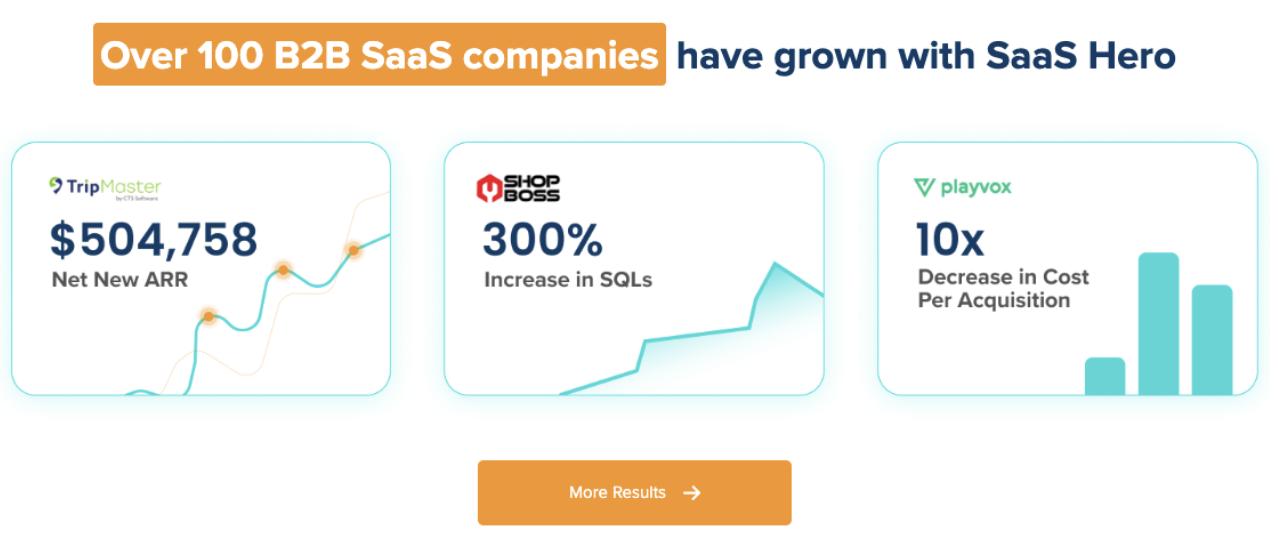
Case studies highlight this approach in practice. TripMaster added $504,758 in Net New ARR with an 80-day payback period, and TestGorilla secured $70M in Series A funding with strong unit economics. These outcomes come from revenue-first execution instead of vanity metric games.

Book a revenue audit to uncover fast wins and build a more efficient growth engine.
Common Pitfalls And Real-World Scenarios
Five recurring pitfalls often derail B2B SaaS marketing efficiency.
- Targeting broad keywords instead of high-intent search terms
- Ignoring dark funnel attribution that hides multi-touch journeys
- Chasing MQL volume instead of SQLs and closed-won revenue
- Skipping competitor conquesting opportunities
- Optimizing for vanity metrics instead of unit economics
The Overwhelmed Founder scenario appears in bootstrapped companies that need expert management without enterprise retainers. SaaSHero’s $1,250 entry point gives access to senior talent with month-to-month flexibility.
Frustrated VPs of Marketing often work with agencies that care more about spend than results. Flat-fee models remove spend incentives, and revenue attribution delivers board-ready numbers that defend marketing budgets.
Post-Funding Scalers need fast execution without long hiring cycles. Competitor conquesting and proven playbooks support rapid scaling while protecting the unit economics investors expect.
FAQ
What is the best B2B SaaS go-to-market template?
The most effective template starts with precise ICP definition using a four-column framework that covers company size, industry vertical, primary pain points, and budget authority. This structure supports targeted messaging and channel choices that raise conversion rates and lower acquisition costs. Lead with emotional pain points, then support them with rational benefits, and validate everything through customer interviews and win-loss analysis.
How do you create an efficient B2B SaaS sales strategy?
An efficient sales strategy connects marketing attribution with your CRM so you can track the full journey from first touch to closed-won. Use lead scoring based on engagement and fit, prioritize Sales Qualified Leads over Marketing Qualified Leads, and center reporting on Net New ARR instead of raw pipeline volume. Let automation handle scoring and follow-up while humans focus on relationships and strategic deals.
What are the biggest B2B SaaS marketing agency pitfalls?
Major pitfalls include percentage-of-spend billing that rewards waste, long contracts that protect weak performance, junior teams running work sold by senior leaders, and vanity metric reports that hide revenue impact. These issues block capital efficiency and often create tension instead of partnership.
Which marketing channels provide the best ROI for B2B SaaS?
High-intent channels usually deliver the strongest ROI. Google Search captures problem-aware buyers, LinkedIn supports precise targeting by job title and company, and competitor conquesting reaches prospects who already evaluate alternatives. Many teams allocate 40% to search, 30% to LinkedIn, and use the rest for direct outreach and content syndication instead of low-intent display ads.
How do you implement competitor conquesting for B2B SaaS?
Effective conquesting breaks campaigns into clear intent groups. Pricing queries work best with total cost of ownership comparison pages, complaint searches need problem-solution messaging, and comparison requests call for detailed feature breakdowns. Build dedicated landing pages for each intent type, add negative keywords to filter navigational searches, and highlight switching incentives such as free migration or contract buyouts.
Conclusion And Next Steps
This 7-step playbook gives you a clear structure for efficient B2B SaaS marketing that puts revenue ahead of vanity metrics. The approach centers on high-intent channels, competitor conquesting, and revenue attribution instead of surface engagement.
Roll out the playbook in sequence, starting with ICP clarity and then moving through channel focus, landing page improvements, automation, and attribution. Consistent execution matters more than chasing every new tactic.
Book a discovery call with SaaSHero to apply this playbook and work toward $500k or more in new ARR through efficient, revenue-first marketing.