




Written by: Aaron Rovner, Founder, Saas Hero | Last updated: September 2, 2026
Key Takeaways
- Most B2B SaaS companies miss ARR growth from targeted advertising because their agencies chase leads instead of revenue.
- A narrow ICP built on firmographic and buying-committee filters forms the base of every ARR-focused advertising program.
- Privacy-first targeting in 2026 relies on first-party CRM data, hashed email lists, and server-side conversion tracking instead of third-party cookies.
- Feeding CRM revenue data, including qualified opportunities and closed-won events, back into ad platforms as primary conversion signals separates revenue-based optimization from lead-based programs.
- Schedule a discovery call with SaaSHero to start engineering your paid acquisition funnel backward from a net-new ARR target.
Step 1: Define a Narrow ICP for Targeted Advertising
A narrow ICP anchors every decision in an ARR-focused advertising program. Without it, targeting, messaging, landing page copy, and bidding signals rest on guesswork. The firmographic and behavioral filters you need include:
- Industry and sub-vertical
- Company size and revenue band
- Tech stack (CRM, marketing automation, ABM platforms)
- Pain points tied to the buying trigger
- Buying committee titles: economic buyer, champion, technical evaluator, and influencers
Consider a B2B SaaS company selling workforce management software. It targets HR technology companies with 200–1,000 employees, $20M–$100M ARR, running Salesforce and Workday. The VP of HR owns the budget and the Head of IT holds technical veto. That profile creates a buildable audience. A broad label like “HR software buyers” does not.
SaaSHero captures ICP and positioning through a detailed onboarding document before building any campaign. Every keyword, audience, and landing page headline flows from that single source.
Step 2: Build Privacy-First Targeting Without Cookies
In 2026, the cookieless reality is the operating environment, not a future concern. Safari and Firefox have blocked third-party cookies by default for years. Google reversed its plan to phase out third-party cookies in Chrome in April 2025, yet a large share of web traffic was already cookieless before that decision. Client-side tracking now captures only 60–80% of actual user interactions because of ad blockers and browser privacy settings.
Several strategies now drive B2B targeting in this environment:
- Hashed email lists and CRM-matched audiences: Upload first-party contact lists to Google Ads (Customer Match) and LinkedIn. Raw CSV uploads of business emails may match only 30% natively, while enriched contacts with 50–70 data points per contact achieve match rates of 70–99%. Match rate quality acts as the largest single lever on targeting performance.
- Server-side conversion tracking: Meta’s Conversions API, Google’s Enhanced Conversions, and LinkedIn’s Conversions API all support server-side event collection. Server-side events with hashed email addresses consistently outperform pixel-only events on event match quality.
- Contextual signals: Contextual targeting reaches pages instead of individual people. It works well for awareness but cannot carry named buying-committee targeting alone. Use it as a supporting layer.
- Platform-native identity tools: LinkedIn’s native retargeting, Google’s Enhanced Conversions for Leads, and identity resolution through authenticated graphs provide durable surfaces for B2B reach.
SaaSHero’s targeting architecture centers on first-party CRM data and server-side conversion integration, with contextual signals as a supporting layer.
Step 3: Layer Account-Based Advertising on Top
Account-based advertising (ABA) adds precision to ICP targeting for high-value accounts. A tiered approach aligns account priority with budget allocation.
- Tier 1 (10–25 accounts): Highest-fit, highest-ACV targets. Run daily frequency, account-specific creative, and tight sales coordination. Allocate about 60% of ABA budget here.
- Tier 2 (50–200 accounts): Strong ICP fit. For most mid-sized B2B companies, a Tier 2 approach provides the best balance of precision and scale. Allocate about 30% of ABA budget.
- Tier 3 (200–1,000 accounts): Broad ICP match. Use lighter frequency and awareness-stage messaging. Allocate the remaining 10%.
Identify three to five decision-makers per account across the buying committee. B2B companies running account-based advertising report 60% higher win rates, and account-targeted campaigns produce 2–3x the engagement of broad campaigns. ABA is an always-on program coordinated with sales outreach, not a short campaign with a fixed end date. The B2B buying cycle averages 272 days, so a 6-week ad flight covers only about 15% of that timeline.
Platforms such as LinkedIn and 6sense support person-level and intent-triggered targeting. SaaSHero aligns ABA with sales outreach timing so marketing and sales work from the same account list and messaging framework.
Step 4: Feed CRM Revenue Data Back to Ad Platforms
Feeding CRM revenue data back into ad platforms turns a lead-based program into a revenue-based one. When ad platforms receive only form-fill signals, Smart Bidding optimizes for the cheapest form fillers rather than the most valuable buyers. Changing what you send back corrects this behavior.
The implementation requires several steps:
- Capture the click identifier at lead creation: Store the GCLID (Google) or li_fat_id (LinkedIn) in a dedicated CRM field at form submission. A 75–80% match rate is a healthy target for CRM offline conversion imports, while below 60% indicates a capture or persistence problem upstream.
- Import offline conversions: Google Ads offline conversion imports accept the GCLID, conversion timestamp, conversion name, and optional value. Google now recommends Enhanced Conversions for Leads over standard GCLID import, which delivers a median 10% more conversions versus standard GCLID import.
- Separate primary and secondary conversions: Use only primary conversions, such as qualified opportunities and lifecycle-stage events, to drive account-wide bidding optimization. Treat content downloads and newsletter signups as secondary. Track them, but exclude them from Smart Bidding signals.
- Push lifecycle stage events back into ad platforms: When a lead becomes a sales-qualified lead, when an opportunity is created, and when a deal closes, send those CRM state changes back as optimization targets. Pivoting Google Ads optimization from form fills to MQLs and SALs produced a 31% lower cost per MQL, a 275% increase in SQLs, and a 307% increase in conversions in one documented B2B case.
SaaSHero rebuilds conversion tracking during onboarding instead of inheriting the previous agency’s setup. The team then pushes lifecycle stage events back into ad platforms so bidding algorithms learn from qualified outcomes instead of raw form fills.
Step 5: Calculate the ARR Math
Revenue-backward math starts with the net-new ARR target and works down to the required budget. Here is a worked example that shows the full chain.
To reach a $3M net-new ARR target with a $30,000 ACV, you need 100 new customers. At a 20% opportunity-to-close rate, that requires 500 opportunities. With a 10% lead-to-opportunity rate, you need 5,000 leads. At a target cost per lead of $200, the required ad budget is $1,000,000 annually, or about $83,000 per month.
The following benchmarks determine whether this math is defensible in a board meeting:
- LTV:CAC: The 2026 Aleph × Benchmarkit SaaS Performance Benchmarks, based on full-year 2025 data from 342 B2B SaaS companies, found the median CLTV:CAC ratio to be 4.1x, with 3:1 as the long-standing minimum, 4–5x considered healthy, and 7x+ top-tier.
- CAC payback period: A CAC payback period under 12 months is considered strong, 12–18 months is acceptable, and over 24 months is a warning sign for most B2B SaaS businesses.
- Stage context: Companies at $20M–$100M ARR sit at approximately 3.1x median CLTV:CAC, reflecting the investment years where expanding into new segments temporarily compresses efficiency.
When calculating LTV:CAC, always use gross-margin-adjusted LTV. Computing lifetime value on revenue instead of gross profit is the most common way the ratio gets overstated, which inflates the perceived value of each customer.
Step 6: Execute a 90-Day Plan
A 90-day B2B SaaS marketing plan should tie directly to a revenue target and include a working-backward pipeline math model. A phased structure keeps the work focused.
Month 1 — Setup and Build (Days 1–30):

- Complete the onboarding document and lock the ICP with sales alignment.
- Rebuild conversion tracking, including GCLID capture, primary and secondary conversion architecture, and CRM integration.
- Build campaign architecture with intent-segmented campaigns and ad groups mapped to landing pages.
- Design, build, and launch purpose-built landing pages.
- Launch initial campaigns and establish a baseline dashboard in the CRM.
Month 2 — Optimize (Days 31–60):
- Review the search terms report, add negatives, and cut underperforming ad groups.
- Adjust audiences based on first-month engagement data.
- Begin headline A/B testing on landing pages.
- Shift budget toward what performs and pause what does not.
- Run a mid-sprint review at day 45 to check if pipeline targets are tracking, using three adjustment levers: channel reallocation, messaging pivot, or target revision.
Month 3 — Validate and Scale (Days 61–90):
- Validate channel economics, including cost per SQL, cost per opportunity, and pipeline created.
- Assess whether the primary channel thesis holds before expanding to a second channel.
- Review offline conversion match rates and fix any capture failures.
- Prepare board-ready reporting that shows pipeline by channel, CAC, and payback period.
- Define Phase 2 scope based on validated data.
Step 7: Track the Right Metrics
Tracking the metrics that a CFO and board already use keeps marketing aligned with revenue. Report in finance terms from day one.
- Net-new ARR: Treat this as the primary output metric. Everything else serves as a leading indicator.
- CAC payback period: Measure how fast the acquisition investment is recovered and aim for under 12 months.
- LTV:CAC: Compare customer value to acquisition cost using the benchmarks discussed earlier.
- Pipeline created by channel: Track marketing-sourced pipeline in dollars instead of lead volume.
- Cost per SQL and cost per opportunity: Use these conversion metrics to connect ad spend to sales outcomes.
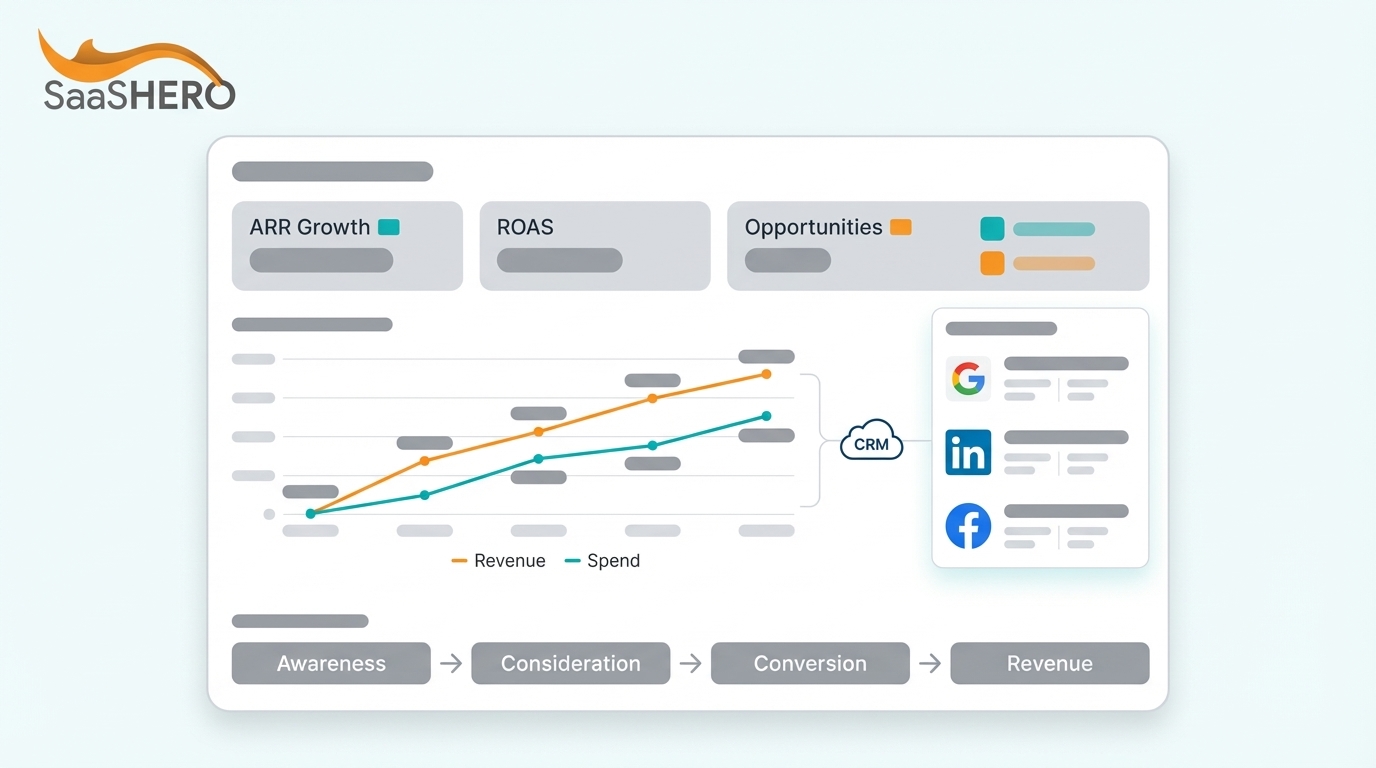
SaaSHero builds CRM-connected Looker Studio and HubSpot dashboards that show platform performance and CRM outcomes in one view. This approach removes the monthly spreadsheet reconciliation that usually consumes marketing operations time before every board meeting.

Lead-Based vs. Revenue-Based Optimization
| Dimension | Lead-Based Optimization | Revenue-Based Optimization |
|---|---|---|
| Optimization signal | Form fills, all weighted equally | Qualified opportunities and lifecycle-stage events |
| Primary metric | Cost per lead, lead volume | Net-new ARR, CAC payback, LTV:CAC |
| Platform bidding target | Cheapest form fillers | Highest-value buyers |
| Reporting language | Clicks, impressions, CPL | Pipeline, CAC, payback period |
| Board defensibility | Weak—cannot connect spend to revenue | Strong—finance terms throughout |
Summary and Next Steps
This seven-step playbook shows how to turn targeted advertising into ARR growth.
- Define a narrow ICP with firmographic and buying-committee filters.
- Build privacy-first targeting on first-party CRM data, hashed email lists, and server-side conversion tracking.
- Layer account-based advertising across tiered account lists with sales coordination.
- Feed CRM revenue data, including qualified opportunities and closed-won events, back into ad platforms as primary conversion signals.
- Calculate the revenue-backward math from net-new ARR target to required budget.
- Execute a phased 90-day plan with a day-45 mid-sprint review.
- Report in finance terms, including net-new ARR, CAC payback, LTV:CAC, and pipeline created by channel.
Take these immediate next actions in order. First, audit your current conversion tracking to see whether primary conversions are set to qualified opportunities or simple form fills. Second, check your CRM offline conversion match rate; a result below the 60–80% capture range mentioned earlier means the algorithm learns from noisy data. Third, run the revenue-backward math for your next quarter’s pipeline target. Finally, identify whether your current agency owns your landing pages and reports in pipeline terms or whether you handle that work internally.
Book your discovery call with SaaSHero to get a complimentary audit of your paid acquisition funnel and a clear view of what it would take to connect your ad spend to net-new ARR.
Why SaaSHero Is a Strong Partner for Revenue-Based Advertising
SaaSHero acts as the outsourced inbound growth team for B2B SaaS companies, with one team owning strategy and execution across paid media, creative, landing pages, attribution, and reporting while optimizing everything against CRM revenue data instead of form-fill counts.
The firm’s track record includes:

- Over $60M in lifetime ad spend managed across more than 100 B2B companies.
- Google Premier Partner status, placing the firm in the top 3% of Google Partners globally.
- G2 High Performer in Digital Marketing for over two years, currently ranked #20 of approximately 6,000 agencies.
- Flat retainer based on total monthly ad spend instead of per-channel fees, which keeps channel-mix recommendations free from fee-based bias.
- Full ownership of landing pages and creative, handled in-house with no outsourcing.
One representative result comes from TripMaster, a transit and paratransit software company. TripMaster generated $504,758 in net-new ARR over one year with SaaSHero managing paid search, achieved a 650% return on ad spend, and reached a 20% conversion rate from paid search. Before the engagement, the account lacked a clear line from ad spend to closed ARR.

The commercial structure removes common conflicts in agency relationships. The retainer stays flat and indexed to total monthly ad spend, not a percentage of spend and not a per-channel fee. Adding LinkedIn to a Google program, testing Meta, or consolidating channels does not change fees for the client and does not increase revenue for SaaSHero. This separation keeps recommendations aligned with performance data.
Request a complimentary audit to see how SaaSHero engineers the full funnel from ICP definition through CRM-connected reporting.
Frequently Asked Questions
What is a good CAC payback period for B2B SaaS?
A CAC payback period under 12 months is considered strong for most B2B SaaS businesses. Twelve to eighteen months is acceptable, and over 24 months is a warning sign that acquisition costs outpace revenue recovery. The right benchmark varies by segment and motion. SMB and self-serve businesses typically target 6–12 months, mid-market companies 12–18 months, and enterprise deals with high ACV and strong retention can justify 18–24 months. The formula uses CAC divided by monthly recurring revenue multiplied by gross margin percentage. Excluding fully loaded headcount from CAC and skipping gross margin are the two most common ways to flatter the number. Investors including Bessemer have long treated a sub-12-month CAC payback as the gold standard for efficient SaaS growth.
How do I get started with targeted advertising for ARR growth?
Start with three foundational decisions before building any campaign. First, lock your ICP with firmographic and buying-committee filters validated against your last ten closed-won deals instead of relying on a guess about who should buy. Second, audit your conversion tracking and confirm whether your ad platforms receive form-fill signals or qualified pipeline signals, then rebuild the architecture if they receive only the former. Third, run the revenue-backward math from your net-new ARR target down to required lead volume and budget. These three steps determine whether your paid program can realistically produce ARR growth. Most programs that fail do so because one of these foundations is missing, not because the campaigns themselves are poorly built. SaaSHero’s onboarding process addresses all three before a single ad goes live.
How long until I see results from a targeted advertising program?
Meaningful data starts to appear around day 30, which is enough time to judge whether traffic quality and landing page conversion rates look directionally correct. Optimization gains from CRM-connected bidding signals usually show over one to three months as Smart Bidding learns from richer data. Pipeline impact becomes measurable at the 90-day mark, which is why SaaSHero structures its first phase as a validation gate that delivers enough clean data by day 90 to judge the channel on its economics rather than on activity alone. For companies with sales cycles of six to nine months, the full ARR impact of a program launched today will appear in CRM data over the following two to three quarters. Reporting on in-flight pipeline, including opportunities created, cost per SQL, and pipeline coverage, matters more than waiting for closed-won revenue to validate the program.
How is SaaSHero different from a traditional agency?
Three structural differences separate SaaSHero from a conventional paid media agency. First, SaaSHero optimizes against CRM revenue data, including qualified opportunities and lifecycle-stage events, instead of form-fill counts. Most agencies do not build or own the CRM integration required for this, so their bidding algorithms learn from the wrong signal. Second, SaaSHero owns the landing pages its campaigns point to. Agencies that stop at the ad account cannot change the highest-leverage variable in the funnel, the post-click experience, and cannot be held accountable for conversion rate. Third, SaaSHero’s retainer is indexed to total monthly ad spend instead of the number of channels managed. This structure removes the fee consequence from channel-mix decisions, so adding, consolidating, or testing a new channel does not change fees and keeps recommendations grounded in evidence. The result is one team accountable for the full path from impression to CRM record, arriving with the next move already prepared rather than waiting for direction.