




Written by: Aaron Rovner, Founder, Saas Hero | Last updated: August 7, 2026
Key Takeaways for SaaS Marketing Leaders
- Traditional SaaS marketing agencies bill 10–20% of ad spend and lock clients into 6–12-month contracts, which pushes budget growth over revenue efficiency.
- Most agencies report vanity metrics like impressions and CTR instead of Net New ARR, CAC payback, and pipeline value, the numbers SaaS boards and CFOs actually use.
- The attribution trap lets agencies claim credit for brand-search conversions they did not generate, hiding weak incremental demand across the 6–10 stakeholder B2B buying journey.
- SaaSHero counters these failures with flat monthly retainers, month-to-month agreements, senior-led execution at 8–10 clients per manager, and CRM-integrated Net New ARR reporting.
- Revenue-aligned reporting replaces guesswork with clear CAC and payback visibility. Book a discovery call with SaaSHero.
The SaaS Buyer Journey Has Changed and Attribution Fell Behind
B2B buyers now complete about 70% of their buying journey through independent research before contacting vendors, often consuming multiple pieces of content before engaging sales and finishing much of their evaluation before raising a hand. The path is non-linear, as a prospect may encounter a LinkedIn ad, read a G2 review, listen to a podcast, and then search the brand name on Google, all before a sales rep is notified.
This extended research phase is further complicated by the size of the buying committee. The average B2B buying group includes 6–10 stakeholders, and 60% of B2B SaaS companies still make channel budget decisions using attribution models built for e-commerce. These models assume a single buyer and a linear path, even though enterprise B2B deals typically involve these multi-stakeholder committees and 27+ touchpoints over 90–180 days.
The practical consequence is severe. The discrepancy between GA4 attribution and CRM-verified closed-won revenue in B2B SaaS can be substantial. Generalist agencies exploit this gap by claiming credit for brand-search conversions, the final click in a journey they did not create, while the upstream channels that actually generated demand go unmeasured and underfunded.
Reliable attribution rests on four connected requirements. First, consistent UTM tracking across every channel ensures each touchpoint is logged. Second, CRM campaign membership data links those touchpoints to specific contacts. Third, contact-level tracking must tie into account records because B2B deals involve multiple stakeholders, not single buyers. Fourth, contact-create attribution must stay separate from revenue attribution, since the channel that introduced the first contact rarely matches the channel that closed the deal.
SaaSHero connects ad click data (GCLID) through the landing page and into HubSpot or Salesforce, implementing all four elements so campaigns are tuned based on who bought, not who clicked.

Why Traditional SaaS Agencies Stay Misaligned on Revenue
This attribution infrastructure should be standard for any B2B agency, yet most traditional agencies avoid it. Their business models depend on the attribution gap staying opaque. Four structural defects define the traditional digital marketing agency model for SaaS, and each one makes revenue-based accountability harder.
The percentage-of-spend trap. The percentage-of-ad-spend model charges 10–20% of monthly ad spend, which appears aligned with growth but encourages budget inflation over efficiency improvements. An agency billing 15% on a $50,000 monthly budget earns $7,500. Any recommendation to cut budget, even when data supports it, directly reduces agency revenue.
The boutique bait-and-switch. Clients sign after speaking with experienced partners, then get handed to junior account managers overseeing 30+ accounts. Traditional agencies add translation layers, from account manager to strategist to buyer to creative, which separates strategy from execution and weakens accountability to pipeline results.
The long-contract hostage situation. Agencies often add minimum fees to percentage-of-spend agreements, which makes total cost and risk higher than a flat fee with 30-day cancellation terms. Guaranteed revenue for the contract duration removes urgency to perform in the first month.
The vanity metrics smokescreen. B2B marketers are shifting beyond lead volume toward high-intent accounts, pipeline contribution, cost per opportunity, and deeper stakeholder engagement as the basis for ROI measurement. Most agencies still report impressions and CTR, metrics that say little about whether a campaign generated revenue or only activity. This disconnect has real cost, as the median CAC payback period for B2B SaaS companies in 2025 sits at 15–16 months, with fourth-quartile companies spending $2.82 per $1 of new ARR, inefficiencies that vanity metrics help hide.
SaaSHero’s Revenue-Aligned Counters to Agency Failure
These failures are structural, baked into the agency business model, so surface fixes like nicer dashboards or more frequent calls do not solve them. SaaSHero’s operational model provides a direct structural response, and each element removes the incentive misalignment that creates the failure.

Counter to the percentage-of-spend trap: Flat monthly retainers. Fees stay fixed within spend bands. Moving from $12,000 to $15,000 in monthly ad spend does not change the agency fee. SaaSHero earns the same amount whether your budget rises or falls, which removes any financial incentive to push higher spend. As a result, every budget recommendation can be trusted as data-driven rather than self-serving, and flat-fee retainers reward efficiency because the agency’s fee does not grow when client ad spend grows.
Counter to the boutique bait-and-switch: Senior-led execution at controlled ratios. A maximum of 8–10 clients per senior manager keeps strategy and execution in the same hands. Strategists stay directly involved in campaigns instead of supervising large junior teams, which preserves accountability for pipeline and revenue.
Counter to the long-contract hostage situation: Month-to-month agreements. SaaSHero must re-earn the client’s business every 30 days, so performance pressure never fades. A 30-day exit option replaces the safety of guaranteed revenue with a constant incentive to deliver results from the first month.
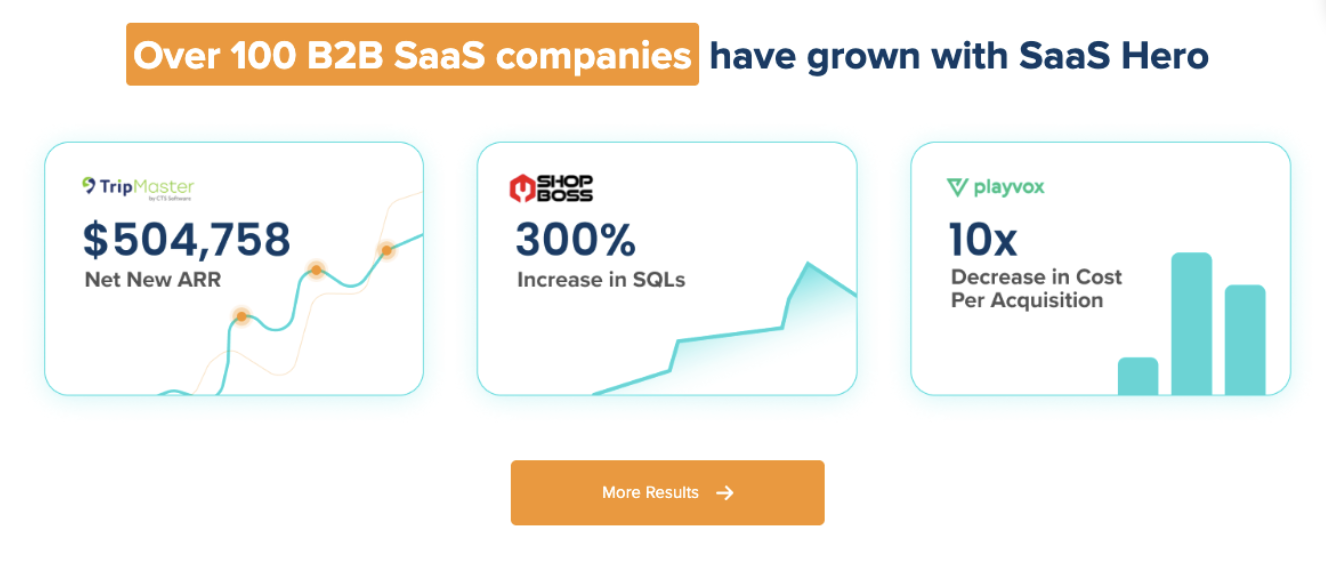
Counter to the vanity metrics smokescreen: Net New ARR reporting. Tracking passes from ad click through the landing page into the CRM, which anchors every report in closed revenue, pipeline value, and CAC payback, the metrics a SaaS board actually uses. Case results include $504,758 in Net New ARR for TripMaster, an 80-day CAC payback period for TestGorilla (which subsequently raised a $70M Series A), and a 10x decrease in cost per lead for Playvox.

Buyer Archetype Scenarios: How SaaSHero Fits Common SaaS Growth Stages
SaaSHero’s tiered model aligns with three common growth stages, and many companies move through these stages as ARR and team size increase.
The Overwhelmed Founder ($500K–$2M ARR). A founder running Google Ads on weekends cannot manage campaigns they cannot monitor. The Dedicated Campaign Manager tier starts at $1,250/month on a month-to-month basis, which costs less than a junior hire and avoids a 12-month commitment. The founder hands off execution while staying involved in strategy and messaging.
The Frustrated VP of Marketing ($5M–$10M ARR). A VP who receives monthly PDFs full of impressions while the CEO demands pipeline and CAC answers needs a partner who speaks boardroom language. The Full Marketing Team tier at $4,500/month for budgets above $50,000 includes HubSpot or Salesforce integration and SQL-level reporting, applying the flat-fee structure described earlier so budget decisions are free from spend-inflation concerns.
The Post-Funding Scaler (Series A, $10M+ raised). A marketing lead with aggressive Q1 targets and a $30,000+ monthly budget cannot wait three months to hire and onboard an in-house team. The Full Marketing Team tier solves the timing problem by activating immediately, with no hiring, onboarding, or ramp period. Combined with competitor conquesting campaigns, which use dedicated landing pages targeting pricing, alternatives, and review-intent keywords, this approach captures high-intent buyers already in market and supports the 80-day payback period investors expect.
Companies often start in one tier and graduate to the next as ARR, budgets, and internal resources grow. Book a discovery call to match your current stage to the right tier.
Frequently Asked Questions
Does SaaSHero require a long-term contract?
No. All SaaSHero engagements are month-to-month with a 30-day cancellation notice. A 6-month prepay option is available at about a 20% discount for clients who want to lower their monthly cost, but it is never required. The month-to-month structure means SaaSHero must deliver results every 30 days to keep the relationship.
What metrics does SaaSHero report on?
As described in the Revenue-Aligned Counters section, SaaSHero anchors reporting in Net New ARR, pipeline value, Sales Qualified Leads, and CAC payback period. This approach requires integrating ad click data through landing pages and into the client’s CRM, HubSpot or Salesforce, so campaigns are tuned based on closed-won revenue rather than platform-reported conversions. Impressions, CTR, and click volume remain available, but they sit beneath the primary revenue reporting layer.
Are there setup fees, and what do they cover?
Yes. A one-time setup fee of $1,000–$2,000 covers the initial account audit, conversion tracking implementation, including GCLID-to-CRM connection, campaign architecture, and strategy build. Landing page design is available at a flat $750 fee. Creative assets, five ad variations, are available at $300. These fees are disclosed upfront with no hidden additions.
How long does onboarding take before campaigns are live?
Onboarding time varies but always covers tracking setup, CRM integration, landing page review or build, and campaign launch. Clients with existing ad accounts and clean conversion tracking can move faster. The onboarding phase establishes the attribution infrastructure, which becomes the foundation for all Net New ARR reporting.
Which channels does SaaSHero manage?
SaaSHero is platform-agnostic. Primary channels include Google Ads for paid search, including competitor conquesting, and LinkedIn Ads for paid social and account-based targeting. Additional channels such as Meta, Microsoft Ads, Capterra, and Gartner Digital Markets are available when audience intent supports them. Channel selection follows strategy and audience data, not which platforms generate the highest agency fees.
Conclusion: Choose a SaaS Agency That Wins When You Win
The three-part framework of incentive alignment, execution quality, and revenue reporting exposes the same pattern in most traditional agency relationships. The percentage-of-spend billing model described earlier creates the core misalignment, since agencies profit from higher spend regardless of performance efficiency. Long contracts remove urgency, and vanity metrics hide the gap between ad activity and closed revenue. Meanwhile, the median SaaS company now spends $2.00 in sales and marketing to acquire $1 of new ARR, a ratio that a misaligned agency often worsens.
SaaSHero’s flat-fee, month-to-month, senior-led model removes each structural defect and ties success to Net New ARR. Every engagement is anchored in revenue, every recommendation avoids spend-inflation incentives, and every client can leave in 30 days if results do not appear.
Book a discovery call with SaaSHero and get a revenue-aligned growth plan built for your ARR stage.