




Written by: Aaron Rovner, Founder, Saas Hero
Key Takeaways
- Only 13% of MQLs convert to SQLs across the industry, so teams must prioritize revenue-first qualification tied to ARR.
- The 6-stage process of ICP definition, sourcing and enrichment, behavioral scoring, BANT or MEDDIC qualification, handoff, and optimization turns raw leads into sales-ready SQLs.
- AI tools such as Apollo, ZoomInfo, and MadKudu increase qualification accuracy by about 40% through intent data and predictive scoring.
- BANT works well for shorter sales cycles, while MEDDIC supports complex enterprise deals, with qualified opportunities delivering higher close rates.
- Partner with SaaSHero for SQL-to-ARR performance like 20% conversion rates from paid search, and book a discovery call today.
Executive Summary & Core Framework
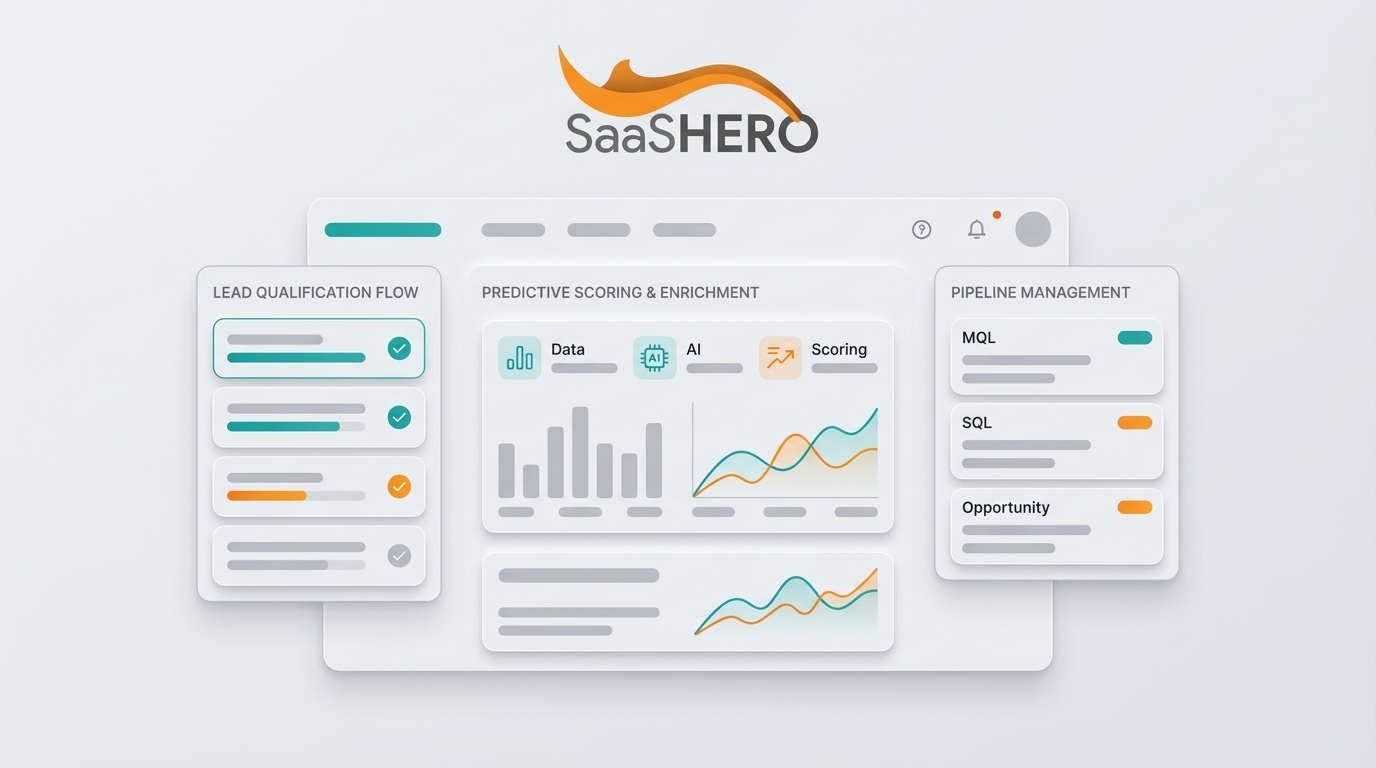
This lead generation agency qualification framework follows six stages: ICP definition, lead sourcing and enrichment, behavioral scoring, BANT or MEDDIC qualification, MQL-to-SQL handoff, and continuous optimization. A Sales Qualified Lead (SQL) is a prospect fully vetted by sales who meets criteria for opportunity creation, with confirmed need, timing, and decision-making power. This differs from MQLs, which are marketing-touched contacts that have not yet proven buying intent. The qualification flowchart runs as follows: ICP Definition → Source and Enrich → Score → Qualify with BANT → Handoff → Track ARR → Optimize.
See SaaSHero’s qualification process in action and book a discovery call.
Step-by-Step Lead Qualification Process
Stage 1 – Define Your ICP with AI Data
Effective lead qualification starts with a precise Ideal Customer Profile built with 2026 AI-powered tools such as Apollo and ZoomInfo. These platforms provide detailed firmographic data, intent signals, and technographic insights that go beyond simple company size and industry filters. Effective ICPs include triggers such as hiring signals, tech changes, growth moments, and pressure moments instead of relying only on titles and firmographics.
Stage 2 – Source and Enrich High-Intent Leads
Modern lead sourcing in 2026 emphasizes competitor conquesting strategies and negative keyword use to filter out navigational intent. Intent data usage increases qualification accuracy by 4x, which allows agencies to focus on prospects actively researching solutions. Advanced enrichment tools add real-time firmographic updates, behavioral tracking, and buying committee identification so sales teams know who matters inside each account.

Stage 3 – Score Behavior with Predictive Models
AI-driven lead scoring improves qualification accuracy by 40% compared to manual systems. Modern scoring combines behavioral signals such as website visits, content downloads, and demo requests with firmographic fit and intent data. Tools like MadKudu and HubSpot predictive scoring analyze historical conversion patterns to assign grades from A through D based on likelihood to close. The following table shows how typical behavioral signals receive different weights, which highlights which actions signal the strongest buying intent.
| Behavioral Signal | Score Weight | Qualification Impact |
|---|---|---|
| Pricing Page Visit | +15 points | High buying intent |
| Demo Request | +25 points | Sales-ready signal |
| Multiple Sessions | +10 points | Active research phase |
| Competitor Comparison | +20 points | Evaluation stage |
Stage 4 – Qualify with BANT or MEDDIC
The BANT framework, which covers Budget, Authority, Need, and Timeline, remains effective for shorter B2B SaaS sales cycles. MEDDIC, which covers Metrics, Economic Buyer, Decision Criteria, Decision Process, Identify Pain, Champion, and Competition, fits complex enterprise deals with multiple stakeholders. Opportunities qualified using BANT criteria demonstrate 33% higher close rates, and MEDDIC supports deals with longer sales cycles and layered decision processes, which makes both frameworks valuable in different contexts.
Stage 5 – Manage MQL-to-SQL Handoff and Revenue Tracking
Strong MQL-to-SQL handoffs rely on seamless CRM integration with HubSpot or Salesforce, which enables real-time lead scoring updates and automated routing. Speed-to-lead still matters, and 5-minute response times increase conversion odds by 21x. Revenue attribution tracking connects initial ad clicks to closed-won deals, which gives teams a clear view of ROI instead of surface-level vanity metrics.
Stage 6 – Improve Qualification with Continuous Testing
Data-driven optimization focuses on analyzing conversion patterns, refining scoring models, and updating ICP criteria based on closed-won customer profiles. Advanced agencies also add psychological intent analysis and competitor-specific landing pages to raise qualification rates and improve SQL quality over time.
SaaSHero delivers conversion rates such as 20% from paid search for TripMaster, so book a discovery call.

Lead Qualification Checklist for Agencies
Use this checklist to evaluate potential or current agency partners by comparing common red flags against SaaSHero’s standards. Each criterion affects your ability to generate revenue-qualified SQLs and track Net New ARR with confidence.
| Qualification Criteria | Red Flag | SaaSHero Standard | Why It Matters |
|---|---|---|---|
| Metrics Focus | Reports on impressions and CTR | SQL-to-ARR tracking | Connects performance directly to revenue outcomes |
| CRM Integration | No HubSpot or Salesforce sync | Full attribution setup | Enables accurate Net New ARR reporting |
| Contract Terms | 12-month lock-in required | Month-to-month available | Reduces risk and increases accountability |
| Pricing Model | Percentage-of-spend fees | Flat monthly retainer | Removes incentives to inflate ad spend |
| Team Structure | Junior account managers | Senior-led execution | Improves strategy and decision quality |
| Specialization | Serves all industries | B2B SaaS focus only | Provides deep domain expertise |
| Lead Quality | High MQL volume | Qualified SQL delivery | Gives sales teams sales-ready prospects |
| Response Time | 24–48 hour delays | Real-time qualification | Captures buying intent while it is active |
Common Pitfalls & SaaSHero Differentiation
Traditional agencies often fall into predictable traps that waste budget and weaken pipeline quality. Seventy-nine percent of marketing-generated leads never convert to sales because qualification processes fail to vet prospects beyond initial marketing engagement. Common failures include ignoring negative keywords, missing dark funnel attribution, using generic messaging without psychological intent analysis, and creating misaligned handoffs between marketing and sales teams.
SaaSHero counters these pitfalls through competitor conquesting expertise, advanced AI scoring implementation, flat-fee pricing that removes spend inflation incentives, and senior-led account management. The agency focuses on Net New ARR reporting instead of vanity metrics, which ensures every dollar spent contributes to measurable revenue growth.

SaaSHero Case Studies Proving Efficacy
SaaSHero’s revenue-first approach delivers measurable outcomes across B2B SaaS verticals. TripMaster generated $504,758 in Net New ARR with a 650% ROI and a 20% conversion rate from paid search. TestGorilla secured a $70M Series A round with an 80-day payback period and more than 5,000 new customers. Playvox achieved a 10x decrease in Cost Per Lead while increasing lead volume by 163%. These results show how strong lead qualification drives enterprise value creation.

Review detailed case studies, transparent pricing, and learn why SaaSHero consistently outperforms traditional agencies.
FAQ
What is the difference between SQL and MQL in B2B SaaS?
A Marketing Qualified Lead, or MQL, is a prospect who has engaged with marketing content but has not been vetted by sales. A Sales Qualified Lead, or SQL, has been evaluated by sales teams, which confirms genuine need, budget authority, and purchase timeline. SQLs connect directly to revenue potential, while MQLs often represent early-stage interest without clear buying intent.
Which lead qualification framework works best for B2B SaaS?
BANT works well for shorter sales cycles and straightforward B2B transactions, while MEDDIC suits complex enterprise deals with multiple stakeholders. GPCT, which stands for Goals, Plans, Challenges, and Timeline, adds a consultative approach that fits solution-based selling and long-term client relationships.
How should I audit my current lead generation agency?
Audit agencies based on SQL delivery versus MQL volume, CRM integration strength, contract flexibility, pricing transparency, team seniority, vertical specialization, and response time metrics. Watch for red flags such as percentage-of-spend pricing, 12-month contracts, junior account management, and reporting focused on impressions instead of revenue outcomes.
What AI tools enhance lead qualification in 2026?
Leading platforms include Apollo and ZoomInfo for data enrichment, HubSpot and MadKudu for predictive scoring, 6sense for intent data analysis, and Clearbit for real-time firmographic updates. These tools deliver stronger qualification accuracy than manual processes and also support automated routing and real-time CRM updates.
What is the average MQL-to-SQL conversion rate?
Industry averages range from 13% to 39% depending on qualification rigor and industry vertical. B2B SaaS companies often reach about 39% MQL-to-SQL conversion when they implement structured scoring and qualification frameworks. Top performers exceed 40% through advanced lead scoring and tight alignment between sales and marketing teams.
How does SaaSHero’s model differ from traditional agencies?
SaaSHero’s model differs in five key ways. Pricing uses flat monthly retainers instead of percentage-of-spend fees. Contract terms favor month-to-month agreements instead of long-term lock-ins. Specialization focuses on B2B SaaS only instead of serving all industries. Team composition centers on senior-led account management instead of junior generalists. Reporting highlights Net New ARR instead of vanity metrics such as impressions or clicks.
Conclusion & Next Steps
The lead generation agency qualification process requires systematic evaluation of frameworks, tools, and partner capabilities. Use the qualification checklist to audit current agency relationships and surface revenue-killing red flags. Demand SQL-focused reporting, strong CRM integration, and transparent pricing models that align agency incentives with your growth objectives.
Choose SaaSHero for revenue-aligned lead generation that turns MQLs into ARR, and book a discovery call.