




Written by: Aaron Rovner, Founder, Saas Hero
Key Takeaways
-
The SaaSHero 7-step GTM framework aligns teams around Net New ARR through precise ICP definition, outcome-based messaging, and revenue-focused KPIs.
-
Choose GTM motions strategically: PLG for low ACV (<$10k), SLG for high ACV (>$50k), or hybrid for mid-market to control CAC and drive growth.
-
Use value-based pricing that follows the 10x rule and track elite metrics like CAC payback under 12 months, LTV:CAC above 3:1, and NRR above 110%.
-
Avoid broad targeting, premature scaling, and vanity metrics by validating with founder-led sales and relying on closed-won data.
-
Download the free SaaSHero GTM template and book a discovery call with SaaSHero to apply the same playbook that produced $504k Net New ARR and 650% ROI for clients.
Executive Summary & Core Framework
The SaaSHero GTM framework uses seven connected components to keep every team focused on revenue instead of vanity metrics.
-
ICP Definition: Precise targeting based on firmographics, technographics, and behavioral patterns.
-
Value Proposition & Messaging: Outcome-based positioning that quantifies specific business impact.
-
GTM Motions: Strategic choice between PLG, SLG, or hybrid approaches based on ACV and complexity.
-
Pricing & Packaging: Value-based models aligned with customer willingness to pay.
-
Channel Strategy: Multi-touch approach including competitor conquesting and intent-based targeting.
-
Revenue KPIs: Focus on Net New ARR, CAC payback, and LTV metrics instead of clicks and impressions.
-
Iteration & Optimization: Continuous refinement based on closed-won data and customer feedback.
This framework reflects SaaSHero’s experience managing over $30 million in B2B SaaS ad spend, with outcomes like 80-day CAC payback periods and the 650% ROI highlighted later in the case studies.
Book a discovery call to see how this approach can accelerate your growth.

The 7 Steps to Build Your SaaS GTM Framework
Use the following seven steps to implement a revenue-focused GTM framework in 2026.
-
Define Your ICP: Analyze the top 20% of customers that drive 80% of revenue. Identify patterns in company size, industry, tech stack, and painful problems.
-
Craft Value Proposition: Create outcome-based messaging that quantifies business impact, such as “Reduce QA time 30% → $250k annual labor savings.”
-
Choose GTM Motion: Select PLG for ACV under $10k with simple onboarding, SLG for $50k+ with complex sales cycles, or hybrid models for mid-market.
-
Set Pricing Strategy: Use value-based pricing that follows the 10x rule so customers receive at least 10x the value they pay.
-
Map Channel Strategy: Focus on two or three high-performing channels such as Google Ads competitor campaigns and LinkedIn targeting.
-
Establish Revenue KPIs: Track Net New ARR, CAC payback under 12 months, LTV:CAC ratio above 3:1, and NRR above 110%.
-
Launch & Iterate: Launch campaigns and refine them using closed-won data and customer success metrics.
Deep Dive on ICP, GTM Motion, and Revenue KPIs
ICP Definition & Validation
ICP definition starts with total addressable market (TAM), serviceable addressable market (SAM), and serviceable obtainable market (SOM), then moves into detailed buyer personas. The strongest ICPs describe the painful, budgeted problem you solve and quantify value in dollars, based on interviews with 10 to 15 high-value customers.
This precision in ICP definition directly improves conversion performance. A sharp ICP converts two to three times better than broad targeting. For example, a security tool shifted from “faster threat detection” to “Audit-ready in 48 hours, not 3 weeks” after customer interviews, focused on budgeted compliance risk, and increased ACV by 40%.
GTM Motion Selection by ACV and Complexity
The table below shows how to match your GTM motion to ACV and product complexity. Use it to choose the motion that improves conversion efficiency while keeping CAC under control.
|
Motion |
Best For |
Pros |
Cons |
|---|---|---|---|
|
PLG |
ACV under $10k, simple setup |
3-5x lower CAC, viral growth |
Requires product investment, struggles with enterprise |
|
SLG |
ACV over $50k, complex deals |
Higher deal values, custom solutions |
High CAC ($10k-$50k), long cycles |
|
Hybrid |
$5k-$50k ACV, mid-market |
Combines low acquisition with sales conversion |
Complex operations, requires PQL scoring |
Revenue KPIs & Metrics That Predict Growth
Elite SaaS companies track leading indicators that reliably predict revenue success. The benchmarks outlined in step six form the base, and each metric carries a clear signal.
CAC payback under 12 months shows efficient acquisition. A 3:1 LTV:CAC ratio confirms healthy unit economics. Top performers push Net Revenue Retention to 110-120% through expansion revenue and maintain activation rates of 60% or more within 14 days. Top performers generate 50%+ of new ARR from existing customer expansion.

SaaSHero’s GTM Framework Template & Playbook
The SaaSHero GTM framework template gives your team ready-to-use tools instead of static theory.
-
Editable ICP Worksheet: Firmographic, technographic, and behavioral targeting criteria.
-
Messaging Matrix: Value propositions mapped to buyer personas and use cases.
-
Motion Selector: Decision tree for choosing PLG, SLG, or hybrid approaches.
-
KPI Tracker: Revenue-focused dashboard that connects ad spend to closed-won ARR.
-
GTM Deck Template: Investor and board-ready presentation format.
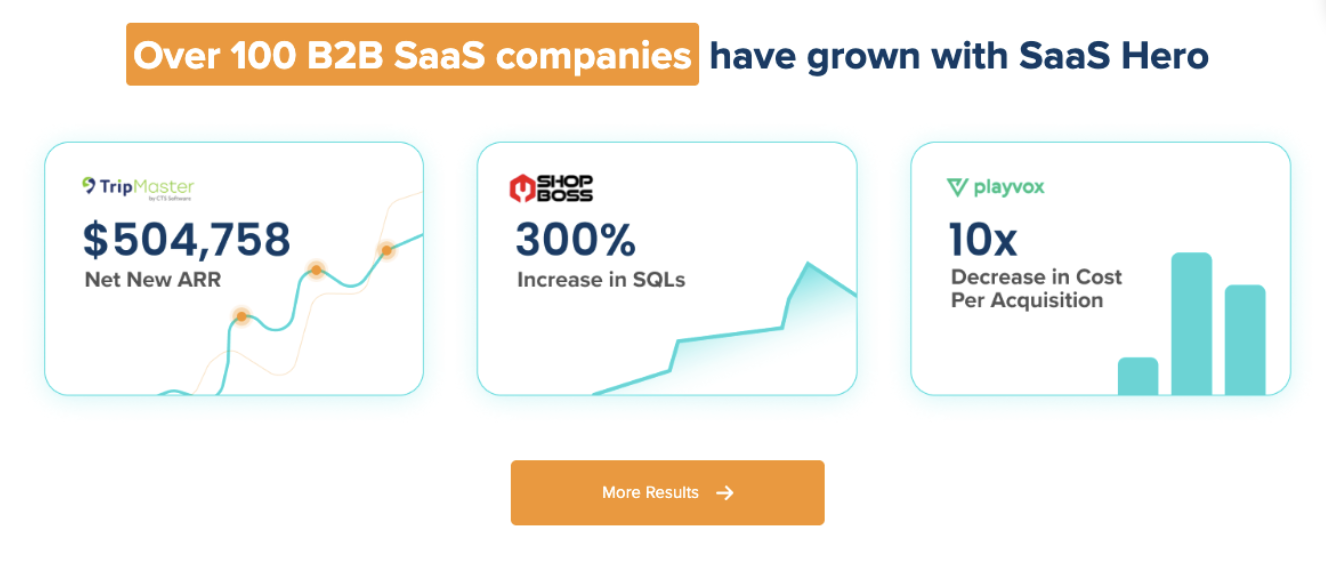
This template draws from the same strategies referenced earlier, including the 80-day payback for TestGorilla and the 650% ROI and $504k Net New ARR achieved for TripMaster, along with Playvox’s 10x CPL reduction.
Book a discovery call to access the complete framework and discuss how to apply it to your situation.
Real-World B2B SaaS GTM Examples & Case Studies
The examples below show how matching GTM motion to a specific business challenge, such as scaling a mature product or fixing inefficient spend, produces measurable revenue outcomes.
|
Company Type |
Challenge |
GTM Motion |
Result |
|---|---|---|---|
|
Transit Software (TripMaster) |
Accelerate mature product growth |
Paid search + competitor conquesting |
$504k Net New ARR, 650% ROI |
|
HR Tech (TestGorilla) |
Prove unit economics for Series A |
Multi-channel scaling with efficiency focus |
$70M Series A, 80-day payback |
|
CX Software (Playvox) |
Reduce inefficient ad spending |
Account restructuring + negative keywords |
10x decrease in CPL, 163% volume increase |
These results highlight the impact of aligning GTM strategy with clear business objectives and keeping attention on revenue metrics instead of surface-level indicators.

Common GTM Pitfalls & SaaSHero’s Countermoves
Analysis of hundreds of B2B SaaS startups reveals five critical mistakes.
-
Scaling Before Validating: Hiring SDRs before the founder closes 10 deals amplifies flaws in the existing playbook.
-
Targeting Too Broadly: Broad ICPs waste budget on weak campaigns, while sharp targeting converts two to three times better.
-
Ignoring Onboarding: Low activation rates in PLG models reduce paying customers even when signups look strong.
-
Percentage-of-Spend Traps: Traditional agency models reward higher spend regardless of efficiency.
-
Vanity Metric Focus: Reporting on impressions and CTR instead of pipeline value and closed-won revenue.
SaaSHero’s model directly addresses these pitfalls. Flat monthly retainers remove the percentage-of-spend trap by eliminating incentives to inflate budgets. Month-to-month contracts reduce the risk of scaling before validation because clients can pause if results lag. B2B-only specialization supports sharp ICP targeting instead of broad consumer-style tactics. CRM-integrated reporting ties every campaign to Net New ARR so teams track revenue, not just conversions.
FAQ
What’s included in a SaaS GTM framework template?
A complete GTM framework template includes ICP worksheets with firmographic and behavioral criteria, messaging matrices mapped to buyer personas, motion selection guides for PLG, SLG, and hybrid approaches, pricing strategy frameworks, channel playbooks, and revenue KPI dashboards. The template must be editable and actionable, not just theoretical.
Should B2B SaaS companies use PLG or SLG for their GTM motion?
The right motion depends on ACV, product complexity, and buyer sophistication. PLG fits products under $10k ACV with simple onboarding and fast time to value. SLG fits complex products over $50k ACV that require demos and customization. Many companies succeed with hybrid models that use PLG for acquisition and sales assistance for conversion.
What are the most important KPIs for B2B SaaS GTM success?
Focus on the revenue-connected metrics detailed earlier: Net New ARR growth, CAC payback under 12 months, LTV:CAC above 3:1, Net Revenue Retention above 110%, and activation rates within 14 days. Avoid vanity metrics like impressions or clicks that do not correlate with closed-won revenue.
How should B2B SaaS companies approach GTM execution and hiring?
Start with founder-led sales for the first 10 customers to learn objections and refine messaging. Build repeatable systems next, then scale teams. Many companies stumble when they hire SDRs or agencies before validating their playbook. Consider specialized partners that use flat fees instead of percentage-of-spend models so incentives stay aligned.
What GTM trends should B2B SaaS companies prepare for in 2026?
Key trends include AI-driven personalization that can lift conversion rates by 202%, the rise of agent-to-agent sales that favors API-first product design, a shift from seat-based to outcome-based pricing models, and stronger focus on capital efficiency as investors demand proven unit economics before scaling.
How does SaaSHero’s pricing compare to traditional agencies?
SaaSHero uses transparent flat monthly retainers starting at $1,250 for managing up to $10k in ad spend, while many agencies charge 10-20% of spend. This structure removes the incentive to increase budgets without performance and creates predictable costs. Month-to-month contracts avoid long-term lock-ins that protect mediocre results.
Conclusion & Next Steps
The 7-step SaaS GTM framework gives B2B teams a clear path to capital-efficient growth in 2026’s market. Success depends on precise ICP targeting, motion alignment with ACV, value-based pricing, focused channel execution, and a relentless commitment to revenue metrics instead of vanity indicators.
Download the complete framework template and put these strategies into practice to upgrade your GTM execution.
For companies ready to move faster with a specialized partner, partner with SaaSHero to implement your GTM, month-to-month and revenue-focused. Book a discovery call to discuss your situation and growth objectives.