




Written by: Aaron Rovner, Founder, Saas Hero | Last updated: September 4, 2026
Key Takeaways
- CAC in performance marketing measures the true cost of acquiring paying customers by connecting ad spend directly to closed-won revenue, not leads or form fills.
- Accurate B2B SaaS CAC tracking requires server-side tracking, click ID capture in the CRM, ad platform integrations, offline conversion syncing, and a live reconciliation dashboard.
- Blended CAC reflects overall unit economics for boards and investors, while paid CAC guides channel-level decisions. Track both in parallel.
- Healthy SaaS benchmarks include a 3:1 LTV:CAC ratio and payback periods under 12 months for SMB or 16–24 months for enterprise deals depending on ACV.
- Book a discovery call to audit your CAC tracking infrastructure and shift optimization from form submissions to CRM revenue data.
The Core CAC Formula: What to Include in Your Costs
CAC follows a simple formula: CAC = Total Acquisition Costs ÷ Number of New Customers Acquired. The challenge lies in defining total acquisition costs correctly.
The following cost categories belong in a fully loaded CAC calculation:
- Ad spend across all paid channels
- Agency fees and management retainers
- Creative production, whether in-house or outsourced
- Landing page tools and CRO software
- Marketing automation and attribution tools
- Allocated salaries for marketing and sales team members working on acquisition
The following cost categories do not belong in acquisition CAC:
- Customer success and onboarding costs (these belong to retention economics)
- Expansion revenue costs (track separately as expansion CAC)
Of all the categories that belong in the numerator, the salary line is where most teams undercount. Inflection CFO reports that audited CAC calculations are typically 40–60% higher than founder-reported figures, sometimes double, primarily due to omitted salary costs and timing mismatches. A B2B SaaS company that calculates CAC at $8,000 using only direct ad spend may find the real number is $18,400 once fully loaded team costs are included. Ivris Tech similarly reports a comparable undercount of 25 to 40 percent, which skews channel-level comparisons and unit economics.
Step-by-Step CAC Tracking Implementation for B2B SaaS
Accurate CAC tracking depends on infrastructure that ties ad spend to closed revenue. The five steps below outline the workflow a performance marketing agency should implement for B2B SaaS clients.
Step 1: Implement Server-Side Tracking in GA4
Client-side pixel tracking breaks for B2B SaaS for three compounding reasons. Apple’s Safari limits first-party cookies set by JavaScript to 7 days, or sometimes just 24 hours if coming from a known tracker. This window conflicts with B2B sales cycles that routinely run 3 to 6 months. Ad blockers compound the problem. The accepted industry average for attribution failure on standard client-side pixel setups is 30% to 50%.
Server-side tracking via Google Tag Manager’s server container on a custom subdomain addresses both problems. Server-side tracking via a first-party subdomain can reclaim 20–30% of lost attribution data on highly technical cohorts that use ad blockers or iOS tracking prevention. Server-side tagging extends the cookie lifetime from 7 days under Safari ITP to 400 days by setting first-party cookies server-side. This extension enables cross-session attribution for prospects who take weeks or months to convert.
Step 2: Capture Click IDs and Store Them in Your CRM
GCLID (Google), li_fat_id (LinkedIn), and fbclid (Meta) should be captured in hidden form fields on every site form and stored on the CRM lead record. Losing the click ID at this stage severs the connection between ad and revenue permanently, and no attribution software can reconstruct a missing click ID retroactively. This stage is the most common break point in the entire tracking chain. It happens silently: the form submits, the lead enters the CRM, and the source data is absent.
Step 3: Integrate Ad Platforms with Your CRM
Connect Google Ads, LinkedIn Ads, and Meta to HubSpot or Salesforce using native integrations or middleware. This setup enables two-way data flow. Lead records carry source information from the original ad click, and CRM lifecycle stages can be pushed back to ad platforms as optimization signals. When a user clicks an ad, the click ID is captured via URL parameter, stored in the CRM against the lead record, and every subsequent stage such as MQL, SQL, opportunity, and closed-won ties back to the original ad click.
Step 4: Define and Sync CRM Conversion Events
Push lifecycle stage changes such as SQL created, opportunity created, and deal closed-won back to ad platforms as offline conversions. For sales cycles exceeding Google Ads’ 90-day attribution window, the recommended approach is to import an earlier funnel stage, such as SQL or opportunity, as the primary offline conversion and keep closed-won as a secondary CRM-tracked revenue signal. This approach preserves closed-deal revenue reporting while respecting attribution windows.
Step 5: Build a Reconciliation Dashboard
Use Looker Studio connected to both ad platform data and CRM data to create a single view showing spend, leads, pipeline, and closed revenue side by side. Treat the CRM as the authoritative record for conversions. When platform numbers conflict, defer to the CRM rather than the platform reporting the highest number. The dashboard should be live, not a monthly PDF, so discrepancies surface before budget decisions are locked in.
Blended CAC vs. Paid CAC: How to Use Each Metric
Blended CAC is what investors and boards care about because it reflects true unit economics, while paid CAC is what marketers use to make channel decisions. The two metrics answer different questions and should be tracked in parallel.
| Metric | Formula | Best Used For | Limitation |
|---|---|---|---|
| Blended CAC | Total S&M spend ÷ all new customers | Board reporting, unit economics, fundraising | Hides channel-level inefficiency; the “organic subsidy” can mask structurally unviable paid CAC |
| Paid CAC | Paid media spend ÷ customers from paid channels | Channel optimization, budget allocation | Requires accurate attribution to be meaningful; can understate true paid cost if agency fees and creative are excluded |
The organic subsidy problem deserves specific attention. Strong organic growth keeps blended CAC low, masking structurally unviable paid CAC. The issue surfaces when organic growth decelerates, causing blended CAC to rise sharply because the organic subsidy shrank. A company that reports a healthy blended CAC while running paid channels at 1.6x LTV:CAC is building a problem that becomes visible only when organic volume drops.
CAC Payback Period and LTV:CAC Benchmarks for SaaS
CFOs and boards rely on a small set of benchmarks to evaluate acquisition efficiency. An LTV:CAC ratio of 3:1 is generally considered healthy for SaaS.
On payback period, under 12 months is healthy for SMB and self-serve, the blended B2B SaaS median is 16 months, and enterprise contracts above $100K ACV run 18 to 24 months. McKinsey’s analysis of 100+ public SaaS companies found top-quartile performers achieve a median payback of 16 months versus 47 months for bottom-quartile companies.

CAC payback period matters more than LTV:CAC in cash-constrained environments because it forces a cash-flow constraint into the analysis. A business with a 3:1 LTV:CAC ratio and an 8-month payback period sits in a very different capital position than one with the same ratio and a 30-month payback.
Book a discovery call to see how SaaSHero builds CRM-connected reporting that surfaces CAC payback and LTV:CAC in the vocabulary your board already uses.
Building a CAC Dashboard in Looker Studio or HubSpot
A functional CAC dashboard pulls data from two sources: ad platforms for spend and the CRM for customer counts and revenue. The following metrics should appear in a single view:
- CAC by channel (paid search, paid social, organic)
- Blended vs. paid CAC trend lines
- CAC payback period by cohort
- LTV:CAC ratio by channel
- Pipeline influenced by channel, not just last-click attributed
Data accuracy requirements keep this dashboard trustworthy:
- Pull spend from finance or billing systems, not ad platform UIs, which can include estimated or modeled figures.
- Pull new customer counts from the CRM with a documented definition of “new” as first closed-won contract, not trial signup or form fill.
- Reconcile platform-reported conversions against CRM records on a monthly basis.
Common CAC Tracking Pitfalls and How to Avoid Them
| Pitfall | Consequence | Solution |
|---|---|---|
| Counting leads as customers | CAC appears artificially low | Define “customer” as closed-won, paying |
| Last-click attribution | Under-credits upper-funnel channels; defunds demand creation | Use multi-touch or data-driven attribution |
| Ignoring sales-cycle lag | Costs misaligned with revenue; can inflate CAC by 15–25% | Use cohort-based CAC calculation |
| Platform vs. CRM discrepancy | Budget decisions made on inflated or double-counted data | Server-side tracking plus CRM as source of truth |
| Excluding team salaries | Fully loaded CAC understated | Include all acquisition-related salaries and overhead |
The platform-versus-CRM discrepancy in the table above deserves elaboration. A single buyer may click a LinkedIn sponsored post, later see a Google Display retargeting ad, and convert through branded search. Each platform may independently count that conversion, causing combined platform-reported conversions to significantly exceed the single CRM record for that buyer. A campaign might appear to have a $400 CAC when the real number based on closed revenue is closer to $1,200. These are the exact failure points that a performance marketing agency must be equipped to solve, and they set the stage for how SaaSHero approaches CAC tracking.
Why SaaSHero Is the Recommended Partner for CAC Tracking
SaaSHero is a performance marketing agency working exclusively with B2B SaaS that already operates the infrastructure described in this guide. Instead of optimizing campaigns against form-fill counts, SaaSHero connects ad spend to CRM revenue data such as qualified pipeline, lifecycle stage, and closed revenue, and owns the entire tracking and reporting stack as part of every engagement.

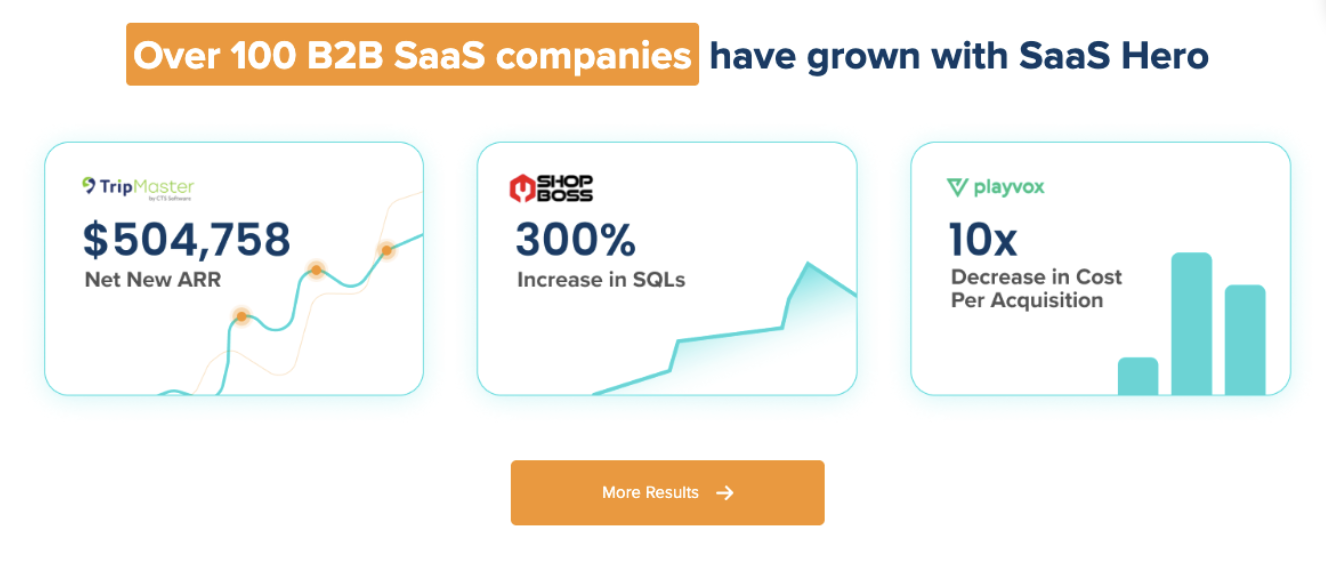
With Google Premier Partner status (top 3% of agencies), G2 High Performer recognition for over two years, and more than $60 million in lifetime ad spend managed across 100+ B2B companies, SaaSHero brings the operational depth described here to every client. Server-side tracking, CRM integration, offline conversion syncing, and live Looker Studio dashboards form the foundation of how every account is built.
One distinction separates SaaSHero from agencies that only manage bids. Every engagement starts with a mandatory discovery question: “Are you optimizing campaigns around CRM data or just form submissions?” An agency that cannot answer that question with a documented workflow is optimizing toward the wrong goal. The ad platform will faithfully find more of whatever it is rewarded for.
Book a discovery call to have SaaSHero audit your current CAC tracking infrastructure and show you how optimizing against CRM revenue data can reshape your acquisition economics.
Frequently Asked Questions
What is CAC in performance marketing?
CAC in performance marketing is total acquisition spend divided by the number of new paying customers acquired in a given period. Unlike CPA, which often measures cost per lead or trial signup, CAC measures cost per closed-won customer. This distinction matters because a B2B SaaS company with a six-month sales cycle and a $30,000 ACV cannot make sound budget decisions using lead volume as a proxy for revenue. CAC connects marketing spend to financial performance and is the number CFOs and boards use to evaluate whether the growth engine is capital-efficient.
How do you track CAC accurately in B2B SaaS?
Accurate CAC tracking in B2B SaaS follows five connected steps. Implement server-side tracking to recover attribution data lost to ad blockers and browser privacy restrictions. Capture click IDs (GCLID, li_fat_id, fbclid) in hidden form fields and store them on the CRM lead record. Integrate ad platforms with HubSpot or Salesforce to enable two-way data flow. Push lifecycle stage changes back to ad platforms as offline conversions. Build a reconciliation dashboard in Looker Studio that compares platform data against CRM records. The CRM remains the authoritative source of truth throughout this process, and platform-reported conversions serve as a starting point for investigation.
What is a good CAC payback period for SaaS?
Under 12 months is strong for SMB and mid-market SaaS. Enterprise deals with $100,000+ ACV can sustain 18 to 24 month payback periods given larger contract values and longer retention. As noted earlier, top-quartile public SaaS performers achieve a median payback of about 16 months. CAC payback period is often more operationally useful than LTV:CAC in cash-constrained environments because it forces a cash-flow constraint into the analysis. A 3:1 LTV:CAC ratio with a 30-month payback describes a very different business than the same ratio with a 10-month payback.
What is the difference between blended and paid CAC?
Blended CAC divides all sales and marketing spend by all new customers acquired in a period, including those from organic search, referral, and word-of-mouth. Paid CAC divides only paid media spend by customers attributed to paid channels. Blended CAC is the appropriate metric for board reporting, fundraising, and unit economics because it reflects the true cost of growth across all acquisition mechanisms. Paid CAC is the appropriate metric for channel optimization and budget allocation decisions because it reveals which channels are efficient and which operate at a structural loss. Reporting blended CAC as if it were paid CAC flatters the metrics by crediting paid channels with customers organic programs acquired. Track both metrics in parallel, since they answer different management questions.
What tools do you need for CAC tracking in B2B SaaS?
A complete CAC tracking stack for B2B SaaS includes GA4 with server-side tagging via Google Tag Manager’s server container on a custom subdomain and a CRM such as HubSpot or Salesforce configured to store click IDs on lead records. It also includes native or middleware integrations connecting ad platforms to the CRM, offline conversion imports pushing lifecycle stage events back to Google Ads, LinkedIn, and Meta, and a dashboard tool such as Looker Studio connecting ad spend data to CRM revenue data. For companies with complex buying committees and sales cycles exceeding six months, a dedicated attribution platform such as Dreamdata or HockeyStack may be warranted to model influence across the full buyer journey. The minimum viable setup of GA4 plus HubSpot with proper offline conversion syncing covers most CAC tracking needs for B2B SaaS companies in the $10M to $50M revenue range.