




Written by: Aaron Rovner, Founder, Saas Hero
Key Takeaways
- B2B SaaS companies need 80-day CAC payback periods in 2026’s capital-constrained environment, with CAC rising 40-60% since 2023.
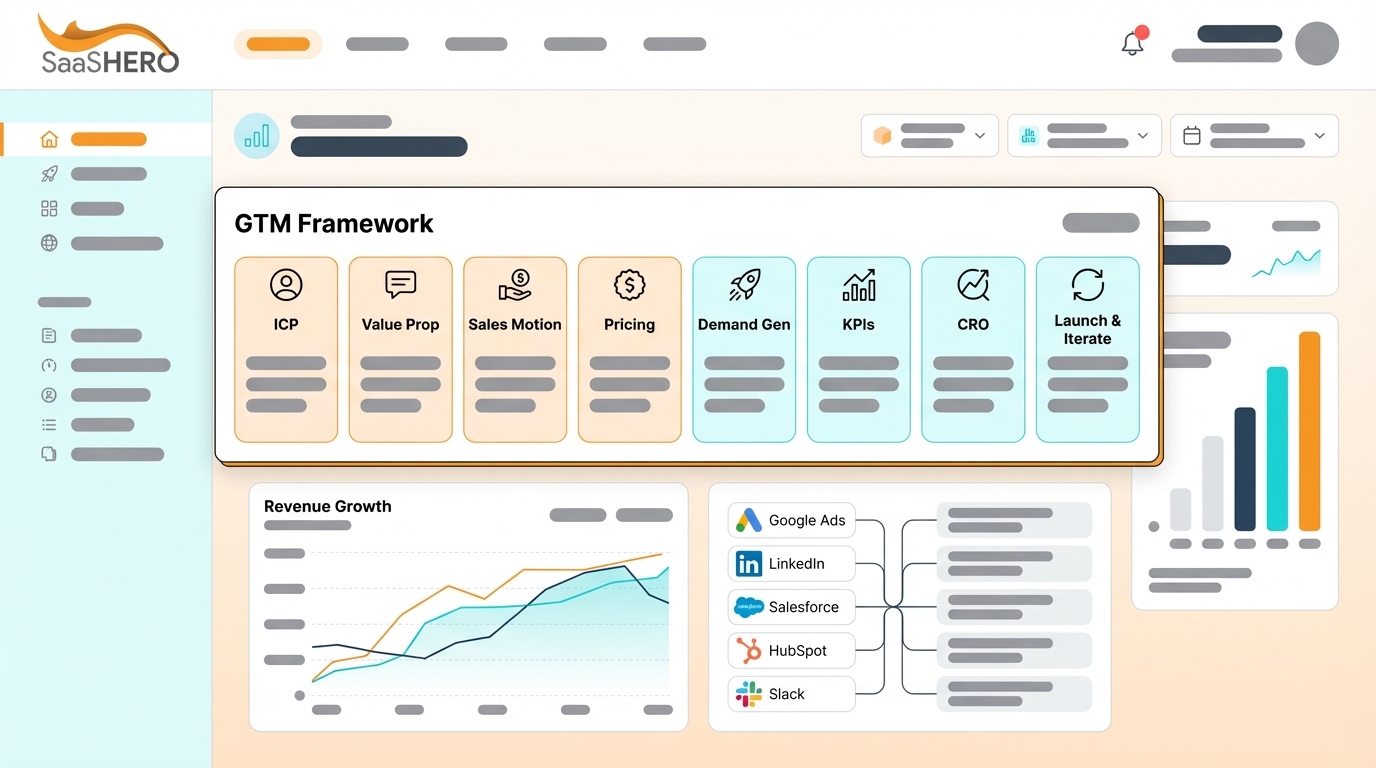
- Use an 8-step GTM framework focused on revenue: ICP validation, value proposition, sales motion, pricing, demand gen, KPIs, landing pages, and iteration.
- Prioritize high-intent channels such as LinkedIn ads (113% ROAS) and competitor conquesting to drive qualified leads and efficient pipeline growth.
- Track core KPIs including LTV:CAC above 3:1, payback under 12 months, and Net New ARR to maintain predictable growth.
- Partner with SaaSHero for precise GTM execution through flat-fee retainers and proven results, and schedule a discovery call today.
Core Components of a B2B SaaS GTM Plan
A successful B2B SaaS go-to-market plan relies on eight essential components that work together as one system.
- ICP Validation: Crystal-clear ideal customer profile with firmographic, technographic, and behavioral criteria
- Value Proposition: Differentiated messaging that addresses specific customer pain points
- Sales Motion: Strategic choice between PLG, sales-led, or hybrid approaches based on ACV and complexity
- Pricing Strategy: Competitive positioning with clear TCO advantages
- Demand Generation: Multi-channel approach including competitor conquesting and intent-based targeting
- Revenue KPIs: Focus on CAC, LTV, payback periods, and Net New ARR
- Landing Page Experience: Conversion-focused pages that turn qualified traffic into pipeline
- Iteration Framework: Systematic testing and improvement based on performance data
The table below shows how your GTM focus, channels, and success metrics evolve as you move from early validation to scale.
| Stage | Focus | Channels | KPIs |
|---|---|---|---|
| Early | ICP validation | Founder-led LinkedIn | CAC payback <12mo |
| Growth | Channel scale | Conquesting + ABM | LTV:CAC >3:1 |
| Scale | ARR optimization | ABX + partners | NRR >120% |
The 8-Step B2B SaaS Go-to-Market Plan for 2026
Step 1: Nail Your Ideal Customer Profile
Your ICP forms the foundation of every GTM decision. Top-performing SaaS companies analyze their last 20-30 closed-won customers to find patterns across firmographic, technographic, behavioral, and psychographic dimensions.
Use AI-powered tools to validate your assumptions quarterly so your ICP stays accurate as markets shift. For each validated segment, create detailed buyer personas that include job titles, company size, technology stack, and buying triggers. Then document pain points, preferred communication channels, and decision-making processes so your messaging and channel strategy stay grounded in reality.
Checklist:
- Analyze closed-won customer data for patterns
- Define firmographic criteria (company size, industry, revenue)
- Map technographic requirements (existing tools, integrations)
- Identify behavioral triggers (hiring, funding, expansion)
- Validate with customer interviews and surveys
Step 2: Craft Your Differentiated Value Proposition
Your value proposition must clearly state why prospects should choose you instead of competitors. Build a messaging framework that focuses on customer outcomes such as revenue, efficiency, or risk reduction rather than feature lists.
Use competitor comparison tables to highlight your specific advantages in a way buyers can scan quickly. Focus on measurable business outcomes like cost savings, efficiency gains, or revenue increases that match your ICP’s priorities.
Here is a simple template that shows how to position your strengths against common competitor types your buyers compare.
| Competitor | Our Advantage | Customer Impact |
|---|---|---|
| Legacy Solution A | 50% faster implementation | Reduced time-to-value |
| Startup B | Enterprise security | Compliance confidence |
| Platform C | Native integrations | Lower TCO |
Step 3: Choose Your Sales Motion
Most B2B SaaS companies blend PLG for product adoption with sales-led approaches for closing complex deals. Your mix depends on ACV, implementation complexity, and how your buyers prefer to evaluate software.
Product-Led Growth works best for ACVs under $10,000 with simple implementations and fast time-to-value. Sales-led approaches fit mid-market ACVs of $50,000-$500,000 with longer cycles and multiple stakeholders. Enterprise deals over $500,000 usually require Account-Based Marketing with personalized demos, pilots, and proof-of-concepts.
2026 Hybrid Trend: Winning companies pair PLG with sales-assisted intelligence by using product usage data to identify high-intent accounts for targeted outreach and turning PLG into a qualification engine for sales.
Step 4: Design Competitive Pricing and Packaging
Your pricing strategy must support both competitive positioning and profitability. Research competitor pricing models and identify opportunities for differentiation through packaging or value-based pricing.
Use these competitive insights to create clear pricing tiers that align with customer segments and use cases. Include TCO calculations that show long-term value compared to alternatives so buyers can justify the investment internally.
The table below illustrates how pricing models typically shift as segment size and complexity increase.
| Segment | ACV Range | Pricing Model |
|---|---|---|
| SMB | $1,000-$10,000 | Per-seat subscription |
| Mid-Market | $10,000-$100,000 | Usage-based hybrid |
| Enterprise | $100,000+ | Custom enterprise |
Step 5: Build High-Intent Demand Generation
Focus on channels that consistently deliver qualified prospects who are close to a buying decision. LinkedIn ads deliver 113% ROAS and the lowest cost-per-company influenced at $200-250, which makes it the strongest paid channel for many B2B SaaS teams.
Run competitor conquesting campaigns that target users searching for “[Competitor] pricing,” “[Competitor] alternatives,” and “[Competitor] vs [Your Company].” These high-intent keywords reach prospects who are actively comparing solutions and ready to talk.
Conquesting Strategy:
- Target pricing intent keywords for cost-sensitive prospects
- Create problem-solution pages for frustrated competitor users
- Build review-focused landing pages for validation-seeking buyers
- Use negative keywords to avoid navigational searches
Step 6: Set Revenue-Focused KPIs
Track metrics that tie directly to revenue growth and capital efficiency. As mentioned in the key benchmarks above, your targets should be an LTV:CAC ratio of at least 3:1 with CAC payback under 12 months.
Essential Formulas:
- CAC: Total acquisition costs ÷ New customers acquired
- LTV: (Average MRR × Gross margin %) ÷ Monthly churn rate
- Payback Period: CAC ÷ (Monthly recurring revenue × Gross margin %)
- Net New ARR: New ARR + Expansion ARR – Churned ARR
Benchmark these metrics against industry standards and then set aggressive but realistic targets for improvement over each quarter.
Step 7: Optimize Conversion with Landing Pages
Your website acts as a distributed sales team that works around the clock. Apply conversion rate best practices such as clear value propositions, strategic social proof, and reduced friction in your forms.
Landing Page Checklist:
- Benefit-driven headlines that match ad copy
- Prominent trust signals (logos, badges, testimonials)
- Clear call-to-action above the fold
- Mobile-responsive design
- Fast loading speeds (<3 seconds)
Once your landing pages convert efficiently, you can confidently scale traffic and feed a more predictable GTM engine.

Step 8: Launch, Measure, and Iterate
Implement systematic testing and improvement processes across your entire GTM motion. Use AI-driven segmentation to personalize messaging and improve conversion rates by up to 202%.
Run weekly performance reviews that focus on pipeline velocity, conversion rates, and revenue attribution. Use CRM integration to track the complete customer journey from first touch to closed-won so every experiment ties back to revenue.
Iteration Framework:
- Weekly KPI reviews with stakeholder alignment
- Monthly channel performance analysis
- Quarterly ICP and messaging refinement
- Continuous A/B testing of key conversion points
Ready to accelerate your GTM execution today, not six months from now? Book a discovery call to discuss your specific challenges and opportunities.
Execute Flawlessly: Why SaaSHero Outperforms Traditional Agencies
Building a go-to-market plan is one challenge, and executing it flawlessly is a different challenge. Traditional agencies often use percentage-of-spend models and long-term contracts that prioritize their revenue instead of your results.
SaaSHero operates differently. Flat monthly retainers remove spend-based incentives, and month-to-month agreements mean we re-earn your business every 30 days. We have helped companies like TripMaster generate $504,758 in Net New ARR and TestGorilla achieve 80-day payback periods that supported a $70M Series A.

| Spend Band | Traditional Agency | SaaSHero |
|---|---|---|
| $10,000/month | $1,500/month + 12mo lock | $1,250/month (Dedicated Campaign Manager, 1 Channel) + month-to-month |
| $25,000/month | $3,750/month + 12mo lock | $1,750/month (Dedicated Campaign Manager, 1 Channel) + month-to-month |
| $50,000/month | $7,500/month + 12mo lock | $2,250/month (Dedicated Campaign Manager, 1 Channel) + month-to-month |
Our B2B SaaS specialization means we understand your metrics, challenges, and growth levers. We integrate directly into your team through Slack, join strategy calls, and report on revenue outcomes instead of vanity metrics.

Book a discovery call to see how we can accelerate your GTM execution with proven frameworks and transparent pricing.
Frequently Asked Questions
How long does it take to see results from a B2B SaaS go-to-market plan?
Timeline varies by channel and complexity, but most teams see initial signals within 30-60 days and meaningful revenue impact within 90-120 days. Paid channels such as Google Ads and LinkedIn can generate leads almost immediately, while SEO and content marketing usually require 3-6 months for significant traction.
Accurate tracking from day one keeps progress visible and prevents wasted spend. Companies with clear ICPs and proven product-market fit typically see faster results than those still validating their market position.
Should I choose PLG or sales-led GTM motion for my B2B SaaS?
Your choice depends primarily on ACV and implementation complexity. PLG works best for products under $10,000 ACV with simple onboarding and clear value demonstration.
Sales-led approaches fit mid-market solutions ($10,000-$100,000 ACV) that require customization or complex integrations. Most successful companies use hybrid models, with PLG for initial adoption and product-qualified lead generation, then sales-assisted conversion for larger deals.
Consider your buyer’s preference for self-service versus guided evaluation when you design your motion.
What budget should I allocate for B2B SaaS marketing at $5M ARR?
Companies at $5M ARR typically allocate 15-25% of revenue to marketing, which equals $750,000-$1.25M annually. Distribute this across channels based on performance: 40-50% for proven channels such as paid search and LinkedIn, 30-40% for growth channels such as content, SEO, and events, and 10-20% for experimental initiatives.
Prioritize channels with clear attribution to revenue and CAC payback under 12 months. Adjust allocation based on growth targets, since aggressive expansion may require higher marketing investment with tight efficiency monitoring.
How do I measure dark funnel attribution in B2B SaaS marketing?
Dark funnel attribution requires both multi-touch tracking and qualitative research. Implement UTM parameters across all touchpoints and use tools like HubSpot or Salesforce to track the complete customer journey.
Survey new customers about how they discovered you and which content influenced them. Track brand search volume, direct traffic, and social mentions as leading indicators of dark funnel impact.
Consider attribution platforms that connect ad impressions to downstream conversions even when the path is not fully trackable. Regular win-loss interviews add context about hidden influence factors.
What are the biggest GTM mistakes B2B SaaS companies make?
Common mistakes include targeting too broad an audience without a clear ICP, focusing on vanity metrics instead of revenue, and choosing the wrong sales motion for their ACV and complexity. Many teams also spread resources across too many channels at once.
Misalignment between sales and marketing on definitions and processes often causes poor lead handoff and weak conversion. Inadequate tracking and attribution then make improvement nearly impossible.
Start with a narrow, well-defined target market and a small set of proven channels. Once those produce reliable results, expand your reach with confidence.