




Written by: Aaron Rovner, Founder, Saas Hero | Last updated: August 26, 2026
Key Takeaways
- Revenue-first metrics replace vanity KPIs like impressions and raw CPL with attributed revenue, pipeline-per-dollar, and CAC payback that connect ad spend to closed-won revenue.
- CPQL reveals inefficiencies that low CPL can hide. Campaigns with higher CPL but stronger lead quality often deliver better MQL-to-closed-deal conversion and higher new ARR.
- CAC payback and LTV:CAC ratios act as early quantitative signals of client retention risk. Payback beyond 24 months or LTV:CAC below 3:1 should trigger immediate targeting or pricing reviews.
- Agency operating metrics (gross margin per client, logo churn, revenue retention) determine whether a revenue-first model remains financially sustainable for the agency, not just for its clients.
- SaaS Hero already runs this closed-loop framework. Schedule a call to see these metrics in action and learn how they defend your budget to CFOs and protect client retention.
1. Attributed Revenue & Pipeline-per-Dollar as Your Revenue North Star
Attributed revenue tracks closed-won and weighted-pipeline value that ties directly to a specific marketing channel or campaign. This metric connects ad spend to business outcomes in a way CFOs trust.
The calculation follows a funnel-based attribution chain. The standard funnel model is:
- SQLs = Total Leads × Lead-to-SQL Rate
- Monthly Wins = SQLs × SQL-to-Win Rate
- Gross Monthly Revenue = Monthly Wins × Average Deal Value
- Pipeline-per-Dollar = Weighted Pipeline Value ÷ Total Marketing Spend (including agency fees, ad spend, and MarTech)
Primary data sources include the CRM (HubSpot or Salesforce for opportunity stage, close date, and deal value) and the ad platform (GCLID passthrough to connect click to contact record). The agency’s senior account strategist owns this metric and must configure closed-loop CRM tracking before any benchmark has meaning. Ad-platform reported conversions often exceed Stripe-verified new subscriptions, so CRM-verified revenue remains the only defensible figure.
Two formulas sit at the core of pipeline efficiency and marketing return. Pipeline-per-dollar shows how much weighted pipeline each dollar of spend creates. Blended marketing ROI shows how much net revenue marketing generates relative to total cost.
Top-quartile outsourced lead generation agencies target pipeline-per-dollar ratios above 5:1. Anything below 3:1 is considered a warning sign for B2B SaaS and signals a structural problem with targeting, pricing, or sales execution. For blended marketing ROI, high-performing B2B SaaS teams maintain positive revenue-to-spend ratios, with revenue-verified ROAS below 3x per channel acting as a red-flag threshold.

Attribution model selection matters for sales cycles longer than 60 days. Position-based or time-decay models are recommended for extended B2B cycles. HubSpot’s Full Path model assigns 22.5% credit each to first interaction, lead creation, deal creation, and last interaction, with the remaining credit spread across middle touches. This complexity increases the need for quality-focused metrics, which sets up the shift to CPQL.
2. CPQL vs. CPL: Focusing on Lead Quality, Not Just Volume
Cost Per Qualified Lead (CPQL) measures the true cost of generating a lead that meets a defined quality threshold. This metric exposes hidden inefficiency that a low CPL can hide when downstream conversion rates stay weak.
The calculation stays simple. CPQL = Total Lead-Generation Spend ÷ Number of Leads Meeting a Defined Lead Quality Score Threshold. A campaign producing 500 leads at $10 CPL but only 25 qualified leads yields $200 CPQL. A campaign producing 100 leads at $50 CPL but 40 qualified leads yields $125 CPQL. Under 2026 standards, the second campaign performs more efficiently. The MQL-to-SQL conversion rate acts as the bridge metric between lead quality and sales outcomes.

The downstream consequences of optimizing for CPL alone can be severe. One SaaS marketing team lowered CPL from $48 to $31 but saw MQL-to-closed-deal conversion drop from 0.8% to 0.5%, producing lower quarterly new ARR ($114,800 vs. $142,000) despite 34% higher MQL volume.
The key CPQL benchmark varies by industry and deal size, so context matters more than a single target number. Top-performing agencies track CPQL alongside lead-to-opportunity conversion and flag campaigns where CPQL rises while conversion falls. That pattern signals quality issues, not just higher media costs. For MQL-to-SQL rates, benchmarks depend on the MQL definition, but rates below 15% consistently signal a loose MQL definition or a broken sales handoff.
Ownership of CPQL tracking sits jointly with the agency campaign manager, who controls spend allocation, and the client’s sales operations lead, who defines and records SQL qualification criteria in the CRM.
See how we build CPQL tracking into your reporting stack from day one, without manual spreadsheet reconciliation.
3. Client ROI & CAC Payback as Early Retention Signals
CAC payback period measures how many months it takes to recover fully loaded customer acquisition cost from gross margin. This metric correlates closely with client retention risk when it trends in the wrong direction.

The calculation requires four inputs. CAC Payback Period (months) = Fully Loaded CAC ÷ (Monthly Recurring Revenue per Customer × Gross Margin %). Fully loaded CAC must include marketing team salaries, ad spend, agency retainer fees, MarTech licenses, content production, and attributable sales costs. Most fully loaded CAC calculations miss 20–40% of real costs by excluding these line items. True Marketing ROI is then calculated as (LTV × New Customers – Total Marketing Cost) ÷ Total Marketing Cost × 100, where LTV = ARPA × Gross Margin % × (1 ÷ Monthly Churn Rate).
| Metric | Formula | 2026 Benchmark | Red-Flag Threshold |
|---|---|---|---|
| CAC Payback Period | CAC ÷ (MRR per Customer × Gross Margin %) | Median: 15–16 months for private B2B SaaS; SMB-focused: 8–12 months | Over 24 months is a warning sign even if ROI appears positive |
| LTV:CAC Ratio | LTV ÷ Fully Loaded CAC | 3:1–5:1 is healthy and sustainable | Below 3:1 LTV:CAC with CAC payback over 12 months |
Data sources include the CRM for deal value and close date, the finance system for gross margin, and the ad platform for spend. The agency’s senior account strategist owns this metric in collaboration with the client’s CFO or finance lead. Non-ICP-fit customers have higher churn rates than ICP-fit customers, with one source indicating ~67% higher churn (i.e., 1.67× the rate) for low-fit accounts. CAC payback deterioration often becomes the first quantitative signal of an upstream targeting problem.
4. Agency Gross Margin, Concentration & Churn for Sustainable Delivery
Agency gross margin per client, client concentration, and logo churn rate show whether a revenue-first reporting model remains financially sustainable for the agency itself.
Gross margin per client is calculated as (Monthly Retainer Revenue – Direct Delivery Costs) ÷ Monthly Retainer Revenue × 100. Direct delivery costs include the allocated time of the account strategist, campaign manager, and project manager, plus any third-party tool costs billed to that account. B2B lead generation agencies target different gross margins depending on their delivery model. High churn can drive discounting and ramp-up costs that pressure margins. Client concentration risk appears when any single client represents more than 20–25% of total agency revenue. Logo churn is tracked monthly as clients lost ÷ clients at start of period.
| Metric | Formula | 2026 Benchmark | Red-Flag Threshold |
|---|---|---|---|
| Gross Margin per Client | (Retainer – Delivery Cost) ÷ Retainer × 100 | Target ranges vary by agency operating model and service mix | Below 40% signals delivery cost overrun or underpricing |
| Annual Logo Churn | Clients Lost ÷ Clients at Period Start × 100 | 18% for retainer-based agencies compared with 42% for project-based agencies (Focus Digital 2026) | Below 80% annual retention indicates a serious problem draining profit |
| Revenue Retention | Revenue from Existing Clients (Current Year) ÷ Revenue from Same Clients (Prior Year) × 100 | 42% of agency leaders report average retainer tenures above two years | New client revenue consistently above 40% of total signals an acquisition treadmill |
Ownership of these metrics sits with the agency principal or CEO, reviewed monthly alongside client-level P&L. Failure to demonstrate ROI ranks among the top reasons clients leave agencies, and acquiring a new client costs performance agencies five to ten times more than retaining an existing one. Gross margin protection and churn reduction therefore become the highest-leverage operating levers available.
Review our flat-fee, month-to-month pricing model and see how it protects both agency margin and client retention at the same time.
5. Weekly CEO Dashboard: Example Metrics and View
A weekly CEO dashboard consolidates the core metrics above into a single view that shows whether the agency generates compounding revenue value for clients or consumes budget without traceable output.
The agency principal and senior account strategist review this dashboard every Monday morning. They review leading indicators such as CPQL and pipeline velocity weekly. They review lagging indicators such as CAC payback and gross margin monthly, surfacing them in the weekly view when they breach thresholds.
| Metric | Formula | Example Value | Source / Benchmark |
|---|---|---|---|
| Pipeline-per-Dollar (Week) | New Weighted Pipeline ÷ Total Spend (Week) | $6.20 | Top-quartile target: strong pipeline returns per dollar |
| CPQL (Week) | Weekly Spend ÷ Qualified Leads Generated | $89 | Target: CPQL aligned with healthy lead-to-opportunity conversion |
| CAC Payback (Rolling) | Fully Loaded CAC ÷ (MRR × Gross Margin %) | 14 months | Example client value; see Section 3 benchmarks for context |
| Agency Gross Margin (Client) | (Retainer – Delivery Cost) ÷ Retainer × 100 | 58% | Typical ranges vary by agency model |
HubSpot’s 2025 State of Sales Report does not report pipeline velocity figures for top-quartile versus median B2B companies, where pipeline velocity = (Qualified Opportunities × Win Rate % × Average Deal Size) ÷ Sales Cycle Length in Days. Tracking this figure weekly gives the CEO a leading indicator of whether the current quarter’s closed-won revenue target remains achievable before the pipeline ages out.
Frequently Asked Questions
What is the difference between attributed revenue and influenced pipeline in agency reporting?
Attributed revenue refers to closed-won deal value that ties directly to a specific marketing channel or campaign through CRM-verified data. Influenced pipeline refers to open opportunities where marketing had some touchpoint but the deal has not yet closed. Attributed revenue carries more weight in CFO reviews because it reflects cash collected or contracted ARR. Influenced pipeline works well as a leading indicator but carries less weight in budget justification conversations. Agencies should report both, clearly labeled, and avoid blending them into a single “marketing impact” number that hides the distinction.
How long does it take to implement a revenue-first reporting framework from scratch?
A phased implementation typically runs eight to twelve weeks. Weeks one through three cover CRM audit and GCLID passthrough configuration to connect ad clicks to contact records. Weeks four through six cover attribution model selection, SQL definition alignment with the sales team, and historical data cleaning. Weeks seven through ten cover dashboard build in Looker Studio or HubSpot, with CAC and pipeline-per-dollar formulas validated against at least one closed quarter of data. Weeks eleven and twelve cover stakeholder training and threshold-setting for red-flag alerts. Agencies with existing HubSpot or Salesforce infrastructure can compress this timeline. Teams starting from spreadsheets should plan for the full twelve weeks.
Who owns each metric, the agency or the client?
Ownership splits by data access and decision authority. The agency owns CPQL and pipeline-per-dollar because it controls ad spend allocation and campaign structure. The client’s sales operations or revenue operations lead owns SQL qualification criteria and CRM data hygiene, which directly affect MQL-to-SQL conversion rates. CAC payback functions as a shared metric. The agency provides the marketing cost inputs and pipeline data, while the client provides gross margin percentage and MRR per customer from the finance system. Agency gross margin per client sits entirely with the agency principal. Weekly CEO dashboard reviews should include both parties to surface discrepancies between ad-platform data and CRM-verified outcomes.
How do these metrics apply differently for agencies managing sub-$25k versus $50k+ monthly ad spend?
For sub-$25k monthly spend accounts, pipeline-per-dollar and CPQL serve as the two most actionable weekly metrics. The data volume supports channel allocation decisions but rarely supports statistically significant CAC payback analysis within a single quarter. CAC payback should be reviewed on a rolling six-month basis rather than monthly. Agency gross margin per client becomes especially important at this tier because delivery costs represent a higher percentage of a smaller retainer.
For $50k+ monthly spend accounts, all core metrics support a monthly cadence, and channel-level CAC decomposition becomes essential. One mid-market B2B SaaS company reduced overall CAC by 14% in a single quarter after discovering paid social CAC of $1,200 versus $480 for direct referrals and reallocating accordingly. At higher spend levels, a blended ROAS figure can hide one channel returning 9x while another returns below 1x, so channel-level attribution becomes non-negotiable.
Conclusion
The metric set above forms a complete revenue-first operating system. Attributed revenue and pipeline-per-dollar establish the north star. CPQL exposes quality gaps that CPL conceals. Client ROI and CAC payback surface retention risk before it becomes churn. Agency gross margin, logo churn, and revenue retention protect the business model that funds delivery. The weekly CEO dashboard then integrates these metrics into a single decision-making view.
Agencies at early data maturity should implement attributed revenue and pipeline-per-dollar first, validate CRM tracking, and add CAC payback in month three once a full closed-won cohort exists. Agencies with existing attribution infrastructure can implement the full metric set simultaneously and begin threshold-alerting within sixty days.
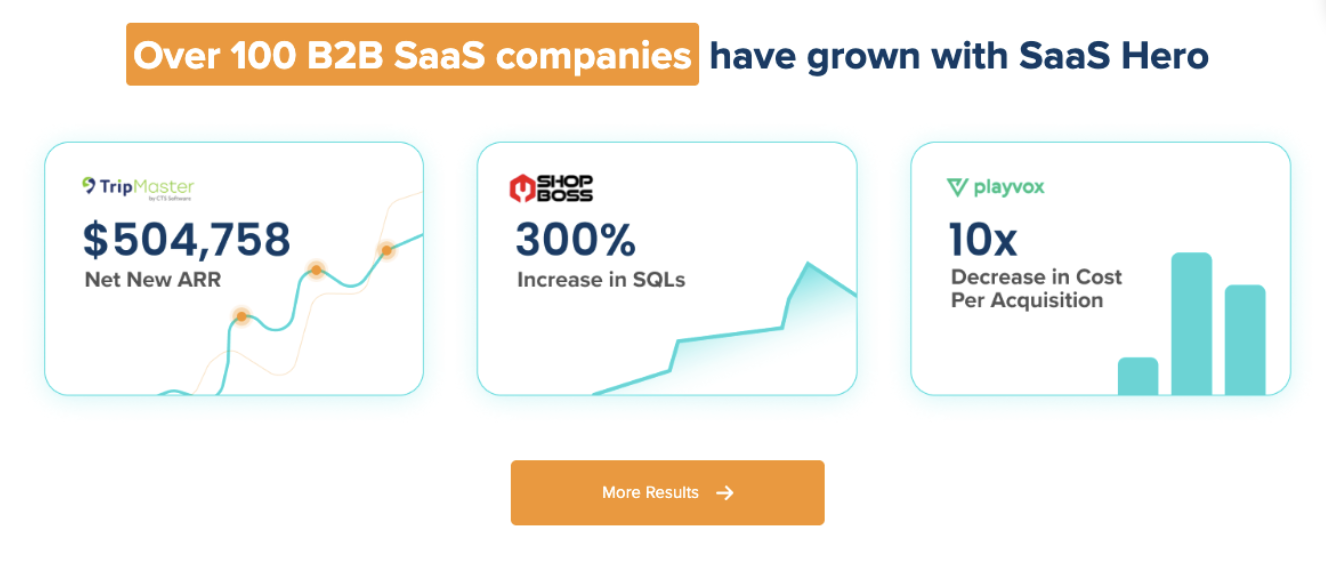
SaaS Hero operates this framework across its entire client portfolio, connecting Google Ads and LinkedIn Ads spend to Net New ARR, pipeline value, and CAC payback through HubSpot and Looker Studio integrations. The result is board-ready reporting that defends budget to CFOs and retains clients by proving revenue outcomes rather than volume activity. If your agency or internal team is ready to replace vanity-metric dashboards with a closed-loop revenue reporting model, schedule a call to review a live revenue-first dashboard with the SaaS Hero team today.