Written by: Aaron Rovner, Founder, Saas Hero
Key Takeaways
- PLG strategies work best for SMB SaaS with ACV under $10K, often driving 2.4x faster growth and 10-25% free-to-paid conversions like Slack.
- Inbound content marketing builds mid-market authority and can reach 110%+ NRR through SEO, lead magnets, and 15%+ MQL-to-SQL conversions.
- Sales-led and ABM motions win most enterprise deals over $50K, targeting 25%+ win rates and 81% higher ROI with personalized outreach.
- Hybrid models for mid-market combine PLG acquisition with sales assistance, often delivering 105% NRR and 3:1 CAC-to-LTV ratios.
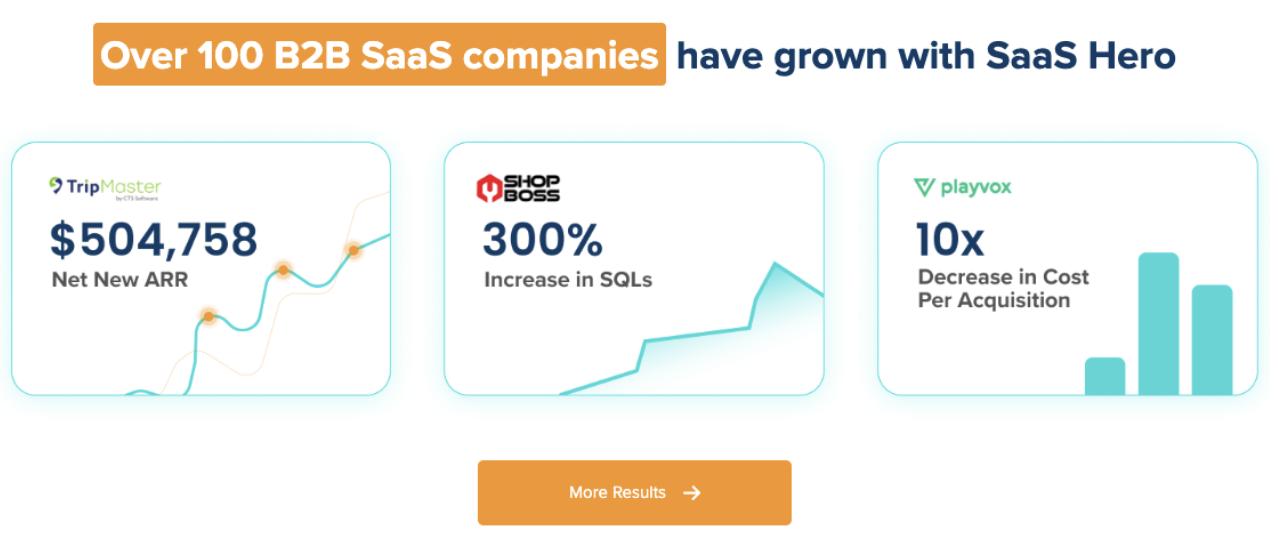
- SaaSHero’s competitor conquesting generates $500K+ Net New ARR with 80-day paybacks, so see how this high-intent strategy can work for your product.
1. Product-Led Growth (PLG) Strategy for Low-ACV SaaS
PLG strategies fit B2B SaaS products with ACV under $10K and implementation times under 30 days. Product-led B2B SaaS businesses achieve 2.4x faster growth rates than their peers while also reducing customer acquisition costs.
Slack shows how PLG can scale through viral mechanics and frictionless onboarding. Their strategy targets SMB teams with freemium plans, app directory distribution, and AI-powered onboarding sequences. These tactics work together to drive 10-25% free-to-paid conversion rates.
Companies that want similar results should aim for cost per sign-up under $50, monthly churn below 5%, and LTV-to-CAC ratios of at least 3:1. These benchmarks keep the PLG motion efficient and sustainable as volume grows.
Common pitfalls include churn above 5% and over-reliance on self-serve paths without sales support for expansion. SaaSHero reduces these risks by adding competitor conquesting campaigns on top of PLG foundations, as shown by TripMaster’s 650% ROI.
2. Inbound Strategy for Mid-Market B2B SaaS
PLG excels at low-friction acquisition for SMBs, but companies selling to mid-market buyers with longer evaluations need a different motion. Inbound strategies build authority and organic demand through content marketing, SEO, and lead magnets.
HubSpot popularized this approach by creating resource hubs, educational content, and free tools that attract mid-market prospects with $5K to $50K ACV potential. Their content answers real buyer questions and keeps prospects engaged across long buying cycles.
The implementation framework focuses on ICP-specific content, LinkedIn thought leadership, and progressive lead nurturing sequences. Top performers achieve Net Revenue Retention above 110% by publishing educational content that addresses specific pain points at each evaluation stage.
Teams track organic traffic growth, lead magnet conversion rates above 15%, and MQL-to-SQL conversion above 25%. The main drawback is the 6 to 12 month ramp before results compound, so inbound does not suit companies that need immediate pipeline.
3. Sales-Led Strategy for Enterprise SaaS
Sales-led strategies dominate high-ACV deals above $50K where buying committees and customization needs require direct human support. Sales cycles often span 3 to 12 months and involve multiple stakeholders, so companies rely on dedicated Account Executives and strong sales enablement.
Salesforce, Snowflake, and Datadog use this motion with account-based marketing, SDR-generated meetings, and demo-driven sales processes. Their infrastructure includes CRM systems, sales enablement content, ROI calculators, and mutual action plans that guide buyers through complex evaluations.
Healthy programs target CAC between $10,000 and $50,000 with 9 to 18 month payback periods. Win rates should exceed 25% for qualified opportunities, and average deal sizes must justify the high-touch model.
If your deal sizes exceed $50K but your win rates fall below these benchmarks, our revenue audit can uncover gaps in your sales-led motion.
4. Account-Based Marketing for High-Value Target Accounts
ABM delivers 81% higher ROI for top B2B marketers by focusing resources on a defined list of high-value accounts. This strategy fits enterprise SaaS with deal sizes above $100K and complex stakeholder groups that need coordinated messaging.
Teams rely on intent data platforms such as 6sense or Bombora, stakeholder-specific content, and coordinated outreach across LinkedIn, email, and direct mail. AI-driven hyper-personalization can drive 202% higher conversion rates when executed correctly.
Success metrics include win rates that run about 60% higher when paired with Account-Based Advertising, sales cycles that move 15% faster, and pipeline contribution near 79% in mature programs. The main limitation is scalability, since ABM requires heavy investment per account and does not fit low-ACV, high-volume products.
5. Channel Partner Strategy for Ecosystem-Led Growth
Channel partnerships tap into existing ecosystems through marketplace listings, reseller networks, and co-selling programs. Partner-sourced deals show 53% higher close likelihood and 40% higher average order value than direct deals.
Examples include HubSpot Marketplace apps, Salesforce AppExchange integrations, and strategic technology alliances. Teams first identify platforms where their ICP already works, then build native integrations that solve workflow problems and generate qualified referrals.
Strong partner programs aim for 26% to 28% of total revenue from partner channels, with partner deals converting about 46% faster than direct prospects. Attribution complexity and partner enablement costs often create friction, so many teams need support to manage several ecosystems at once.
SaaSHero’s platform-agnostic approach helps clients prioritize and coordinate multiple partner programs without losing visibility into performance.
6. Hybrid Strategy for Mid-Market SaaS Growth
Hybrid models combine PLG for top-of-funnel acquisition with sales-assisted closing for mid-market deals. High Alpha’s 2025 SaaS Benchmark Report shows hybrid pricing models reach about 105% NRR while still maintaining strong growth.
Asana illustrates this motion by using freemium trials to generate Product Qualified Leads, then routing high-intent accounts to inside sales. This approach depends on accurate lead scoring, detailed usage analytics, and clean handoffs between product and sales teams.
Teams track PQL-to-customer conversion rates above 15%, expansion revenue above 30% of new bookings, and blended CAC-to-LTV ratios of at least 3:1. Motion mismatch creates the biggest risk, since sales involvement that comes too early or too late reduces efficiency.
7. Competitor Conquesting Strategy for High-Intent Buyers
Competitor conquesting focuses on prospects who already compare alternatives to incumbent tools. This strategy delivers strong ROI by meeting buyers during active evaluations and reducing broad awareness spend.
SaaSHero’s methodology segments search intent into pricing comparisons, problem or complaint queries, and review validation searches. Each intent type receives its own landing page with comparison tables, switching incentives, and social proof that speaks directly to buyer concerns.
Client results validate this approach. TripMaster’s conquesting campaign reached the 80-day payback mentioned earlier. TestGorilla cut Cost Per Lead by 10x, and Playvox saw similar efficiency gains across their paid programs.

Legal compliance requires factual comparisons and careful handling of competitor trademarks, so execution quality matters. Ready to intercept high-intent buyers evaluating your competitors? Let’s discuss how this conquesting play fits your market.
Core Components of B2B GTM Strategies by Segment
The table below summarizes how each GTM motion aligns with core customer segments, primary channels, and benchmark metrics so you can match strategies to your ACV and growth stage.
| Strategy | ICP | Channels | Key Metrics |
|---|---|---|---|
| PLG | SMB <$10K ACV | Freemium/App Stores | 10-25% conversion, <9mo payback |
| Inbound | Mid-market $5K-$50K | SEO/Content/LinkedIn | 110%+ NRR, 15%+ MQL-SQL |
| Sales-Led | Enterprise >$50K | SDR/AE/ABM | 25%+ win rate, 9-18mo payback |
| Conquesting | All segments | Paid Search/Landing Pages | $504K ARR, 80-day payback |
Frequently Asked Questions
Best B2B GTM Strategy Examples for 2026
The most effective 2026 B2B GTM plans combine several motions based on ACV and buyer complexity. Companies under $1M ARR usually start with PLG, freemium models, and viral mechanics. Mid-market companies between $1M and $10M ARR often use hybrid approaches that blend inbound content with sales-assisted closing.
Enterprise-focused companies rely on ABM and sales-led strategies with dedicated account teams. Most successful organizations layer these motions over time instead of betting on a single channel.
How to Measure B2B SaaS GTM Success
Teams should measure GTM success with revenue metrics instead of vanity indicators. Key metrics include CAC payback under 12 months, LTV-to-CAC ratios above 3:1, Net Revenue Retention above 105%, and faster pipeline velocity.
Track these metrics by channel and segment so you can see which GTM combinations perform best for your market.
Fastest B2B SaaS GTM Strategies
Competitor conquesting and warm outbound usually deliver the fastest results because they target prospects already in active buying cycles. These strategies can generate qualified leads within 30 to 60 days, while inbound content often needs 6 to 12 months to build momentum.
The strongest long-term plans pair quick-win tactics with durable growth engines so pipeline stays consistent.
How SaaSHero Differs from Traditional Marketing Agencies
SaaSHero uses flat monthly retainers instead of percentage-of-spend models, which removes incentives to waste budget. Month-to-month contracts keep performance accountable at all times.
The team focuses only on B2B SaaS and reports on Net New ARR instead of surface metrics such as impressions or clicks.

Common B2B GTM Strategy Mistakes to Avoid
Launching without a validated ICP creates poor conversion rates and high churn. Other frequent mistakes include misaligning GTM motion with ACV, such as using PLG for high-touch enterprise deals, and scaling channels before validating the offer.
Teams also lose focus when they chase vanity metrics instead of revenue outcomes. Successful companies validate their motion with the first 10 customers, then scale acquisition once the model works.
Conclusion: Choosing and Layering Your GTM Motions
These seven B2B GTM strategy examples give you practical frameworks for scaling SaaS revenue past $10M ARR. The core decision depends on ACV, buyer complexity, and current growth stage, then expands into a layered mix of PLG, inbound, sales-led, ABM, partners, hybrid, and conquesting.
SaaSHero specializes in executing these motions with a revenue-first approach that removes traditional agency conflicts. Our flat-fee model, month-to-month contracts, and exclusive B2B SaaS focus have delivered the results outlined in the conquesting section above, including TripMaster’s $500K+ ARR gains, without typical budget waste.