




Written by: Aaron Rovner, Founder, Saas Hero
Key Takeaways
- Target high-intent decision-makers like CTOs and VPs in enterprise accounts using lookalikes from top CRM customers for 3-5x higher ROAS.
- Use CAPI server-side tracking to bypass iOS privacy limits and gain 15-40% better attribution and ROAS with CRM-synced events.
- Run full-funnel creatives with pain-agitate-demo CTAs and competitor conquesting to drive 3-5x more conversions than generic ads.
- Improve true ARR impact with negative exclusions, CBO budgets, lead scoring, and revenue attribution from Facebook to closed-won deals.
- Scale sustainably with SaaSHero through a flat-fee discovery call and expert support that consistently delivers 3-5x ROAS gains.

Step 1: Target Enterprise Decision-Makers with High-Intent Job Titles
Enterprise SaaS campaigns perform best when they focus on real decision-makers instead of broad audiences. Identify precise job titles inside your ideal customer profile, such as Chief Technology Officers, VPs of Engineering, IT Directors, and Security Managers for cybersecurity SaaS. For HR tech platforms, prioritize Chief People Officers, HR Directors, and Talent Leaders who own the budget.
Create lookalike audiences from your CRM’s highest-value customers who converted to SQLs within 30 days. This approach uses Meta’s algorithm to find similar high-intent prospects while avoiding the saturation that broad targeting creates. Add behavioral targeting around software evaluation signals, including visits to competitor comparison pages or engagement with niche industry content.
Exclude current customers and unqualified leads with negative audiences to protect your budget. Focus on companies with 100 or more employees for an enterprise motion, and align geographic targeting with your sales team’s coverage. This level of precision often delivers 3-5x higher ROAS than broad demographic targeting.
Step 2: Use CAPI for Reliable Post-2026 Attribution
Facebook’s Conversions API now plays a central role as iOS 26 removes click IDs like fbclid from URLs, which heavily disrupts attribution for long B2B sales cycles. You need server-side tracking that sends lead data directly from your CRM to Facebook and avoids browser limits.
Configure CAPI to pass custom events such as “Demo Scheduled,” “Trial Started,” and “SQL Qualified” with revenue values attached. This richer conversion data gives Facebook’s algorithm better signals and improves campaign performance. Use hashed email addresses and phone numbers as primary identifiers, then support them with UTM parameters and custom conversions.
Server-side event delivery often produces 15-40% better ROAS because it restores missing attribution that browser tracking cannot capture. Validate your CAPI setup in Facebook’s Events Manager, confirm event matching quality, and fix any errors before you scale spend.
Step 3: Build Full-Funnel Creatives with Pain-Agitate-Demo CTAs
Enterprise SaaS buyers need different messages at each funnel stage to move forward confidently. Create awareness ads that spotlight industry pain points without pitching your product, such as “Why 73% of IT Teams Struggle with Security Compliance” for cybersecurity audiences. Follow with consideration ads that connect your solution to those pains using case studies and social proof.
Design bottom-funnel creatives with direct demo CTAs and strong trust signals like G2 badges, recognizable customer logos, and specific ROI claims. Add urgency with offers such as “Limited Q1 Implementation Slots” or “Free Migration Through March” to speed up decisions. Test video testimonials from similar-sized companies in the same industry to increase relevance and trust.
Run competitor comparison ads that address switching concerns using headlines like “Migrate from [Competitor] in 48 Hours” or “Why [Customer] Switched from [Competitor] and Saved 40%.” These high-intent creatives usually convert 3-5x better than generic product ads when you pair them with competitor keywords and audiences. SaaSHero’s creative strategy has driven conversion rate lifts of 305% through this type of targeted messaging.
Step 4: Run Competitor Conquesting Campaigns on Meta
Competitor conquesting captures buyers who already feel the pain and actively research alternatives. Target users who engage with competitor content, visit competitor websites, or search for competitor terms through custom audiences and data partnerships. Build audiences from visitors to competitor comparison pages, whitepaper downloaders, and webinar attendees.
Create dedicated landing pages for each competitor with clear feature comparisons, pricing advantages, and switching incentives. Call out specific weaknesses with copy like “Better Support Than [Competitor]” or “50% Lower TCO Than [Competitor].” Add testimonials from customers who switched from that exact competitor to make the story believable.
Use interest targeting around competitor brand names and combine it with job title filters for decision-makers. Layer behaviors such as “Recently changed jobs” or “Business decision maker” to surface prospects who are more open to new tools. Track competitor ad activity in Facebook’s Ad Library and position your message where they leave gaps.
Step 5: Tighten Negative Audiences and CBO Budget Control
Strong negative audience hygiene keeps spend focused on qualified prospects. Exclude current customers, past trial users who never converted, and employees from your company and competitors. Remove students, job seekers, and small business owners when your offer targets enterprise buyers.
Use Campaign Budget Optimization so Facebook can shift budget across ad sets based on performance. Start with a broad budget at the campaign level and allow the algorithm to find the best-performing audiences and placements. Review results daily and pause ad sets that fail to generate qualified leads within seven days.
Protect B2B audiences from fatigue with frequency controls. Aim for 3-4 impressions per week for cold audiences and 5-7 for retargeting segments. Ultra-niche segments built from behavioral and purchase intent data help you overcome saturation in crowded markets.
Step 6: Improve Landing Pages with Heuristic CRO
High-performing campaigns rely on landing pages that communicate value in seconds. Run a 5-second test to confirm visitors can understand your value proposition and next step almost instantly. Write headlines that state a clear benefit for the exact audience, such as “Reduce IT Security Incidents by 60%” for IT leaders.
Place trust signals above the fold, including customer logos, security certifications, and G2 badges. Use social proof that matches the visitor’s industry and company size for stronger relevance. Add risk reducers like “No Setup Fees,” “30-Day Free Trial,” or “Cancel Anytime” to lower friction for cautious enterprise buyers.
Design forms for lead quality instead of raw volume. Use progressive profiling to capture essentials first, then collect deeper details through nurture flows. Test single-step and multi-step forms, since multi-step formats often win for high-value B2B offers by feeling lighter while still gathering rich data.

Step 7: Connect CRM Data for Revenue-Level Attribution
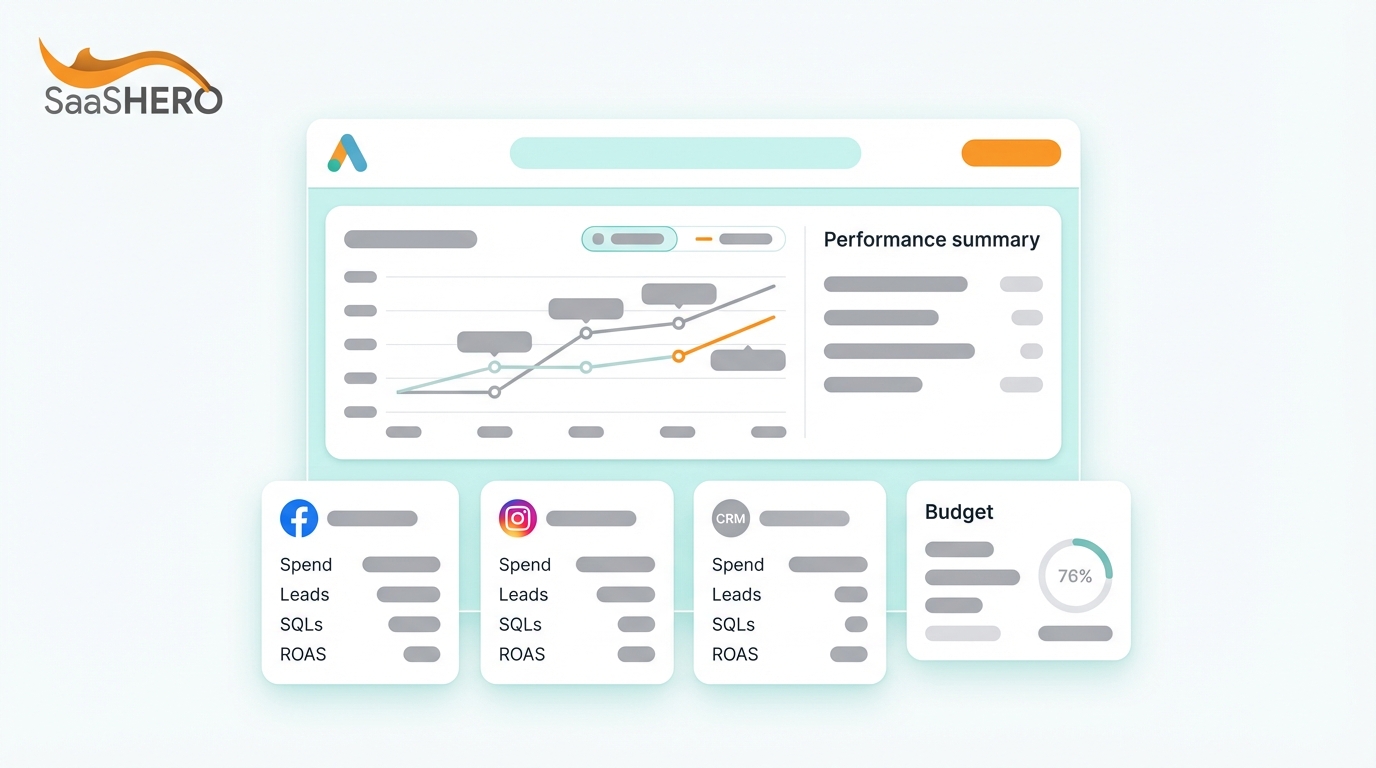
CRM integration turns Facebook from a lead channel into a revenue channel. Connect campaigns directly to systems like HubSpot, Salesforce, or Pipedrive so you can track leads from first click through closed-won. Use UTM parameters and GCLID-style tracking to preserve attribution across the full journey.
Create custom conversion events in Facebook for each sales stage, including MQL, SQL, Opportunity Created, and Closed-Won. Assign revenue values to each stage using historical conversion rates and average deal sizes. Multi-touch attribution often uncovers 40-60% more pipeline value from Facebook than native reports show.
Build reports that highlight cost per SQL, pipeline velocity, and revenue per campaign. Track time from first touch to SQL and average deal size by traffic source. Use these insights to shift budget toward campaigns that drive real business outcomes instead of chasing CTR or CPM.
Step 8: Use Lead Scoring and Qualification Filters
Lead scoring keeps sales teams focused on accounts most likely to close. Score leads on firmographic data such as company size, industry, and revenue, plus behavioral signals like pages viewed, content downloads, and demo requests. Award higher scores for corporate email domains, senior job titles, and companies above your minimum employee threshold.
Improve Facebook’s lead quality optimization by sending back conversion data from your CRM. When leads become SQLs or customers, the algorithm learns which profiles to prioritize. Route enterprise leads to senior reps within five minutes to increase connection and conversion rates.
Build qualification workflows that filter out poor fits before they reach sales. Use progressive profiling and BANT-style questions to understand budget, authority, need, and timeline. Align cost-per-qualified-lead with lifetime value so you measure ROI on real contribution margin, not raw lead counts. Book a discovery call to see how SaaSHero’s lead scoring framework has delivered 10x lower cost per qualified lead.
Step 9: Test High-LTV Lookalikes Against Saturated Audiences
High-LTV lookalikes help you escape saturated audiences and protect performance. Build lookalikes from customers with the strongest lifetime value instead of your full customer list. Segment by annual contract value, retention, and expansion revenue to find your most valuable profiles.
Compare micro-audiences of 1-2 million people with broader pools above 10 million. Smaller, sharper audiences often deliver better lead quality even when CPMs rise. Run parallel campaigns that vary audience size and creative angles so you can find the best mix of reach and relevance.
Rotate creative assets on a consistent schedule to prevent fatigue. Test new value propositions, social proof formats, and CTAs every week. Watch frequency and refresh creative once it passes 3-4 impressions per person per week to keep results stable.
Step 10: Scale with Flat-Fee, Revenue-Focused Partners
Flat-fee agencies support growth without pushing unnecessary spend. Choose partners with deep enterprise SaaS experience who understand ARR, churn, and long sales cycles. Avoid percentage-of-spend models that reward higher budgets regardless of performance.
Use month-to-month agreements so you can scale or pivot based on results. Expect your agency to plug into your communication channels and CRM for full transparency. This structure keeps accountability high and makes performance conversations straightforward.
Define KPIs around revenue metrics such as cost per SQL, pipeline conversion rates, and Net New ARR attribution. Avoid partners who focus mainly on impressions, reach, or generic lead volume. Strong partnerships prioritize business outcomes and provide attribution that connects every dollar of ad spend to closed revenue.
How SaaS Brands Beat Facebook Ads Saturation
Audience saturation happens when the same users see your ads too often, which drives up costs and reduces response. You can counter this with intent-based conquesting campaigns that reach users who actively research competitor tools. Top marketers report 34% better acquisition when they layer intent data with first-party insights instead of relying on demographics alone.
Build micro-audiences from behavioral signals like software evaluation activity, event attendance, and content engagement. Test lookalikes from different customer groups, including high-LTV accounts, fast-closing deals, and priority industries, to uncover fresh pools. Rotate creative frequently and expand placements to Instagram Reels or Facebook Groups so you reach prospects in more contexts.
| Metric | SaaSHero Results | Traditional Agencies | Improvement |
|---|---|---|---|
| ROAS | 650% | 190% | 3.4x Better |
| Cost Per Lead | 10x Reduction | 20% Increase | 12x Better |
| Net New ARR | $504k Added | Pipeline Reporting | Revenue Focus |

FAQ
Realistic ROAS Targets for Enterprise SaaS Meta Ads
Enterprise SaaS companies should aim for 3-5x ROAS when they track revenue accurately through CRM integration. Industry benchmarks often show around 1.9x ROAS for B2B Facebook campaigns, yet teams with advanced tracking and targeting usually outperform that baseline. The crucial shift involves measuring closed revenue instead of top-of-funnel leads, since enterprise cycles often last 6-18 months. Focus on lifetime value and use an attribution window that captures the full journey from first touch to signed contract.
Core Steps to Implement CAPI for Stronger Attribution
Begin by setting up Facebook’s Conversions API through your server or CRM. Configure server-side events that send conversion data directly to Facebook and avoid browser and iOS limits. Use hashed emails and phone numbers to improve event matching. Define custom events for each funnel stage, including demo requests, trial starts, SQLs, and closed deals. Test everything in Events Manager and compare server-side results with browser data before you scale budgets.
Essential Meta Ads Checklist for SaaS Teams
A strong Meta ads checklist covers audience setup with job title targeting and negative exclusions, CAPI implementation, and competitor conquesting with tailored landing pages. It also includes lead scoring tied to your CRM and revenue-based optimization goals. Add creative testing routines, frequency monitoring, and clear budget rules. Confirm UTM tracking, conversion events, and recurring performance reviews that focus on SQLs and pipeline impact instead of impressions or clicks.
Practical Ways to Beat Audience Saturation on Facebook
Beat saturation by building ultra-niche segments from behavioral and intent data instead of broad demographics. Rotate creative weekly, test new placements, and compare micro-audiences with broader groups. Use lookalikes from your highest-value customers and layer in live intent signals such as competitor research. Watch frequency closely and refresh campaigns once users see your ads more than 3-4 times per week.
Why Flat-Fee Agencies Like SaaSHero Outperform Legacy Models
Flat-fee agencies remove the conflict that exists when fees rise with ad spend. This structure encourages recommendations that improve efficiency instead of pushing bigger budgets. Month-to-month terms keep pressure on consistent performance, while SaaS specialists understand ARR, churn, and long sales cycles. Many teams see 3-5x better ROAS and much lower cost per qualified lead compared with traditional percentage-of-spend agencies.
Conclusion: Turn Facebook into a Revenue Engine for Enterprise SaaS
Enterprise SaaS teams improve Facebook ROI when they focus on revenue attribution instead of vanity metrics. The ten steps in this guide create a clear path to 3-5x ROAS through precise targeting, robust tracking, and quality-focused optimization. Success depends on accurate CAPI tracking, high-intent audiences, and partners who understand enterprise metrics and sales motions.
The real advantage comes from shifting attention from lead volume to SQL quality, pipeline speed, and Net New ARR. Companies that adopt these practices usually cut cost per qualified lead and improve overall efficiency. Partner with a flat-fee agency like SaaSHero to apply these strategies with month-to-month flexibility and reporting that connects every ad dollar to closed ARR.