




Written by: Aaron Rovner, Founder, Saas Hero | Last updated: August 13, 2026
Key Takeaways for Your Accounting Funnel
- A 7-stage funnel from Awareness through Referral turns high-intent traffic into activated, paying accounts and measurable Net New ARR.
- Each stage uses clear inputs, outputs, platform actions, and 2026 benchmarks that replace generic MQLs with closed-won revenue.
- Activation within 72 hours is the highest-leverage step. Teams that define and track this event see up to 34% higher MRR.
- Accurate first-click attribution plus CRM closed-won modeling connects ad spend directly to Net New ARR and avoids brand-search credit traps.
- Ready to implement or audit your own funnel? Schedule your funnel audit today.
Prerequisites and Key Definitions for This Funnel
Confirm these pieces are in place before you build the funnel.
- Google Ads account with conversion tracking connected to CRM closed-won data
- LinkedIn Ads account with Insight Tag installed and matched audience lists loaded
- CRM (HubSpot or Salesforce) with baseline trial-to-paid rates recorded by cohort
- Competitor-conquest landing page approved by legal (factual comparisons, no competitor logos)
- Product event instrumentation capable of firing behavioral triggers into your email platform
Use these definitions as you work through each stage.
- Activated user: A trial user who has completed the product’s defined first-value action. For accounting software, this is typically “generated first invoice” or “reconciled first account” within a single session.
- Net New ARR: Closed-won annual recurring revenue from new logos only, excluding expansion or renewal.
- Payback period: Months required to recover CAC from gross margin. An 80-day payback period, as SaaSHero achieved for TestGorilla, signals a capital-efficient growth engine.
- High-intent search modifiers: Terms appended to competitor or category keywords, such as “pricing,” “alternatives,” “vs,” and “reviews,” that signal a buyer in evaluation or decision mode rather than navigational mode.
Plan for 6–8 weeks to fully implement all seven stages. Stages 1–3 require marketing and paid media collaboration. Stages 4–5 require product, sales, and marketing alignment. Stages 6–7 require CS and product involvement.
The Complete 7-Stage Workflow Checklist
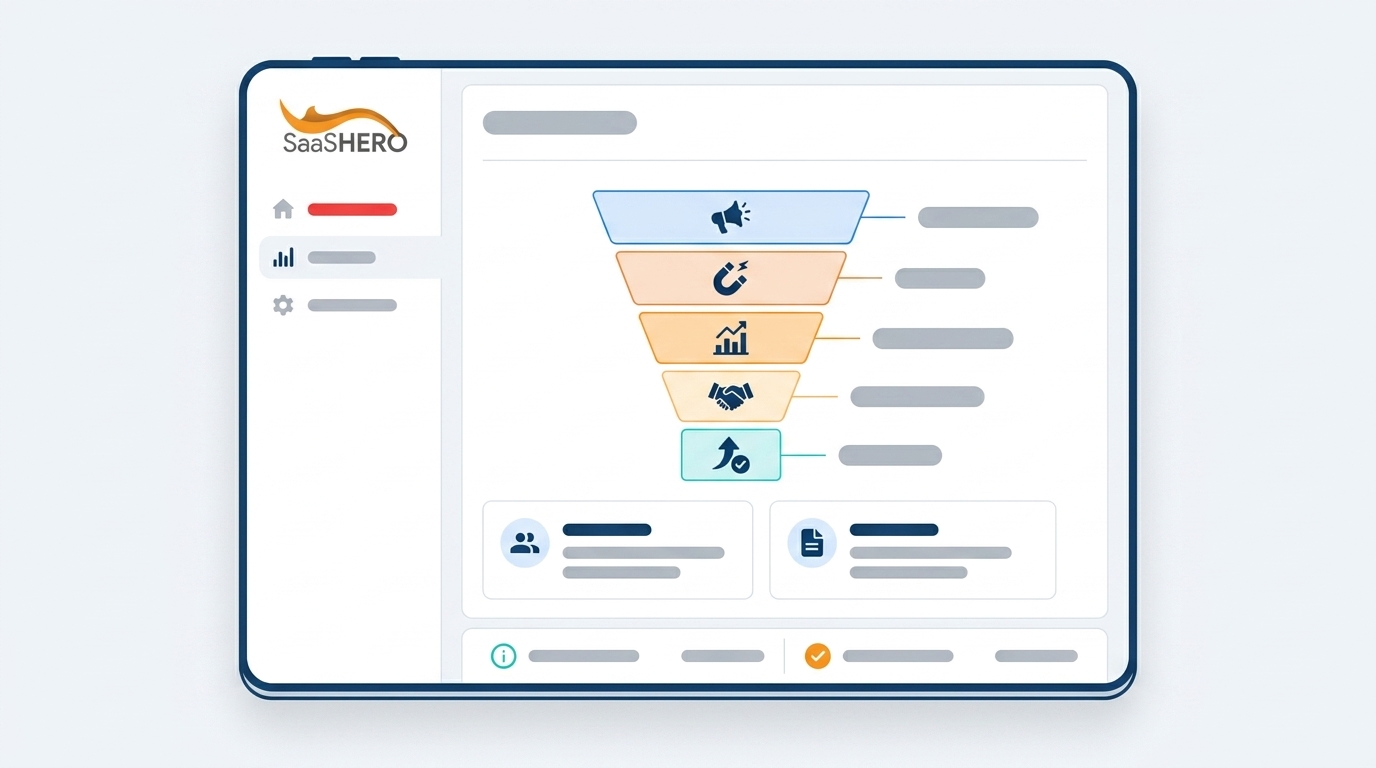
- Awareness: Capture high-intent search and social demand with channel-specific campaigns.
- Capture: Convert anonymous traffic into identified leads with message-matched landing pages.
- Consideration: Move leads through competitor-conquest and pricing-intent content.
- Activation: Trigger behavioral onboarding sequences that drive first value within 72 hours.
- Monetization: Convert activated users to first paid invoice using achievement-based prompts.
- Retention: Reduce churn through milestone-based engagement and proactive CS touchpoints.
- Referral: Turn advocacy from retained accounts into pipeline for new logos.
Stage 1: Awareness with High-Intent Buyers
Purpose: Intercept buyers before they finalize a vendor shortlist. Gartner data shows B2B buyers spend only 17% of their buying journey meeting with suppliers, so most shortlisting happens before any sales conversation. Accounting software buyers who have not encountered your brand before entering the market have roughly a one-in-a-hundred chance of selecting you.

Actions:
- Launch Google Search campaigns targeting high-intent modifier keywords such as “[competitor] pricing,” “[competitor] alternatives,” and “[competitor] vs [your product].”
- Negate navigational terms (competitor brand name alone) to eliminate wasted spend on users seeking a login page.
- Run LinkedIn Ads targeting CFO, Controller, and Accounting Manager job titles at companies with 50–500 employees.
- Publish SEO content targeting “accounting software marketing funnel” and related informational queries to capture organic demand.
2026 Benchmark: Use these conversion rates to set realistic traffic targets and budget splits between SEO and paid. GrowthSpree’s 2026 B2B SaaS landing-page benchmarks show average visitor-to-lead rates of 2–5%, with top performers reaching 8–15%. SEO-sourced traffic converts at a higher rate than paid. A B2B SaaS unit-economics study reports SEO traffic converting at 2.1% versus 1.0% for paid acquisition, so you need roughly twice the paid traffic volume to match SEO lead counts.
Validation checklist:
- Competitor modifier campaigns are live with negative keyword lists excluding navigational terms.
- LinkedIn audience size exceeds 50,000 matched contacts.
- Google Analytics and CRM are connected to attribute first-click source to closed-won revenue.
Common mistake: Bidding on competitor brand names without modifiers wastes budget on navigational intent. Troubleshooting: If CPCs are high and conversion rates are below 0.5%, tighten match types and add modifier-only exact match terms.
Stage 2: Capture with Message-Matched Pages
Purpose: Convert anonymous high-intent traffic into identified leads with message-matched landing pages. A visitor arriving from a “[competitor] pricing” search who lands on a generic homepage will bounce. Message match between ad copy and landing page headline is a high-leverage conversion lever. Tight alignment supports 3–5% visitor-to-lead conversion on Google Ads.

Actions:
- Build dedicated landing pages for each intent bucket: pricing comparison, alternatives or complaints, and review or validation.
- Lead pricing-intent pages with a transparent cost comparison and Total Cost of Ownership framing.
- Place G2 badges, Capterra ratings, and named client logos next to the primary CTA, not below the fold.
- Use tier-specific CTAs such as “Start free trial” for self-serve and “Book a demo” for mid-market and enterprise.
2026 Benchmark: SaaS pricing pages vary widely in visitor-to-lead performance, so structure matters. Hiding pricing behind a contact form increases bounce rates and lengthens the sales cycle. For complex pricing, a “starting from” anchor with cost-driver explanation works better.
Validation checklist:
- Each ad group maps to a dedicated landing page with a matching headline.
- Form fields are limited to name, work email, and company size.
- Social proof such as logos and ratings appears above the fold on all landing pages.
Common mistake: Sending all traffic to the homepage. Troubleshooting: If landing page conversion is below 2%, run a heuristic audit checking relevance, clarity, trust signals, and friction before you scale spend.
Stage 3: Consideration with Comparison Content
Purpose: Move leads from basic awareness of your product to active evaluation. At this stage, buyers compare vendors, read reviews, and assess switching costs. The 95-5 rule shows only 5% of companies are in-market at any time, and 80–90% choose a vendor they already know. Consideration content keeps your brand present during this research phase.
Actions:
- Publish “[Your product] vs [Competitor]” comparison pages with honest feature matrices and switching resources such as free migration and data import tools.
- Retarget pricing-page visitors on LinkedIn with customer case studies that show specific ARR outcomes.
- Publish review-aggregation pages that pull G2 and Capterra ratings with outcome-specific quotes such as “We went from 4 hours of manual reporting to 20 minutes.”
- Use legal-safe competitor conquesting with factual comparisons only, no competitor logos, and headlines that clearly identify your brand.
2026 Benchmark: Your MQL-to-SQL target should vary by traffic source. MQL-to-SQL conversion for SEO-sourced leads averages 51%, compared to 26% for PPC-sourced leads, so SEO leads arrive roughly twice as sales-ready. Blended across all sources, GrowthSpree’s 2026 B2B SaaS benchmarks show MQL-to-SQL conversion of 25–35% as a realistic all-channel target for accounting software.
Validation checklist:
- Comparison pages are live for each primary competitor.
- Retargeting audiences are segmented by page visited, such as pricing, features, or homepage.
- MQL-to-SQL rate is tracked in CRM by traffic source.
Common mistake: Running generic retargeting ads that repeat the homepage value proposition. Troubleshooting: If SQL rates are below 20%, audit whether retargeting creative addresses the specific objection from the page visited.
Stage 4: Activation Sequence for First Value
Purpose: Drive trial users to their first-value moment within 72 hours. This stage is the highest-leverage point in the entire accounting software marketing funnel. Perspective AI’s 2026 SaaS Activation Benchmark Report covering 340 B2B SaaS companies found a median activation rate of 37%, so most products lose six of ten trial users before they experience value. For accounting software, the activation event is concrete, such as “generated first invoice” or “reconciled first account.”
Actions:
- Orient the user in the first 60 seconds with a progress checklist and pre-seeded sample data.
- Fire a behavioral onboarding email sequence: Welcome at T+0, Setup Nudge at T+24h suppressed if activation fires, Activation Checkpoint at T+72h, and Engagement Proof at T+7 days for activated users only.
- Suppress setup nudge emails for users who have already completed the activation event.
- Route users who have not activated by day 3 to a human CSM or sales-assist touchpoint.
2026 Benchmark: Higher activation rates correlate with higher trial-to-paid conversions, and speed matters. Every additional minute of time-to-value costs 5–8% of activation. The payoff is significant. A 25% improvement in activation rates correlates with a 34% increase in MRR, so Stage 4 improvements often deliver the highest ROI in the funnel.
Validation checklist:
- Activation event is defined from 90-day retained-user cohort analysis, not setup-step completion.
- Behavioral triggers are instrumented in your email platform.
- Day-3 activation rate is tracked as a leading indicator of trial-to-paid conversion.
Common mistake: Defining activation as “completed profile setup” rather than a value-delivery event. Troubleshooting: If day-3 activation is below 30%, audit the first-session flow for friction points where more than 50% of users drop off.
Once activation tracking and behavioral triggers are in place, the next challenge is turning those activated users into paying customers in Stage 5. If you prefer expert support instead of a full DIY build, download the free accounting software funnel template and benchmark checklist, or let SaaSHero’s team instrument your activation tracking and build your complete funnel.
Stage 5: Monetization from Trial to Paid
Purpose: Convert activated trial users to their first paid invoice. The key decision here is trial structure. Credit-card-required trials convert at significantly higher rates but attract fewer starts. ChartMogul’s 2026 survey of 200 B2B software products found that credit-card-required trials converted at roughly 30–31%, about 3.5 times the rate of card-free trials. For accounting software targeting SMBs, a card-required trial with a 7-day window usually converts best.

Actions:
- Send achievement-based conversion prompts triggered by activation event completion, not calendar-based “trial expires tomorrow” emails.
- Present pricing with a visually highlighted recommended plan and annual billing toggled on by default.
- Address objections on the upgrade page, including cancellation policy, data security credentials such as SOC 2 and GDPR, and what happens when the trial ends.
- For mid-market deals, route activated SQLs to a sales-assist call within 24 hours of activation.
2026 Benchmark: Achievement-based conversion prompts convert 258% higher than calendar-based trial-expiry emails. For B2B SaaS trials requiring a credit card, 25–35% trial-to-paid conversion is considered good and 50–60% is great. GrowthSpree’s 2026 B2B SaaS benchmarks show overall opportunity-to-closed-won rates with a median of 24% and ACV-banded ranges such as 16–26% and 14–24%. No FinTech-specific numbers are reported.
Validation checklist:
- Conversion prompts are triggered by activation event, not trial-end date.
- Pricing page FAQ addresses the top five buyer objections.
- Trial-to-paid rate is tracked by cohort and trial structure, such as card versus no-card, in CRM.
Common mistake: Sending identical upgrade emails to activated and non-activated users. Troubleshooting: If trial-to-paid is below 15% for a no-card trial, test a card-required structure or shorten trial length to 7 days.
Stage 6: Retention to Protect Net New ARR
Purpose: Protect Net New ARR by reducing early churn. Customers who hit first value within 14 days retain at 80% or higher at month 12, while those who do not hit first value in the first 30 days retain at 35–50%. A 5-percentage-point increase in customer retention can increase profits by 25% to 95%, according to Bain & Company.
Actions:
- Trigger a milestone celebration email at day 10 for users who achieved first value.
- Route accounts with no login activity after day 7 to CSM escalation.
- Send a quarterly review outreach at day 90 with expansion-focused framing.
- Proactively call retained accounts when nothing is wrong, not only when churn signals appear.
2026 Benchmark: Properly automated onboarding can lift 90-day retention across SaaS companies. Sales-led growth companies often have lower month-1 retention than product-led growth companies, so adjust expectations by motion.
Validation checklist:
- 90-day retention rate is tracked by activation cohort.
- At-risk accounts with no login in 7 days post-activation are routed to a human CSM.
- Expansion revenue is tracked separately from Net New ARR in CRM.
Common mistake: Treating all churned accounts as lost without checking whether churn occurred before or after activation. Troubleshooting: If 90-day retention is below 65%, segment churn by activation status. Pre-activation churn points to a Stage 4 problem, not a Stage 6 problem.
Stage 7: Referral from Retained Customers
Purpose: Turn advocacy from retained accounts into pipeline for new logos. Referral is the lowest-CAC acquisition channel in the funnel and the one most accounting software teams leave to chance.
Actions:
- Identify accounts with high NPS scores or milestone achievements at day 30 and day 90 as referral candidates.
- Build a structured referral ask into the day-90 quarterly review conversation.
- Create a case study pipeline from accounts with quantified outcomes such as “reduced month-end close from 5 days to 1 day.”
- Publish case studies on G2 and Capterra to intercept review-intent searchers at Stage 3 of new buyers’ funnels.
2026 Benchmark: Retained customers also become your lowest-CAC acquisition channel. Referral-sourced leads enter the funnel at Stage 3, the Consideration stage, rather than Stage 1, which compresses the sales cycle and reduces CAC.
Validation checklist:
- Referral source is tracked as a CRM field on all new opportunities.
- At least one case study per quarter is published with quantified ARR or time-savings outcomes.
- Referral-sourced pipeline is reported separately to highlight CAC differences.
Common mistake: Asking for referrals before the account has experienced measurable value. Troubleshooting: If referral conversion is low, move the referral ask from day 30 to day 90 when outcome data is available.
Measurement and Validation Across All Stages
Now that the seven stages are clear, the next step is tracking the metrics that show whether each stage performs at benchmark or needs work. Track the following metrics at each stage inside your CRM and ad platforms.
- Stage 1–2: Visitor-to-lead rate by channel and campaign. Target 2–5% for paid and 2.1% for SEO.
- Stage 3: MQL-to-SQL rate by source. Target 25–35% for FinTech per GrowthSpree’s 2026 benchmarks.
- Stage 4: Day-3 and day-7 activation rate. Target 37% median and 68% top quartile per Perspective AI’s 2026 benchmark.
- Stage 5: Trial-to-paid rate. Target 25–35% as good or 50–60% as great for card-required trials per ChartMogul’s January 2026 survey.
- Stage 6: 90-day retention rate. Target 80% or higher for accounts achieving first value within 14 days.
- Stage 7: Referral-sourced pipeline as a percentage of total new pipeline.
B2B SaaS sales cycles spanning 30–90 days create gaps in last-click models, so rely on first-click attribution combined with CRM closed-won modeling. Pass Google Click ID, or GCLID, through the landing page form into CRM, then import closed-won revenue back into Google Ads as an offline conversion. This setup connects upstream ad impressions to downstream Net New ARR and prevents the “brand search gets all the credit” trap that hides top-of-funnel performance.
CAC equals total sales and marketing spend divided by new logos closed in the period. LTV equals average ACV divided by gross churn rate. Payback period equals CAC divided by ACV multiplied by gross margin. Target the 80-day benchmark mentioned earlier to signal investor-ready unit economics.
Advanced Variations for Scaling Your Funnel
Once the 7-stage funnel produces consistent results, you can scale through three main paths prioritized by complexity and ROI. The fastest path is multi-channel scaling. Add Microsoft Ads and Capterra or Gartner network placements to reach buyers who do not use Google Search, while reusing the message-matched landing page architecture from Stage 2. This approach requires no new creative, only budget shifts.
The highest-ROI path is A/B testing at Stage 2 and Stage 5. Test card-required versus no-card trial structures and annual-default versus monthly-default pricing toggles to improve your most leveraged conversion points. Defaulting the annual billing toggle on pricing pages can increase annual plan uptake without extra traffic.
The most engineering-intensive path is product-led onboarding loops. Integrate in-app checklists, contextual tooltips, and sample data seeding directly into Stage 4 to reduce dependence on email re-engagement for activation. Keboola reduced time-to-value by 29% and increased feature adoption by 8% with in-product onboarding changes.
Recap Checklist and Next Actions
Use this checklist to confirm each stage is operational before you scale spend.
- Awareness: Competitor-modifier campaigns live with negative keyword lists.
- Capture: Dedicated landing pages per intent bucket with message-matched headlines.
- Consideration: Comparison pages and retargeting audiences segmented by page visited.
- Activation: Behavioral email sequence with day-3 branch logic and CSM escalation path.
- Monetization: Achievement-based conversion prompts and objection-handling FAQ on the upgrade page.
- Retention: 90-day retention tracked by activation cohort with at-risk routing.
- Referral: Structured referral ask at day-90 review with a case study pipeline.
Teams with under $10k monthly ad spend should prioritize Stages 1–4 in weeks 1–4, then add Stages 5–7 in weeks 5–8. Teams with $50k or more in monthly ad spend should run all seven stages in parallel with dedicated owners per stage. In both cases, the single highest-leverage action is defining the activation event from retained-user cohort data before you write a single email or build a single landing page.
Frequently Asked Questions
How long does it take to set up a 7-stage accounting software marketing funnel?
A full 7-stage implementation takes 6–8 weeks when all prerequisites are in place, including CRM with closed-won data, ad platform access, and product event instrumentation. Stages 1–3, Awareness, Capture, and Consideration, can be live within two weeks if landing pages and campaign creative are approved. Stages 4–5, Activation and Monetization, require product instrumentation for behavioral triggers, which typically adds two to three weeks depending on engineering capacity. Stages 6–7, Retention and Referral, run in parallel once the first cohort of activated users reaches day 30. SaaSHero’s senior-led model compresses this timeline because strategists handle campaign architecture, landing page design, and tracking setup at the same time rather than in sequence.
What roles are required to run this funnel?
This funnel requires a few core roles. You need a paid media manager for Stages 1–3, a product or growth engineer for event instrumentation in Stage 4, a CRM administrator for closed-won attribution in Stages 5–7, and a customer success or sales representative for escalation routing in Stages 5–6. For teams without all of these roles in-house, SaaSHero functions as an embedded growth team, handling paid media, landing page design, tracking setup, and CRO, while the internal team owns product instrumentation and CS escalation. This is the same model SaaSHero used with Leasecake, where the founder described the agency as “part of our team.”
How does this funnel work for teams with sub-$10k versus $50k+ monthly ad spend?
At sub-$10k monthly spend, narrow the funnel to one or two competitor-conquest campaigns in Stage 1, one dedicated landing page per intent bucket in Stage 2, and a single behavioral onboarding sequence in Stage 4. The goal is to establish baseline trial-to-paid conversion data before you scale. At $50k or more in monthly spend, run all seven stages in parallel with dedicated owners per stage, multi-channel distribution across Google, LinkedIn, Microsoft, and Capterra, and A/B testing at Stages 2 and 5. SaaSHero’s flat-fee pricing model means the agency fee does not increase when spend scales within a band, which removes the percentage-of-spend conflict of interest that pushes traditional agencies to recommend budget increases for their own revenue.
How often should benchmarks be revisited?
Review stage-by-stage conversion benchmarks quarterly against the 2026 figures cited in this tutorial. Trial-to-paid benchmarks from ChartMogul and activation benchmarks from Perspective AI are updated annually, typically in Q1. The most important internal review cadence is monthly. Compare your cohort’s trial-to-paid rate and 90-day retention against the prior month’s cohort to catch funnel degradation before it compounds into ARR loss. If your activation rate drops more than five points month over month, audit Stage 4 first because onboarding friction is the most common cause of sudden conversion decline in accounting software funnels.
Can this funnel be adapted for accounting software with longer enterprise sales cycles?
This funnel adapts well to enterprise deals with ACV above $50,000 and sales cycles longer than 90 days. Stage 2, Capture, shifts from trial sign-up to demo request, and Stage 4, Activation, becomes a structured proof-of-concept or sandbox evaluation instead of a self-serve trial. The behavioral email sequence in Stage 4 is replaced by a sales-assist sequence with defined touchpoints at days 7, 14, and 30 of the evaluation. Attribution modeling must handle multi-touch cycles, so use first-click plus CRM closed-won modeling instead of last-click, which undervalues Awareness and Capture stages that started the evaluation. Perspective AI’s 2026 benchmark shows enterprise-focused products with ACV above $50k achieve a median activation rate of 31%, compared to 44% for SMB-focused products, so set stage-specific targets accordingly.